ET awards: looks like we’ve got us a trend thingy

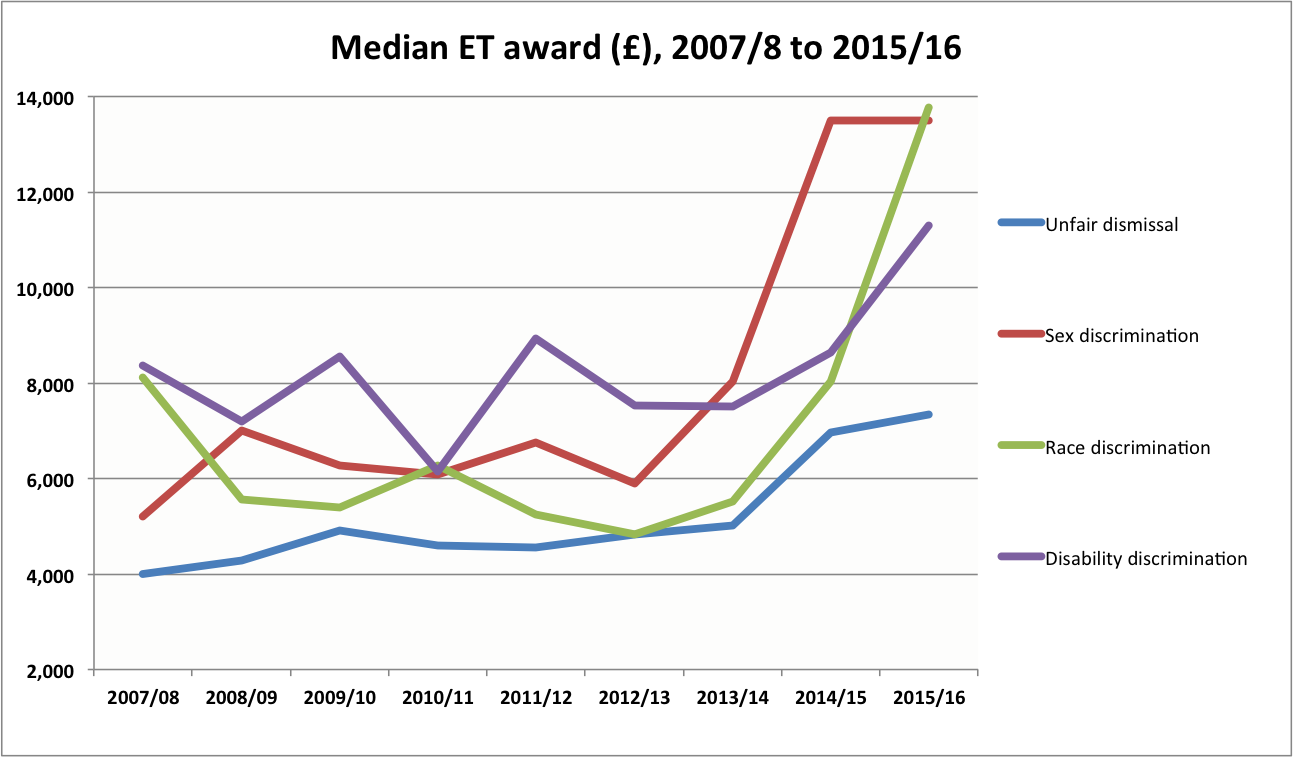
Six months ago, I noted on this blog that, in 2014/15, there had been a marked increase in the median awards for unfair dismissal or discrimination (the only jurisdictions for which the lackadaisical HMCTS bothers to record the relevant data). And I suggested that this might be the beginning of a sharply upward trend, due to the justice-denying fees introduced in July 2013 having eliminated many lower value unfair dismissal and discrimination claims.

Well, this week we got the figures for 2015/16, in amongst the latest set of quarterly ET statistics, for Q1 of 2016/17. And, as the following chart shows, we do appear to have what Sean Jones QC would call a trend thingy.

etawardssept16

I have left out Age, Religious and Sexual Orientation discrimination, for the simple reason that the number of awards in those jurisdictions has always been very small. For example, the median award for Age discrimination did increase, from £7,500 in 2014/15 to £8,417 in 2015/16, but there were only four such awards in 2015/16. Similarly, the median award for Religious discrimination increased from £1,080 in 2014/15, to £16,174 in 2015/16, but there was just one such award in 2014/15, and only four in 2015/16. With such small numbers, the median award is prone to significant variation in any case.

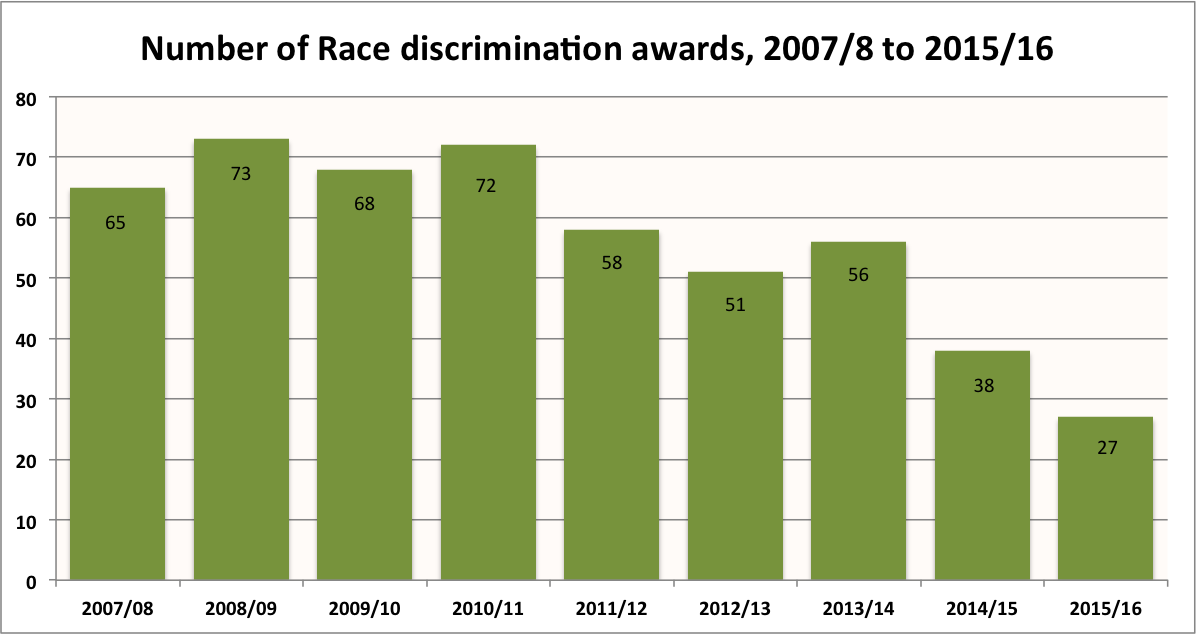
And, as the following charts show, the upward trend in the median award is indeed married to a sharply downward trend in the number of awards – reflecting the sharp fall in the number of claims following the introduction of fees in July 2013 (as well as the introduction of Acas early conciliation in April 2014).

etawardsud

etawardssexdiscetawardsraceIf you’re reading this and you’re a junior minister at the Ministry of Injustice, you are no doubt thinking, ‘ah, but lots of people are now getting their claim for unfair dismissal or discrimination resolved by Acas, for free!’. Which is true, to some extent at least. But, crucially, while the quarterly ET statistics have always told us the number and outcome of claims in each jurisdiction, the quarterly Early Conciliation statistics issued by Acas are not broken down by jurisdiction. So it’s hard to know to what extent Early Conciliation by Acas is successfully mopping up the lower value unfair dismissal and discrimination claims and awards lost to fees.

Now that Early Conciliation by Acas plays such a significant part in the ’employment dispute resolution’ system, that is a serious shortcoming that Acas needs to fix.

Posted in Justice | Tagged , , , | Leave a comment

Enforcement of the NMW – a fair sport?

Earlier this month, the newly re-named Department for Business, Energy & Industrial Strategy (BEIS, formerly BIS) named & shamed another batch of 197 NMW rogues. With six months having passed since the last batch, in early February, BEIS was able to hype this one as “the largest ever list of NMW offenders”, but the length of the list merely served to highlight the relatively small sums owed by all but a handful of the 197, who between them owed a combined total of £465,290 in NMW arrears to 2,166 workers.

Among the usual mix of hairdressers/beauty salons (27), bars, restaurants, cafes and hotels (25), car dealers/motor garages (15), and childcare providers (12), only 85 employers owed more than £1,000 of arrears, and 131 (66%) had underpaid only one worker. The median sum owed was just £759.32, 80 employers owed less than £500 of arrears in total, and only 12 had underpaid more than 25 workers. The four ‘worst’ offenders – including the high-end San Lorenzo Wimbledon restaurant and the Regis chain of hair & beauty salons – accounted for 37% of the total arrears owed, and for 49% of the 2,166 unpaid workers.

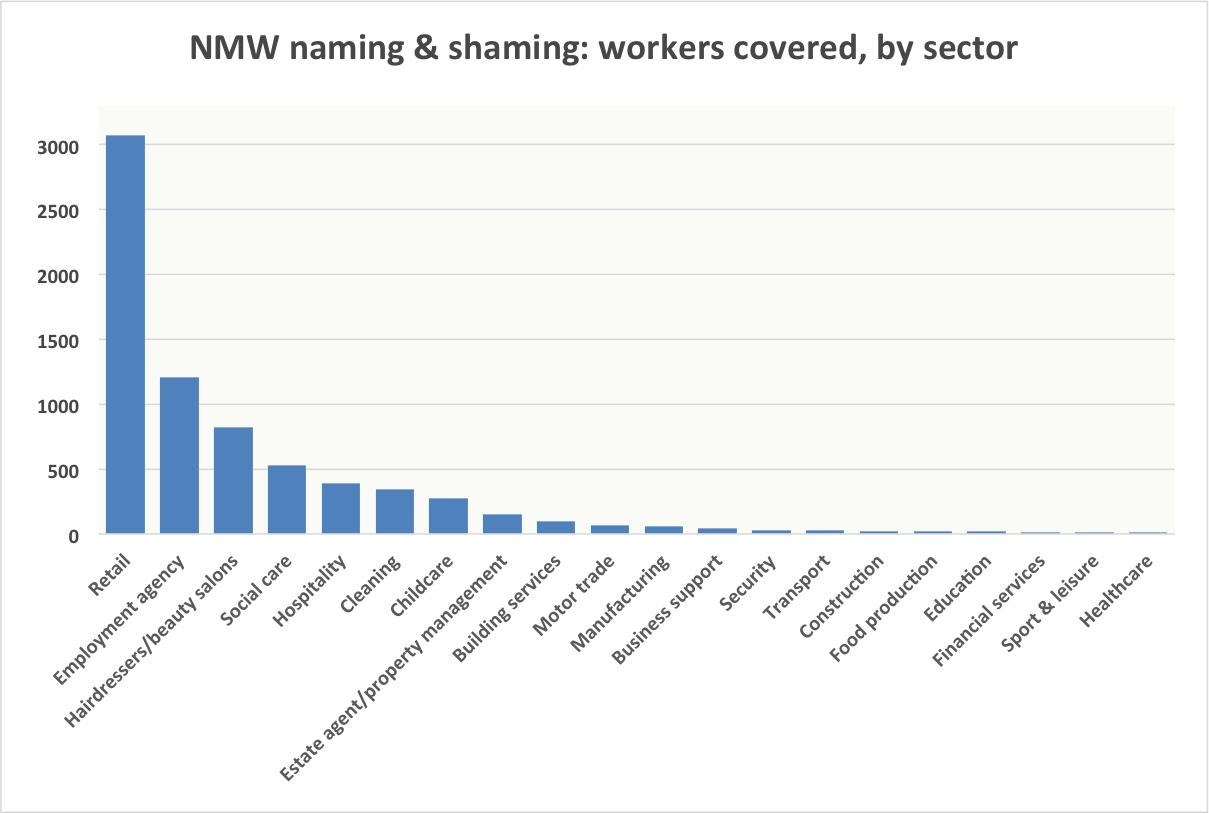
Indeed, perhaps the most newsworthy aspect of the list – overlooked by most if not all journalists, as far as I can tell – is that it included no fewer than 24 social care employers, ten more than BIS had managed to include among the 490 NMW rogues named & shamed in all previous batches since the re-booting of the scheme in October 2013. However, most of the 24 appear to be small fry, with 15 having underpaid fewer than four workers and 18 owing less than £2,500 in total. But at least ‘social care’ – a sector in respect of which HMRC has long appeared to have a bit of a blind spot – has moved a little towards the left of this updated ‘chart of the meanies, by sector’.

NMWnamingsectorsAug16

With the re-booted scheme in force for almost three years now, and almost 700 NMW-breaching employers named & shamed, it is also interesting – well, it is if you’re a nerd like me – to look at breakdowns by sector of (a) the arrears owed, and (b) the number of workers to whom arrears were owed. NB: for the following ‘arrears owed’ chart, I have excluded the extraordinary sum of £1,742,655.56 owed by security firm TSS Ltd, and for the ‘workers covered’ chart I have excluded both the 2,519 TSS Ltd security workers and the 2,895 hospitality workers to whom the Arta bar/club/restaurant in Glasgow somehow managed to underpay a total sum of £45,124.00 (an average of just £15.59 per worker).

NMWarrears


NMWworkers

However, even with the exclusion of the TSS Ltd security workers and the Arta hospitality workers, the ‘workers covered’ chart paints a slightly false picture. For example, all but 125 of the 3,071 retail workers were employed by four NMW-breaching retailers: Monsoon Accessorize (1,438 workers), Foot Locker (601), H&M (540), and French Connection UK (367). Of the other 65 retail sector employers, 48 (74 per cent) owed arrears to just one worker, and all but six owed arrears to fewer than five workers. Similarly, 604 of the 818 hairdresser/beauty salon workers were employed by one employer: the national chain Regis UK Ltd. And, of the other 118 hairdressers/beauty salons, 73 (62 per cent) owed arrears to just one worker, and a further 28 (24 per cent) owed arrears to just two workers.

Between them, those 118 hairdressers/beauty salons owed total arrears of £226,831.77 to 214 workers (an average of £1,060 to each worker). And, on average, each of those 118 mostly small, low-profitability businesses owed total arrears of £1,922. Which means that, roughly speaking, each would also have been required to pay, in addition to those arrears, a financial penalty to HM Government of £1,922 (see sections 3.7 and 3.8 of this July 2016 explanation of NMW enforcement policy). The 92 NMW-breaching employers named & shamed in February, for example, were required to pay a combined total of “over £629,000” in financial penalties (some £6,800 each, on average, but note that the 92 included the above-mentioned TSS Ltd and their arrears of £1.74 million).

OK, a penalty of some £2,000 might not sound very much, but £2,000 is in fact a not insignificant sum to a small business such as a local hairdresser/beauty salon (even if the penalty is discounted by 50 per cent for prompt payment, i.e. within 14 days).

So, if I was the owner/manager of one of those 118 small businesses, I might well be wondering whether the highly profitable Sports Direct is going to be required to pay a financial penalty of some £1 million after striking an apparent deal with HMRC and the union Unite to pay some £1 million of NMW arrears to “thousands” of its warehouse workers. (The current penalty rate is 200 per cent of the total arrears owed, but that only applies to underpayments made since 1 April this year. For underpayments made between 7 March 2014 and 1 April 2016, the penalty rate is 100 per cent, and for underpayments made prior to 7 March 2014 it is 50 per cent).

As the Guardian’s economics editor, Larry Elliott, noted on the day the story broke:

“There appears to be no reason for clemency. The government seems quite happy to name and shame little known companies for relatively modest sums, and this was no minor infraction. Sports Direct’s flouting of minimum wage legislation had been going on for four years” … and … “Sports Direct is a prime example of how companies can use employment agencies to avoid giving what are effectively full-time staff members the rights which they are legally due. Employees are too frightened to make a fuss for fear that they will not get any more work.”

Time will tell, but – as noted previously on this blog – HMRC does appear to have quietly introduced a questionable practice of allowing some NMW-breaching employers to ‘self-correct’ and pay the arrears owed without being issued with a Notice of Underpayment, thereby evading both naming & shaming, and – more importantly – the imposition of a financial penalty.

In 2015/16, according to the answers given by BIS (now BEIS) to a series of parliamentary questions, 60 employers took advantage of an effective amnesty (announced in July 2015) to “voluntarily disclose [total] arrears of £786,038 owed to 4,869 workers”, without being issued with a financial penalty or named & shamed, and a further 85 employers were able to ‘self-correct’, also without being issued with a Notice of Underpayment, so were not issued with a financial penalty and will not be named & shamed. And BIS/BEIS seems reluctant to say how much was owed by those 85 employers, and to how many workers – a parliamentary question tabled on 3 June has gone unanswered, despite a chasing question.

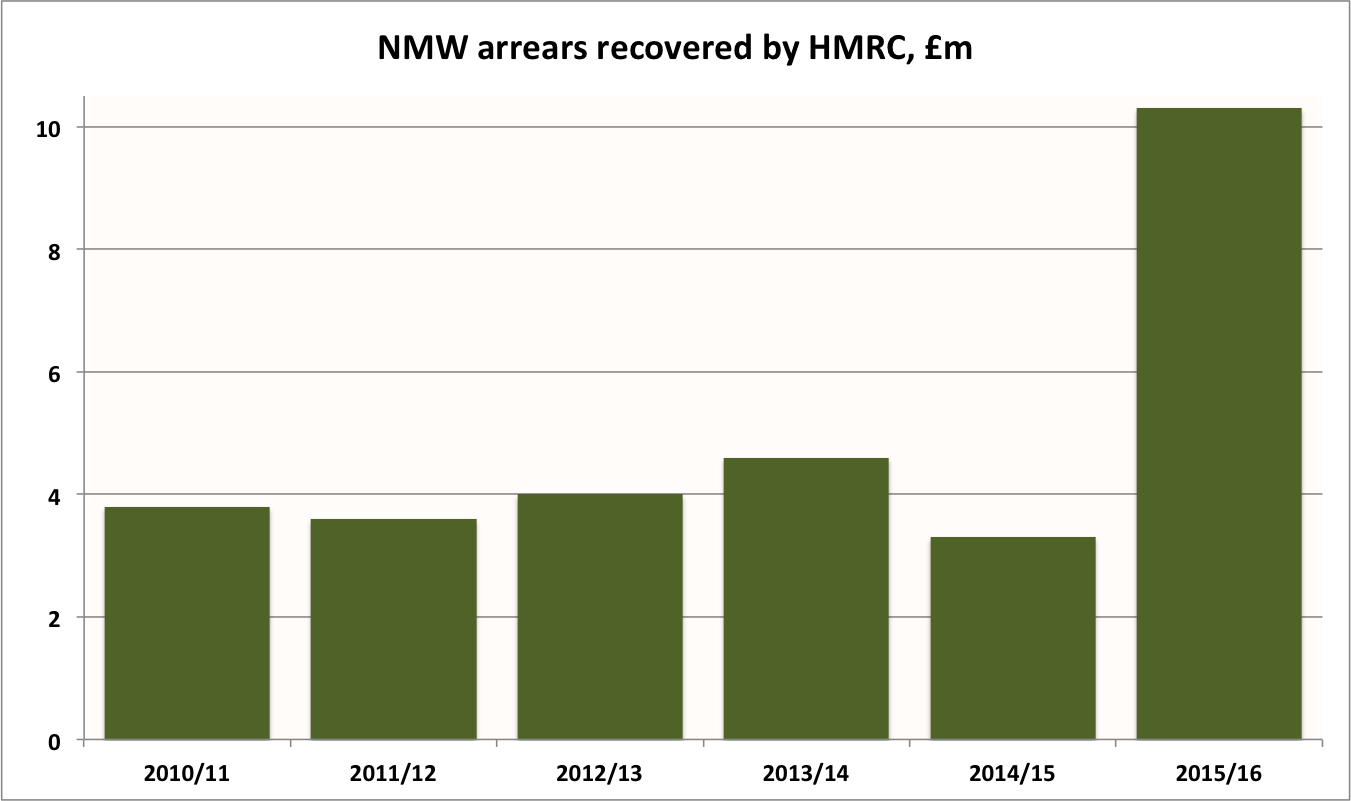
Yet, over the year, the total arrears ‘recovered’ by HMRC leapt from an average of £3.9m in previous years, to a remarkable £10.3m. The suspicion has to be that those 85 unnamed, non-shamed and, most importantly, financial penalty-evading NMW rogues were responsible for much of that otherwise astonishing increase.

Is Sports Direct also being allowed to ‘self-correct’, and so evade a financial penalty of some £1 million? We should be told.

Posted in Workers' rights | Tagged , , | Leave a comment

What does the appointment of Liz Truss as justice secretary mean for the MoJ review of employment tribunal fees?

I’m sorry I haven’t a clue.

Update (19 July): However, with the enforced departure from the MoJ this week of both slow-reading junior injustice minister Shailesh Vara and slightly less junior injustice minister Dominic Raab – who appeared to have taken over responsibility for the much-delayed ET fees review from the hapless Vara in recent weeks – there must be some doubt as to whether we will see the long-awaited review report any day soon. For, if the report recommends reform of the fees regime, then at least someone in the new ministerial team is going to be asked to sign-off on the associated financial hit to the catastrophically cash-strapped Ministry. And, if it doesn’t, someone’s going to want to read themselves in before going out to absorb the inevitable political and media heat.

In the meantime, I remain available to any new minister who’d like to learn how to square this tricky circle by reforming the fees regime on a cost-neutral basis. Unlike those introduced by the Ministry in July 2013, my fees are very reasonable.

Posted in Justice | Tagged | Leave a comment

Justice by Committee

No, it wasn’t the report we #ukemplaw nerds have been holding our breath for. We are still waiting for the Ministry of Justice’s report of its post-implementation review of the justice-denying employment tribunal (ET) fees introduced in July 2013. But on 20 June, at the start of a quiet news week, the Justice Committee of MPs finally published the report of its own inquiry, launched last year, into the impact of the fees.

Given what was happening later in the week, plus the fact that Parliament was in recess at the time, I do find myself wondering whether at least some members of the Committee were hoping the report would pass largely unnoticed by the mainstream media. Whatever, the Committee’s conclusions and recommendations are commendably pithy. I particularly enjoyed their barbed comments on the laughably poor oral evidence of injustice minister Shailesh Vara, and his meaningless obsession with the figure of 83,000 early conciliation cases handled by Acas:

In coming to a judgement about the impact on access to justice of employment tribunal fees, we consider, on the weight of the evidence given to us, that Mr Vara’s heavy reliance on the figure of 83,000 cases dealt with at Acas early conciliation to support his contention that access to justice has not been adversely affected by employment tribunal fees was, even on the most favourable construction, superficial. Those cases cannot be simplistically assumed to represent displaced cases which were settled satisfactorily otherwise than by being taken to tribunal.

The Committee also notes what it politely calls “inconsistencies” in the hapless Vara’s account of progress with the Ministry’s internal, post-implementation review, the report of which landed on Vara’s desk as long ago as last October: “It is difficult to see how a Minister can urge his officials to progress a review which they apparently submitted to him four months or more previously.” Furthermore:

“There is a troubling contrast between the speed with which the government has brought forward successive proposals for higher fees, and its tardiness in completing an assessment of the impact of the most controversial change it has made. We find it unacceptable that the Government has not reported the results of its review one year after it began and six months after the government said it would be completed.”

Ouch. And, on the impact of the fees on access to justice, the Committee is equally clear:

“The arguments presented to us by the Government in this inquiry, limited as they are, have not swayed us from our conclusion, on the evidence, that the regime of employment tribunal fees has had a significant adverse impact on access to justice for meritorious claims.”

In a statement accompanying the report, the Committee’s chair, Bob Neill MP, added:

“The Ministry of Justice has argued that changes to employment law and the improving economic situation, as well as the pre-existing downward trend in the number of employment tribunal cases being brought, may account for part of the reduction in the number of cases. These may indeed be factors but the timing and scale of the reduction following immediately from the introduction of fees can leave no doubt that the clear majority of the decline is attributable to fees.”

In calling for the fees to be “substantially reduced” as well as for reform of the fee remission system, the Committee recognises that this “would have cost implications for the Ministry of Justice”. However, the Committee stresses – repeatedly – that “if there were to be a binary choice between income from fees and preservation of access to justice”, then “the latter must prevail as a matter of broader public policy”.

All good stuff, then, and the Committee’s members and chair, Bob Neill, deserve praise for their work. That said, I would have liked to have seen a bit more analysis by the Committee of the Government’s arguments to date, and especially the role that Acas early conciliation is now playing in the resolution of potential ET claims. As the following chart shows, about half of the single ET claims ‘lost’ to fees are now successfully resolved through early conciliation. And, of course, not all of the other half would have been successful (at a hearing or default judgment) or satisfactorily settled.

missingJune16This lack of analysis in the Committee’s report was replicated in this week’s debate in the House of Commons, which focused on the Committee’s report but which, technically, was on a motion to approve the remaining £4bn of the Ministry’s £7bn budget for 2016-17 that it hasn’t yet had from the Treasury. (By convention, such ‘Estimate Day’ motions are not put to a vote, but – seemingly under pressure from backbench ‘rebels such as Chuka Umunna – Labour’s front-bench eventually decided to vote against the motion).

It is probably significant that, in his contribution to the debate, justice minister Dominic Raab – who has taken over responsibility for this matter from the hapless Shailesh Vara, and is perhaps most famous for having once been the Foreign Office’s in-house expert on “the international law of outer space” – noted that “there has been virtually no mention of [Acas early conciliation] in this debate”. My guess is there will will be quite a lot about early conciliation in the Ministry’s much-delayed post-implementation review report. Indeed, the emerging evidence on early conciliation may well explain much of the delay.

As for when we might get to read that report, Raab told MPs that “the review is very close to completion, so I hope to be able to make an announcement in the near future”. Which, who knows, might well mean ‘on Wednesday, when everyone is looking the other way’.

Posted in Uncategorized | Leave a comment

Latest ET stats. Nothing to see, move along.

It would be nice if the latest set of quarterly employment tribunal (ET) statistics, published by the Ministry of Injustice today, provided some distraction from the imminence of World War III, the associated bonfire of all our employment rights, and the precisely calculated 18.3142% fall in the value of our houses. Sadly, the statistics provide little more mental stimulation than the latest Stronger IN initiative. Or, indeed, any Stronger IN initiative since the excruciating EU referendum campaign began, some 200 years ago.

Since the last set of these increasingly banal statistics, in March, the Ministry of Injustice has not completed its internal review of the justice-denying fees introduced in July 2013. The chair and members of the Justice committee of MPs appear to have forgotten that they conducted an inquiry into the impact of the fees late last year. And the Corbyn-led Workers’ Party is seemingly no nearer to having a meaningful policy on the matter (prior to last year’s general election, Labour’s policy was to replace the fees with something else, but we still have no idea what that ‘something else’ might be).

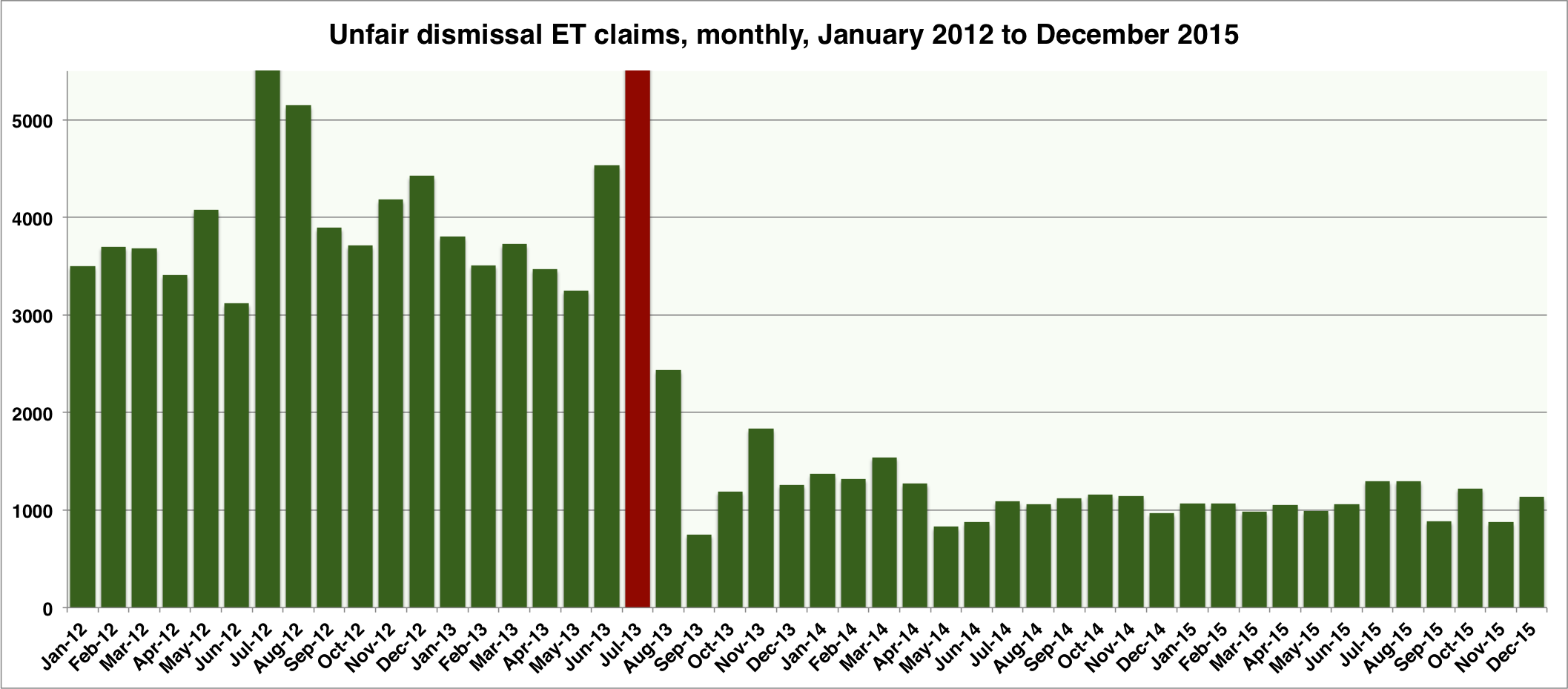
It will soon be three years since those fees of up to £1,200 caused the number of ET cases to fall off a cliff. And it is 12 months almost to the day since Michael Gove – then everyone’s favourite justice secretary, but maybe a little less loved now – agreed to let the Ministry’s internal, so-called post-implementation review go ahead, some 14 months after Liberal Democrat ministers in the Coalition had first tried to hide their blushes by ‘announcing’ it whenever faced with awkward questions about the fees.

However, we know that the Department for Business, Innovation & Skills considers it “too early” to even consider whether reform of the fees regime is needed. And we know that the Ministry of Injustice, having pretty much run out of dosh, is not well placed to bear the increase in operational costs that would inevitably flow from abolition (or a substantial reduction in the level) of the fees. Unless, of course, those extra costs could be covered by, for example, the introduction of fees for respondent employers to defend a claim.

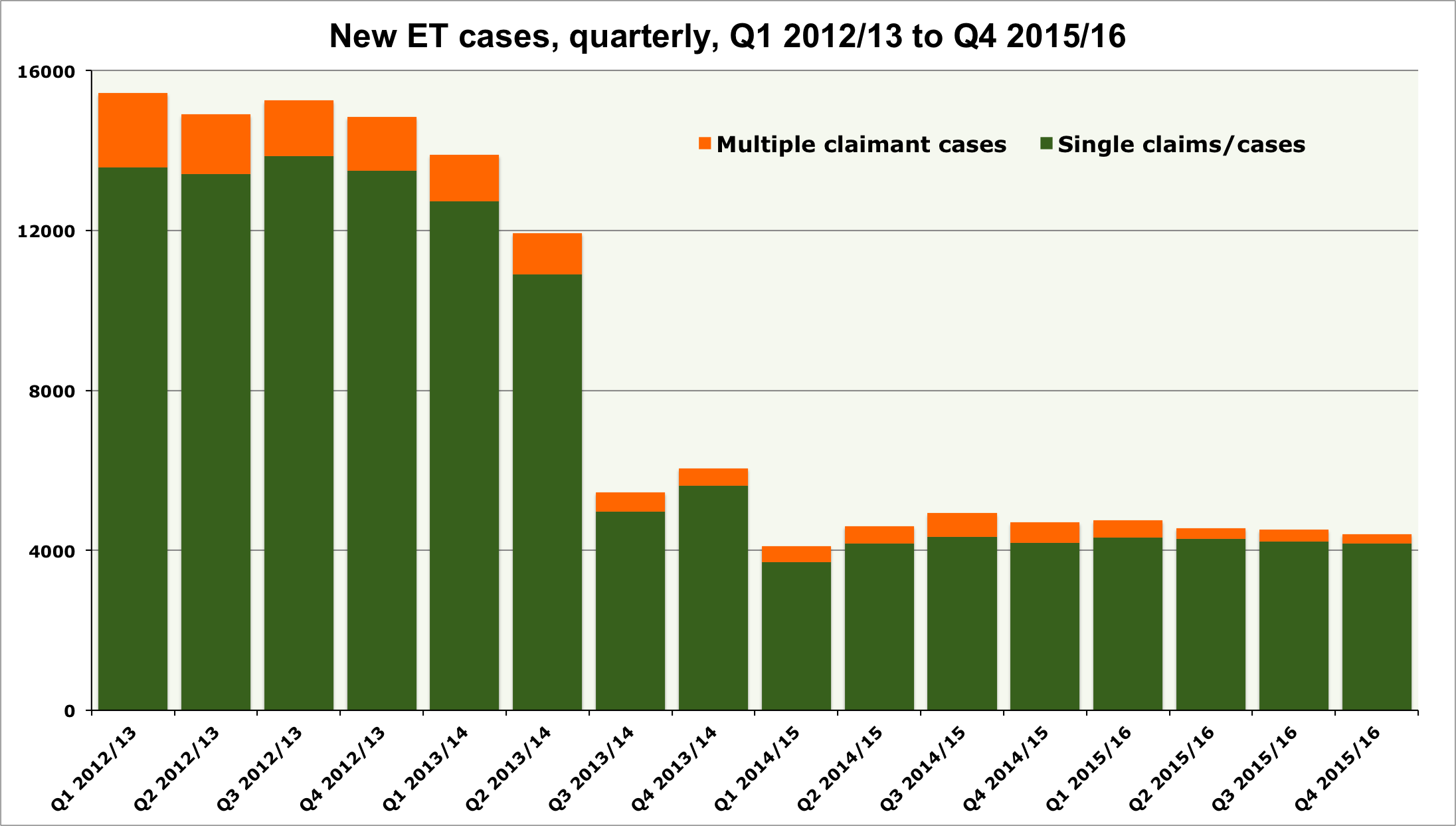
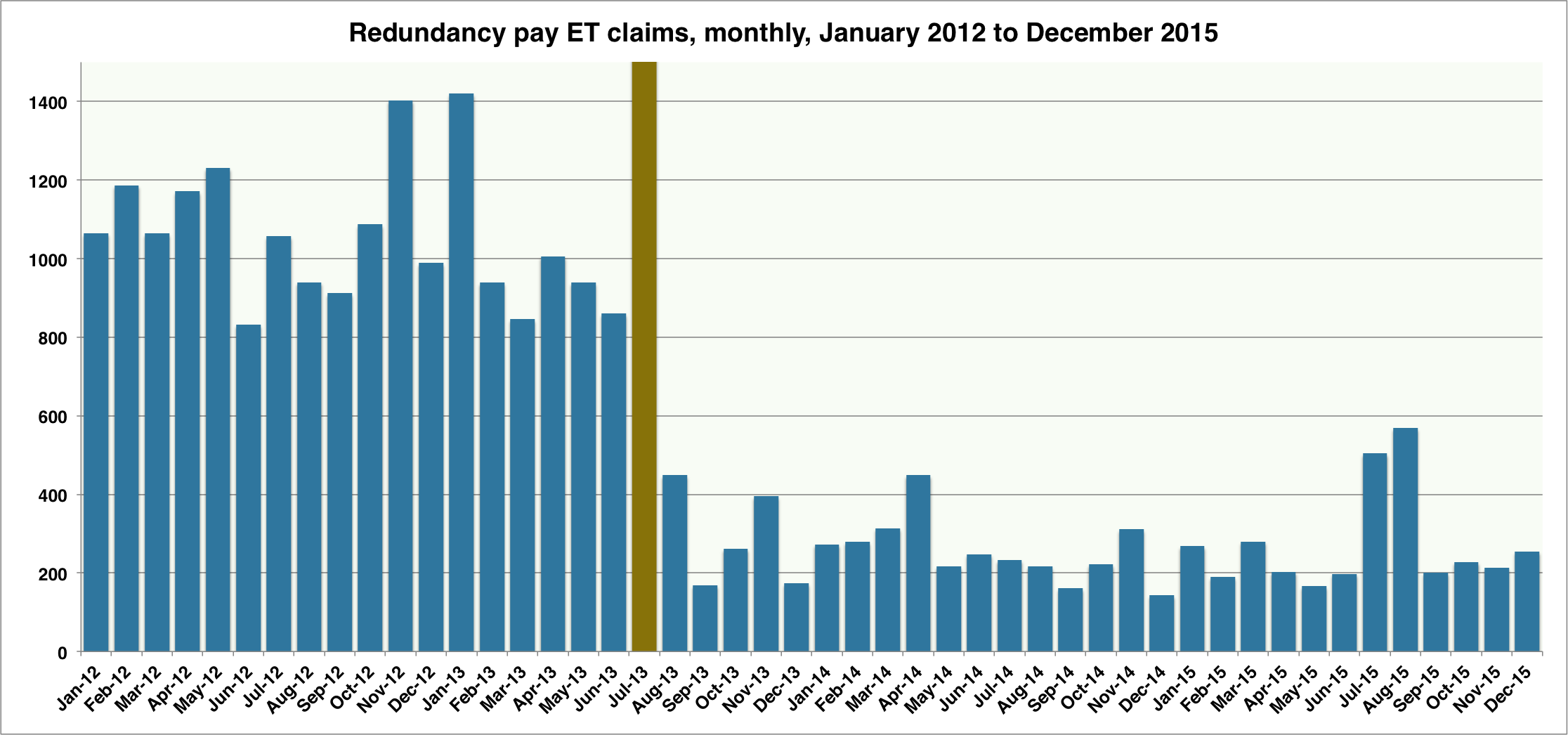
Whatever, I’ve now had as much of this quarterly pointlessness as it is reasonable to expect an unpaid policy wonk to bear. So, for the last time, here are some updated charts showing the impact of ET fees since July 2013. This ain’t rock ‘n’ roll, this is genocide!

Chart 1: New ET cases, Q1 2012/13 to Q4 2015/16

NewETcasesJune16

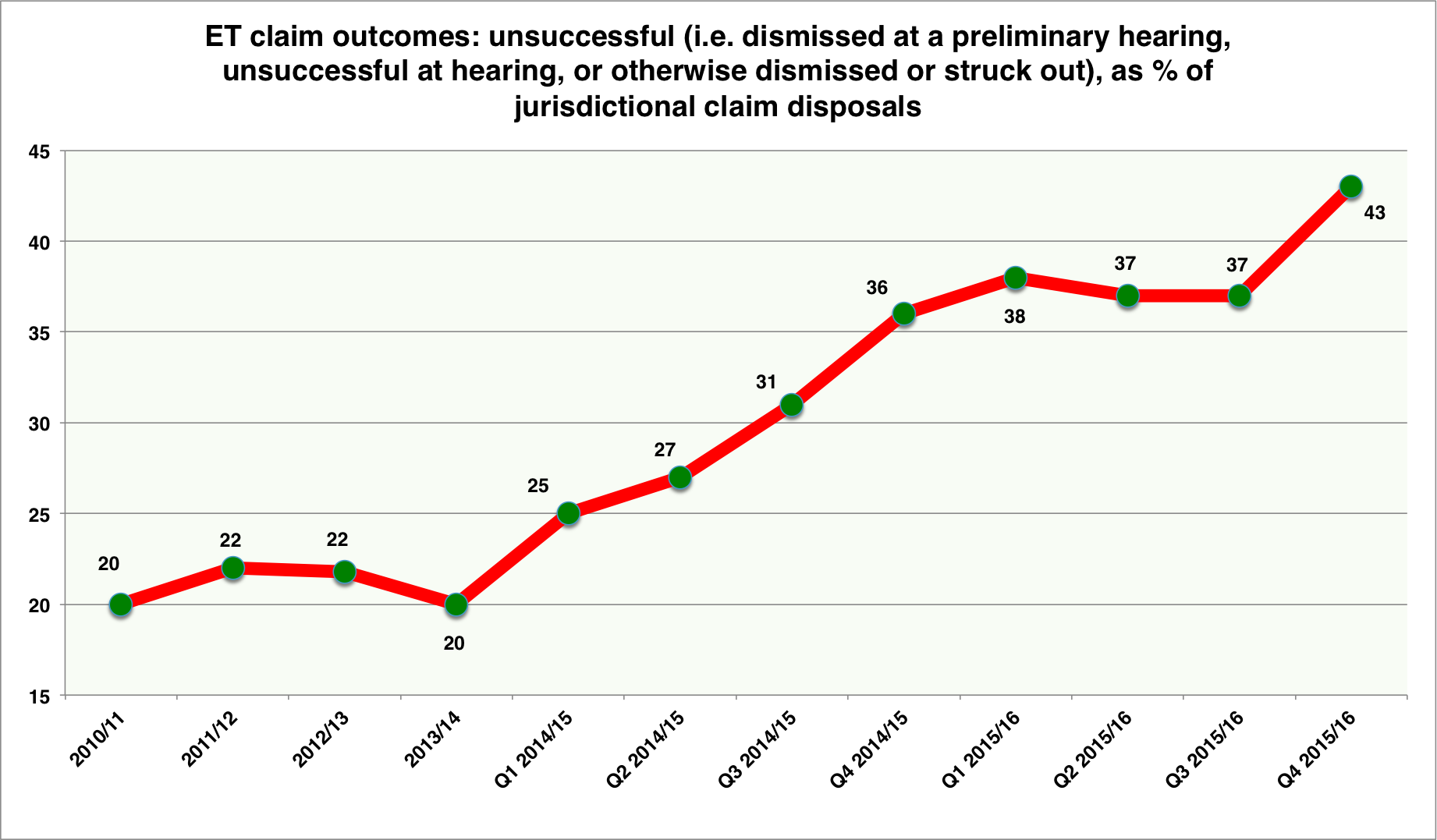
 Charts 2 and 3: ET claim outcomes

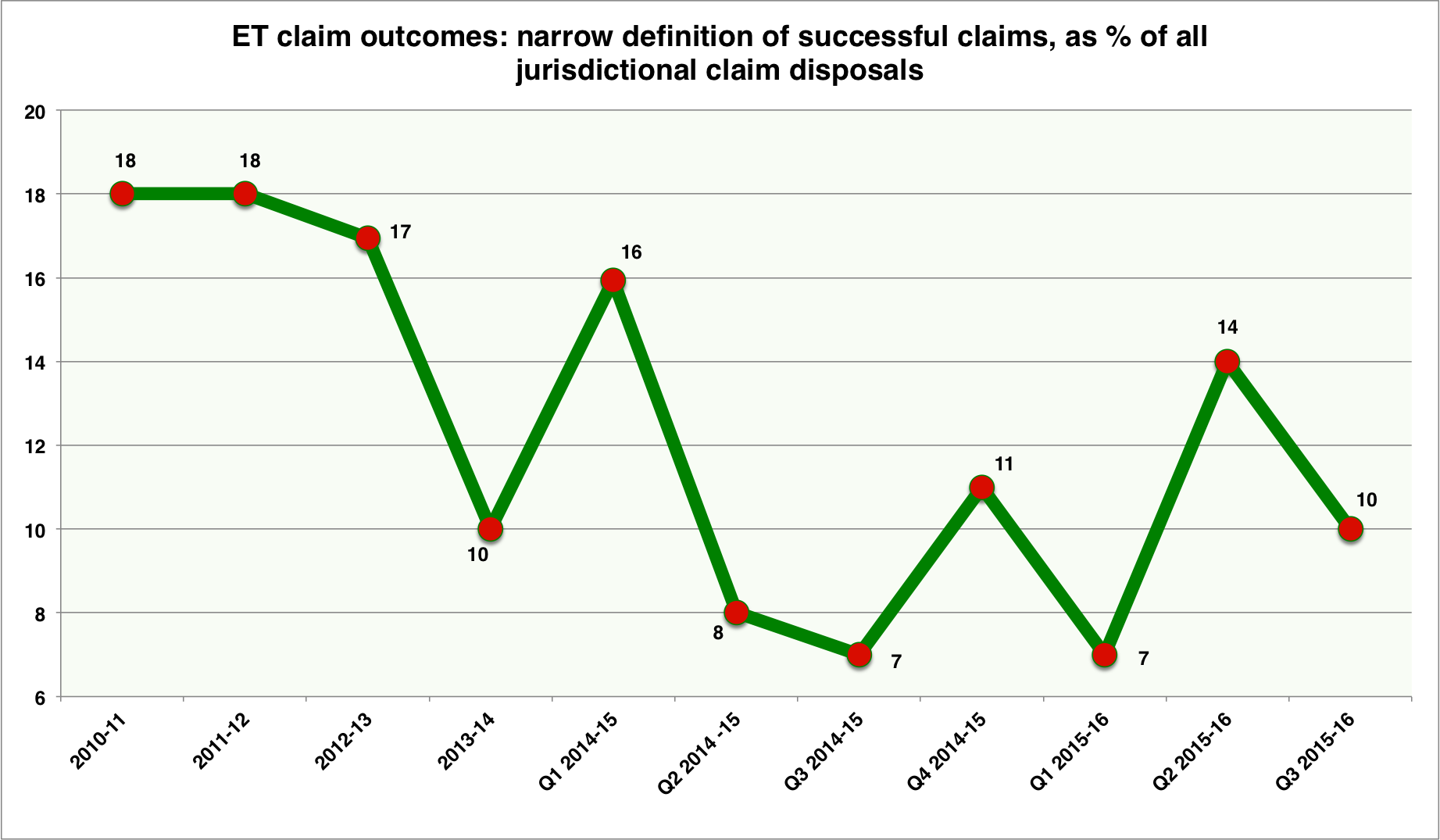
According to the famed Hancock Theorem of Vexatious ET Claims, the success rate of ET claims should have shot up towards 100 per cent in recent quarters, and the failure rate down towards zero, as all the vexatious and otherwise unfounded claims that were ‘clogging up the system’ prior to July 2013 have been cleverly weeded out by fees.

However, for reasons that I doubt keep Mr Hancock awake at night, that hasn’t happened. The (narrowly defined) success rate has fallen, and the overall failure rate has risen.

successfulJune16

unsuccesful0616

 Chart 4: ET fees and Acas early conciliation

As this chart shows, the (very welcome) fact that some 4,000 potential ET single cases are successfully conciliated by Acas each quarter, via the (free) ‘early conciliation’ regime introduced in April 2014, does not balance out the loss of access to justice caused by fees since July 2013. As of the end of March, we were still ‘missing’ some 54,000 ET single claims/cases (i.e. not including multiple claimant cases), and that figure continues to grow by some 4,000 every quarter – so, at the time of writing, is approaching 58,000.

(As previously explained on this blog, the projection on which this chart is based takes into account the mild downward trend in ET case numbers that was evident in mid-2013, as well as the improvement in economic conditions noted by injustice minister Shailesh Vara whenever he comments on the impact of fees).

Of course, the optimistic way of looking at the figures on which this chart is based is that the justice-denying impact of fees could be pretty much eliminated, going forward at least, if Acas could just increase the number of successful conciliations by 100%.

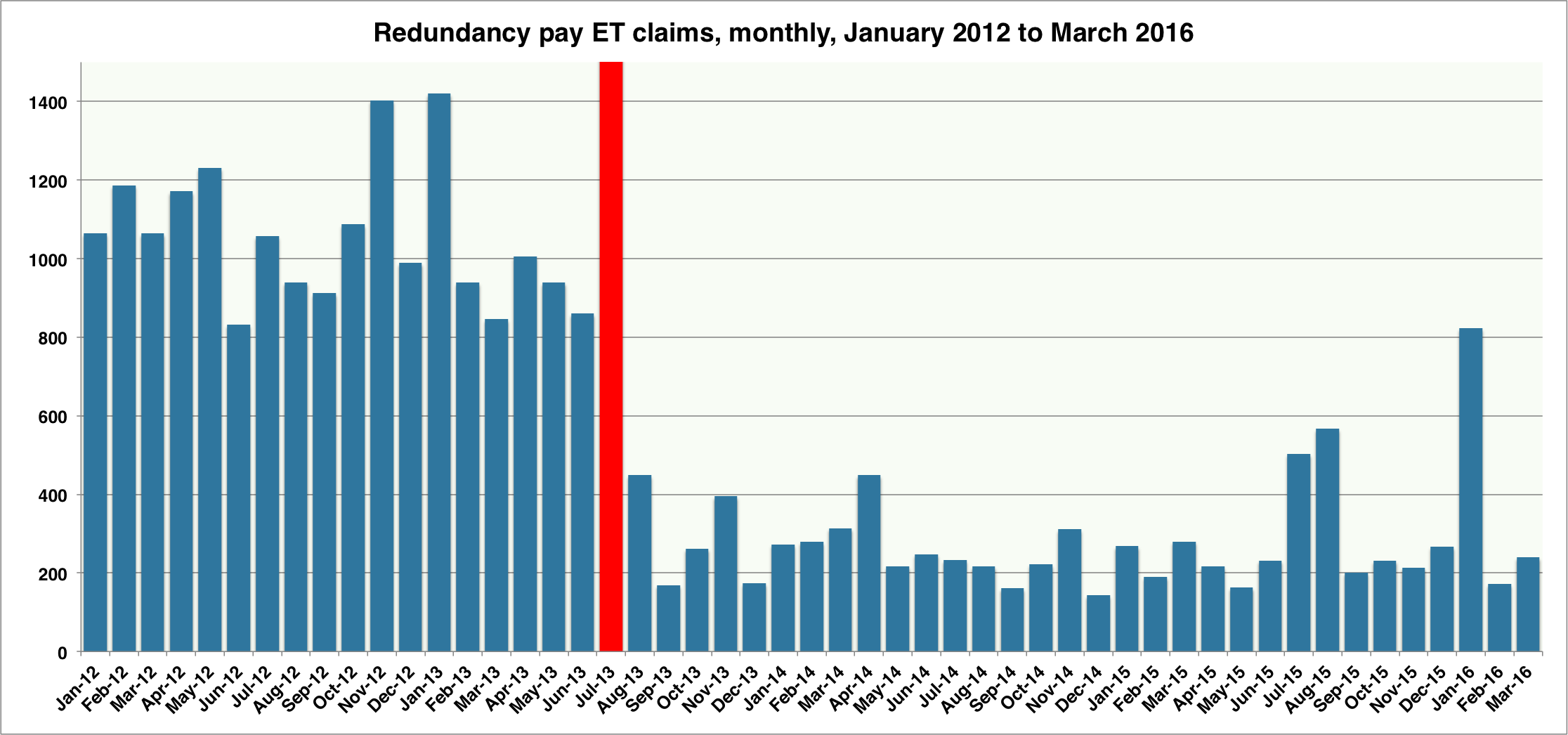
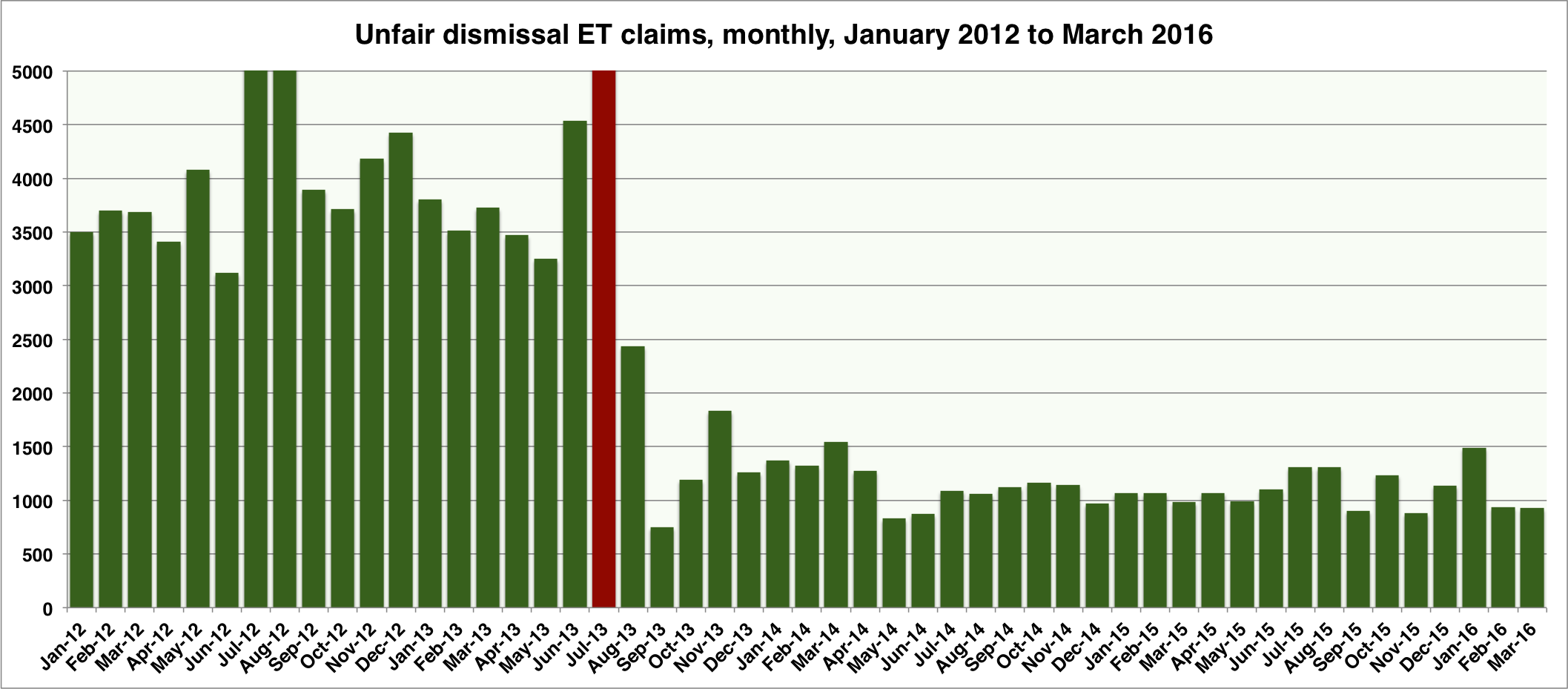
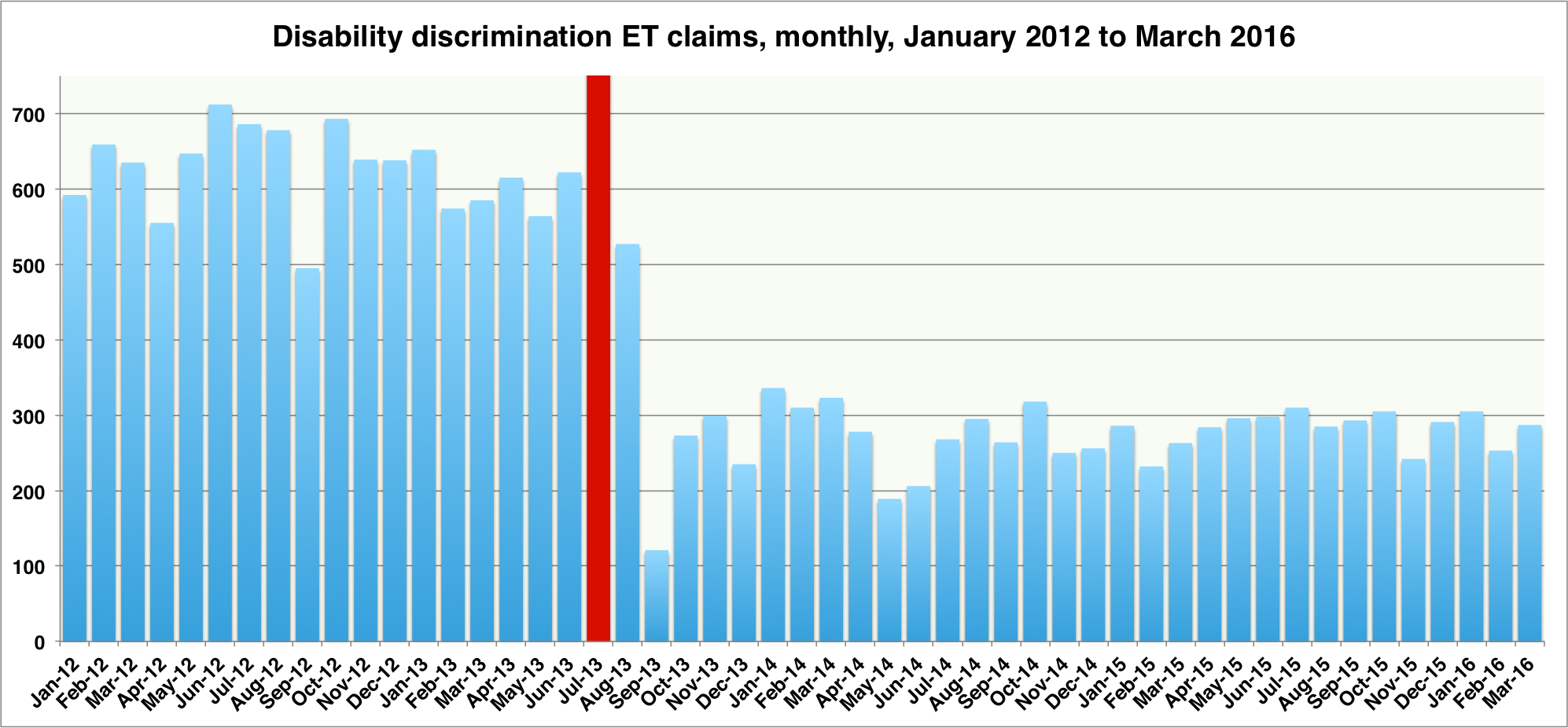
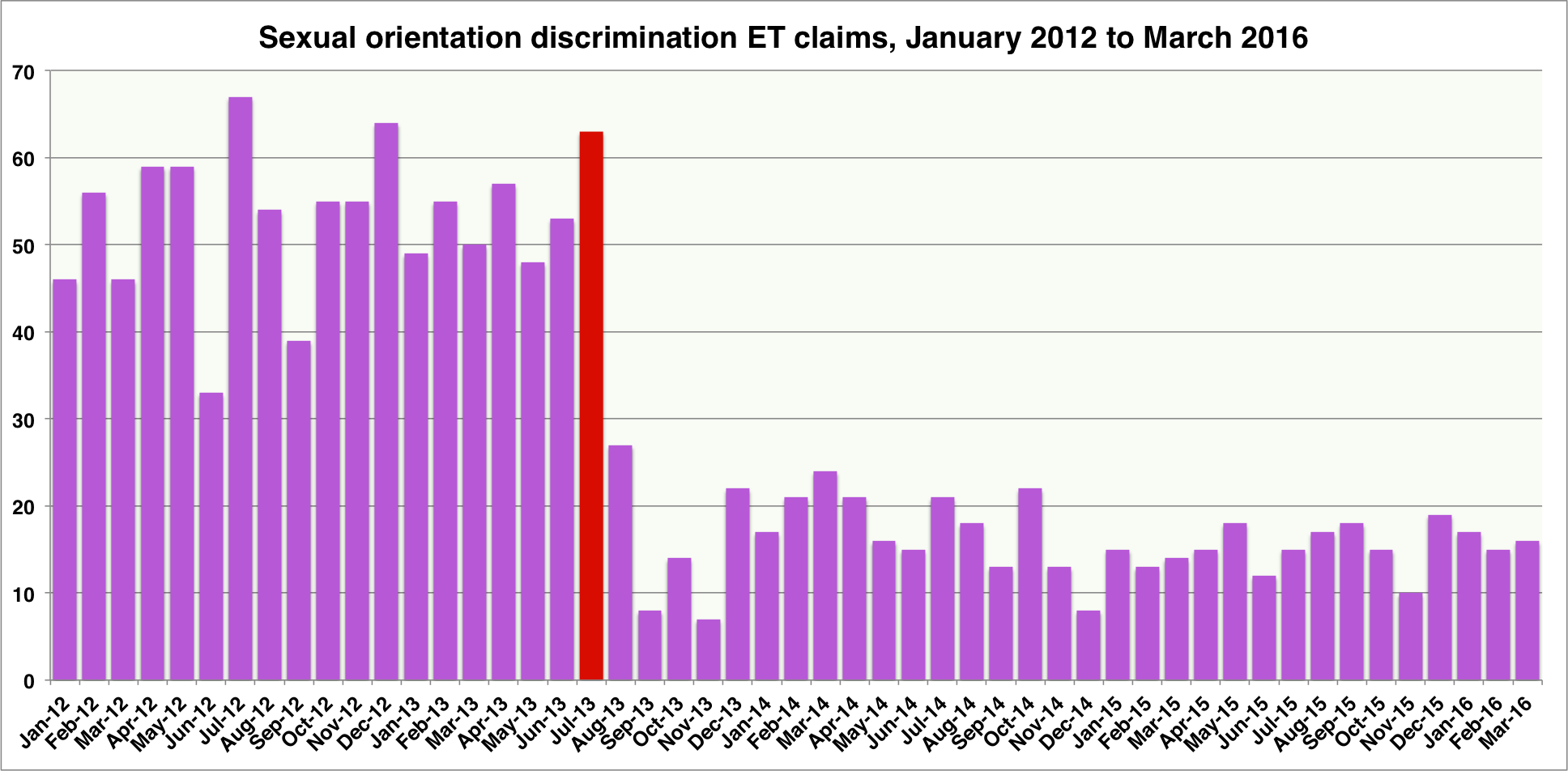
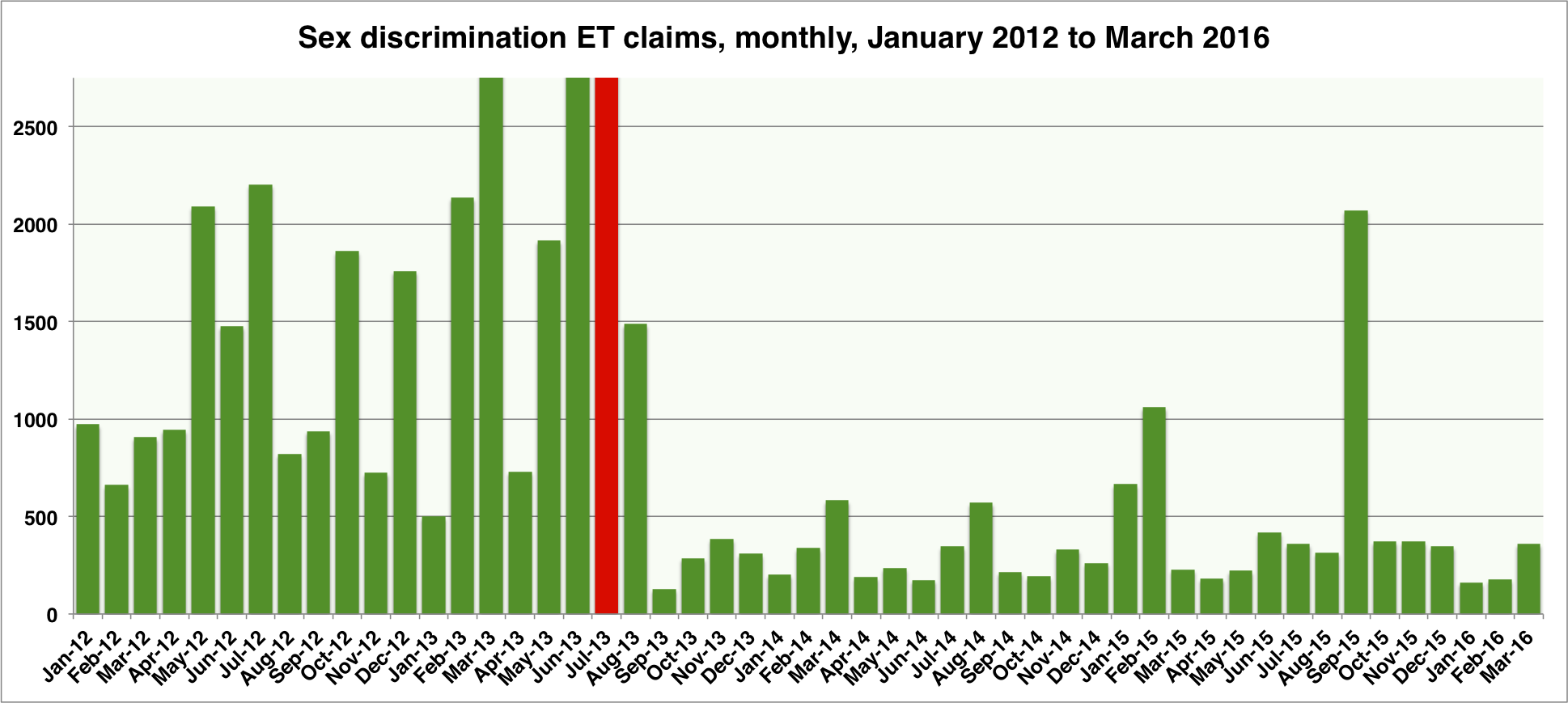
missingJune16Charts 5, 6, 7, 8, 9 & 10: selected jurisdictions, monthly

redundancy0616

UD0616

disability0616

race0616

sexorient0616

sex0616

Posted in Justice | Tagged , , | 1 Comment

71% of Acas research is rubbish

So, this week Acas published yet another ‘independent’ research report purporting to show how wonderful Acas is. It’s a dense and lengthy tome – 106 pages, not including the copy of its survey questionnaire – and, to convince you of its authoritativeness, it’s packed full of phrases like “multivariate analysis”, “post-stratification weight”, “rebasing exercise”, “potential non-response bias”, and “cognitive testing”.

But the main thing Acas wants you, the general public, and government ministers to take away is that “seven out of ten (71%) of [potential employment tribunal] claimants avoided going to [tribunal] after receiving help from Acas”.

If we are of a strong constitution, we can imagine the junior injustice minister, Shailesh Vara MP, doing a little jig around his office when he was informed of this finding. For, why worry about the justice-denying impact of employment tribunal fees, if seven out of ten workplace disputes are happily resolved by Acas? For free! It can only be a matter of time before the 71% figure finds its way into a speech by Mr Vara or his less intellectually-challenged but equally amoral boss, Michael Gove.

Except that, for all the post-stratification weighting, logistic regression and multivariate analysis, that 71% figure is simply rubbish.

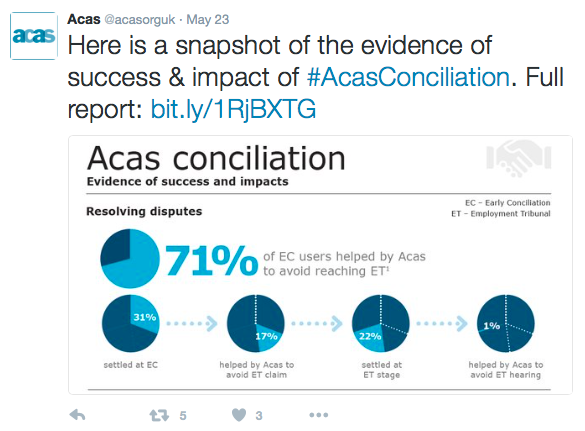
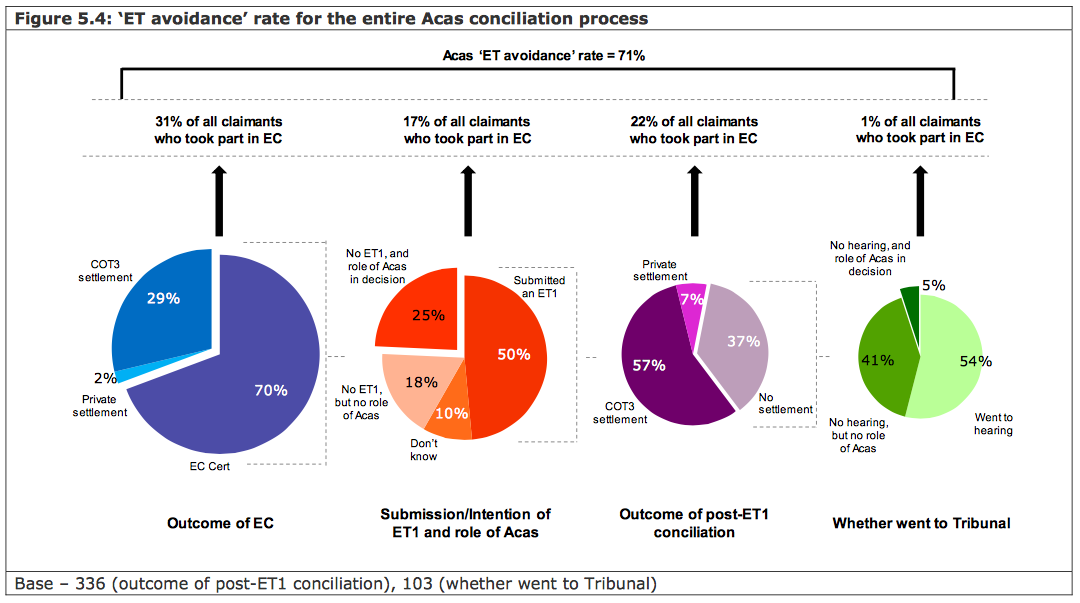
To see why that is so, let’s take this infographic, as tweeted by Acas (as well as the more detailed chart on page 72 of the report – see further below).

Screen Shot 2016-05-24 at 21.59.20

That’s right: 31 + 17 + 22 + 1 = 71. In other words, if you took any 100 cases as they entered the early conciliation process introduced in April 2014, 31 cases would be settled via that early conciliation process – let’s call this Stage A. According to the more detailed chart on page 72 of the full report (see below), among those 31 cases would be 29 that result in a COT3 (Acas) settlement, and two that result in a private settlement, thanks to the involvement of Acas. And, of the remaining 69 cases, 17 (25%) would not be settled but would nonetheless not proceed to an employment tribunal claim, thanks to the involvement of Acas.

Then, of the 35 cases (50% of 69) that proceed to an employment tribunal claim, 22 (a stonking 64%) would be settled without reaching a tribunal hearing, either through post-ET1 conciliation by Acas (57%), or by private settlement (7%) – let’s call this Stage B. And one employment tribunal claim would otherwise be withdrawn before reaching a tribunal hearing, thanks to the involvement of Acas. And 31 + 17 + 22 + 1 = 71.

The first thing to say here is that, even if we accept these figures at face value, Acas did not prevent 71% of cases “reaching tribunal”, as the above tweet disingenuously suggests. It only prevented 48% of cases ‘reaching tribunal’. The other 52% either went to tribunal, or Acas cannot claim credit for them not having done so. The 71% figure relates to those cases that didn’t go to a full tribunal hearing. But it was always the case that only a minority of all ET cases went to a full hearing.

However, we cannot accept the research figures at face value. For they bear little if any relation to what happens in the real world – that being the place where workers who have been mistreated or exploited by their employer have to try and find justice (if they can afford to do so). It would be lovely if such workers could simply ask Acas’ independent researchers to resolve their dispute for them, through a process of logistic regression, but sadly the real world doesn’t work like that.

In the real world, we know the actual Acas settlement figures for Stages A and B, and they are not 29% and 57%. According to the early conciliation updates published by Acas, the actual figure for Stage A in 2015/16 was just 17%, not 29%. And, according to the most recent set of HMCTS quarterly tribunal statistics, the actual proportion of tribunal claims resolved by means of an Acas settlement (at Stage B) was 32% in Q1 of 2015/16, 35% in Q2, and 40% in Q3 – all somewhat short of 57%. Let’s run with 35%.

If we plug those figures into Acas’ suspect formula, we find that just 38% of cases (17 + 25% of 83) were prevented by Acas from ‘going to tribunal’, and that just 53% (38 + 35% of 83/2), not 71%, were prevented by Acas from ‘going to a full tribunal hearing’.

However, even those figures assume that 50% of the cases not settled by Acas through early conciliation proceed to a tribunal claim (i.e. 50% of 69 = 35/100). And, again, we know from the early conciliation updates published by Acas that, in the real world, the actual figure in 2015/16 was just 18%, not 35%. If we also plug that figure into Acas’ suspect formula, we find that just 44% of cases were prevented by Acas from ‘going to a full tribunal hearing'(38 + (18 x 0.35)). Which is a bit different to 71%.

Sure, we can boost that 44% figure a bit, if we accept the research findings that 2% of cases resulted in a private settlement thanks to the involvement at Acas at Stage A, and 7% at Stage B, but it doesn’t make a huge difference. Doing that produces a figure of 40% for ‘prevented by Acas from going to tribunal’, and a figure of 48% for ‘prevented by Acas from going to a full tribunal hearing’ (by Stage B, we’re talking about an extra 7% of just 18 cases, which works out at just over one case). And 48% is still very different to 71%.

In short, the headline figures that emerge from the research study’s unrepresentative sample are way out of whack with the real world. And, as the unrepresentative sample grossly overstates the influence of Acas in resolving cases, the rest of the research findings – such as those about workers’ satisfaction with Acas conciliation, and the importance of fees in workers’ decision-making – must also be taken with a large dose of salt. If you’ve somehow managed to create a sample in which 71% of cases were happily resolved by Acas, the chances are that sample will say they pretty much love Acas.

On Twitter this week, a number of people – including Michael Ford QC and the good people at Thompsons Solicitors – have noted the research finding that ‘20% of withdrawals [of an ET claim] were due to the hearing fee, mostly because the worker could not afford the fee’. However, if my criticism above is correct, the research findings greatly overstate the (positive) role of Acas, and understate the role of fees in workers’ decision-making. That is, the actual figure may well be considerably more than 20%.

All publicly-funded bodies seek to overstate their value, so as to try and impress their funder (the relevant minister). But, to my mind, mistreated and exploited workers deserve better than this from Acas.

Screen Shot 2016-05-27 at 18.25.39

Posted in Justice | Tagged , , , | 1 Comment

NMW enforcement: has BIS kissed goodbye to £4m in financial penalties?

As noted on this blog in February, something very unusual went on with enforcement of the national minimum wage (NMW) in 2015/16, with both the total amount of NMW arrears recovered by HMRC and the number of workers benefiting from that recovery being way up on previous years.

Last month, BIS minister Nick Boles indicated that “more than £10 million” of arrears were recovered – up from £3.3m in 2014/15, and an average of £3.8m in recent years – for some 58,000 workers, more than double the 26,318 who benefited from HMRC enforcement action in 2014/15. And this week – in his answer to a parliamentary question by Caroline Lucas MP – the minister confirmed that £10.3m was recovered from a total of 958 employers.

arrears

More interestingly, the minister also stated that 145 (15%) of those 958 employers were not issued with a Notice of Underpayment, so were not issued with any financial penalty in respect of their non-compliance. I’ve never seen such a figure before and, according to BIS policy on NMW enforcement (see section 3.1), it would be highly exceptional for a Notice of Underpayment not to be issued in a case where the HMRC investigation reveals arrears to be owed. That policy states:

The Employment Act 2008 amended the National Minimum Wage Act 1998 to replace enforcement and penalty notices with a single Notice of Underpayment. These changes came into effect on 6 April 2009. Except in exceptional circumstances, a Notice of Underpayment should be issued in all cases where a compliance officer finds that arrears of minimum wage were outstanding at the start of an investigation.

A Notice of Underpayment should be issued where the employer has repaid the arrears to the worker subsequent to the start of the investigation and before the date the notice is issued …

The reasons for the underpayment should not be taken into account when determining whether or not to issue a Notice of Underpayment. Notices should be issued in all cases where arrears are outstanding at the start of an investigation, notwithstanding that the employer claims that the underpayment of minimum wage was accidental.

So, to my mind, by far the most likely explanation for those 145 employers not being issued with a Notice of Underpayment is that the vast majority if not all of them took advantage of the effective amnesty for NMW offenders quietly announced by BIS in late July last year, and which ran until the end of January this year. Under the terms of that amnesty, employers who self-reported their non-compliance to HRMC escaped a financial penalty equivalent to the arrears owed, as well as ‘naming and shaming’ by BIS:

Screen Shot 2015-12-31 at 13.15.35


And could it be that those 145 amnestied employers account for much of that £7m increase in arrears recovered, relative to 2014/15? That 212% increase is not easily explained by the 43% increase in the HMRC enforcement team’s budget (£9.2m to £13.2m) and associated 47% increase in FTE staff (183 to 269), as the number of closed cases increased by only 21%, from 2,204 to 2,667. So, let’s (very generously) assume that £1.3m (40% of £3.3m) of that £7m increase is simply due to increased enforcement activity.

We also know that one of the 813 employers who were issued with a Notice of Underpayment – security firm TSS (Total Security Services) Ltd – was found to owe a whopping £1.7m of arrears (we know, because the firm was ‘named & shamed’ by BIS in early February). That case is truly exceptional – £1.7m is 613 times the average arrears of£2,770 owed by the other 489 NMW rogues ‘named & shamed’ by BIS to date.

That leaves some £4m (or possibly more, if my above assumption is over-generous) of unexplained, excess arrears. And, if I’m right that that £4m or more was ‘recovered’ from the 145 employers who seemingly took advantage of the BIS amnesty, that means those 145 employers evaded some £4m or more in financial penalties. Lucky them. (And, if you think £4m doesn’t sound very much, bear in mind that the total amount of penalties issued over the past four years is just £4.2m).

Interestingly, this week the National Audit Office published a report on enforcement of the minimum wage by HMRC, which notes but makes no attempt to explain the 212% increase in the amount of arrears recovered in 2015/16. However, the report does note that

In 2015, HMRC also introduced ‘self correction’ where, following an intervention from HMRC, employers are required to self-correct underpayments of the National Minimum Wage. Since 1 April 2015, 177 employers have notified self-corrected arrears, identifying £4,614,929 for 22,607 workers. The employers are in the process of repaying this money to workers and ex-workers. HMRC is also responsible for checking that these arrears have been paid.

Is that the BIS amnesty? It’s not clear. But the NAO’s £4.6m is not a million miles away from my ‘£4m or more’, even if there is no obvious explanation for the difference between the NAO’s ‘177 employers’ and the figure of 145 given in the minister’s answer to the PQ by Caroline Lucas.

Perhaps it’s about time someone in BIS did some explaining?

Update (2 June): Well, I was wrong. Yes, you read that right. According to the answer BIS has given this week to a further parliamentary question by Caroline Lucas MP, the 6-month amnesty for NMW-breaching employers announced by BIS in July 2015 does not explain more than a small part of the remarkable increase in arrears recovered in 2015/16. 60 employers took advantage of the amnesty, but they owed only some £786K in arrears to some 4,800 workers. However … that still leaves another 85 employers (145 – 60) that BIS says were not issued with a Notice of Underpayment, so were not issued with a financial penalty. And BIS seems reluctant to say how much of the £10.3m was recovered from those 85 employers. Watch this space.

Posted in Workers' rights | Tagged , , , | Leave a comment

ET fees: Who said what to the Justice committee of MPs

With the report of the Ministry of Injustice’s internal review of the employment tribunal fees introduced in July 2013 having now been sitting on the desks of justice secretary Michael Gove and his intellectually-challenged junior minister, Shailesh Vara, for seven months – three more than it took Ministry officials to ‘research’ and write the damn thing – there must be a chance that some kind of decision will be reached soon. Though as to what that decision will be, the omens are not good: not only has the Government stated recently that “it is too soon to consider whether any action is needed here” – in that case, why did they launch a review in June 2015? – but just last month the Ministry justified a whopping 500% increase in immigration appeal fees on the basis that, well, it has run out of dosh.

Anyway, just in case, I thought it would be worth reminding ourselves what those with first-hand experience of the employment tribunal system since July 2013 said last autumn to the Justice committee of MPs, which was then busy inquiring into the impact of the fees but which now also seems to be encountering some difficulty in making up its mind and publishing its inquiry report.

In its September 2015 submission to the Inquiry, the Council of Employment Judges (the membership of which “consists of the great majority of salaried and fee paid Employment Judges in England, Wales, Scotland and Northern Ireland”) concluded that:

There can be no doubt that there has been a decline in cases presented to Employment Tribunals but [our members’] experience that there has been a particularly marked decline in the types of cases brought by ordinary working people – that is, claims for unpaid wages, notice pay, holiday pay and simple claims of unfair dismissal – is borne out by the statistics. The Council considers that there is clear evidence that fees are deterring meritorious but lower value claims, whether they be money claims, unfair dismissal or discrimination complaints where compensation for injury to feelings and lost earnings may be relatively low. High fees deter such complaints and act as a barrier to justice and, in the context of discrimination, undermine the aims of the Equality Act 2010.

UD

The Council of Employment Judges further noted that

Fees have had no impact on weeding out weak claims: if they had done so the number of claims succeeding in front of Employment Judges would have increased significantly. [Our members’] experience is that misguided but determined litigants remain undeterred by the fees.

In his September 2015 submission to the Inquiry, the President of the Employment Tribunals (England and Wales), Judge Brian Doyle, agreed, noting that

We do not consider that there has been an obvious reduction in weak or unmeritorious claims. Had that been the case we would have expected the percentage of successful claims to have risen, whereas in fact it has declined slightly. In any event, the definition of what is a weak or unmeritorious case is notoriously elusive. In only a very small percentage of claims is it possible to identify an obviously weak or unmeritorious claim until there has been some rudimentary case management, a preliminary hearing or the determination of conflicting evidence.

outcomes

In their September 2015 submission to the Inquiry, the Employment Tribunals (Scotland) concluded

Given the dramatic reduction in the number of claims across all claim types, the information emerging from system users, and the difficulties identified [in this submission] in connection with the remission scheme (which was designed to maintain access to justice), it is the position of the Employment Judges in Scotland that the objective of maintaining access to justice – including ensuring that only those who can afford to contribute to the cost of running the system are required to do so – has not been met. Put another way, Employment Judges in Scotland consider the fee system has acted to significantly reduce access to justice.

redundancyThose ‘difficulties with the remission scheme’ were illustrated by the following case example, included in the September 2015 submission to the Inquiry of Working Families:

Camilla, pregnant and until very recently working 30 hours per week as a hotel cleaner on a zero-hours contract, contacted [our] legal helpline in 2015 after being summarily dismissed for taking time off work due to pregnancy-related illness. The helpline team considered Camilla to have a strong claim for unlawful pregnancy-related dismissal, but she was unwilling to risk up to £1,200 of her savings on issuing and pursuing a tribunal claim. Not without difficulty, Camilla had managed to save just over £3,000 to cover the extra expense she knew would come with having a baby – not least because she would receive only the statutory rate of maternity pay (just 60 per cent of the National Minimum Wage) while on maternity leave. And those savings meant that Camilla would not be eligible for any remission of the tribunal fees.

In its October 2015 submission to the Inquiry, the Law Society of England & Wales stated:

The evidence suggests that the introduction of Employment Tribunal (ET) fees has harmed access to justice and [that] since July 2013 many people are not able to enforce their employment rights. It is likely that other factors, such as the economic upturn and the introduction of Acas early conciliation have had some impact on the decline in the number of ET cases, but we are of the view that the impact of these factors is minor compared to the consequences of ET fees. Our members have told us that claimants with strong cases see the fee as a significant deterrent to pursuing a complaint. We also know of examples where respondents have refused to consider engaging in early conciliation or settling the matter before it reaches the tribunal because they wanted to “call the claimants bluff” on whether the employee would pay the fee.

The Yorkshire Employment Tribunal Members’ Association agreed that the introduction of Acas early conciliation in April 2014 “has only marginally contributed to the decline
in ET cases”, and that “those most adversely affected [by the fees] are those on low incomes, women and those wishing to pursue a claim for race and/or sexual orientation discrimination”.

race

Noting that the number of pregnancy-related detriment or dismissal claims “fell by some 40 per cent immediately following the introduction of fees in July 2013, from an average of 126 per month in the nine months up to June 2013, to an average of 76 per month in the six-month period September 2013 to February 2014”, and that “the deliberate creation of such a barrier to justice is deeply unfortunate when the latest detailed research – undertaken jointly by the Department for Business, Innovation & Skills (BIS) and the Equality & Human Rights Commission (EHRC) – indicates that as many as 54,000 women are now forced out of their job each year on account of their pregnancy or maternity leave”, Maternity Action suggested in their August 2015 submission to the Inquiry that

the creation of such a barrier to justice is detrimental not only to those women who are denied justice, but also to the great majority of law-abiding employers – who are denied a level playing field – and to the public policy goal of eliminating gender inequality. These are important, long-term considerations that far outweigh any short-term financial benefit to the Ministry of Justice (in terms of net fee income, and lower operational costs due to reduced case numbers). Accordingly, we believe that abolition (or a very substantial reduction in the level) of the fees must now be a priority for ministers.

pregWorking Families made much the same point, concluding in their September 2015 submission to the Inquiry that

The denial of access to justice on such a scale also matters if you believe – as we do – that law-abiding employers deserve a level-playing field on which to compete with their business rivals. The employment tribunal system is intended to ensure a more equal power relationship between the most vulnerable workers and their employers, without which – in the words of Winston Churchill more than a century ago – the good employer is undercut by the bad, and the bad employer is undercut by the worst.

Largely as a result of the fees introduced in July 2013, the UK’s 1.2 million employers now risk facing a tribunal claim just once every 60 years, on average, and a private sector business just once every century. And that is simply a charter for Britain’s worst employers.

In their November 2015 submission to the Inquiry, the Lay Members of the Employment Appeal Tribunal (EAT) concluded that “on the basis of the evidence now available, the introduction of tribunal fees has impacted adversely on access to justice in respect of the EAT”, and that “there is a strong case for the Government to reconsider the application of fees to the tribunal system”.

cases

In the interests of balance, it is only fair to note that, in their September 2015 submission to the Inquiry, Peninsula Business Services asserted that the fees introduced in July 2013 “do not pose a barrier to accessing justice, have served to deter the pursuit of speculative claims [and] have improved access to justice for all by helping to ensure that the tribunal’s resources are allocated effectively”.

I imagine Gove and Vara will be going with Peninsula Business Services. Well, the evidence is overwhelming, isn’t it?

Posted in Justice | Tagged , , | Leave a comment

Lies, damned lies, and co-authored articles in the Guardian

In “The Truman Show” – the film in which the eponymous hero comes to realise he is living in a constructed reality television show – Truman Burbank first suspects his marriage is a sham when he finds a wedding photo of his wife with her fingers crossed.

The EU referendum campaign has already had me wondering more than once whether I am also living in a constructed reality television show, in Series 2 of which the rather dim Daniel Hannan MEP will become Prime Minister and the even dimmer British public will happily vote away their rights to paid holiday and maternity leave.

But things got really surreal on Wednesday, when prime minister David Cameron and Sir Brendan Barber – the former TUC general secretary who now heads up Acas, as well as sitting on the board of Stronger In – co-authored a classic piece of Project Fear in the Guardian. I can only assume our bizarre bedfellows had the fingers of one hand firmly crossed behind their back when they jointly typed that

Being in Europe has helped to deliver many of the crucial rights that underpin fairness at work. Paid holidays, maternity rights, equal treatment for the millions of people working part-time, protections for agency workers, even equal pay for women at work: all are guaranteed by Europe and all could be at risk if we left.

As Paul Waugh of Huffington Post notes, “some unions (the FBU and Napo among them) are furious with Barber for teaming up with Cameron, and are writing to the TUC to complain”. Indeed, the general secretary of the FBU, Mark Wrack, used an article in Thursday’s Guardian to spell out just how “staggered” and “appalled” he is by the Barber-Cameron love-in.

But for me the most astonishing aspect of what Polly Toynbee also mocks as the “jaw-dropping spectacle” of this co-working is the sheer hypocrisy of Cameron in claiming concern for rights such as “equal pay for women”. For, as a House of Lords select committee noted just last month:

Rights which are unenforceable are not worth having.

And the truth of this is clear from the following chart, which shows the drop-off in equal pay-related tribunal claims as a result of the fees introduced by the suddenly EU-derived-workplace-rights-loving Cameron and his then Liberal Democrat mates in July 2013.

equalpayOver the 18 months immediately prior to the introduction of the justice-denying fees of up to £1,200 in July 2013, there were 36,898 equal pay claims. And, in the 18 months after July 2013, there were just 11,586 such claims. Even after allowing for the fact that some of the missing 25,000 equal pay claims will have been conciliated by Sir Brendan’s Acas under the early conciliation scheme introduced a year later, that is a lot more equal pay claims than would be lost as a direct result of Brexit (that being: none, at least until Prime Minister Hannan enters Downing Street and the British public says nein danke to having paid holiday and the right to equal pay).

And what about the other rights that Cameron and Comrade Barber say are “guaranteed by Europe” – ‘guaranteed’ means, like, you get it whatever, yes? Well, maybe not. As the following chart shows, the number of pregnancy-related detriment or dismissal claims has fallen from an average of 132 per month over the 18 months prior to July 2013, to an average of just 72 per month over the 18 months after the introduction of fees. Maybe employers just stopped mistreating pregnant workers so much? I don’t think so. Indeed, the Equality & Human Rights Commission says unlawful discriminatory treatment of new and expectant mothers is currently more common than ever.

preg

Or what about equal treatment for the “millions of people working part-time”? Well, as with claims for equal pay and pregnancy-related detriment, the number of part-time workers regulations claims has also fallen off a cliff since Cameron decided that unfairly treated part-time workers no longer need access to justice. In the 18 months prior to the introduction of fees there were 1,521 such claims, but in the last 18 months there were just 326 – a fall of 79%, to an average of just 18 claims per month.

And, if rogue employers know that the chances of any of their mistreated part-time workers bringing an ET claim are little more than zero, that EU guarantee is – as the House of Lords select committee would say – not worth having.

parttime

But, somehow, Brother Barber failed to point any of this out to his Tory co-author. I wonder why.

Posted in Equality, Workers' rights | Tagged , , , , , , , | Leave a comment

NMW enforcement: curiouser and curiouser

To their credit – and that is not something I tend to say very often – Tory ministers appear to have been stung into action by revelations that large, profitable companies such as B&Q, Morrisons, Tesco and Caffe Nero are using this month’s hike in the minimum wage rate (for those aged 25 and over) to cut overtime rates and other basic entitlements, leaving many low-paid workers worse off. Well, it must be a tad galling to have corporate fat cats – to whom you’ve just gifted yet another cut in corporation tax – piss on your fantabulous national living wage parade.

On Monday, at the end of a Labour-initiated backbench debate in the House of Commons, BIS minister Nick Boles felt it necessary to make a remarkable proposal:

I wish to conclude by making this proposal to [MPs on all sides of the House]: please bring to me [and to the chancellor, George Osborne] any case of a company that seems to be trying to evade the spirit of the legislation in an unreasonable way. I am talking about companies that are profitable and will be benefiting from the dramatic cut in corporation tax, and companies that will be benefiting from the employer allowance or from the cuts in business rates. Bring those cases to me and I promise that we will use the full force of our office to put pressure on those companies to live up not only to their legal obligations, which are our job to set out in making legislation in this House, but to their moral obligations, which are the ones we feel matter a great deal more.

And on Tuesday, seemingly having woken up to the unfortunate consequences of what shadow BIS minister Kevin Brennan described in Monday’s debate as “the Great Osborno [pulling] a rabbit out of his hat, to the delight of his misdirected audience on the Conservative benches”, the chancellor himself went on TV to warn employers not to cut perks to pay for his dishonestly-named ‘national living wage’.

Time will tell how many MPs take up the chancellor’s offer, and how many profitable but miserably penny-pinching employers then feel sufficiently ashamed to ‘do the right thing’. But there was more good news from Nick Boles during Monday’s debate, as he announced that the budget for enforcement of the minimum wage by HMRC has increased from £13.2m in 2015/16, to a whopping £20m in 2016/17. As the minister gleefully noted, that is considerably more than twice what the supposedly worker-friendly Labour government devoted to such enforcement (a mere £8.3m) in its last year in power.

Interestingly, Boles also confirmed that, in 2015/16, HMRC recovered “more than £10 million of arrears for more than 58,000 workers”. As the minister could not contain himself from noting, that is “three times the arrears identified in 2014/5, and for twice as many workers”.

This is to be welcomed. But – as previously noted on this blog – it also begs a question: how did this stonkingly good performance by HMRC come about? For it is not easily explained by previous, much less dramatic increases in the HMRC enforcement team’s budget. Could it possibly have something to do with the (effective) amnesty for NMW rogues that BIS quietly announced in the summer of 2015? We really should be told.

NMWarrears

Posted in Workers' rights | Tagged , , , | Leave a comment