71% of Acas research is rubbish

So, this week Acas published yet another ‘independent’ research report purporting to show how wonderful Acas is. It’s a dense and lengthy tome – 106 pages, not including the copy of its survey questionnaire – and, to convince you of its authoritativeness, it’s packed full of phrases like “multivariate analysis”, “post-stratification weight”, “rebasing exercise”, “potential non-response bias”, and “cognitive testing”.

But the main thing Acas wants you, the general public, and government ministers to take away is that “seven out of ten (71%) of [potential employment tribunal] claimants avoided going to [tribunal] after receiving help from Acas”.

If we are of a strong constitution, we can imagine the junior injustice minister, Shailesh Vara MP, doing a little jig around his office when he was informed of this finding. For, why worry about the justice-denying impact of employment tribunal fees, if seven out of ten workplace disputes are happily resolved by Acas? For free! It can only be a matter of time before the 71% figure finds its way into a speech by Mr Vara or his less intellectually-challenged but equally amoral boss, Michael Gove.

Except that, for all the post-stratification weighting, logistic regression and multivariate analysis, that 71% figure is simply rubbish.

To see why that is so, let’s take this infographic, as tweeted by Acas (as well as the more detailed chart on page 72 of the report – see further below).

Screen Shot 2016-05-24 at 21.59.20

That’s right: 31 + 17 + 22 + 1 = 71. In other words, if you took any 100 cases as they entered the early conciliation process introduced in April 2014, 31 cases would be settled via that early conciliation process – let’s call this Stage A. According to the more detailed chart on page 72 of the full report (see below), among those 31 cases would be 29 that result in a COT3 (Acas) settlement, and two that result in a private settlement, thanks to the involvement of Acas. And, of the remaining 69 cases, 17 (25%) would not be settled but would nonetheless not proceed to an employment tribunal claim, thanks to the involvement of Acas.

Then, of the 35 cases (50% of 69) that proceed to an employment tribunal claim, 22 (a stonking 64%) would be settled without reaching a tribunal hearing, either through post-ET1 conciliation by Acas (57%), or by private settlement (7%) – let’s call this Stage B. And one employment tribunal claim would otherwise be withdrawn before reaching a tribunal hearing, thanks to the involvement of Acas. And 31 + 17 + 22 + 1 = 71.

The first thing to say here is that, even if we accept these figures at face value, Acas did not prevent 71% of cases “reaching tribunal”, as the above tweet disingenuously suggests. It only prevented 48% of cases ‘reaching tribunal’. The other 52% either went to tribunal, or Acas cannot claim credit for them not having done so. The 71% figure relates to those cases that didn’t go to a full tribunal hearing. But it was always the case that only a minority of all ET cases went to a full hearing.

However, we cannot accept the research figures at face value. For they bear little if any relation to what happens in the real world – that being the place where workers who have been mistreated or exploited by their employer have to try and find justice (if they can afford to do so). It would be lovely if such workers could simply ask Acas’ independent researchers to resolve their dispute for them, through a process of logistic regression, but sadly the real world doesn’t work like that.

In the real world, we know the actual Acas settlement figures for Stages A and B, and they are not 29% and 57%. According to the early conciliation updates published by Acas, the actual figure for Stage A in 2015/16 was just 17%, not 29%. And, according to the most recent set of HMCTS quarterly tribunal statistics, the actual proportion of tribunal claims resolved by means of an Acas settlement (at Stage B) was 32% in Q1 of 2015/16, 35% in Q2, and 40% in Q3 – all somewhat short of 57%. Let’s run with 35%.

If we plug those figures into Acas’ suspect formula, we find that just 38% of cases (17 + 25% of 83) were prevented by Acas from ‘going to tribunal’, and that just 53% (38 + 35% of 83/2), not 71%, were prevented by Acas from ‘going to a full tribunal hearing’.

However, even those figures assume that 50% of the cases not settled by Acas through early conciliation proceed to a tribunal claim (i.e. 50% of 69 = 35/100). And, again, we know from the early conciliation updates published by Acas that, in the real world, the actual figure in 2015/16 was just 18%, not 35%. If we also plug that figure into Acas’ suspect formula, we find that just 44% of cases were prevented by Acas from ‘going to a full tribunal hearing'(38 + (18 x 0.35)). Which is a bit different to 71%.

Sure, we can boost that 44% figure a bit, if we accept the research findings that 2% of cases resulted in a private settlement thanks to the involvement at Acas at Stage A, and 7% at Stage B, but it doesn’t make a huge difference. Doing that produces a figure of 40% for ‘prevented by Acas from going to tribunal’, and a figure of 48% for ‘prevented by Acas from going to a full tribunal hearing’ (by Stage B, we’re talking about an extra 7% of just 18 cases, which works out at just over one case). And 48% is still very different to 71%.

In short, the headline figures that emerge from the research study’s unrepresentative sample are way out of whack with the real world. And, as the unrepresentative sample grossly overstates the influence of Acas in resolving cases, the rest of the research findings – such as those about workers’ satisfaction with Acas conciliation, and the importance of fees in workers’ decision-making – must also be taken with a large dose of salt. If you’ve somehow managed to create a sample in which 71% of cases were happily resolved by Acas, the chances are that sample will say they pretty much love Acas.

On Twitter this week, a number of people – including Michael Ford QC and the good people at Thompsons Solicitors – have noted the research finding that ‘20% of withdrawals [of an ET claim] were due to the hearing fee, mostly because the worker could not afford the fee’. However, if my criticism above is correct, the research findings greatly overstate the (positive) role of Acas, and understate the role of fees in workers’ decision-making. That is, the actual figure may well be considerably more than 20%.

All publicly-funded bodies seek to overstate their value, so as to try and impress their funder (the relevant minister). But, to my mind, mistreated and exploited workers deserve better than this from Acas.

Screen Shot 2016-05-27 at 18.25.39

Posted in Justice | Tagged , , , | 1 Comment

NMW enforcement: has BIS kissed goodbye to £4m in financial penalties?

As noted on this blog in February, something very unusual went on with enforcement of the national minimum wage (NMW) in 2015/16, with both the total amount of NMW arrears recovered by HMRC and the number of workers benefiting from that recovery being way up on previous years.

Last month, BIS minister Nick Boles indicated that “more than £10 million” of arrears were recovered – up from £3.3m in 2014/15, and an average of £3.8m in recent years – for some 58,000 workers, more than double the 26,318 who benefited from HMRC enforcement action in 2014/15. And this week – in his answer to a parliamentary question by Caroline Lucas MP – the minister confirmed that £10.3m was recovered from a total of 958 employers.

arrears

More interestingly, the minister also stated that 145 (15%) of those 958 employers were not issued with a Notice of Underpayment, so were not issued with any financial penalty in respect of their non-compliance. I’ve never seen such a figure before and, according to BIS policy on NMW enforcement (see section 3.1), it would be highly exceptional for a Notice of Underpayment not to be issued in a case where the HMRC investigation reveals arrears to be owed. That policy states:

The Employment Act 2008 amended the National Minimum Wage Act 1998 to replace enforcement and penalty notices with a single Notice of Underpayment. These changes came into effect on 6 April 2009. Except in exceptional circumstances, a Notice of Underpayment should be issued in all cases where a compliance officer finds that arrears of minimum wage were outstanding at the start of an investigation.

A Notice of Underpayment should be issued where the employer has repaid the arrears to the worker subsequent to the start of the investigation and before the date the notice is issued …

The reasons for the underpayment should not be taken into account when determining whether or not to issue a Notice of Underpayment. Notices should be issued in all cases where arrears are outstanding at the start of an investigation, notwithstanding that the employer claims that the underpayment of minimum wage was accidental.

So, to my mind, by far the most likely explanation for those 145 employers not being issued with a Notice of Underpayment is that the vast majority if not all of them took advantage of the effective amnesty for NMW offenders quietly announced by BIS in late July last year, and which ran until the end of January this year. Under the terms of that amnesty, employers who self-reported their non-compliance to HRMC escaped a financial penalty equivalent to the arrears owed, as well as ‘naming and shaming’ by BIS:

Screen Shot 2015-12-31 at 13.15.35


And could it be that those 145 amnestied employers account for much of that £7m increase in arrears recovered, relative to 2014/15? That 212% increase is not easily explained by the 43% increase in the HMRC enforcement team’s budget (£9.2m to £13.2m) and associated 47% increase in FTE staff (183 to 269), as the number of closed cases increased by only 21%, from 2,204 to 2,667. So, let’s (very generously) assume that £1.3m (40% of £3.3m) of that £7m increase is simply due to increased enforcement activity.

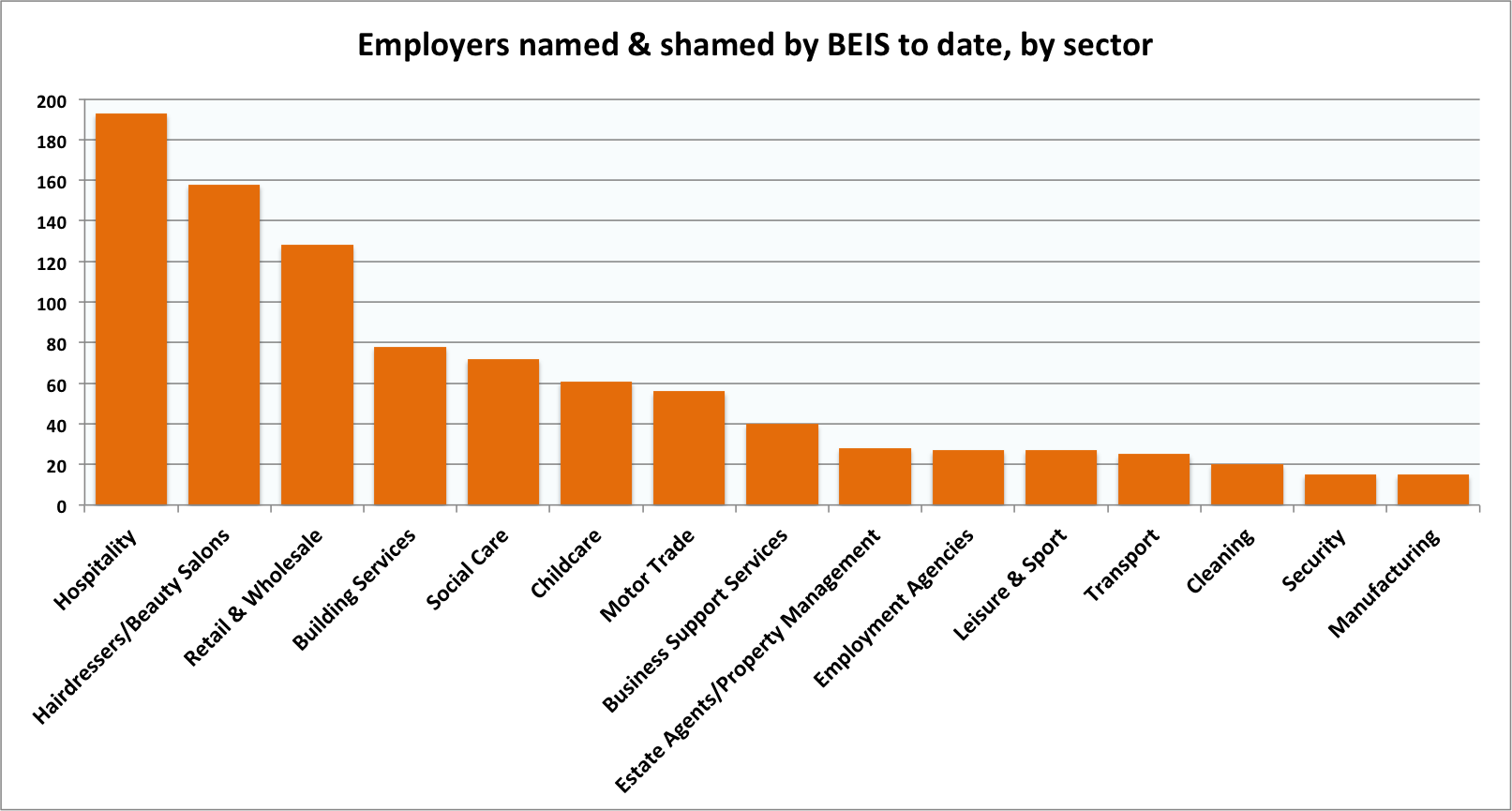
We also know that one of the 813 employers who were issued with a Notice of Underpayment – security firm TSS (Total Security Services) Ltd – was found to owe a whopping £1.7m of arrears (we know, because the firm was ‘named & shamed’ by BIS in early February). That case is truly exceptional – £1.7m is 613 times the average arrears of£2,770 owed by the other 489 NMW rogues ‘named & shamed’ by BIS to date.

That leaves some £4m (or possibly more, if my above assumption is over-generous) of unexplained, excess arrears. And, if I’m right that that £4m or more was ‘recovered’ from the 145 employers who seemingly took advantage of the BIS amnesty, that means those 145 employers evaded some £4m or more in financial penalties. Lucky them. (And, if you think £4m doesn’t sound very much, bear in mind that the total amount of penalties issued over the past four years is just £4.2m).

Interestingly, this week the National Audit Office published a report on enforcement of the minimum wage by HMRC, which notes but makes no attempt to explain the 212% increase in the amount of arrears recovered in 2015/16. However, the report does note that

In 2015, HMRC also introduced ‘self correction’ where, following an intervention from HMRC, employers are required to self-correct underpayments of the National Minimum Wage. Since 1 April 2015, 177 employers have notified self-corrected arrears, identifying £4,614,929 for 22,607 workers. The employers are in the process of repaying this money to workers and ex-workers. HMRC is also responsible for checking that these arrears have been paid.

Is that the BIS amnesty? It’s not clear. But the NAO’s £4.6m is not a million miles away from my ‘£4m or more’, even if there is no obvious explanation for the difference between the NAO’s ‘177 employers’ and the figure of 145 given in the minister’s answer to the PQ by Caroline Lucas.

Perhaps it’s about time someone in BIS did some explaining?

Update (2 June): Well, I was wrong. Yes, you read that right. According to the answer BIS has given this week to a further parliamentary question by Caroline Lucas MP, the 6-month amnesty for NMW-breaching employers announced by BIS in July 2015 does not explain more than a small part of the remarkable increase in arrears recovered in 2015/16. 60 employers took advantage of the amnesty, but they owed only some £786K in arrears to some 4,800 workers. However … that still leaves another 85 employers (145 – 60) that BIS says were not issued with a Notice of Underpayment, so were not issued with a financial penalty. And BIS seems reluctant to say how much of the £10.3m was recovered from those 85 employers. Watch this space.

Posted in Workers' rights | Tagged , , , | Leave a comment

ET fees: Who said what to the Justice committee of MPs

With the report of the Ministry of Injustice’s internal review of the employment tribunal fees introduced in July 2013 having now been sitting on the desks of justice secretary Michael Gove and his intellectually-challenged junior minister, Shailesh Vara, for seven months – three more than it took Ministry officials to ‘research’ and write the damn thing – there must be a chance that some kind of decision will be reached soon. Though as to what that decision will be, the omens are not good: not only has the Government stated recently that “it is too soon to consider whether any action is needed here” – in that case, why did they launch a review in June 2015? – but just last month the Ministry justified a whopping 500% increase in immigration appeal fees on the basis that, well, it has run out of dosh.

Anyway, just in case, I thought it would be worth reminding ourselves what those with first-hand experience of the employment tribunal system since July 2013 said last autumn to the Justice committee of MPs, which was then busy inquiring into the impact of the fees but which now also seems to be encountering some difficulty in making up its mind and publishing its inquiry report.

In its September 2015 submission to the Inquiry, the Council of Employment Judges (the membership of which “consists of the great majority of salaried and fee paid Employment Judges in England, Wales, Scotland and Northern Ireland”) concluded that:

There can be no doubt that there has been a decline in cases presented to Employment Tribunals but [our members’] experience that there has been a particularly marked decline in the types of cases brought by ordinary working people – that is, claims for unpaid wages, notice pay, holiday pay and simple claims of unfair dismissal – is borne out by the statistics. The Council considers that there is clear evidence that fees are deterring meritorious but lower value claims, whether they be money claims, unfair dismissal or discrimination complaints where compensation for injury to feelings and lost earnings may be relatively low. High fees deter such complaints and act as a barrier to justice and, in the context of discrimination, undermine the aims of the Equality Act 2010.

UD

The Council of Employment Judges further noted that

Fees have had no impact on weeding out weak claims: if they had done so the number of claims succeeding in front of Employment Judges would have increased significantly. [Our members’] experience is that misguided but determined litigants remain undeterred by the fees.

In his September 2015 submission to the Inquiry, the President of the Employment Tribunals (England and Wales), Judge Brian Doyle, agreed, noting that

We do not consider that there has been an obvious reduction in weak or unmeritorious claims. Had that been the case we would have expected the percentage of successful claims to have risen, whereas in fact it has declined slightly. In any event, the definition of what is a weak or unmeritorious case is notoriously elusive. In only a very small percentage of claims is it possible to identify an obviously weak or unmeritorious claim until there has been some rudimentary case management, a preliminary hearing or the determination of conflicting evidence.

outcomes

In their September 2015 submission to the Inquiry, the Employment Tribunals (Scotland) concluded

Given the dramatic reduction in the number of claims across all claim types, the information emerging from system users, and the difficulties identified [in this submission] in connection with the remission scheme (which was designed to maintain access to justice), it is the position of the Employment Judges in Scotland that the objective of maintaining access to justice – including ensuring that only those who can afford to contribute to the cost of running the system are required to do so – has not been met. Put another way, Employment Judges in Scotland consider the fee system has acted to significantly reduce access to justice.

redundancyThose ‘difficulties with the remission scheme’ were illustrated by the following case example, included in the September 2015 submission to the Inquiry of Working Families:

Camilla, pregnant and until very recently working 30 hours per week as a hotel cleaner on a zero-hours contract, contacted [our] legal helpline in 2015 after being summarily dismissed for taking time off work due to pregnancy-related illness. The helpline team considered Camilla to have a strong claim for unlawful pregnancy-related dismissal, but she was unwilling to risk up to £1,200 of her savings on issuing and pursuing a tribunal claim. Not without difficulty, Camilla had managed to save just over £3,000 to cover the extra expense she knew would come with having a baby – not least because she would receive only the statutory rate of maternity pay (just 60 per cent of the National Minimum Wage) while on maternity leave. And those savings meant that Camilla would not be eligible for any remission of the tribunal fees.

In its October 2015 submission to the Inquiry, the Law Society of England & Wales stated:

The evidence suggests that the introduction of Employment Tribunal (ET) fees has harmed access to justice and [that] since July 2013 many people are not able to enforce their employment rights. It is likely that other factors, such as the economic upturn and the introduction of Acas early conciliation have had some impact on the decline in the number of ET cases, but we are of the view that the impact of these factors is minor compared to the consequences of ET fees. Our members have told us that claimants with strong cases see the fee as a significant deterrent to pursuing a complaint. We also know of examples where respondents have refused to consider engaging in early conciliation or settling the matter before it reaches the tribunal because they wanted to “call the claimants bluff” on whether the employee would pay the fee.

The Yorkshire Employment Tribunal Members’ Association agreed that the introduction of Acas early conciliation in April 2014 “has only marginally contributed to the decline
in ET cases”, and that “those most adversely affected [by the fees] are those on low incomes, women and those wishing to pursue a claim for race and/or sexual orientation discrimination”.

race

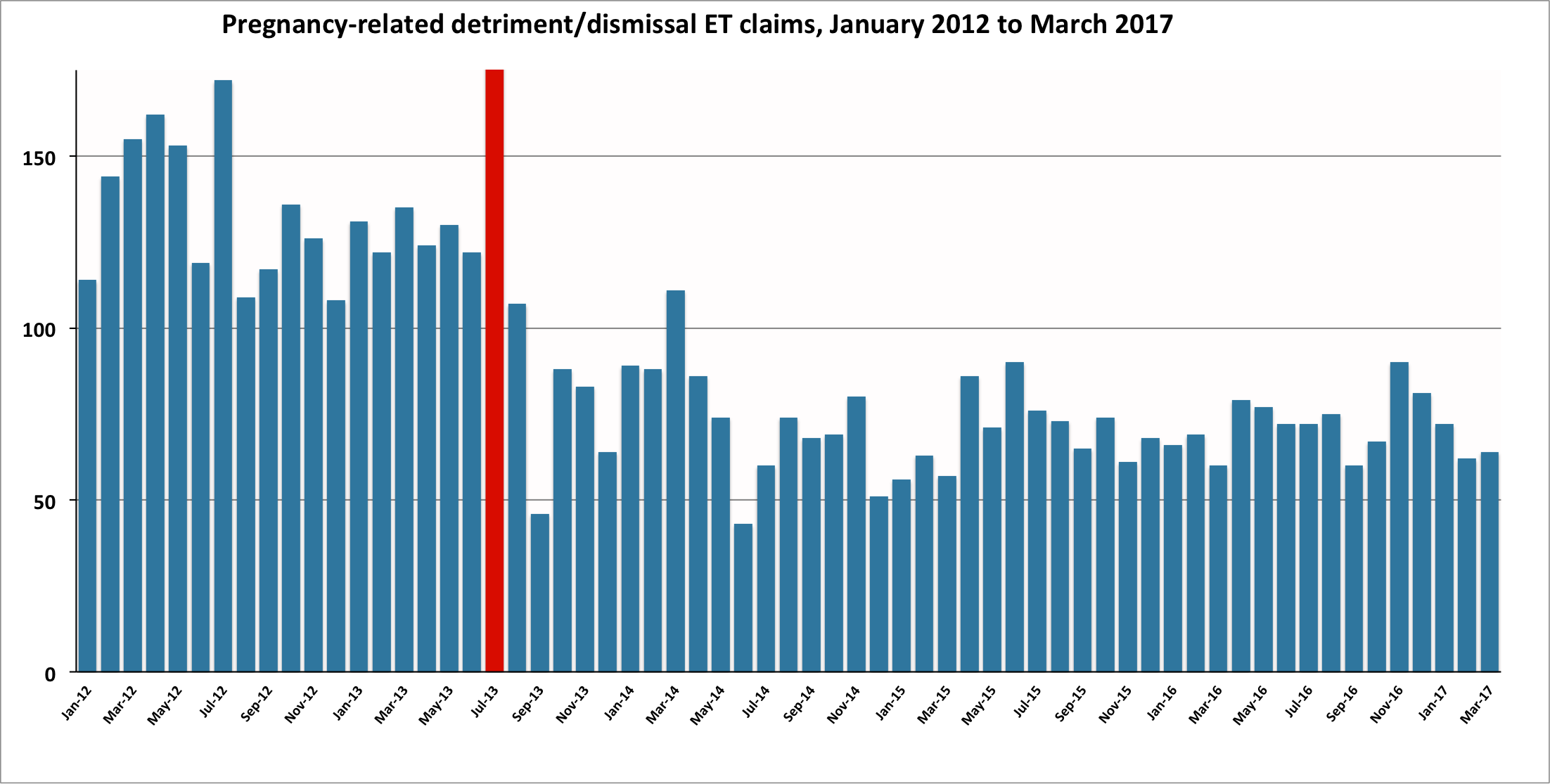
Noting that the number of pregnancy-related detriment or dismissal claims “fell by some 40 per cent immediately following the introduction of fees in July 2013, from an average of 126 per month in the nine months up to June 2013, to an average of 76 per month in the six-month period September 2013 to February 2014”, and that “the deliberate creation of such a barrier to justice is deeply unfortunate when the latest detailed research – undertaken jointly by the Department for Business, Innovation & Skills (BIS) and the Equality & Human Rights Commission (EHRC) – indicates that as many as 54,000 women are now forced out of their job each year on account of their pregnancy or maternity leave”, Maternity Action suggested in their August 2015 submission to the Inquiry that

the creation of such a barrier to justice is detrimental not only to those women who are denied justice, but also to the great majority of law-abiding employers – who are denied a level playing field – and to the public policy goal of eliminating gender inequality. These are important, long-term considerations that far outweigh any short-term financial benefit to the Ministry of Justice (in terms of net fee income, and lower operational costs due to reduced case numbers). Accordingly, we believe that abolition (or a very substantial reduction in the level) of the fees must now be a priority for ministers.

pregWorking Families made much the same point, concluding in their September 2015 submission to the Inquiry that

The denial of access to justice on such a scale also matters if you believe – as we do – that law-abiding employers deserve a level-playing field on which to compete with their business rivals. The employment tribunal system is intended to ensure a more equal power relationship between the most vulnerable workers and their employers, without which – in the words of Winston Churchill more than a century ago – the good employer is undercut by the bad, and the bad employer is undercut by the worst.

Largely as a result of the fees introduced in July 2013, the UK’s 1.2 million employers now risk facing a tribunal claim just once every 60 years, on average, and a private sector business just once every century. And that is simply a charter for Britain’s worst employers.

In their November 2015 submission to the Inquiry, the Lay Members of the Employment Appeal Tribunal (EAT) concluded that “on the basis of the evidence now available, the introduction of tribunal fees has impacted adversely on access to justice in respect of the EAT”, and that “there is a strong case for the Government to reconsider the application of fees to the tribunal system”.

cases

In the interests of balance, it is only fair to note that, in their September 2015 submission to the Inquiry, Peninsula Business Services asserted that the fees introduced in July 2013 “do not pose a barrier to accessing justice, have served to deter the pursuit of speculative claims [and] have improved access to justice for all by helping to ensure that the tribunal’s resources are allocated effectively”.

I imagine Gove and Vara will be going with Peninsula Business Services. Well, the evidence is overwhelming, isn’t it?

Posted in Justice | Tagged , , | Leave a comment

Lies, damned lies, and co-authored articles in the Guardian

In “The Truman Show” – the film in which the eponymous hero comes to realise he is living in a constructed reality television show – Truman Burbank first suspects his marriage is a sham when he finds a wedding photo of his wife with her fingers crossed.

The EU referendum campaign has already had me wondering more than once whether I am also living in a constructed reality television show, in Series 2 of which the rather dim Daniel Hannan MEP will become Prime Minister and the even dimmer British public will happily vote away their rights to paid holiday and maternity leave.

But things got really surreal on Wednesday, when prime minister David Cameron and Sir Brendan Barber – the former TUC general secretary who now heads up Acas, as well as sitting on the board of Stronger In – co-authored a classic piece of Project Fear in the Guardian. I can only assume our bizarre bedfellows had the fingers of one hand firmly crossed behind their back when they jointly typed that

Being in Europe has helped to deliver many of the crucial rights that underpin fairness at work. Paid holidays, maternity rights, equal treatment for the millions of people working part-time, protections for agency workers, even equal pay for women at work: all are guaranteed by Europe and all could be at risk if we left.

As Paul Waugh of Huffington Post notes, “some unions (the FBU and Napo among them) are furious with Barber for teaming up with Cameron, and are writing to the TUC to complain”. Indeed, the general secretary of the FBU, Mark Wrack, used an article in Thursday’s Guardian to spell out just how “staggered” and “appalled” he is by the Barber-Cameron love-in.

But for me the most astonishing aspect of what Polly Toynbee also mocks as the “jaw-dropping spectacle” of this co-working is the sheer hypocrisy of Cameron in claiming concern for rights such as “equal pay for women”. For, as a House of Lords select committee noted just last month:

Rights which are unenforceable are not worth having.

And the truth of this is clear from the following chart, which shows the drop-off in equal pay-related tribunal claims as a result of the fees introduced by the suddenly EU-derived-workplace-rights-loving Cameron and his then Liberal Democrat mates in July 2013.

equalpayOver the 18 months immediately prior to the introduction of the justice-denying fees of up to £1,200 in July 2013, there were 36,898 equal pay claims. And, in the 18 months after July 2013, there were just 11,586 such claims. Even after allowing for the fact that some of the missing 25,000 equal pay claims will have been conciliated by Sir Brendan’s Acas under the early conciliation scheme introduced a year later, that is a lot more equal pay claims than would be lost as a direct result of Brexit (that being: none, at least until Prime Minister Hannan enters Downing Street and the British public says nein danke to having paid holiday and the right to equal pay).

And what about the other rights that Cameron and Comrade Barber say are “guaranteed by Europe” – ‘guaranteed’ means, like, you get it whatever, yes? Well, maybe not. As the following chart shows, the number of pregnancy-related detriment or dismissal claims has fallen from an average of 132 per month over the 18 months prior to July 2013, to an average of just 72 per month over the 18 months after the introduction of fees. Maybe employers just stopped mistreating pregnant workers so much? I don’t think so. Indeed, the Equality & Human Rights Commission says unlawful discriminatory treatment of new and expectant mothers is currently more common than ever.

preg

Or what about equal treatment for the “millions of people working part-time”? Well, as with claims for equal pay and pregnancy-related detriment, the number of part-time workers regulations claims has also fallen off a cliff since Cameron decided that unfairly treated part-time workers no longer need access to justice. In the 18 months prior to the introduction of fees there were 1,521 such claims, but in the last 18 months there were just 326 – a fall of 79%, to an average of just 18 claims per month.

And, if rogue employers know that the chances of any of their mistreated part-time workers bringing an ET claim are little more than zero, that EU guarantee is – as the House of Lords select committee would say – not worth having.

parttime

But, somehow, Brother Barber failed to point any of this out to his Tory co-author. I wonder why.

Posted in Equality, Workers' rights | Tagged , , , , , , , | Leave a comment

NMW enforcement: curiouser and curiouser

To their credit – and that is not something I tend to say very often – Tory ministers appear to have been stung into action by revelations that large, profitable companies such as B&Q, Morrisons, Tesco and Caffe Nero are using this month’s hike in the minimum wage rate (for those aged 25 and over) to cut overtime rates and other basic entitlements, leaving many low-paid workers worse off. Well, it must be a tad galling to have corporate fat cats – to whom you’ve just gifted yet another cut in corporation tax – piss on your fantabulous national living wage parade.

On Monday, at the end of a Labour-initiated backbench debate in the House of Commons, BIS minister Nick Boles felt it necessary to make a remarkable proposal:

I wish to conclude by making this proposal to [MPs on all sides of the House]: please bring to me [and to the chancellor, George Osborne] any case of a company that seems to be trying to evade the spirit of the legislation in an unreasonable way. I am talking about companies that are profitable and will be benefiting from the dramatic cut in corporation tax, and companies that will be benefiting from the employer allowance or from the cuts in business rates. Bring those cases to me and I promise that we will use the full force of our office to put pressure on those companies to live up not only to their legal obligations, which are our job to set out in making legislation in this House, but to their moral obligations, which are the ones we feel matter a great deal more.

And on Tuesday, seemingly having woken up to the unfortunate consequences of what shadow BIS minister Kevin Brennan described in Monday’s debate as “the Great Osborno [pulling] a rabbit out of his hat, to the delight of his misdirected audience on the Conservative benches”, the chancellor himself went on TV to warn employers not to cut perks to pay for his dishonestly-named ‘national living wage’.

Time will tell how many MPs take up the chancellor’s offer, and how many profitable but miserably penny-pinching employers then feel sufficiently ashamed to ‘do the right thing’. But there was more good news from Nick Boles during Monday’s debate, as he announced that the budget for enforcement of the minimum wage by HMRC has increased from £13.2m in 2015/16, to a whopping £20m in 2016/17. As the minister gleefully noted, that is considerably more than twice what the supposedly worker-friendly Labour government devoted to such enforcement (a mere £8.3m) in its last year in power.

Interestingly, Boles also confirmed that, in 2015/16, HMRC recovered “more than £10 million of arrears for more than 58,000 workers”. As the minister could not contain himself from noting, that is “three times the arrears identified in 2014/5, and for twice as many workers”.

This is to be welcomed. But – as previously noted on this blog – it also begs a question: how did this stonkingly good performance by HMRC come about? For it is not easily explained by previous, much less dramatic increases in the HMRC enforcement team’s budget. Could it possibly have something to do with the (effective) amnesty for NMW rogues that BIS quietly announced in the summer of 2015? We really should be told.

NMWarrears

Posted in Workers' rights | Tagged , , , | Leave a comment

Brexit and workers’ rights: Give me a break!

OLYMPUS DIGITAL CAMERA

The already hyperbolic ‘debate’ around the likely impact of Brexit on UK workers’ rights got significantly sillier this week, with Labour leader Jeremy Corbyn using his Big Speech on Europe to warn of a “bonfire of [workers’] rights” should Britain vote ‘leave’ on 23 June, and the TUC cranking up the volume of its own scaremongering with a dire (in every sense) warning that “the principle of holiday rights for all could simply be abolished”.

In its press release, the TUC warns that

the hard-won right to holiday pay could be lost if Britain votes to leave the European Union, with many people at risk of losing some or all of their paid leave.

Well, yes, there must be a theoretical possibility that, following a ‘leave’ vote in June, Daniel Hannan MEP becomes leader of the Conservative party after David Cameron resigns to spend more time with his tax advisers, and the unlovely Daniel then goes into the next election on a platform of ‘Vote Tory, get no paid holiday!’. On Thursday’s BBC Question Time, the superficially clever but actually rather dim Daniel hinted that all was fine under Neville Chamberlain’s Holidays with Pay Act of 1938, which recommended (but did not require) that employers give their workers one week of paid holiday each year.

However, outside the TUC bunker and Jeremy Corbyn’s under-powered private office, no one seriously believes any of this would happen, should Brexit follow a ‘leave’ vote in June’s referendum. Because the EU-derived rights wouldn’t vanish in a puff of smoke with Brexit – future governments would have to actively legislate to remove them. And, whatever else leaving the EU might mean for such workplace rights (almost certainly ‘not very much’, for the vast majority of workers), the right to four weeks’ paid holiday plus Bank Holidays is the EU-derived right that is least at risk from post-Brexit Tory governments. And you don’t have to take my word for it.

Kirsten Cluer, of Cluer HR, notes “it is inconceivable that any UK Government would choose to repeal discrimination law or maternity leave just because it was no longer bound by EU rules … [and] it is difficult to see any government repealing the right to take paid annual leave”. Connie Cliff, Siobhan Bishop and Jonathan Chamberlain – no relation to Neville, as far as I know – of law firm Gowling WLG, note that “even the most fervent opponents of the Working Time Regulations 1998 would not suggest the wholesale removal of statutory annual leave rights”.

David Whincup of law firm Squire Patton Boggs notes that it is “hard to see” a Conservative government setting about “any material dismantling of the employment rights of the bulk of the electorate, wooing them with such temptations as longer hours, fewer and less-paid holidays, reduced freedom from discrimination, etc.”. And Mr Employment Law himself, barrister Daniel Barnett of Outer Temple chambers, is clear that, in the event of Brexit:

Most of the Working Time Regulations [would] remain. Paid holiday [would] certainly stay, and of course we gold-plated the European Union’s four weeks’ paid annual leave with 5.6 weeks.

Furthermore, as Kirsten Cluer notes, while it is not at all clear what price the EU would impose on an exited UK in return for favourable trading arrangements along the lines of Switzerland or Norway, the deal might well “include the UK having to maintain all existing European employment law so as not to skew the market. In which case, the UK will be back where it was.” Paul Callegari of global law firm K & L Gates says much the same:

Even if the UK leaves the EU, the desire to maintain some sort of free trade agreement with the EU (either by joining the EEA or negotiating bilateral agreements) will mean that the UK is still likely to be required by the EU to maintain minimum standards of employment protection to prevent the UK being able to undercut EU states through lower employment standards. Although the UK may be able to negotiate certain exemptions from the full range of EU laws, current EEA EFTA states (Norway, Iceland and Liechtenstein) are obliged to accept the majority of EU regulations without being part of the EU decision-making process, and the UK is unlikely to be much different if this is the path it chooses to follow.

So, please, give me a break from all this Brexit nonsense. Brexit would be disastrous for British workers (and non-workers), for all sorts of reasons. But even the Daniel Hannans of the Tory right would not abolish the principle of holiday pay for all.

Posted in Workers' rights | Tagged , , , , | Leave a comment

New research: 95% of journalists don’t know their **** from their elbow

Confirmation bias was much in evidence earlier this week, when a small tsunami of press and media reports of a new ‘research’ report by My Family Care on the little-loved Shared Parental Leave – and in particular the report’s headline ‘finding’ that there has been “just one per cent take-up so far” – had a lot of employment lawyers, wonks and HR specialists nodding along and tweeting their lack of surprise. Including me, initially. But then it was just after midnight when I read the Guardian article that had just appeared online, and I had drunk a certain amount of wine.

However, at about the same time, somewhere in Scotland, the former BIS employment relations minister and chief architect of SPL, Jo Swinson, was punching holes in walls and kicking the cat. NB: This may be an exaggeration. I don’t even know if Jo has a cat. She may well not have been in Scotland. But if spouting dubious ‘facts’ is good enough for My Family Care and the Women’s Business Council (who endorsed the ‘research’ report) it’s good enough for a humble blogger. Certainly, there was some wailing and gnashing of teeth in the Swinson household.

For Jo had immediately noticed what legions of journalists and news editors at the Guardian (“Tiny proportion of men are opting for shared parental leave“), the Independent (“Only 1% of fathers [sic] take opportunity to split time off“), Sky News (“just 1% of fathers [sic] have chosen to opt for Shared Parental Leave“), BBC Breakfast (“Shared parental leave: only 1 in 100 dads take what they’re entitled to“) and elsewhere failed to spot: that My Family Care’s ‘research’ is little more than garbage, and their ‘1%’ figure utterly bogus.

Screen Shot 2016-04-09 at 14.04.25

Because My Family Care’s 1% figure is not the percentage of ‘new fathers eligible for SPL’ who took SPL, or even the percentage of ‘fathers’ who took SPL, as suggested in the above self-congratulatory tweet by My Family Care. Rather, as is revealed on page 9 of the My Family Care report, it is the percentage of “all male employees” (in their sample of 200 employers) who took SPL. Which, as was quickly noted by Sarah O’Connor of the Financial Times – one of the few journalists to consistently apply journalistic scrutiny to the stream of press releases sent to her by PR agencies – is “nonsense”.

That is putting it mildly. It is in fact nonsense on stilts, and if there was any justice in the world My Family Care and the Women’s Business Council would now be spending a very, very long time on the naughty step. And a lot of journalists would be getting booked onto a refresher course at journalism school.

For, in any one year, the vast majority of male employees do not become a father, so simply cannot take shared parental leave, however much they might want to. As Jo Swinson later noted in the Financial Times, My Family Care might just as well have issued a ‘research’ report with a headline ‘finding’ that only a small minority of female employees take maternity leave.

According to the February 2013 BIS final impact assessment on SPL, there are about 540,000 maternities each year in which the mother has a partner who is a ‘male employee’ (i.e. she is not a lone parent, and her male partner is in employment). And it has been estimated by the TUC, Working Families and others that only about 60% of those 540,000 new fathers will actually qualify for SPL. So, in ‘SPL’s first year’, about 324,000 male employees became eligible for SPL.

And, according to the ONS, there are some 16.8 million males in employment in the UK. So, even if every single one of those 324,000 new fathers who were eligible for SPL in 2015/16 actually took SPL – that is, if take-up was 100% – that would still be only 1.9% of ‘all male employees’. (Yes, I know, not all ‘males in employment’ are ’employees’, but My Family Care don’t distinguish between employees, workers and self-employed contractors, so why should I?)

However, My Family Care’s 1% figure is not simply bogus – it also fails to reflect their own ‘research’ findings. Buried away on page 20 of the 26-page report is a chart showing that, among the (very small) number of male employees in their sample who had actually become a father in the last 12 months, more than 30% had taken SPL. More than 30%! Yes, the ‘research’ is so sloppy that My Family Care don’t even bother with the exact figure. Yet the Government’s own forecast (which we can safely say was optimistic) was just 2-8%.

Screen Shot 2016-04-07 at 13.58.31Which begs the question, should My Family Care and the Women’s Business Council have issued a press release headlined “Shared parental leave a stunning success!”? To which the short answer is: No. Because, as just noted, the size of the sub-sample of employees interviewed who were new fathers is far too small to be meaningful, and we have no idea whether the 200 employers they selected are in any way representative (My Family Care didn’t bother to include any explanation of their ‘research’ methodology, perhaps because that would simply have confirmed how shoddy the methodology was).

This is not the first time that someone has used the device of paper-thin ‘research’ on shared parental leave to get their organisation’s name in the paper – indeed, My Family Care have form. And, given the evident gullibility/stupidity of so many journalists and news editors, I don’t suppose it will be the last. But, as the employment team at law firm Lewis Silkin noted on Twitter yesterday, “until there is good data, all anyone can say on SPL take-up is that it is somewhere between 0% and 100%”.

Postscript: At least some at the BBC have recognised the error/laziness of their colleagues, with Radio 4’s “More or Less” describing My Family Care’s 1% figure as “massively misleading” and “one of the worst statistics we’ve ever reported on”.

Screen Shot 2016-04-10 at 13.31.21


Postscript 2 [26 April]: Clearly feeling that he hasn’t provided us with quite enough entertainment, Ben Black of My Family Care has now written an hilarious defence of the report and its promotion:

Screen Shot 2016-04-21 at 20.02.37

Posted in Equality | Tagged , | 3 Comments

Putting Shailesh Vara in context (condensed)

I’ve been feeling bad that my last post was a tad, well, unreadable. So this is the condensed version. With charts (see, I do love you, Gem).

So, the question is: Has the introduction of Acas early conciliation been (a) successful; and/or (b) a good thing for workers’ access to justice, to set against the justice-denying impact of the hefty employment tribunal fees introduced in July 2013?

Which begs a further question: What does ‘successful’ mean?

Fortunately, that further question is easy, as the Government has already answered it, on page 38 of its February 2014 Final Impact Assessment on the introduction of Acas early conciliation:

Early conciliation will have been a success if it can be shown that, at least in part, it has caused a reduction in employment tribunal claims and/or earlier resolution of workplace disputes and/or resolution of workplace disputes that lead to better satisfaction with dispute resolution services.

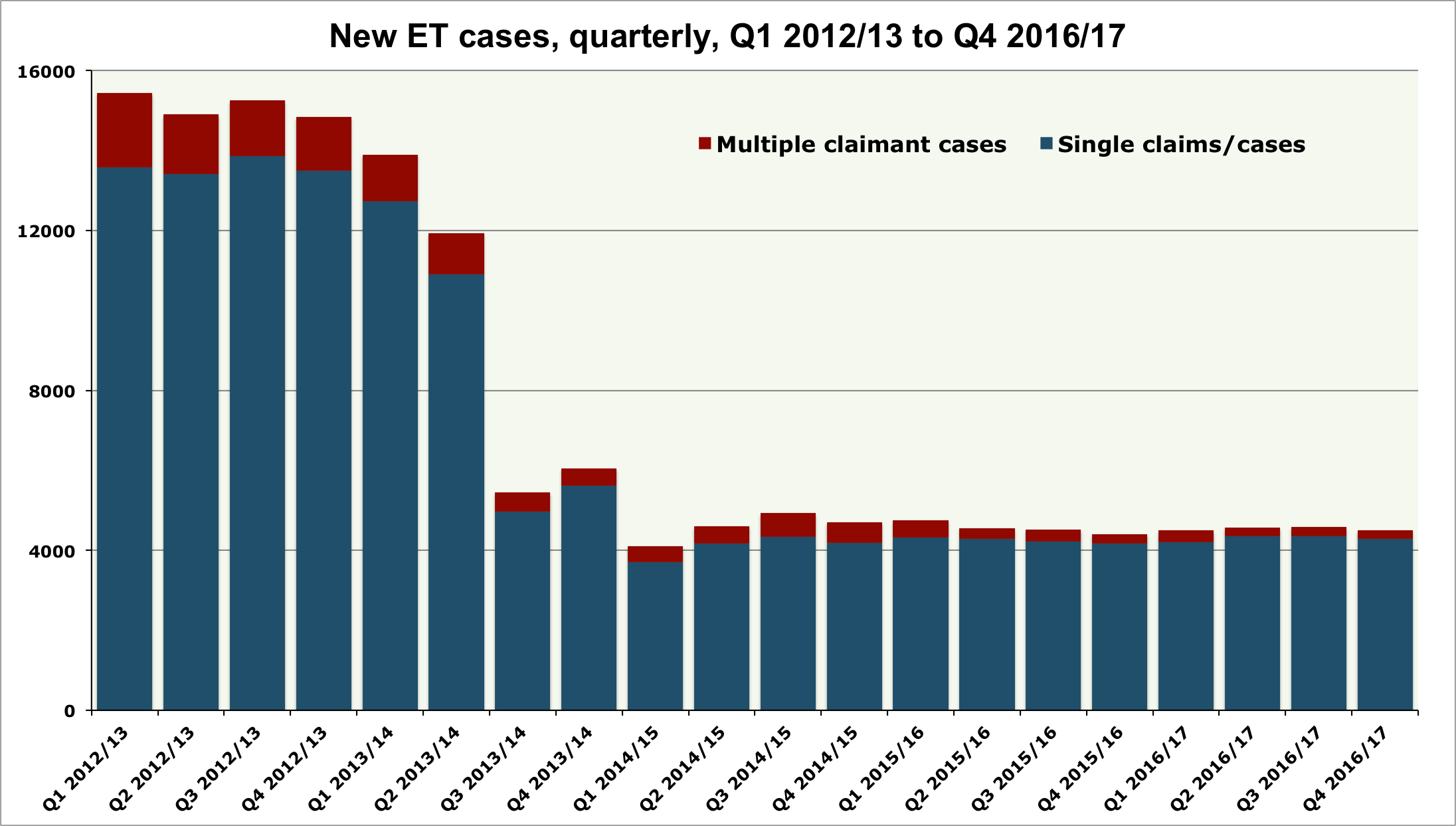
Has early conciliation caused a reduction in employment tribunal cases since its introduction in April 2014? As the following chart shows, there has indeed been a (relatively small) decline in the monthly number of single ET claims/cases since April 2014. If we ignore March 2014, when there seems to have been a rush of such cases to beat the introduction of early conciliation (just as there was in July 2013, to beat ET fees), the monthly average number of single claims/cases has fallen by 15 per cent, from 1,703 over the five-month period October 2013 to February 2014, to 1,447 over the most recent six months for which figures are available, July to December 2015.

postAcasSingles

According to that 2014 Impact Assessment, Acas early conciliation was supposed to bring about a 17% fall in ET case numbers. So, job done, everyone can go home.

Of course, just as junior injustice minister Shailesh Vara argues that the steep fall in ET case numbers from July 2013 was caused by factors other than the introduction of hefty ET fees in July 2013, it could be argued that the relatively small decline from April 2014 was caused by … oh, I don’t know, maybe global warming or something.

Whatever, since April 2014, Acas early conciliation has acquired a further objective, one not mentioned in that Impact Assessment: providing the Ministry of Injustice with a fig leaf for that sharp fall in ET case numbers from July 2013. There has been no denial of access to justice, says Mr Vara (in his oral evidence to the Justice committee of MPs, on 9 February this year), because everyone can go to Acas and have their potential ET claim conciliated. For free!

The problem is, not everyone does get their potential ET claim conciliated by Acas. We can see this in the following chart.

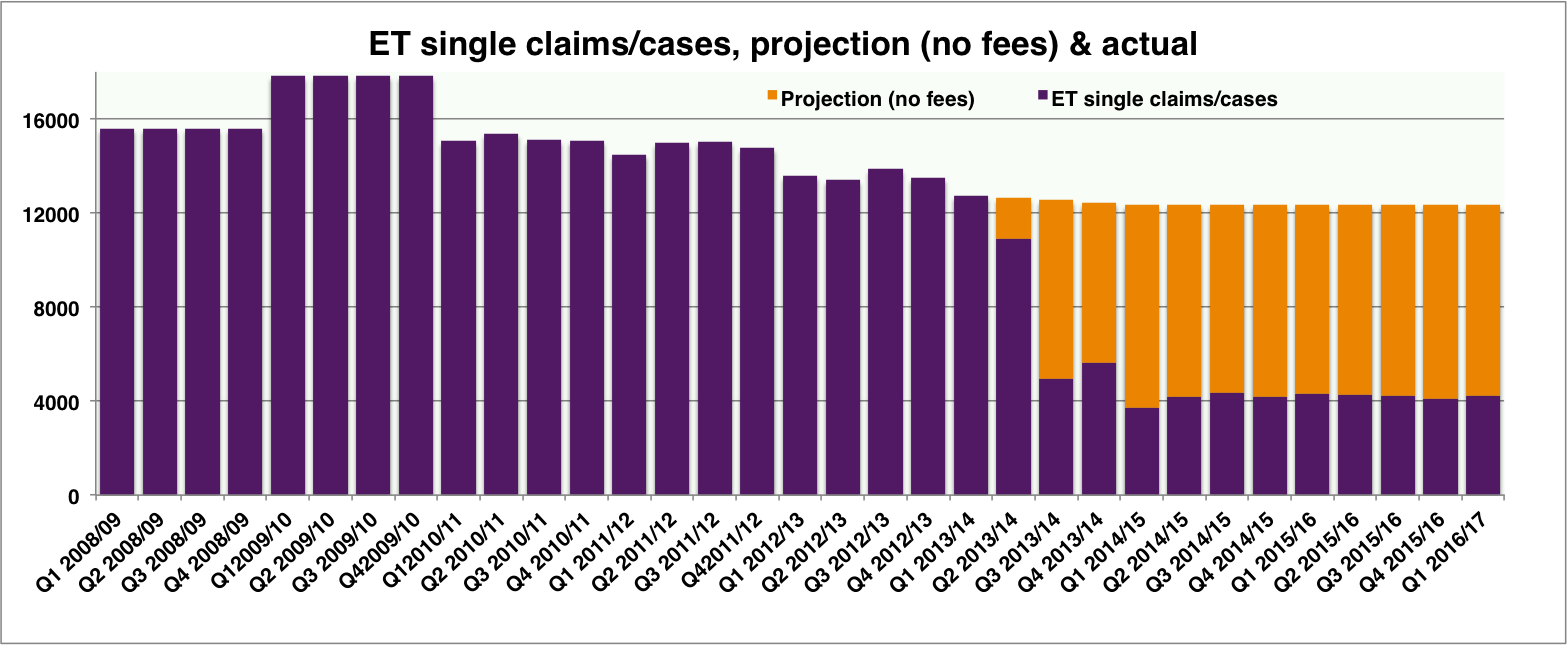
missingFor a full explanation of this chart and its assumptions, see my previous (unreadable) post. But, in a nutshell: the green area is the actual number of single ET claims/cases (by quarter); the blue area is the number of successful Acas conciliations of single cases; and the orange area is the number of ‘missing’ single ET claims/cases – that is, the difference between the actual number of such claims/cases plus the number of successful Acas conciliations, and my (conservative) projection of the number of single ET claims/cases we could have expected, had both ET fees and Acas early conciliation not been introduced. (And that projection allows for both the pre-existing, mild downward trend in ET case numbers, and the improving economy, each cited by Mr Vara as key factors in the sudden, sharp fall in ET case numbers from July 2013).

As of 31 December 2015, the total number of ‘missing’ single ET claims/cases – i.e. the number of ‘lost’ cases that cannot be explained away by the introduction of Acas early conciliation, and/or the pre-existing downward trend in ET case numbers, and/or the improving economy – is 49,937. And, if my projection is too conservative, then the number of ‘lost’ cases is even greater than 49,937.

In short, Acas early conciliation provides the naked Mr Vara with a less than adequate fig leaf for the justice-denying impact of ET fees. Yes, I know, that’s a truly horrible image.

At this point, Mr Vara would probably ask to ‘phone a friend’, and everyone’s favourite mathematical genius, Cabinet Office minister Matthew Hancock MP, would explain to us that all 49,937 ‘lost’ ET claims/cases were vexatious or otherwise unfounded claims that should never have been brought in the first place. He might even aver that all 49,937 workers went to Acas, only to be told that their potential ET claim was in fact a pile of pants.

However, if that were true, then removing such vast numbers of weak or hopeless cases from the ET system would have sent the overall success rate of ET claims rocketing up towards 100 per cent. And, sadly for the Hancock Theorem, the very opposite has happened – the overall success rate has fallen since mid-2014, when claims made post-July 2013 began to dominate the outcome statistics.

Sadly for him – and for anyone within sight – Mr Vara’s fig leaf is vanishingly small.

Posted in Justice, Workers' rights | Tagged , , | Leave a comment

Phantom menace: ET fees & Acas early conciliation

As previously noted on this blog, I have been resisting the urge to write about the feeble performance of the imbecilic junior injustice minister, Shailesh Vara MP, when giving oral evidence on the impact of employment tribunal (ET) fees to the Justice committee of MPs, and in particular his repeated citing of the 83,000 early conciliation (EC) cases handled by Acas in 2014/15. But it has to be done, as – however cretinous the minister’s line – he raises an important issue that needs to be fully understood. It’s just a tad more complicated than suggested by the minister, and his headline figure of 83,000 EC cases.

But before we put that figure in its proper context, it’s worth getting ourselves in the mood by noting what is said about the early conciliation process – introduced in April 2014 – in a new Acas research paper, Managing conflict in the contemporary British Workplace. Among the employment lawyers interviewed by the Acas-commissioned researchers

there was some scepticism as to whether early conciliation had resulted in more claims being settled than would have been the case under the previous system. Lawyers, in particular, doubted its benefits, as the following comments from a focus group illustrate:

Participant 1: “I found [early conciliation] totally irrelevant.

Participant 2: I don’t think [early conciliation] is necessarily settling claims that wouldn’t otherwise have been settled … There is no impetus to use it.

Participant 3: It’s just an additional hurdle.

Participant 4: I was going to say, acting for employers, you can wait and say, let’s wait and see … it doesn’t really change much, just pushes it back rather than bringing it forward.

Participant 5: You can also put a book on exactly how high the first number is going to be so it provides a little bit of amusement … But I don’t think it’s been a tremendously valuable feature.

Hmm, they don’t really see it as transformational, do they? Whatever, this is what Mr Vara said to the Committee (before going on to mention the 83,000 figure a further four times, without ever attempting to put it in context – despite being pressed to do so by the SNP committee member Richard Arkless MP):

It is important to remember that, in the first 12 months of the ACAS conciliation procedure, ACAS handled some 83,000 cases. That is 83,000 cases which, alternatively, might well have ended up before the employment tribunal. Instead of people going to the employment tribunal, there is now a free service, which I hope this Committee would welcome, where people can go and try to resolve an issue in conciliation, rather than going to the employment tribunal.

It is [also] important to remember that, before the employment tribunal fees came into place, the trend of the number of cases going to tribunal had been going down. We also have to remember that the economy has been picking up, and employment is increasing. There have been changes to employment law. All those factors may well have contributed to the number of cases diminishing in the employment tribunal.

And it is true that, in 2014/15, Acas handled 83,423 early conciliation (EC) cases. However, according to Acas, “more than 4,000” of those 83,423 cases were multiple claimant cases. And it makes more sense, when examining trends in ET case numbers and the impact of ET fees, to focus on single claims/cases – even the Ministry of Injustice accepts that now. So, let’s deduct 4,200 (if anyone at Acas would like to give me the actual figure, please do so) from that 83,423. That gives us a figure of 79,223 single EC cases in 2014/15.

In that 12-month period, there were just 16,659 single ET claims/cases. So only 21% of the 79,223 single EC cases handled by Acas progressed to an ET claim. (That is very close to the 22% of all EC cases that Acas itself says progressed to an ET claim in the first three quarters of 2014/15 – for some reason, it appears not ever to have published the outcome figures for Q4 of 2014/15. So we’re all still on the same page, I think.)

Success! We can imagine Mr Vara doing a little jig around his Ministry of Injustice office when he was first presented with these figures. On second thoughts, maybe we shouldn’t.

At this point we need to note in passing that, when Mr Vara idiotically told the Committee that the 79,223 single EC cases handled by Acas in 2014/15 is 79,223 single cases “which, alternatively, might well have ended up before the employment tribunal”, he actually meant 62,564 single cases ‘which, alternatively, might have ended up before the employment tribunal’, as 16,659 of the 79,223 did end up before the employment tribunal.

However, that is only part of the picture. We also need to consider these figures in the context of how many single ET claim/cases there would have been, had both ET fees and Acas early conciliation not been introduced. As Mr Vara noted, “before the employment tribunal fees came into place, the trend of the number of cases going to tribunal had been going down”. Indeed it had, albeit only slowly. Between Q1 of 2012/13 and Q1 of 2013/14, the number of single claims/cases declined by 6.3%. If that rate of decline had continued – a highly questionable assumption, to which I will return – then in 2014/15 we could have expected 46,575 single ET claims/cases (or thereabouts, obvs).

And the first thing this tells us is that, in 2014/15, Acas handled 32,648 more single EC cases than it really needed to. In other words, 32,648 individual workers who would not have made an ET claim in 2014/15 nevertheless used Acas early conciliation. Which is not a bad thing – it’s always been the case that only a minority of all potential ET claims actually get made. So I for one am glad that the taxpayer paid for those 32,648 workers to have Acas attempt to conciliate their workplace dispute. But I’m not sure this was part of what ministers intended.

I haven’t been able to find any published figures for the annual expenditure by Acas on early conciliation, but 32,648 is a hefty chunk – 41.2% – of the total single EC caseload in 2014/15. And 32,648 is considerably more than the some 20,000 cases of pre-claim conciliation that Acas used to handle each year prior to the introduction the early conciliation process. As just noted, it is arguable that this additional expenditure of taxpayers’ money is unnecessary, even if it is to be welcomed, but at the very least it needs to be set against the fee income and operational cost savings enjoyed by the Ministry of Injustice as a result of the introduction of ET fees in July 2013. (On the hand, there have also been operational savings to Acas arising from the fall in ET case numbers caused by the fees, as there are fewer ET cases that go to post-claim conciliation by Acas.)

Furthermore, to that 41.2% we need to add the 21% of single EC cases in which the involvement of Acas was pretty much a total waste of taxpapers’ money, as the individual went on to issue an ET claim in any case. In other words, almost two-thirds of the single EC caseload was either unnecessary (at least in terms of the original policy aim, which was simply to reduce the number of ET cases) or wasteful.

But now we come to the important part. Pay close attention, advisers to Mr Vara.

As there were only 16,659 single ET claims/cases in 2014/15, but there would have been 46,575 such claims/cases, had both ET fees and Acas early conciliation not been introduced, we are missing 29,916 single ET claims/cases (you’ll have to excuse my spurious precision, just for the sake of my argument). And, as Acas managed to successfully conciliate only 15% of the 79,223 single EC cases it handled in 2014/15, just 11,883 (at most) of those 29,916 ‘missing’ single ET claims/cases were conciliated by Acas. (In fact, some of the 11,883 conciliations are likely to have been of cases among that extra, unnecessary caseload described above, but let’s not complicate matters).

In other words, even after allowing for both the downward trend in ET case numbers highlighted by Mr Vara in his oral evidence to the Justice committee, and for the impact of the (rather wasteful) Acas early conciliation, there are still at least 18,033 single ET claims/cases that were ‘lost’ to ET fees in 2014/15.

“Hang on”, chorus those advisers to Mr Vara, “we also have to remember that the economy has been picking up, and employment is increasing”. Indeed. And, the greater the number of people in employment, the greater the number of potential ET claims! Because ET claims aren’t just about redundancy, you numpties. So, my assumption, above – that the 6.3% decline in ET case numbers seen in the quarters up to Q1 of 2013/14 continued in subsequent periods – is highly questionable. It is far more likely that that slow decline (from the peak caused by the post-2008 recession) would have petered out, and that ET case numbers would have levelled out (or even started to increase).

So, let’s assume instead that the rate of decline slowed to just 3% between Q1 2013/14 and Q1 2014/15, and then to just 1% between Q1 2014/15 and Q1 2015/16. On that basis, we could have expected there to be 49,197 single ET claims/cases in 2014/15. And the number of such claims/cases ‘lost’ to ET fees, after allowing for the beneficial impact of Acas early conciliation, rises from 18,033 to 20,655.

That 20,655, not Mr Vara’s specious 83,000, is the figure that members of the Justice committee should have been asking the injustice minister about. Because that is the figure that cannot be explained away by the introduction of Acas early conciliation, and/or the pre-existing downward trend in ET case numbers, and/or the improving economy.

And, of course, that 20,655 is just the figure for 2014/15. There will be a similar figure for 2015/16, in which (according to my revised assumption about the downward trend) we could have expected 48,888 single ET claims/cases, but in which it is looking as if there were only about 17,500 such claims/cases, and in which Acas was on track (based on its figures for the first three quarters) to have successfully conciliated only about 14,400 single EC cases. So, it’s looking as if some 17,000 single ET claims/cases will have beeen ‘lost’ to fees in 2015/16 (I will run these numbers again in June, when the ET and Acas stats for Q4 of 2015/16 are published).

All together, then, some 37,000 single ET claims/cases were ‘lost’ to ET fees in the first two years of Acas early conciliation, even after allowing for the beneficial impact of that early conciliation. And let’s not forget those ET claims/cases ‘lost’ to fees between 29 July 2013 and April 2014, when of course there was no Acas early conciliation.

Of course, our undiscovered mathematical genius, Matthew Hancock MP, would say that all those 37,000 ‘lost’ ET claims/cases were vexatious or unfounded claims that should never have been brought in the first place. But if that were true, then removing such numbers of weak or hopeless cases from the system would have sent the overall success rate of ET claims shooting up towards 100 per cent. And, sadly for the Hancock Theorem, the very opposite has happened – the overall success rate has fallen since 2014.

Shailesh Vara … this is your context.

Screen Shot 2016-04-04 at 06.05.39

Posted in Justice, Workers' rights | Tagged , , , , | Leave a comment

ET cases: going down. ET awards: going up.

A new Acas research paper – Managing conflict in the contemporary British workplace, published this week – includes some interesting, if not entirely surprising, findings on the impact of the hefty employment tribunal (ET) claimant fees introduced in July 2013.

Apart from junior injustice minister Shailesh Vara MP, aka the nation’s slowest reader, and Cabinet Office minister Matthew Hancock MP, aka the nation’s greatest undiscovered mathematical genius, few will be surprised to learn that, among the employment lawyers interviewed by the Acas-commissioned researchers, there was

“a majority view that tribunal fees were a blunt instrument which could have the effect of deterring meritorious as well as weaker claims”.

Furthermore, the employment lawyers “agreed that the introduction of fees had changed the nature of cases that they were being asked to take”. Lower value claims are now much less common, as there is “little benefit” in workers pursuing such claims, given “the obligation to pay fees [as well as] the fear of retaliatory action, particularly for those with less than two years’ service”. Well, blow me down with an ET1 form.

The HMCTS quarterly tribunal statistics confirm that relatively low-value ET claims for deductions of wages (aka ‘wage theft’) have “virtually disappeared”, but there is also evidence that fees have significantly changed the nature of higher value claims for unfair dismissal and discrimination. Just look at this chart, showing the median value (£) of ET awards for unfair dismissal and the principal discrimination jurisdictions.awardsmedian

I am an increasingly grey and wrinkled policy wonk, so I know we shouldn’t make too much of any change in just one time period. But I would be willing to bet a reasonable amount of my rather small salary on this chart showing the beginning of a sharply upward trend in the level of the median ET award for unfair dismissal or discrimination (the only jurisdictions for which the lackadaisical HMCTS bothers to record the relevant data). For the simple reason that, by eliminating lower value unfair dismissal and discrimination claims, the ET fees of up to £1,200 have forced the median value of such claims upwards.

But – duh, I almost forgot – there is no reason to worry. There is Acas early conciliation. Everything is hunky-dory. Though I do wish those Acas stats were a bit more transparent.

Posted in Justice | Tagged , , , | 1 Comment