ET fees: lies, damn lies, and Ministry number-crunching

Previously on this blog, I had a pop at the Ministry of Injustice’s attempt – in its laughably poor report of its laughably poor internal review of the ET fees regime introduced in July 2013 – to put a figure on the number of people discouraged from making an ET claim by the fees. The Ministry’s report repeatedly uses a range of “3,000 to 8,000”, but I suggested that – as the Ministry’s range of 3,000 to 8,000 is just for one 12-month period (2014/15) – it would have been more honest of the Ministry to use a cumulative total range (up to the end of 2016) of 16,000 to 53,000.

However, as barrister and #ukemplaw hero Michael Ford QC was quick to point out on Twitter, the lower bound of the Ministry’s range (i.e. the “3,000” figure) is utterly worthless, because it is based on two wholly unreliable figures in a laughably poor Acas report on Acas early conciliation. And I completely agree – the Ministry calculated its lower bound using two figures in the Acas report (namely, the 31% and 34% figures that I attack in my previous post) that bear no relation to the known reality (the actual figures are 15% and 22% respectively).

The same cannot be said of the upper bound of the Ministry’s range (i.e. the “8,000” figure), because the Ministry calculated that figure using the known reality figures (i.e. the 15% and 22% figures ignored by Acas in its laughably poor research report). And, if we accept the methodology used by the Ministry to calculate that upper bound, we can generate an alternative range for the (cumulative total) number of people discouraged from making an ET claim by the fees since July 2013.

At this point, it gets a bit complicated to explain, so the easiest way to do so is to use the figures set out in Table 14 on page 83 of the Ministry’s report. The lower bound of the alternative range is calculated by taking the Ministry’s figure of 8,000 for the number of Early Conciliation (EC) users who did not settle but did not progress to an ET claim, and who said (according to the Acas research) that they could not afford to pay the fees, and then scaling up to give a cumulative total (to the end of March 2017) of 30,900. And the upper bound of the alternative range is calculated by taking the Ministry’s figure of 14,000 for the number of EC users who did not settle but did not progress to an ET claim, and who said the fees were a factor in that decision, and then scaling up to give a cumulative total (to the end of March 2017) of 54,300.

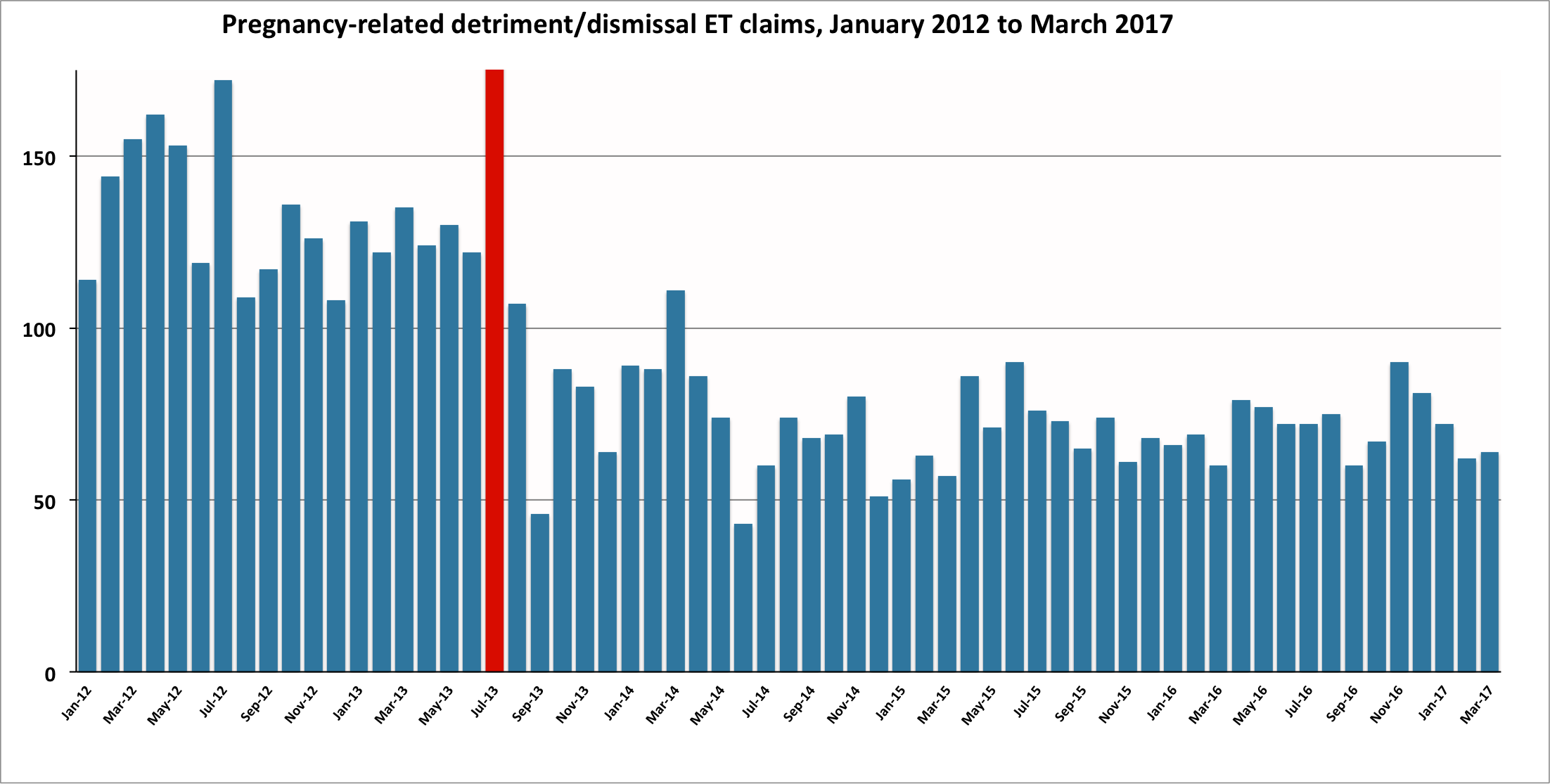
In short, this alternative range for the total number of people discouraged from making an ET claim by the fees since July 2013 is 30,900 to 54,300. And, at this point, it is perhaps worth comparing that range against my own suggestion of the total number of ET single cases/claims lost to fees since 2013, based on the difference between the actual number of such cases plus the number of cases conciliated by Acas, and the number of such cases we could have expected, had fees not been introduced. That figure – shown by the red area in the following chart – is 70,059 (up to the end of March 2017).

However, as noted in my previous post, those 8,000 and 14,000 figures calculated by the Ministry are, without doubt, significant underestimates. So, even a range of 30,900 to 54,300 is conservative, and it is entirely credible that every single one of those 70,059 single claimants ‘lost’ to fees since July 2013 was discouraged by the fees. But the truth is, there’s no way of knowing from the Ministry’s review report, because the Ministry didn’t do (or find) the necessary research. The Ministry simply took some woefully inadequate (and unrepresentative) research by Acas and did a few basic – and, as I’ve sought to show, inappropriate – sums.

Hopefully, the Supreme Court has been no more impressed by this charade than me. But I’m not holding my breath.

Posted in Justice, Workers' rights | Tagged , , , | Leave a comment

ET fees: a statistical injustice

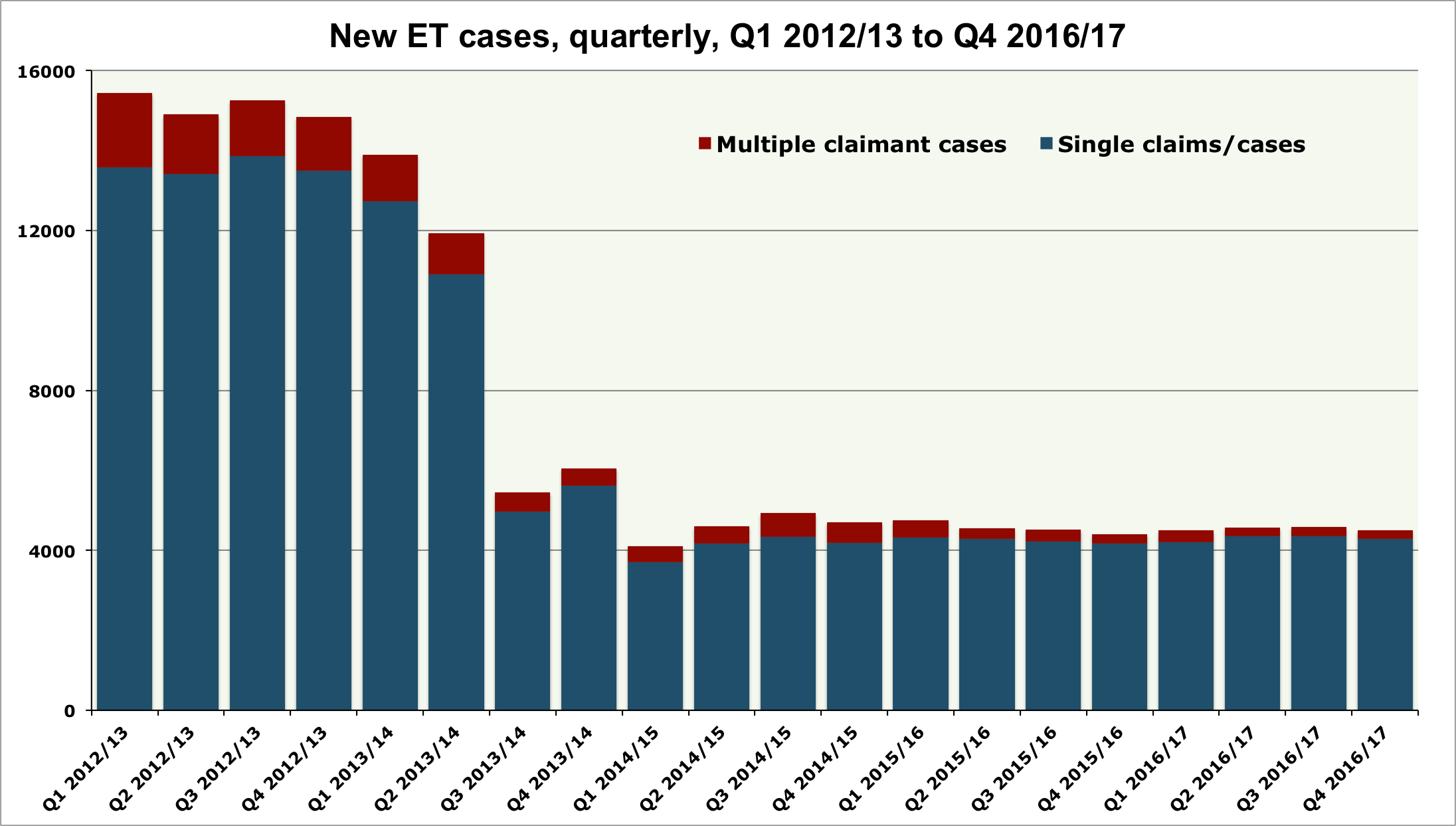
The quarterly employment tribunal (ET) statistics issued by the Ministry of Injustice haven’t been terribly newsworthy since the figures became somewhat lacking in variability in mid-2014. So there was very little chance of the latest set – published at 9.30am yesterday, as a weary nation dragged itself to the polls – generating headlines. But it does provide me with an excuse both to update a couple of charts, and to have a long overdue pop at the laughably poor report, published in January, of the Ministry’s internal review of the ET fees regime introduced in July 2013. So, here’s an updated chart:

There is much that can be said about the Ministry’s report of its much-delayed internal review – very little of it complimentary. But in this post I’m going to focus on the report’s repeated use of a range of “between 3,000 and 8,000” for the number of people that it candidly accepts have been “discouraged from bringing [ET] claims” by the hefty fees.

The report is written in such a way that a reader unfamiliar with the subject might easily conclude that “between 3,000 and 8,000” represents the total number of workers discouraged from making an ET claim by the fees since 2013. In fact, it is the Ministry’s figure for just one financial year, namely 2014/15. And, in the real world, between 2014/15 and the publication of the report in January of this year, we had the whole of 2015/16 and three-quarters of 2016/17. And let’s not forget the two-thirds of 2013/14 that came before 2014/15, but after the introduction of fees on 29 July 2013. On that basis, it would have been more honest of the Ministry to give a cumulative total range of ‘between 8,000 and 30,000’. Which is a little scarier than “between 3,000 and 8,000”.

However, the Ministry bases its range of “between 3,000 and 8,000” on a single finding in the Acas research report, Evaluation of Acas Early Conciliation, published in April 2015. And that report, as the Ministry pretty much acknowledges, is itself a pile of pants. The first key finding of that Acas research, which was based on a survey of a sample of workers who had used the (mandatory) Early Conciliation (EC) process, was that 31% of the workers in the sample obtained formal settlement of their potential ET claim (either through Acas, or privately). The research also found that 17% of the sample surveyed “did not obtain a formal settlement but decided not to submit a claim about their dispute, and reported that Acas was a factor in helping them reach this conclusion”.

The second key finding of the Acas research was that 34% of the workers in the sample did not obtain a settlement, and went on to issue an ET claim. Another 19% did not obtain a settlement, but did not issue an ET claim, with 5% saying the fees were a factor in the decision not to issue an ET claim, and 14% saying the fees were not a factor in that decision. The research then broke that 5% down even further: 3% said they “could not afford to pay the fees”, and 2% “gave another reason”. The Ministry then extrapolates that 3% figure to all 83,423 EC users in 2014/15 to generate the 3,000 figure in its range of “between 3,000 and 8,000” workers discouraged from making an ET claim by the fees, and to a much broader measure of “claimants who did not settle [as a result of EC] but did not progress to a tribunal” – which, according to Acas’s real world management information, was 63% of all 83,423 EC users in 2014/15 – to generate the 8,000 figure in its range of “between 3,000 and 8,000”. Still with me?

Again, it would have been more honest of the Ministry to use the 5% figure, not the 3% figure. As the Law Society noted in March, in its response to the Ministry’s review report, “there is no good reason to suppose that, when the [surveyed EC users] said that they could not afford to pay the fees, they did not mean it”. But it is also perfectly possible for a worker to be discouraged from making an ET claim by the fees, despite being able to afford to pay the fees. For example, a worker looking to recover £250 of unpaid wages or holiday pay from a former employer might well conclude that it is not worth paying £390 in fees to do so, when there is no guarantee of recovering either the unpaid wages (or holiday pay) or the fees, even if the claim is successful. And using the 5% figure, rather than the 3% figure, would have raised the cumulative total range to ‘between 16,000 and 53,000’. Which is a lot scarier than “between 3,000 and 8,000”.

Yet, as the Ministry’s report candidly admits, the 31% and and 34% figures – i.e. the two key findings of the Acas survey – are total bollocks (the report puts it slightly differently). Sure, those are the figures produced by the Acas survey of a sample of EC users. But we happen to know the actual figures for the parent sample of all EC users: as set out in paragraph 120 of the Ministry’s report, they are 15% and 22% respectively. In other words, the sample and the survey findings are not representative of all EC users, so cannot be extrapolated to all EC users – or, more accurately, should not be extrapolated to all EC users. Furthermore, the combined effect of these two unrepresentative research findings is, as the Ministry acknowledges, to “underestimate the proportion of [EC users] who did not, or were unable to, conciliate and did not go on to issue” an ET claim. In plain English, both the 3% figure used by the Ministry and the 5% figure that I say it should have used instead are almost certainly significant underestimates of the proportion of EC users who do not settle but do not issue an ET claim, at least in part because of the fees.

For the sake of argument, let’s assume (somewhat conservatively) that the 5% is actually 8%. That would change my suggested range of the cumulative total of workers prevented (by an inability to afford the fees) or simply discouraged from issuing an ET claim by the fees since July 2013, from ‘between 16,000 and 53,000’ to ‘between 22,000 and 70,000’. Which is a hell of a lot scarier than “between 3,000 and 8,000”.

The Ministry is not scared, however. Indeed, it’s not the least bit bovvered. Although the review report goes on to admit (in paragraph 318) that the Ministry’s own analysis “indicates that the introduction of fees may have resulted in indirect discrimination”, this discrimination is “justified” because the fees are “a proportionate means of achieving a legitimate aim”. This is the line parroted by the Prime Minister, Theresa May, when she said recently that the fees ‘strike the right balance’ (presumably, the balance between protecting exploited workers’ access to justice, and helping the Ministry of Injustice balance its books).

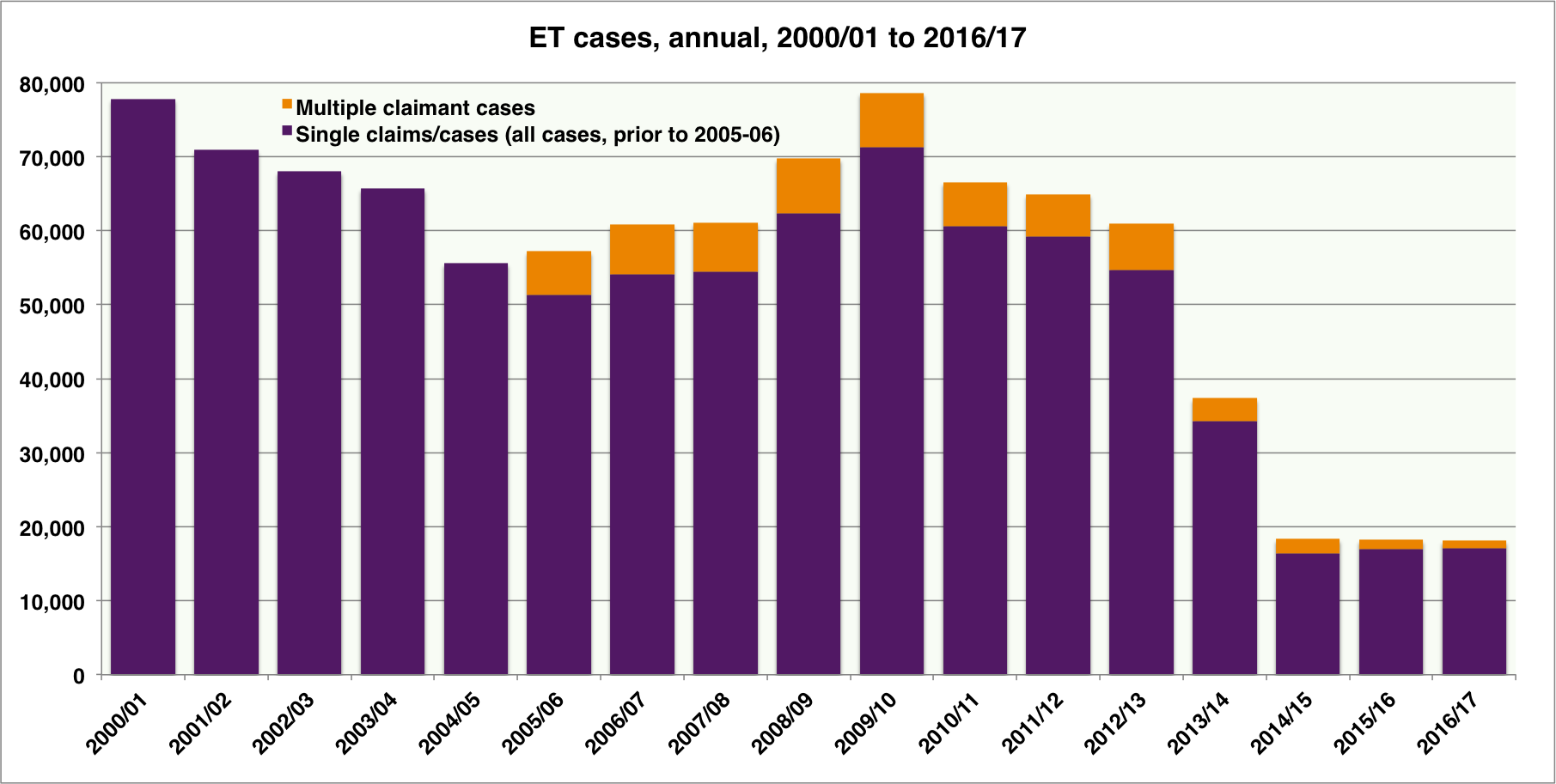
Fortunately, thanks to the brilliance and tenacity – over four long years – of Adam Creme, Shantha David and the rest of the UNISON legal team, whether or not the hefty fees ‘strike the right balance’ is still a (legal) moot point. So, for those of you who prefer whole years to quarters, here’s another updated chart:

Posted in Justice, Workers' rights | Tagged , , | 5 Comments

BEIS: Not so good with the name thingies.

“I’ve never been too good with names,” sang Evan Dando and The Lemonheads on the title track of their fifth album It’s a shame about Ray in 1992. The song (and the album) is an indie classic that has easily stood the test of time. Well, it has in my house. Which is more than can be said for the Department for Business, Energy & Industrial Strategy (BEIS, formerly BIS), and its policy of naming & shaming employers found by HMRC to have flouted the National Minimum Wage (aka the National Living Wage, for those aged 25+). Not only does the naming & shaming scheme lack transparency – essential to the very purpose of the scheme – but it is not being fully applied to the very worst offenders.

Never slow to blow its own trumpet, in February this year BEIS puffed its latest round of naming & shaming (the tenth round to date) as listing a “record number” of NMW rogues. But of course, the 359 employers named in February was only a record number because six months had passed since the previous round, in August 2016, which BEIS trumpeted then as “the largest ever list of NMW offenders”. In contrast, the first eight rounds (in 2014, 2015 and early 2016) had come at much shorter intervals of as little as four weeks, and it is clear that the scheme, revamped in late 2013, is only now approaching full speed. I imagine BEIS officials are under strict instructions to ensure that the next round includes at least 360 employers.

Most of the associated press and media coverage focused on the list being topped by the household name retailer Debenhams, which had been found to owe total arrears of almost £135,000 to 11,858 workers. This is, indeed, the second largest sum of arrears owed by any of the 1,046 employers named & shamed by BEIS to date (since the naming scheme was revamped in late 2013), though still someway short of the whopping £1.74m owed by security firm TSS Ltd, named & shamed in February 2016. However, of more interest to me was the fact that, for the first time, BEIS published alongside its press notice (scroll to the bottom) an Excel spreadsheet giving basic details of each of the 359 employers.

Alongside the employer’s full name and address, and the sum of arrears owed to workers, the spreadsheet categorises each employer by sector – information that has not been available from BEIS for the previous nine rounds of naming & shaming. Since 2014, I have spent many happy hours surfing the internet in order to produce my own breakdowns of the named employers by sector, set out in some colourful charts. But I do have better things to do with my time, so it’s very welcome that BEIS have started to share their data.

Ten sectors are represented in the BEIS spreadsheet: Agriculture (4 employers); Childcare (20); Cleaning (6); Employment Agencies (8); Food processing (3); Hairdressing (39); Hospitality (84); Leisure & Sport (11); Retail (51); and Social Care (24). There is also one employer categorised as sector Not Known.

Social Care is a sector that has featured far less in the previous naming and shaming rounds than one might have expected, given its well-deserved reputation for low pay. According to the BEIS spreadsheet, three of the 24 Social Care employers named in February had underpaid 47, 40 and 19 workers respectively, but only four of the 24 had underpaid more than four workers, and 15 had underpaid only one worker. All but six owed total arrears of less than £1,000, and 14 owed less than £500; the ‘worst’ offender owed some £17,680 to 40 workers. Which tends to suggest that most are either small employers or relatively marginal offenders, or both.

Somewhat unhelpfully, however, no fewer than 109 of the 359 named employers are categorised in the BEIS spreadsheet as “non low-paying sector”. Yet simple internet research quickly reveals ten of these 109 employers t0 be in the Social Care sector, eight in Retail, three in Childcare; three in Leisure & Sport, two in Hospitality, and one in Cleaning. And, among these ten Social Care employers, for example, Pembrokeshire Care Ltd in Haverfordwest owed more than £55,000 to 154 workers, while the “national social care charity” Community Integrated Care owed almost £20,000 to 69 workers.

Indeed, the ten Social Care employers wrongly categorised by BEIS as “non low-paying sector” between them owed twice as much in arrears (£86,033.61, to 326 workers) as the 24 Social Care employers that BEIS categorised correctly (£43,636.90, to 145 workers). It’s not clear how BEIS managed to not even suspect that employers called Apollo Care, Bay Care Domicilary Care Ltd, Community Integrated Care, Pembrokeshire Care Ltd, and Tailored Care Ltd might be Social Care employers, but maybe BEIS really did get Evan Dando to compile their Excel spreadsheet.

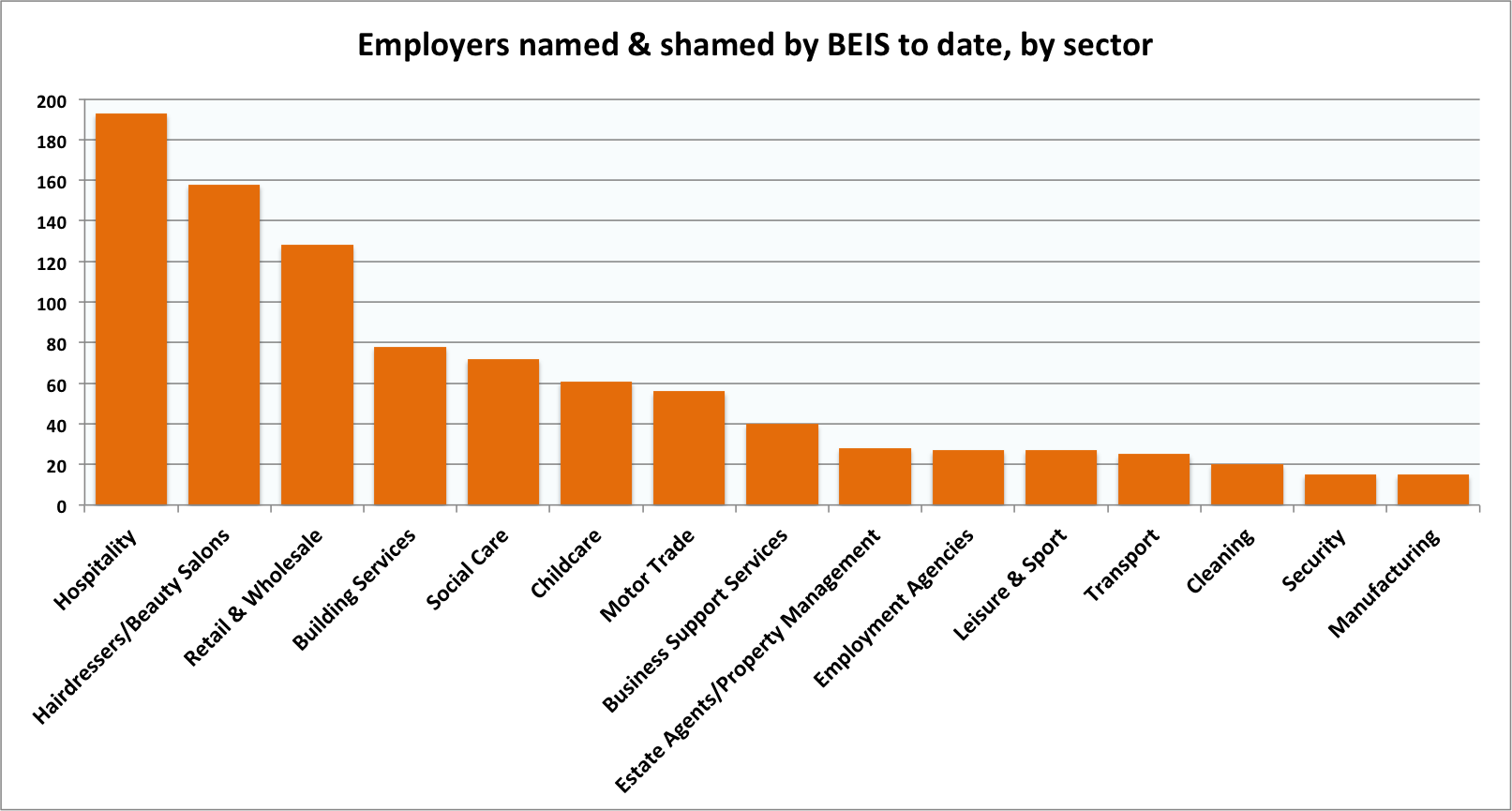
Whatever, here is an updated chart showing the number of employers named and shamed by BEIS to date, by sector (sectors with fewer than 15 named employers not shown).
While BEIS deserves credit for publishing the Excel spreadsheet alongside its press notice – a practice I hope will continue – the biggest problem with the naming & shaming scheme is what BEIS doesn’t tell us about the named employers. According to the spreadsheet and the press notice, the 359 employers named in February between them owed arrears of £994,685.83, to 15,513 workers. And between them they paid financial penalties of “around £800,000” on those arrears (penalties are currently levied at a rate of 200% of total arrears owed, but that rate only applies to underpayments made after 1 April 2016; for underpayments made between 7 March 2014 and 1 April 2016, the penalty rate is 100%, and for underpayments made prior to 7 March 2014 it is 50%; the penalty is also reduced by 50% for prompt payment of the arrears owed).

What you won’t find in either the press notice or the spreadsheet, however, is the fact that 60 of the 359 employers paid further arrears totalling £1,435,419, to 30,496 workers. This information was only extracted from BEIS by a written Parliamentary Question, and BEIS has refused to identify the 60 employers, or how much each one paid in further arrears. But, given the total sum of further arrears paid and number of workers involved, it seems reasonable to assume that at least some of the 60 are relatively large employers. More to the point, they clearly include the worst offenders. For all we know, some of those Social Care providers named & shamed by BEIS in February for underpaying just one or two workers might actually have underpaid dozens or even hundreds of workers.

Much the same happened with the previous round of naming and shaming, in August last year. According to the associated BEIS press notice, the 197 named employers between them owed arrears of £465,290, to 2,166 workers. But, according to BEIS’s answer to another written Parliamentary Question, 22 of the 197 employers paid further arrears totalling £410,967, to 1,574 workers. But the identity of the 22 remains a secret.

These further arrears were paid under a so-called self-correction mechanism quietly introduced by HMRC (presumably with BEIS’s blessing) in 2015. The new practice was never formally announced, but in October 2016, in its Evidence for the Low Pay Commission’s Autumn 2016 Report, BEIS stated:

“Where HMRC have investigated an NMW complaint, found arrears and issued a Notice of Underpayment detailing those arrears and penalty due in respect of the complainant [sic], they have the flexibility to instruct the employer to self-correct for the rest of their payroll – freeing up HMRC staff to work on more investigations. This approach is only used in cases where it is deemed appropriate and HMRC follow up with a sample of workers to ensure the arrears due have been paid.”

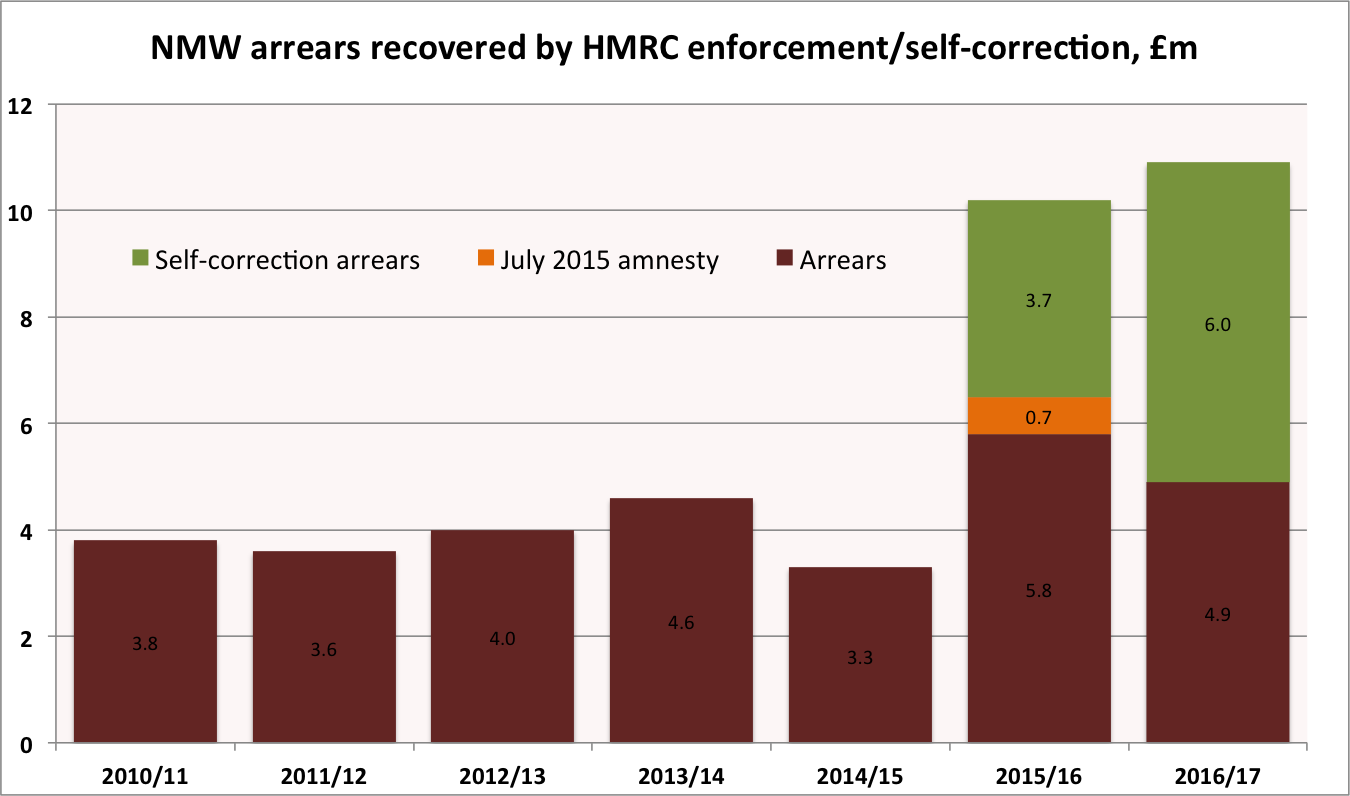
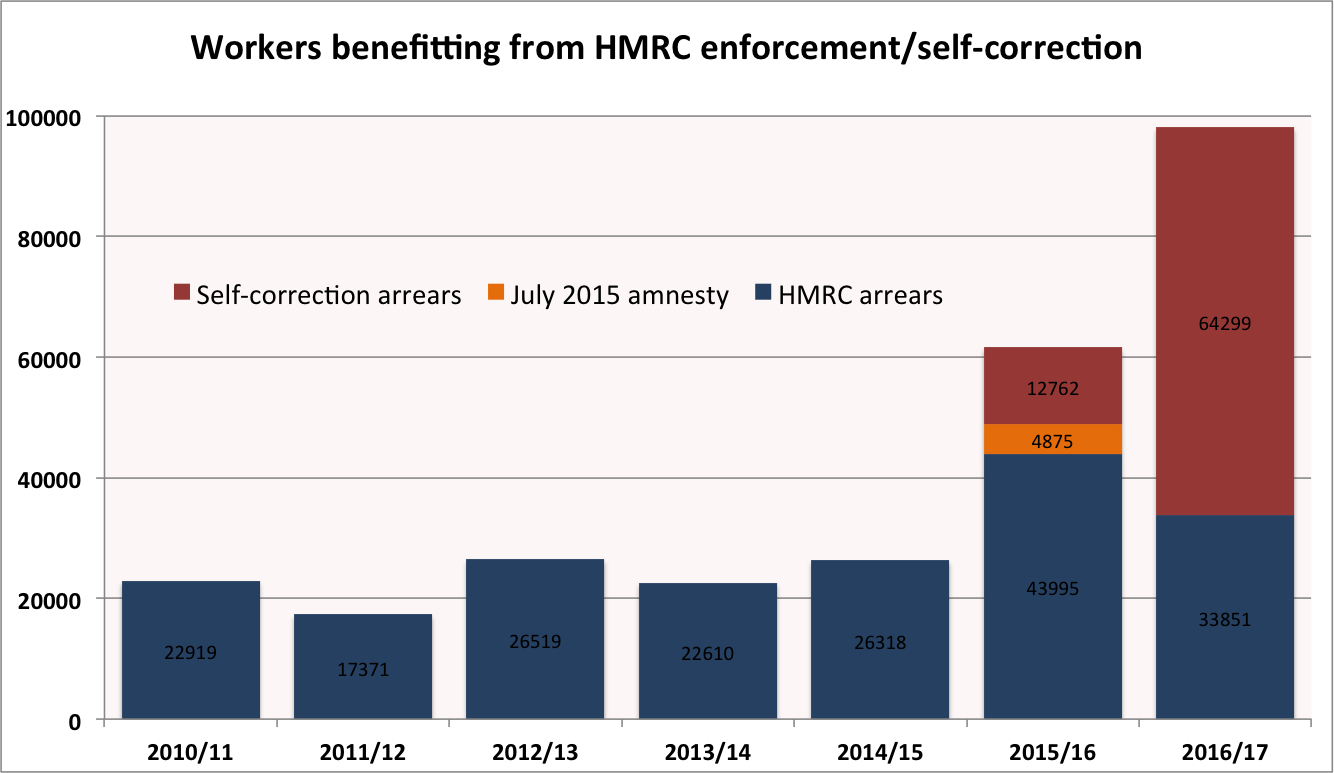
As is clear from the figures above, HMRC is deeming it ‘appropriate’ to apply the mechanism in respect of substantial sums, owed to a significant number of workers by a relatively small number of (presumably large) employers. Indeed, in its answers to further Parliamentary Questions, BEIS has confirmed that, in 2015/16, 113 employers took advantage of this mechanism to self-correct additional arrears of £3.84m, owed to 17,637 workers. And, not only will those employers not be ‘shamed’ for those sums by BEIS in its naming & shaming rounds, despite them being the very ‘worst’ offenders, but no financial penalties are imposed in respect of those additional, self-corrected arrears.

All of which somewhat defeats the very purpose of the naming & shaming scheme.

Posted in Workers' rights | Tagged , , | 1 Comment

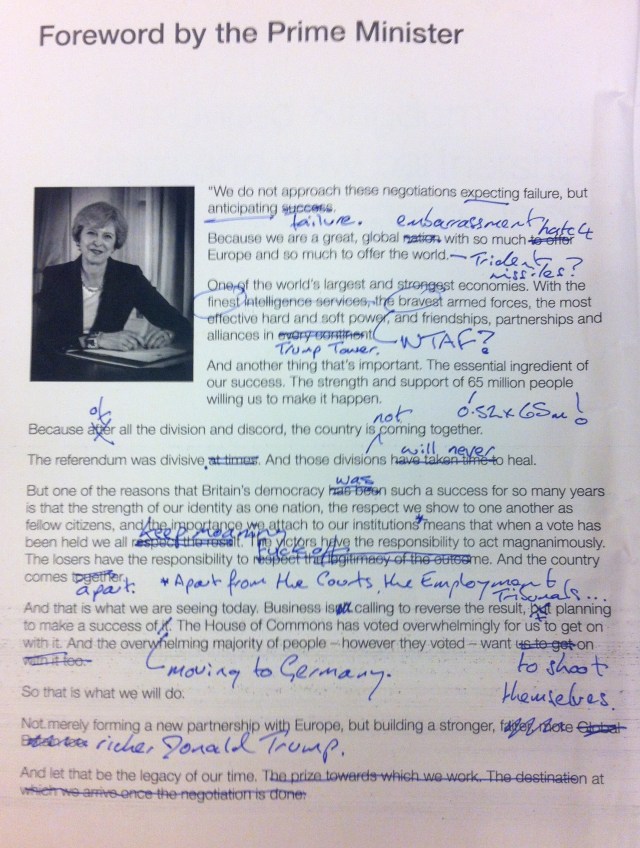
There you go, Theresa May. Fixed that Brexit White Paper foreword for you.

img_4725

Posted in Uncategorized | Leave a comment

On an allotment, somewhere in London N1 …

Aide 1: So, we switch our vote on the EU (Notification of Withdrawal) Bill. As a show of defiance against Trumpzi isolationism.

Aide 2: Even May’s own MPs are appalled by what she’s done. She’s on the back foot. We can seize the political initiative. It will throw the Government into chaos. Unify the Party. It’s a no-brainer. We have to do this, Jeremy.

Corbyn: Sorry guys. You know I’m only a 7 on the EU. Only a 3, really.

Aides (chorus): Shoot me now.

Posted in Uncategorized | Leave a comment

Has the Ministry of Justice solved the problem of unpaid ET awards?

Last month on this blog, I included the low incidence to date of section 150 penalties for non-payment of an employment tribunal (ET) award – just 37 penalty notices, as of 4 November, according to BEIS’s answer to a parliamentary question (PQ) by shadow justice minister Lord Beecham – as evidence of significant changes in the nature and quality of ET claims since the introduction of ET fees in July 2013. And, yesterday, thanks to a further PQ by Lord Beecham, we learnt that the number of penalty notices issued has since increased to 60 (a HT to Daniel Barnett for drawing the PQ answer to my attention).

As BEIS has noted previously, in its answer to a PQ by Caroline Lucas MP, “warning notices are issued in response to complaints [about an unpaid ET award] and can only be issued 42 days after the original award was made”, and “penalty notices are issued 28 days after that if payment is not made in the interim”. As a result, BEIS did not issue its first penalty notices until mid-September. Which means the 60 s150 penalty notices issued to date were issued over a period of about three months. In other words, BEIS is currently issuing s150 penalty notices at the rate of about 20 per month.

Of course, it’s still early days. The s150 penalty regime only came into force on 6 April, and new policies that depend on public awareness and understanding always take time to ratchet up to full speed. But, according to the official ET statistics for the two most recent quarters, each month about 750 ET claims result in an award to the claimant. So, at first glance, there is some reason to conclude that, with its justice-denying ET fees, the Ministry of Justice has heroically solved the long-standing problem of ET awards going unpaid by employers.

As recently as 2013 (just before the introduction of ET fees), research by BEIS revealed (or, more accurately, confirmed previous research by the Ministry of Justice in 2008) that only half (53%) of claimants received their award in full or in part without having to resort to enforcement action, and one in three (35%) never received any money at all.

However, the number of s150 penalty notices issued does not tell us the whole story. For, as noted above, at least 28 days before a penalty notice gets issued by BEIS, the employer receives a warning notice. And it is clear that, as one would expect, in some cases the issuing of a warning notice is sufficient to ensure payment of the unpaid ET award. Indeed, we can see this from the answers to the PQs cited above.

In its most recent answer to Lord Beecham, BEIS states that “as a result of the [s150] penalty regime, the Department has secured £83,245.52 in previously unpaid awards for applicants”. But we already knew, from BEIS’s answer of 7 September to Caroline Lucas’ PQ, that “the issue of warning notices has led to ten claims being settled equating to over £50,000 of previously unpaid tribunal awards”. At that time, remember, not a single penalty notice had been issued. In other words, at least 60% – possibly much more – of that £83,245.52 was secured by means of warning notices alone.

So, we really need to know a bit more about the impact of the s150 penalty regime before we can draw any firm conclusions. In particular, we need to know how many warning notices have been issued by BEIS, and in how many cases the warning notice led to payment (in full or in part) of the unpaid award, without need for a penalty notice.

Fortunately, I anticipate further PQs being tabled in the New Year. Watch this space.

Update (5 January): Yesterday, thanks to yet another PQ by shadow justice minister Jeremy Beecham, we learnt that 164 warning notices have been issued to date. Which is 102 more than had been issued as of 7 September (when, according to BEIS’s answer to the PQ by Caroline Lucas, 62 had been issued since 6 April 2016). In other words, BEIS is currently issuing s150 warning notices at a rate of about 25 per month.

So, either the rate of non-compliance with ET awards has fallen from 47% prior to the introduction of fees in July 2013, to just 3.3% now – that is, the Ministry of Injustice has pretty much solved the problem of non-payment of awards – OR the s150 enforcement regime is not being used by claimants when it should be. No doubt the Ministry’s forthcoming, much-anticipated review of the fees will tell us which it is.

Happy New Year, btw.

Further update (11 January): As I anticipated, above, a further PQ was tabled by Caroline Lucas on 6 January, and has been answered by BEIS today. From this answer, we learn: that 168 warning notices, and 60 penalty notices, have now been issued; that, as I surmised above, of the total of £99,417.53 in unpaid awards recovered by BEIS to date, no less than 99.2% was recovered following the issuing of a warning notice only, without need for a penalty notice; and that only one financial penalty has been paid to date.

Also, a further PQ has been tabled by Green Party peer Jenny Jones in the House of Lords, requesting the number of previously unpaid awards represented by the sum of £83,245.52 given in the 20 December Answer to Lord Beecham’s PQ (see above); an answer is awaited.

screen-shot-2017-01-13-at-09-04-14

Posted in Justice | Tagged , , , | Leave a comment

So long 2016, and thanks for all the #ukemplaw reviews

So, 2016 ends with not one, not two, but four ongoing reviews of the so-called ‘gig economy’ and all that is wrong with our 21st century labour market. Well, maybe not all that is wrong with our labour market, but definitely those aspects – old and new – that are grabbing headlines thanks to the increasingly common 18th century employment practices of companies such as Sports Direct, Hermes, Uber, JD Sports, and Deliveroo.

First up, having already put the boot into Sports Direct, was the Business, Energy & Industrial Strategy (BEIS) committee of MPs, with its inquiry into the future world of work and rights of workers. Get your submission in by next Monday. Not to be outdone, the Work & Pensions committee of MPs, having had pops at both Hermes and Uber, is now conducting an inquiry into self-employment and the gig economy. You have until 16 January to get your submission into that one.

The leader of the Workers’ Party, Theresa ‘works for everyone’ May, has commissioned former Blair adviser and chair of the RSA, Matthew Taylor, to conduct a six-month review into “how employment practices need to change in order to keep pace with modern business models”. (Note how there is no suggestion there that modern business models are just, well, wrong). Mr Taylor says he will tell the PM “what’s wrong with modern work”. I’d like to be a fly on the wall at that meeting.

And the Labour Party – remember them? – have a Future of Work Commission, led by deputy leader Tom Watson and Helen Mountfield QC. I imagine this will report sometime in the 2020s, but in the meantime Tom wants your ideas.

The inquiry reports of the BEIS and Work & Pensions committees will no doubt be serious and compelling. They will most likely generate a few headlines, and maybe even dent profits here and there. But government ministers will most likely do nothing – just like they’ve done nothing in response to the BEIS committee’s scathing report on Sports Direct, the Justice committee’s scathing report on the impact of court & tribunal fees on access to justice, and the Women & Equalities committee’s scathing report on pregnancy and maternity discrimination. Or maybe they will ask someone to do another review.

Indeed, in the circumstances, it would be easy to run away with the idea that Theresa May doesn’t really care about workers’ rights, access to justice, or equality. And, if you think that’s just me being cynical, perhaps you can explain why the prime minister is ploughing on with 25% cuts to the budget of the already severely shrunk Equality & Human Rights Commission, and is content for the Ministry of Injustice to continue to sit on its long overdue review of the justice-denying employment tribunal fees introduced in 2013. This week, we learned that that review – launched, after much prevarication, in June 2015 – is still not finished and will not appear this year. Dead snails have moved quicker.

So, what is likely to happen to the Taylor Review? Assuming Mr Taylor has secured autonomy over publication, to ensure his report does not fall into the limbo inhabited by the review of employment tribunal fees, can we be sure that his review will not suffer the same fate as the last governmental review of these matters, launched by then business secretary Vince Cable in October 2014?

That review was intended to establish “how clear the current employment framework is, what the options are to extend some employment rights to more people and whether there is scope to streamline this very complex area of employment law, thus simplifying and clarifying rights for both employers and employees”. Sound familiar?

As far as we can tell, from parliamentary questions asked by Chuka Umunna in July 2015 and Caroline Lucas in February 2016, the review report was complete and on ministers’ desks by June 2015. And I’m told by someone who should know that it amounted to a substantial body of work. But it’s never been published and, according to the Answer to a further parliamentary question by Caroline Lucas, it’s since been bundled off to a sleepy working group of officials looking – very sedately, it would seem – at the scope for moving to “a more uniform set of tests on employment status across tax, employment rights and the welfare and social security system”.

Somewhat surprisingly, given that Answer to Caroline Lucas’ parliamentary question, the Cable Review report hasn’t been mentioned once in the minutes of the four meetings of the working group to date. And, at its last meeting on 19 October, the working group seems to have decided that there isn’t really any point to it doing any more work until the Taylor Review reports. Yet, as Jill Rutter of the Institute for Government has noted, the Taylor Review appears not to be looking at tax. Doh!

Who knows, maybe Tom Watson’s Commission will report before Theresa May acts upon the Taylor Review. Happy Christmas.

Posted in Uncategorized | Leave a comment

ET fees: ‘full and careful’ consideration of the evidence

So, now we know. Brexit means Brexit, and ‘in due course’ means, well, in due course. And, thanks to a parliamentary question by Labour MP Dawn Butler, we also know that the government’s review of employment tribunal (ET) fees has been ongoing for 17 months because “it is important that full and careful consideration is given to all the relevant evidence”. Say what you like, but there are no cobwebs at the Ministry of Injustice.

But what exactly is this ‘relevant evidence’? How long has the Ministry had it? What does it tell us? Is there more such evidence to come? And what is the point of Liz Truss?

In this post, I will try to answer (most of) these questions.

First, a few essential facts. The justice-denying ET fees of up to £1,200 were introduced on 29 July 2013. And Liz Truss, believe it or not, is Lord Chancellor and Secretary of State for Justice. Far more than the fact that we import two-thirds of our cheese, that is a disgrace.

The relevant evidence (1): the impact of fees

Impact of fees: the number of ET claims/cases

As noted many, many times by any number of commentators, including yours truly, and as is abundantly clear from the following chart, the impact of the fees on overall ET claim/case numbers was sudden, substantial and sustained.

etcases1116

Moreover, the pattern is damn near the same for each and every ET jurisdiction (e.g. unfair dismissal) – see, for example, charts 5, 6, 7, 8, 9 and 10 here.

Which means that, in terms of the impact of the fees on case numbers, the Ministry has had all the evidence it needs since long before it finally launched its interminable review, after much prevarication, in June 2015. Indeed, for measuring the impact of the fees on case numbers, the key period is September 2013 to February 2014 – that is, the six months immediately after the introduction of fees, and immediately before the introduction in April 2014 of Acas early conciliation (see below), which has had its own, much less dramatic, impact on ET claim/case numbers. (NB: we can ignore March 2014, due to there being a pre-Acas EC spike, just as there was a pre-fees spike in July 2013).

Comparing that six-month period with the six months immediately before the introduction of fees (i.e. January to June 2013), the overall number of single claims/cases fell by 63%. Sex discrimination claims fell by 87%, equal pay claims by 88%, and unfair dismissal claims by 65%. And it doesn’t matter how much more ‘full and careful consideration’ the Ministry gives to this evidence – those figures ain’t gonna change.

Impact of fees: changes in the nature and quality of claims/cases

While the evidence of the impact of the fees on claim/case numbers is both indisputable and increasingly aged, there is also a growing body of evidence that the introduction of fees has changed both the nature and the quality of claims/cases – and not in a good way.

Most importantly, there is a range of evidence – both anecdotal evidence from employment law practitioners and ET judges, and hard statistical evidence – that the fees have impacted most, as one would expect, on relatively simple, low-value claims, such as those relating to the non-payment of wages and/or holiday pay (aka ‘wage theft’). According to paragraph 35 of the Ministry’s December 2011 consultation on its then proposed fees, in 2010/11 the majority of ET claims (62%) fell into this category. But, according to the latest set of official figures (see Table ETF.1), in 2015/16 only 24% of the issue fees requested from claimants were in relation to such Type A claims (as opposed to the more complex, Type B claims for e.g. unfair dismissal or discrimination). And, of course, that’s 24% of a much smaller number.

Those relatively simple, low-value claims tended to have a high success rate – the (rogue) employer was usually bang to rights, often not contesting the claim (which accordingly resulted in a default judgment). And the near eradication of such claims by fees – why would you pay £390 in fees to chase unpaid wages of, say, £500? – no doubt partly explains why the ‘success’ rate (as narrowly defined) has fallen, and the wider ‘failure’ rate has risen, markedly, since July 2013 (see charts 2 and 3 here).

We can see further evidence of these changes in the nature and quality of claims/cases in an emergent but seemingly marked increase in the median value of ET awards, and in the very low incidence to date of both s16 penalties (for aggravated breaches of the claimant’s rights) and s150 penalties (for non-payment of an ET award).

As I say, some of this evidence is still emerging. But the direction of travel is as clear as it is regrettable, so waiting another six, 12 or 18 months wouldn’t make any difference to an objective assessment of the impact of the fees regime. Six months from now, there will be a lot more evidence that a racist, misogynistic narcissist won the recent US presidential election. But I think we have more than enough evidence to make that assessment now.

The relevant evidence (2): mitigating factors

Other factors in the fall in claim/case numbers

In seeking to deny the above-illustrated impact of the fees on ET case numbers from July 2013, ministers have cited an “historic downward trend” in those numbers, as well as improving economic conditions (including record levels of employment). And, as we can see from the following chart, in 2o11, 2012 and 2013, there was indeed a (relatively mild) decline from the 2008 crash-induced peak in 2009/10, back towards the level seen in the relatively stable plateau of the mid-2000s.

etannual1116

However, there is no reason to think that even that mild rate of decline would have continued in 2014 and beyond (let alone that it would have accelerated). By 2012/13, the last full year before fees, case numbers were almost back to the record lows of 2004/05 and 2005/06. And the record levels of employment in recent years might well imply an upward trend in ET cases, in some jurisdictions at least. So it seems much more realistic to assume that the overall mild “historic downward trend” would have gradually petered out. And, indeed, we can see (from the first chart, above) that there has in fact been no decline in actual case numbers since mid-2014.

On this basis, we can create the following projection for the number of ET single claims/cases, had both fees and Acas early conciliation (but see below) not been introduced. (NB: the eight columns for 2008/09 and 2009/10 on the far left look odd because they are averages of the annual total, as the quarterly figures are not available).

etproj1116According to this projection, by the end of June 2016 (i.e. the end of Q1 of 2016/17), almost 90,000 single ET claims/cases had been ‘lost’ to fees. And, as that figure increases by some 8,000 every quarter, at the time of writing it is over 100,000.

The Ministry of Injustice might quibble with the details of the above projection, but it can’t credibly argue for a significantly lower one. And, even if it does, the key point is that the picture hasn’t changed, significantly, since before the Ministry launched its review 17 months ago, in June 2015. Nor will it change, going forward – we will just be able to add more columns on the right that look pretty much like that for every quarter since Q2 of 2014/15. So, again, giving this evidence further ‘full and careful consideration’ isn’t going to lead to any different conclusions. It just wastes more time.

Acas early conciliation

However, there is another, far more significant mitigating factor: the introduction, from April 2014, of Acas early conciliation. As noted previously on this blog, ministers have made a great deal of noise about this mitigating factor. And, yes, we do have to lay on top of the chart above the some 4,000 potential ET single cases that Acas successfully conciliates – for free – each quarter, as follows:

etprojacas1116

That reduces the above figure of 100,000 ET single claims/cases ‘lost’ to fees, to just under 60,000, as of the end of June 2016, and more than 65,000 at the time of writing.

As noted previously, it is debatable whether we can offset all of those successful early conciliations (single cases) against the number of single claims/cases ‘lost’ to fees, as it is less than certain that all are conciliations of a ‘dispute’ that, had it not been for the introduction of fees, would have resulted in an ET claim/case. But it’s difficult to see how this might be nailed down either way. So, again, the key point here – am I boring you? – is that the picture has not changed significantly since before the Ministry launched its bloody review, in June 2015. Even after allowing for the (beneficial) impact of Acas early conciliation, we are still missing more than 65,000 ET single claims/cases, and that figure increases by some 4,000 every quarter. Waiting another six, 12 or 18 months won’t throw any further light on the matter.

Some ministers have suggested that we don’t need to worry about these ‘lost’ ET claims/cases, because they are all vexatious or otherwise weak claims that should never have been brought in the first place. This is known as the Hancock Theorem. But there is simply no evidence for the Hancock Theorem that the Ministry could give ‘full and careful’ consideration to, there never has been, and there never will be. It’s just a belief.

Conclusion

I could go on, but if you’ve made it this far you are probably losing the will to live. I know I am. The key point [Haven’t you said this already? Ed] is that the Ministry has had all the evidence it needs to come to some conclusions, and to make a decision about what to do, since before it launched its review in June 2015. It’s taken me a couple of hours, spread over a few days, to write this blog (I’m a slow writer, and the day job takes up a lot of time, as do the kids). The Ministry has seemingly had a team of top-notch officials working full-time on the matter for 17 months. What the **** do they do all day? And how do ministers expect to successfully negotiate Brexit if they can’t nail a simple little matter like this?

No doubt someone in government is giving full and careful consideration to that question. Let’s just hope it’s not Liz Truss.


Posted in Justice | Tagged , | Leave a comment

ET fees: Ministry of Justice keeps us in the dark

Q: How many Ministry of Justice ministers does it take to change a lightbulb?

A: The Ministry’s plan for changing the lightbulb will be published in due course.

Yep, when it comes to its internal review of the justice-denying employment tribunal fees introduced in July 2013, the Ministry of Justice sure likes keeping us in the dark. Finally launched on 11 June 2015, some 14 months after Coalition (well, Liberal Democrat) ministers first started using the review as a fig leaf by suggesting it was just around the corner, the review team had produced a report by early last October. However, 12 months on, that report is still sitting on ministers’ desks, despite the then junior minister, Dominic Raab, telling MPs as long ago as 4 July that he anticipated publishing it “in the near future”. And, by mid-September, ‘in the near future’ had regressed to “in due course”.

In recent weeks, I’d started to wonder whether ‘in the near future’ and ‘in due course’ actually mean ‘not before the Supreme Court has heard Unison’s appeal in its twice-rejected judicial review challenge, on 7 and 8 December’. In other words, it’s all Adam Creme’s fault. But then we learnt that the Supreme Court hearing dates have slipped back to 27 and 28 March next year. And the Ministry surely can’t stretch the definition of ‘in the near future’ to ‘nine months from now’? Or can it?

Time will tell, but with memories of the damning criticism of the fees regime by both the Justice and the Women & Equalities committees of MPs – as well as by a whole load of the kind of person Michael Gove says we’ve all had enough of – becoming dimmer with every passing week, here is a summary of the options for the Ministry, and the associated issues its review report will need to address if it is to have any credibility at all.

Option 1: Abolish the fees

This would make a lot of employment lawyers (and judges) very happy, but it seems somewhat unlikely, and the omens are not good. For outright abolition would come with a price tag of some £20 million per year – £8 million or so in lost fee income, and up to £15 million in increased operational costs (due to the inevitable rise in claim/case numbers). And, as noted previously on this blog, that’s £20 million that the Ministry would appear not to have. It is presumably for this reason that, just last month, the Ministry confirmed it is to press ahead with indefensible increases of up to 500% in immigration & asylum tribunal fees.

Option 2: Reform the fees regime

This would be the sensible option. As I have demonstrated previously, much if not all of the above £20 million could be covered by a combination of (much) reduced fees for claimants, the introduction of (equally modest) fees for respondent employers to defend a claim/case, and a (more substantial) ‘polluter-pays’ financial penalty for employers found by a tribunal to have breached the claimant’s rights. Yes, there might be some (unjustified) squeals from the employer lobby groups, but with the availability of (free) early conciliation by Acas there is no good reason why an employer should not pay a nominal fee to defend a tribunal claim, and even the British Chambers of Commerce has previously accepted that, if claimants have to pay (even nominal) fees, it is only “fair” for losing employers to have to pay “an analogous administration fee to the Treasury”.

However, justice secretary Liz Truss has so far given little indication that she wishes to develop a reputation for being sensible.

Option 3: Do nothing.

The prevarication and delay in concluding the Ministry’s internal review would suggest this is the option favoured by ministers, and that they simply want Unison’s pesky judicial review safely out of the way before they break this policy wonk’s heart. However, if they are not to leave prime minister Theresa May’s (loudly proclaimed) commitment to greater equality – including in the workplace – looking just a tad hollow and cynical, they will need to try and explain away the loss to fees of more than 60,000 single ET cases alone since July 2013, and in particular the loss of cases involving a claim for discrimination. (And yes, since you ask, that figure is based on a projection that takes into account the mild, pre-existing downward trend in case numbers, as well as the improving economy, global warming, and changes in the price of fish).

etacassept16

That figure increases by some 4,000 with every passing quarter, even if we assume – and it’s a highly questionable assumption – that every single one of the 4,000 or so single cases successfully resolved by Acas early conciliation each quarter would otherwise have resulted in a tribunal claim. For, as Acas’ early conciliation caseload far exceeds the number of ET cases we could expect, had fees not been introduced, it seems more likely that at least some of those early conciliations are of ‘disputes’ that would never have gone to tribunal in any event.

In short, the existence of Acas early conciliation does not get ministers off the hook. And there’s absolutely no evidence to support the contention of the Daily Mail, the Daily Express and Matthew Hancock MP that all the ET cases ‘lost’ to fees are simply weak or unfounded cases that should never have been brought in the first place.

If they go for this option, ministers will also need to explain why they are content for their fees to impact most on relatively low-paid, often vulnerable workers subject to the kind of employer abuses covered by the lower level (Type A) fees, such as the non-payment of wages (i.e. wage theft) or holiday pay. According to the Ministry of Justice, in 2010/11 the majority of ET claims (62%) fell into this category. But in 2015/16 only 24% of issue fees requested from claimants were in relation to Type A claims.

But who thinks Theresa May’s stated commitment to greater equality is genuine?

Posted in Justice | Tagged , , | Leave a comment

ET costs awards: what’s been going on?

Rooting around in the latest set of quarterly ET statistics in the hope of finding something of interest – other than the emergent upward trend in median ET awards highlighted in my previous post – I was somewhat taken aback by Table E12 of the annual ET tables, on costs awards. For, as the following chart shows, in the past two years the long-standing imbalance between the number of costs awards made to respondent employers (the orange line), and the number made to claimants (the blue line), has reversed.

In each of the four years 2007/08 to 2010/11, there were about three times as many awards to respondent employers as there were to claimants, and by 2012/13 that ratio had risen to 4:1. But since 2013/14 the number of awards to respondent employers has plummeted, while the number of awards to claimants has risen sharply. And I am at a complete loss as to why that has happened.

costsawards[NB: I have adjusted the figure given in Table E12 for the number of awards made to respondent employers in 2011/12, as that figure (1,294) includes 800 awards arising from one multiple-claimant case in which the 800 claimants were all made liable for a costs award of £4,000 to the respondent, i.e. £5.00 per claimant. I have counted that as just one award, reducing 1,294 to 495, but I don’t think that introduces any relevant distortion.]

Can anyone out there explain what’s been going on? Am I just being even dumber than normal? I imagine the parallel fall in 2015/16 reflects the overall reduction in the ET system’s workload, due to ET fees and Acas early conciliation. But why the (pretty dramatic) switch-around?

Update (23 September): So, barrister Jamie Anderson was first (on Twitter, last night) to suggest what looks to me to be the explanation, closely followed by Sophie Park (see comments, below): the data for costs awards to claimants from 2013/14 onwards includes orders made under Regulation 76(4) of the 2013 Regulations in respect of the repayment of fees, as well as standard costs awards made under Regulation 76(1). Which is a bit silly, really, and maybe someone could suggest, at the next ET User Group meeting, that such orders/awards be recorded separately from standard costs awards.

Posted in Justice | Tagged , | 2 Comments