Phantom menace: ET fees & Acas early conciliation

As previously noted on this blog, I have been resisting the urge to write about the feeble performance of the imbecilic junior injustice minister, Shailesh Vara MP, when giving oral evidence on the impact of employment tribunal (ET) fees to the Justice committee of MPs, and in particular his repeated citing of the 83,000 early conciliation (EC) cases handled by Acas in 2014/15. But it has to be done, as – however cretinous the minister’s line – he raises an important issue that needs to be fully understood. It’s just a tad more complicated than suggested by the minister, and his headline figure of 83,000 EC cases.

But before we put that figure in its proper context, it’s worth getting ourselves in the mood by noting what is said about the early conciliation process – introduced in April 2014 – in a new Acas research paper, Managing conflict in the contemporary British Workplace. Among the employment lawyers interviewed by the Acas-commissioned researchers

there was some scepticism as to whether early conciliation had resulted in more claims being settled than would have been the case under the previous system. Lawyers, in particular, doubted its benefits, as the following comments from a focus group illustrate:

Participant 1: “I found [early conciliation] totally irrelevant.

Participant 2: I don’t think [early conciliation] is necessarily settling claims that wouldn’t otherwise have been settled … There is no impetus to use it.

Participant 3: It’s just an additional hurdle.

Participant 4: I was going to say, acting for employers, you can wait and say, let’s wait and see … it doesn’t really change much, just pushes it back rather than bringing it forward.

Participant 5: You can also put a book on exactly how high the first number is going to be so it provides a little bit of amusement … But I don’t think it’s been a tremendously valuable feature.

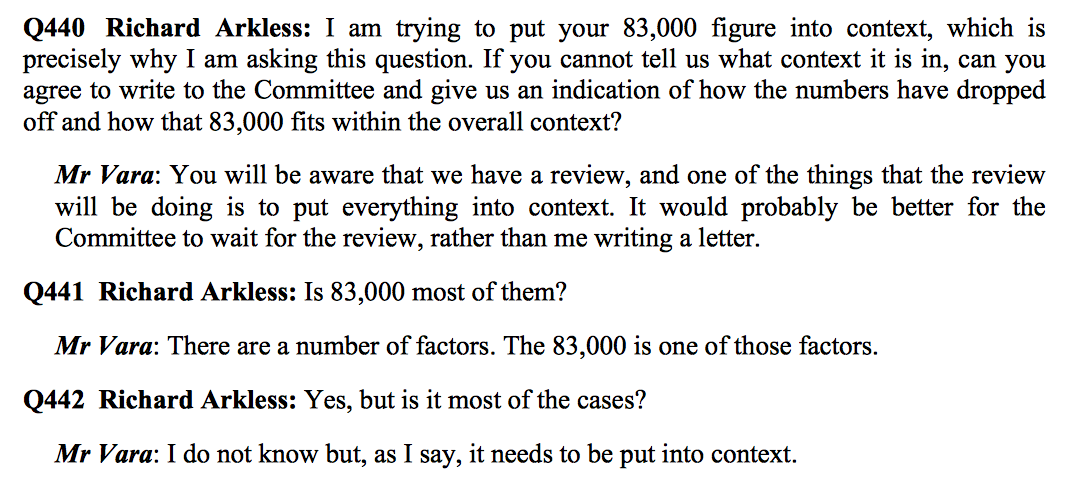
Hmm, they don’t really see it as transformational, do they? Whatever, this is what Mr Vara said to the Committee (before going on to mention the 83,000 figure a further four times, without ever attempting to put it in context – despite being pressed to do so by the SNP committee member Richard Arkless MP):

It is important to remember that, in the first 12 months of the ACAS conciliation procedure, ACAS handled some 83,000 cases. That is 83,000 cases which, alternatively, might well have ended up before the employment tribunal. Instead of people going to the employment tribunal, there is now a free service, which I hope this Committee would welcome, where people can go and try to resolve an issue in conciliation, rather than going to the employment tribunal.

It is [also] important to remember that, before the employment tribunal fees came into place, the trend of the number of cases going to tribunal had been going down. We also have to remember that the economy has been picking up, and employment is increasing. There have been changes to employment law. All those factors may well have contributed to the number of cases diminishing in the employment tribunal.

And it is true that, in 2014/15, Acas handled 83,423 early conciliation (EC) cases. However, according to Acas, “more than 4,000” of those 83,423 cases were multiple claimant cases. And it makes more sense, when examining trends in ET case numbers and the impact of ET fees, to focus on single claims/cases – even the Ministry of Injustice accepts that now. So, let’s deduct 4,200 (if anyone at Acas would like to give me the actual figure, please do so) from that 83,423. That gives us a figure of 79,223 single EC cases in 2014/15.

In that 12-month period, there were just 16,659 single ET claims/cases. So only 21% of the 79,223 single EC cases handled by Acas progressed to an ET claim. (That is very close to the 22% of all EC cases that Acas itself says progressed to an ET claim in the first three quarters of 2014/15 – for some reason, it appears not ever to have published the outcome figures for Q4 of 2014/15. So we’re all still on the same page, I think.)

Success! We can imagine Mr Vara doing a little jig around his Ministry of Injustice office when he was first presented with these figures. On second thoughts, maybe we shouldn’t.

At this point we need to note in passing that, when Mr Vara idiotically told the Committee that the 79,223 single EC cases handled by Acas in 2014/15 is 79,223 single cases “which, alternatively, might well have ended up before the employment tribunal”, he actually meant 62,564 single cases ‘which, alternatively, might have ended up before the employment tribunal’, as 16,659 of the 79,223 did end up before the employment tribunal.

However, that is only part of the picture. We also need to consider these figures in the context of how many single ET claim/cases there would have been, had both ET fees and Acas early conciliation not been introduced. As Mr Vara noted, “before the employment tribunal fees came into place, the trend of the number of cases going to tribunal had been going down”. Indeed it had, albeit only slowly. Between Q1 of 2012/13 and Q1 of 2013/14, the number of single claims/cases declined by 6.3%. If that rate of decline had continued – a highly questionable assumption, to which I will return – then in 2014/15 we could have expected 46,575 single ET claims/cases (or thereabouts, obvs).

And the first thing this tells us is that, in 2014/15, Acas handled 32,648 more single EC cases than it really needed to. In other words, 32,648 individual workers who would not have made an ET claim in 2014/15 nevertheless used Acas early conciliation. Which is not a bad thing – it’s always been the case that only a minority of all potential ET claims actually get made. So I for one am glad that the taxpayer paid for those 32,648 workers to have Acas attempt to conciliate their workplace dispute. But I’m not sure this was part of what ministers intended.

I haven’t been able to find any published figures for the annual expenditure by Acas on early conciliation, but 32,648 is a hefty chunk – 41.2% – of the total single EC caseload in 2014/15. And 32,648 is considerably more than the some 20,000 cases of pre-claim conciliation that Acas used to handle each year prior to the introduction the early conciliation process. As just noted, it is arguable that this additional expenditure of taxpayers’ money is unnecessary, even if it is to be welcomed, but at the very least it needs to be set against the fee income and operational cost savings enjoyed by the Ministry of Injustice as a result of the introduction of ET fees in July 2013. (On the hand, there have also been operational savings to Acas arising from the fall in ET case numbers caused by the fees, as there are fewer ET cases that go to post-claim conciliation by Acas.)

Furthermore, to that 41.2% we need to add the 21% of single EC cases in which the involvement of Acas was pretty much a total waste of taxpapers’ money, as the individual went on to issue an ET claim in any case. In other words, almost two-thirds of the single EC caseload was either unnecessary (at least in terms of the original policy aim, which was simply to reduce the number of ET cases) or wasteful.

But now we come to the important part. Pay close attention, advisers to Mr Vara.

As there were only 16,659 single ET claims/cases in 2014/15, but there would have been 46,575 such claims/cases, had both ET fees and Acas early conciliation not been introduced, we are missing 29,916 single ET claims/cases (you’ll have to excuse my spurious precision, just for the sake of my argument). And, as Acas managed to successfully conciliate only 15% of the 79,223 single EC cases it handled in 2014/15, just 11,883 (at most) of those 29,916 ‘missing’ single ET claims/cases were conciliated by Acas. (In fact, some of the 11,883 conciliations are likely to have been of cases among that extra, unnecessary caseload described above, but let’s not complicate matters).

In other words, even after allowing for both the downward trend in ET case numbers highlighted by Mr Vara in his oral evidence to the Justice committee, and for the impact of the (rather wasteful) Acas early conciliation, there are still at least 18,033 single ET claims/cases that were ‘lost’ to ET fees in 2014/15.

“Hang on”, chorus those advisers to Mr Vara, “we also have to remember that the economy has been picking up, and employment is increasing”. Indeed. And, the greater the number of people in employment, the greater the number of potential ET claims! Because ET claims aren’t just about redundancy, you numpties. So, my assumption, above – that the 6.3% decline in ET case numbers seen in the quarters up to Q1 of 2013/14 continued in subsequent periods – is highly questionable. It is far more likely that that slow decline (from the peak caused by the post-2008 recession) would have petered out, and that ET case numbers would have levelled out (or even started to increase).

So, let’s assume instead that the rate of decline slowed to just 3% between Q1 2013/14 and Q1 2014/15, and then to just 1% between Q1 2014/15 and Q1 2015/16. On that basis, we could have expected there to be 49,197 single ET claims/cases in 2014/15. And the number of such claims/cases ‘lost’ to ET fees, after allowing for the beneficial impact of Acas early conciliation, rises from 18,033 to 20,655.

That 20,655, not Mr Vara’s specious 83,000, is the figure that members of the Justice committee should have been asking the injustice minister about. Because that is the figure that cannot be explained away by the introduction of Acas early conciliation, and/or the pre-existing downward trend in ET case numbers, and/or the improving economy.

And, of course, that 20,655 is just the figure for 2014/15. There will be a similar figure for 2015/16, in which (according to my revised assumption about the downward trend) we could have expected 48,888 single ET claims/cases, but in which it is looking as if there were only about 17,500 such claims/cases, and in which Acas was on track (based on its figures for the first three quarters) to have successfully conciliated only about 14,400 single EC cases. So, it’s looking as if some 17,000 single ET claims/cases will have beeen ‘lost’ to fees in 2015/16 (I will run these numbers again in June, when the ET and Acas stats for Q4 of 2015/16 are published).

All together, then, some 37,000 single ET claims/cases were ‘lost’ to ET fees in the first two years of Acas early conciliation, even after allowing for the beneficial impact of that early conciliation. And let’s not forget those ET claims/cases ‘lost’ to fees between 29 July 2013 and April 2014, when of course there was no Acas early conciliation.

Of course, our undiscovered mathematical genius, Matthew Hancock MP, would say that all those 37,000 ‘lost’ ET claims/cases were vexatious or unfounded claims that should never have been brought in the first place. But if that were true, then removing such numbers of weak or hopeless cases from the system would have sent the overall success rate of ET claims shooting up towards 100 per cent. And, sadly for the Hancock Theorem, the very opposite has happened – the overall success rate has fallen since 2014.

Shailesh Vara … this is your context.
Screen Shot 2016-04-04 at 06.05.39

Posted in Justice, Workers' rights | Tagged , , , , | Leave a comment

ET cases: going down. ET awards: going up.

A new Acas research paper – Managing conflict in the contemporary British workplace, published this week – includes some interesting, if not entirely surprising, findings on the impact of the hefty employment tribunal (ET) claimant fees introduced in July 2013.

Apart from junior injustice minister Shailesh Vara MP, aka the nation’s slowest reader, and Cabinet Office minister Matthew Hancock MP, aka the nation’s greatest undiscovered mathematical genius, few will be surprised to learn that, among the employment lawyers interviewed by the Acas-commissioned researchers, there was

“a majority view that tribunal fees were a blunt instrument which could have the effect of deterring meritorious as well as weaker claims”.

Furthermore, the employment lawyers “agreed that the introduction of fees had changed the nature of cases that they were being asked to take”. Lower value claims are now much less common, as there is “little benefit” in workers pursuing such claims, given “the obligation to pay fees [as well as] the fear of retaliatory action, particularly for those with less than two years’ service”. Well, blow me down with an ET1 form.

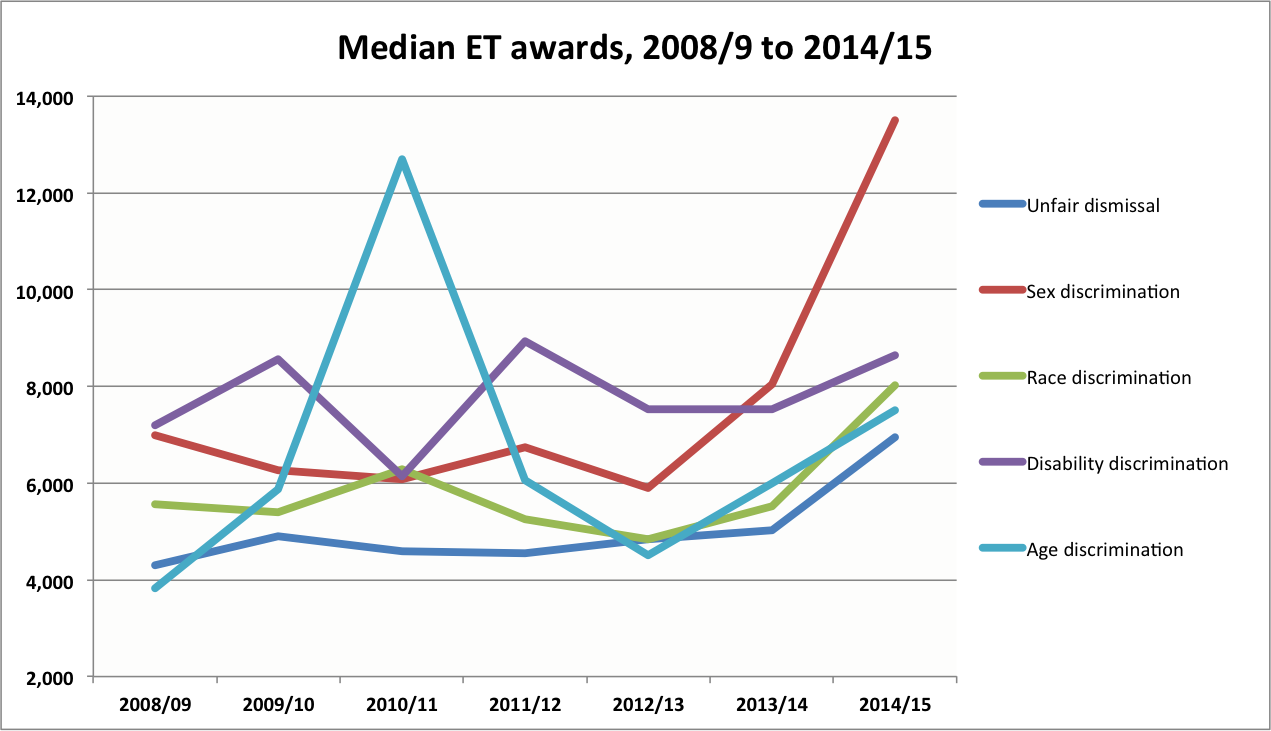
The HMCTS quarterly tribunal statistics confirm that relatively low-value ET claims for deductions of wages (aka ‘wage theft’) have “virtually disappeared”, but there is also evidence that fees have significantly changed the nature of higher value claims for unfair dismissal and discrimination. Just look at this chart, showing the median value (£) of ET awards for unfair dismissal and the principal discrimination jurisdictions.awardsmedian

I am an increasingly grey and wrinkled policy wonk, so I know we shouldn’t make too much of any change in just one time period. But I would be willing to bet a reasonable amount of my rather small salary on this chart showing the beginning of a sharply upward trend in the level of the median ET award for unfair dismissal or discrimination (the only jurisdictions for which the lackadaisical HMCTS bothers to record the relevant data). For the simple reason that, by eliminating lower value unfair dismissal and discrimination claims, the ET fees of up to £1,200 have forced the median value of such claims upwards.

But – duh, I almost forgot – there is no reason to worry. There is Acas early conciliation. Everything is hunky-dory. Though I do wish those Acas stats were a bit more transparent.

Posted in Justice | Tagged , , , | 1 Comment

Brexit & workers’ rights. Meh.

A few weeks ago, I turned down the offer of a freelance assignment: an article on the implications of Brexit for UK employment law. Well, the day job is pretty busy, and frankly the subject matter didn’t float my boat. Because I’m pretty sure a ‘leave’ vote in June’s referendum would have relatively little impact on workers’ rights in the UK – at least for the foreseeable future.

I wasn’t persuaded from that view by the publication, a few days later, of a 17-page TUC report on the issue. “Many rights accumulated over decades, including paid annual leave, time off for antenatal appointments and fair treatment for part-time workers, are ‘used every day by millions of workers’”, the Guardian reported the TUC as saying. But if the UK votes to leave the EU, “no one can say what will happen to these rights”.

A 17-page history of EU-derived workplace rights – some of them key, some of them fairly marginal to many workers’ lives – just to say “no one can say what will happen to these rights”. Well, yes, no one can say for certain. But, if we apply our minds to it – rather than just follow orders from Stronger In campaign HQ to scaremonger about our specialist area – we can probably say that the chances of Brexit leading directly to any significant erosion of those workplace rights are actually pretty slim, for several reasons.

Firstly, it would be a bold (or simply daft) Tory government that decided to cut the hardly over-generous statutory entitlement to paid holiday – just four weeks plus bank holidays – or to blatantly roll-back the scope of anti-discrimination law, or to slash (paper) maternity rights. These rights are now well-entrenched and, in most cases, extremely popular. So, even someone as tactically inept as George Osborne would surely see that “Vote Tory, get less holiday” is not a great campaign slogan.

Sure, some EU-derived rights are much less widely used, so would be less well protected by public support. For example, hardly anyone takes unpaid parental leave, for the simple reason that it is unpaid (though I did). But post-Brexit Tory governments would have many more pressing things to do with their parliamentary time than abolish or amend the largely forgotten parental leave provisions in the Maternity & Parental Leave Regulations 1999, at least for some considerable time. And who can say for sure that, 15 or 20 years from now, the EU itself won’t row back on such rights? Answer: no one.

The EU isn’t some kind of permanent, bleedin’ heart liberal institution. It’s made up of elected governments and politicians. Put more right-wing politicians in, and you get more right-wing (and fewer left-wing) policies out. Unfortunate, but that’s the way it is.

However, the principal reason Brexit would most likely have limited impact on workers’ rights in the UK is that Tory governments – including those aided and abetted by opportunistic if short-sighted Liberal Democrats – simply don’t need Brexit to erode and even destroy such rights. They manage perfectly well as things are.

The outcome of June’s referendum won’t make any difference to whether employment tribunal (ET) fees are abolished or lowered. Yet, by reducing the number of ET cases by 65%, those fees have given a green light to rogue or merely unscrupulous employers to mistreat and abuse their workers, in the almost certain knowledge that they will face no legal consequences. Rights on paper are worthless if they cannot be effectively enforced. And that applies to EU-derived workplace rights just as much as it does to domestically-generated rights. If proof of this were needed, just look at what’s happening with those partly EU-derived maternity rights.

Those justice-denying fees are arguably the single most important current issue when considering the threat to workers’ rights in the UK, yet this weekend Will Hutton failed even to mention them when writing in the Observer that “leaving the European Union – so suspending the array of protections it offers in the workplace – would erode what remains of British worker rights and entitlements.” That is a remarkable oversight. For what use is the ‘protection against detriment’ set out in Regulation 19 of the Maternity & Parental Leave Regulations 1999 if you cannot afford (or are simply not willing to risk) the £1,200 fees to pursue an ET claim against your rogue (former) employer?

A vote to remain in the EU won’t reverse the Coalition government’s erosion of the legal protection against unfair dismissal, or bring back legal aid for employment advice. Nor will it improve the currently pathetic enforcement of the national minimum wage, or reverse the shocking Tory assault on trade unions (and Labour Party funding) via the Trade Union Bill (which Will Hutton rightly describes as “one of the most pernicious pieces of proposed legislation in recent history”). And, against that background, it’s far from clear how it will help combat the growth in zero-hours contracts, bogus self-employment and other forms of precarious employment that has blighted so many workers’ lives.

None of which is to say that the EU-derived rights set out in the TUC’s report are unimportant, or that anyone should vote for Brexit (I certainly won’t be doing so). Apart from anything else, having a floor of basic workplace rights across the EU is crucial to ensuring a level playing field for British businesses (and their workers), whether the UK is in or out. And the European Court of Justice has in the past played an important role in driving forward and enhancing key workplace rights, not least that to equal pay.

Nor is it to deny that there might well be some impact of Brexit on workers’ rights. Darren Newman notes that Brexit could “raise some issues at the geeky margins [of employment law]” – what a wonderful phrase that is – and Michael Reed of the Free Representation Unit similarly suggests that discrimination law “might well drift at the margins”. As for geeky things like TUPE, David Whincup suggests – in his must-read blog earlier this month – that “any attempt to re-write TUPE would inevitably end up looking pretty much like TUPE”.

But to my mind the argument that Brexit would be “disastrous for rights at work” is thin and unconvincing, if not confected. Right now, the key battles over workers’ rights are wholly domestic. And they are mostly being lost.

Posted in Workers' rights | Tagged , , , | 2 Comments

How soon is now? Ministry of Injustice needs more time to work out the bleedin’ obvious.

Two months ago, I was daft enough to venture on this blog that Michael Gove – everyone’s favourite justice secretary – might be close to concluding his Ministry’s snail-like review of the justice-denying employment tribunal fees introduced in July 2013. The review report had by then been on Gove’s desk for four months, and it’s hardly a matter of rocket science. But I noted a teeny-weeny problem: the Ministry has no dosh to pay for a substantial reduction in the level of the fees, let alone full abolition.

Then, one month ago, I was tempted to write a blog post about the feeble performance of Gove’s junior minister, Shailesh Vara, when giving oral evidence on the impact of the fees to the Justice select committee of MPs, on 9 February. But then I found some drying paint to watch, and realised I couldn’t be bothered to count how many times the imbecilic Vara had told the MPs about the 83,000 early conciliation cases handled by Acas.

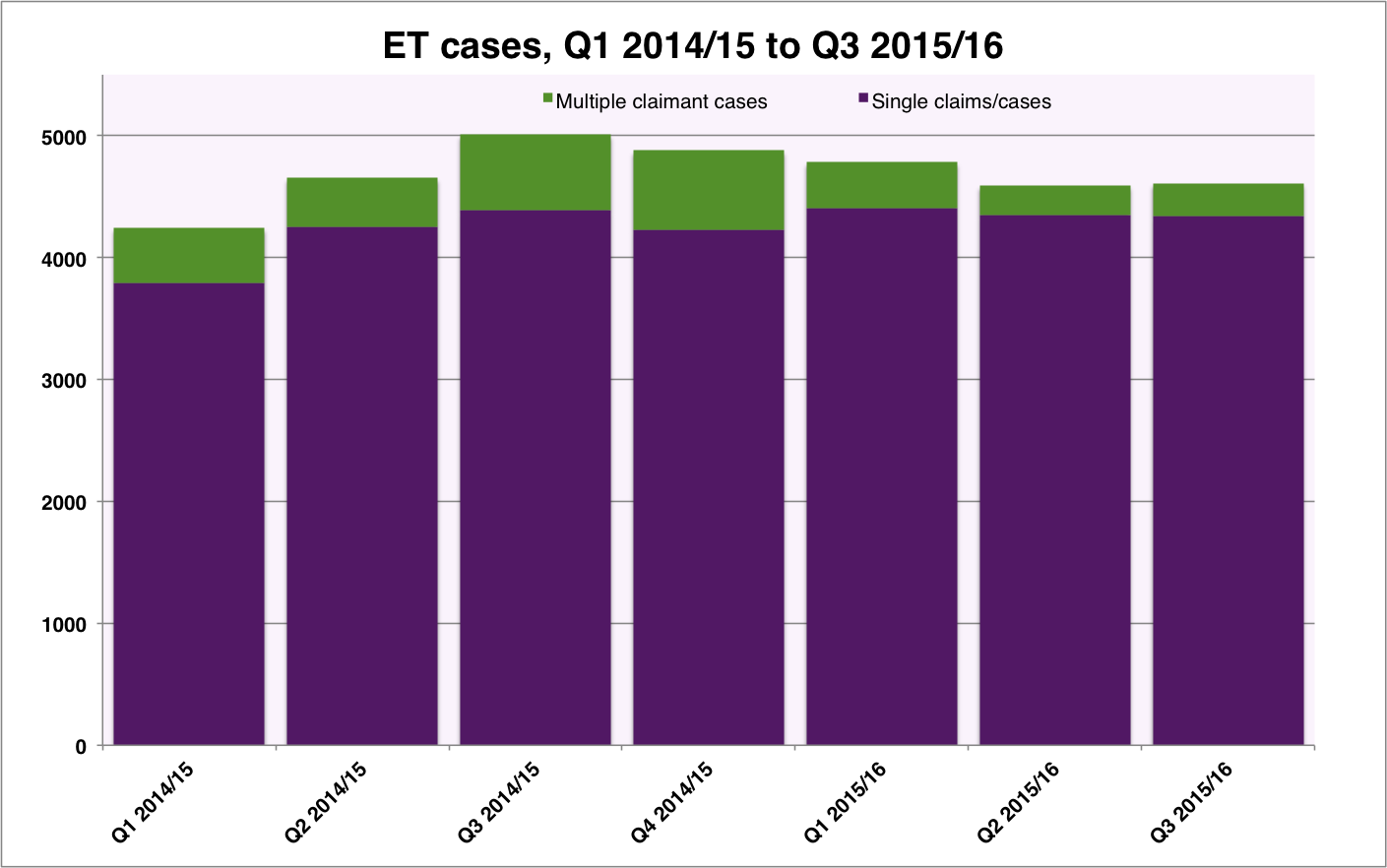
However, just in case you, dear reader, happen to be a member of that committee of MPs, here’s a chart showing how successful Acas early conciliation has been in cutting ET case numbers since its introduction in Quarter 1 of 2014/15 (that’s the column on the far left).

PostAcasECYes, that’s right. In each of the six quarters since the introduction of Acas early conciliation, the number of ET cases has been higher than when Acas early conciliation was introduced. And yet, according to Vara, it is Acas early conciliation that explains the 65% fall in ET case numbers since July 2013, when – by coincidence, obvs – his Ministry introduced claimant fees of up to £1,200.

Anyway, back to this week, and the long-delayed publication of the final reports of the joint BIS/EHRC investigation of pregnancy and maternity discrimination in the workplace. These reports should have been published in the autumn, and their non-appearance by the end of February caused the chair of the Women & Equalities committee of MPs, Maria Miller, to write to business secretary Sajid Javid to ask what the fuck was going on.

Whatever the fuck was going on, the final reports include an EHRC paper setting out ‘recommendations for change’. And among these was a frankly somewhat underwhelming recommendation that the Government, “in light of the findings of [the Ministry of Injustice’s] review, make changes to the employment tribunal fee system to ensure that fees are not a barrier to accessing justice for women experiencing pregnancy and maternity discrimination”.

Is this some kind of coded message? Has the EHRC seen the review report that’s been sitting on Michael Gove’s desk for the last six months? I have no idea. I’m just a policy wonk. I don’t do coded messages. That’s for the big girls and boys.

But I have read the Government’s equally pathetic response. You can too – they have so little shame they put it online. This states, in rejecting the EHRC’s effete recommendation that they “make changes” to the ET fees regime,  that “it is too soon to consider whether any action is needed here”.

Too soon? Not just to take action, but even to “consider whether any action is needed”. Yeah, like it’s too soon to consider whether England didn’t win the 2015 Rugby World Cup. The All Blacks may yet get disqualified en masse for being too big, and too good. It may yet emerge that Wales fielded players who don’t have a Welsh grandmother. Maybe the entire Australia team was on drugs. And Acas handled 83,000 early conciliation cases.

Yes, 83,000 early conciliation cases were handled by Acas. Eighty-three thousand. Did you know Acas handled 83,000 early conciliation cases? Early conciliation, 83,000 cases. Eighty-three thousand.

Have I mentioned Acas early conciliation?

Screen Shot 2016-03-22 at 18.20.52

Posted in Justice, Workers' rights | Tagged , , | Leave a comment

Workers thank their lucky stars for the Workers’ Party. Oh, hang on …

Every now and then, someone in the Labour Party has a pop at the Tories for not prosecuting enough employers for breaching the national minimum wage. When he was shadow business secretary, Chuka Umunna was not averse to skating on this very thin ice. In March 2015, the ‘Danger: Thin Ice’ warning signs were brazenly ignored by Stella Creasy and whoever was then running Labour’s twitter account. And, last weekend, tax law genius and all-round good guy Jolyon Maugham QC waded in, suggesting on Twitter – in response to a Citizens Advice report suggesting that wage theft by rogue employers has risen sharply in the past year – that “if you’re a business exploiting the most vulnerable, the Tories are a reliably sleepy policeman” and “there’s money to prosecute those who overclaim benefits; but none to prosecute those who underpay the minimum wage”.

Now, regular readers of this blog – Hello Gem! Hello Mum! – know that I’m not unwilling to have a pop at the Tory scumbags we are obliged to call Her Majesty’s Government. But in my humble opinion those two assertions by Jolyon need levelling with a few basic facts.

The first is that we shouldn’t get too carried away by what Citizens Advice has chosen to say about a single year-on-year change in its casework recording statistics, so as to get its name in the paper. I worked at Citizens Advice for 13 years, so I know how gnomic – and prone to unexplained fluctuations – those casework statistics can be. One or two CABx recruit enthusiastic new (volunteer) advisers, or send their existing ones on a training course, and suddenly you have a ‘surge’ in cases tagged as involving some particular third-tier problem that many advisers never bother to record. The following year, it’s gone. (It would have been helpful for Citizens Advice to include the figures for previous years, so we could see any trend, but they didn’t. Maybe they flunked Policy Wonk School.)

That said, an increase in the incidence of ‘unlawful deductions’ – or wage theft – by rogue and unscrupulous employers is exactly the kind of outcome that I and many others predicted for the justice-denying employment tribunal fees dreamed up by cuddly Ken Clarke, and introduced by the somewhat less cuddly Chris Grayling in July 2013. Even Michael Gove – everybody’s favourite justice secretary … ever! – has acknowledged this prediction as “a perfectly internally coherent theoretical argument”, while at the same time dismissing it on the grounds that he doesn’t see “evidence that employers are behaving in [such] an outrageous way”. Which is the kind of thing Tory scumbag politicians say when they’re thinking: “You’re right, of course, but I don’t give a fuck.”

However, ‘wage theft’ is not necessarily the same as ‘breaching the national minimum wage’. It is perfectly possible for a worker to be getting the minimum wage (if only just), while at the same time losing hundreds or thousands of pounds to wage theft by their employer. I saw hundreds of such cases during my 13 years at Citizens Advice. And, in such cases, enforcement of the law (via the ET system) falls to the individual worker concerned, not the government.

This was less than satisfactory even before the introduction of hefty ET fees, and I spent a lot of time and effort trying to get the Blair and Brown governments to do something about it. But they wouldn’t, and now the scumbag Tories are doing something that might help address the issue. If I were (still) a member of the Workers’ Party, I’d be a tad embarrassed about that. For an effective Fair Employment Agency could tackle the systemic but often hidden exploitation such as that in London’s hotels.

As for ‘money to enforce the minimum wage’, under the scumbag Tories the annual budget for NMW enforcement has reached a level that humble policy wonks like me could only dream of in the New Labour years. In the last year of Gordon Brown’s government, the budget reached £8.3m, up from £6.8m in 2007/08, and just £5.6m in 2005/06. It then stuck at £8.3m for each of the first three years of the Coalition – despite cuts of 25% or more to most departmental budgets – then increased to £9.2 in 2014/15, before rising again to £13.2m for 2015/16. In the last year of the Labour government the HMRC enforcement team had 140 full-time equivalent staff; it now has 224 FTE staff. And the enforcement budget is set to increase again in 2017/18.

Admittedly, very little if any of that £13.2m goes on criminal prosecutions of NMW rogues – there have been no such prosecutions since 2013. But then – as Chuka Umunna, Stella Creasy and others tended to overlook – it took Labour until 2006 to get around to introducing criminal offences in relation to the minimum wage. And then they only managed seven prosecutions before being booted out of office in 2010.

With criminal prosecutions costing an average of 27 times the average cost of an HMRC investigation and civil enforcement, I can’t see this changing while the Tories remain in power – though ministers have said that some of the increased funding will be used to “establish a new team of compliance officers in HMRC to investigate the most serious cases of employers not paying the NMW”, and that might well lead to some prosecutions. But if Labour want to do things differently, then they really need to spell out how that substantial extra cost would be met. The 2015 manifesto did not contain any pledge of extra funding for NMW enforcement, so a switch to criminal prosecutions would simply have led to a substantial reduction in the level of civil enforcement.

None of this is to say that the current level of civil enforcement of the NMW is adequate – it certainly isn’t, as I have said repeatedly and as today’s news of a successful legal challenge against care company MiHomecare reminds us. Nor is it to say there shouldn’t be some criminal prosecutions – I myself have recently questioned why the security firm found by HMRC to have thieved a whopping £1.742m from 2,500 of its workers hasn’t faced criminal prosecution. But the number of criminal prosecutions is not a reliable indicator of the level of NMW enforcement, and it’s disingenuous of anyone in Labour to suggest otherwise.

danger-thin-ice-sign-s-8286

Posted in Workers' rights | Tagged , , , , | Leave a comment

Oh look, another set of ET claim statisti …. zzzzzzzzzzz

Warning: This post contains selected statistics, taken in isolation and out of context         (© Shailesh Vara, junior injustice minister and officially the nation’s slowest reader)

So, today the Ministry of Injustice coughed up the latest set of quarterly employment tribunal (ET) statistics, covering the period October to December 2015 (Q3 of 2015/16). The days when each new set of these statistics was eagerly anticipated and swiftly pounced upon as evidence of the (predicted) impact of ET fees now seem an awfully long time ago, and it’s fair to say that, these days, the statistics amount to little more than a reasonably effective cure for insomnia. But I have to pursue my doomed quest to win the heart of Gem ‘The Doctor’ Reucroft somehow. So, here are a few charts.

ET case numbers are now really, really, really boring

Never mind the denial of justice, feel the stability! Great for HMCTS management planning. In Q3 of 2015/16, there were 4,338 single claims/cases, just seven fewer than in Q2, when there just 58 fewer than in Q1. Such uniformity is quite remarkable, and suggests ET claim/case numbers really have hit rock bottom.

casesQ

The Hancock Theorem really is a load of cock and bull

Armed with today’s set of statistics, we can hammer a few more nails into the coffin of that wonder of Tory intellectual thought, the Hancock Theorem of Vexatious ET Claims.

According to the second cleverest member of the Government – I’m sure Matthew Hancock himself would concede top place to that titan of intellect, injustice minister Shailesh Vara – the success rate of ET claims should by now be bobbing around at or just below 100 per cent, all the vexatious and otherwise unfounded claims having been cleverly weeded out by the hefty, upfront fees introduced by the also very clever Chris Grayling in July 2013.

Unfortunately – not that the Cabinet Office minister gives a flying fuck – the Hancock Theorem has not been supported by the Ministry of Injustice’s own figures, even when taken in context. These have so far indicated that, far from going through the roof, the success rate has in fact fallen significantly since mid-2014. Oops.

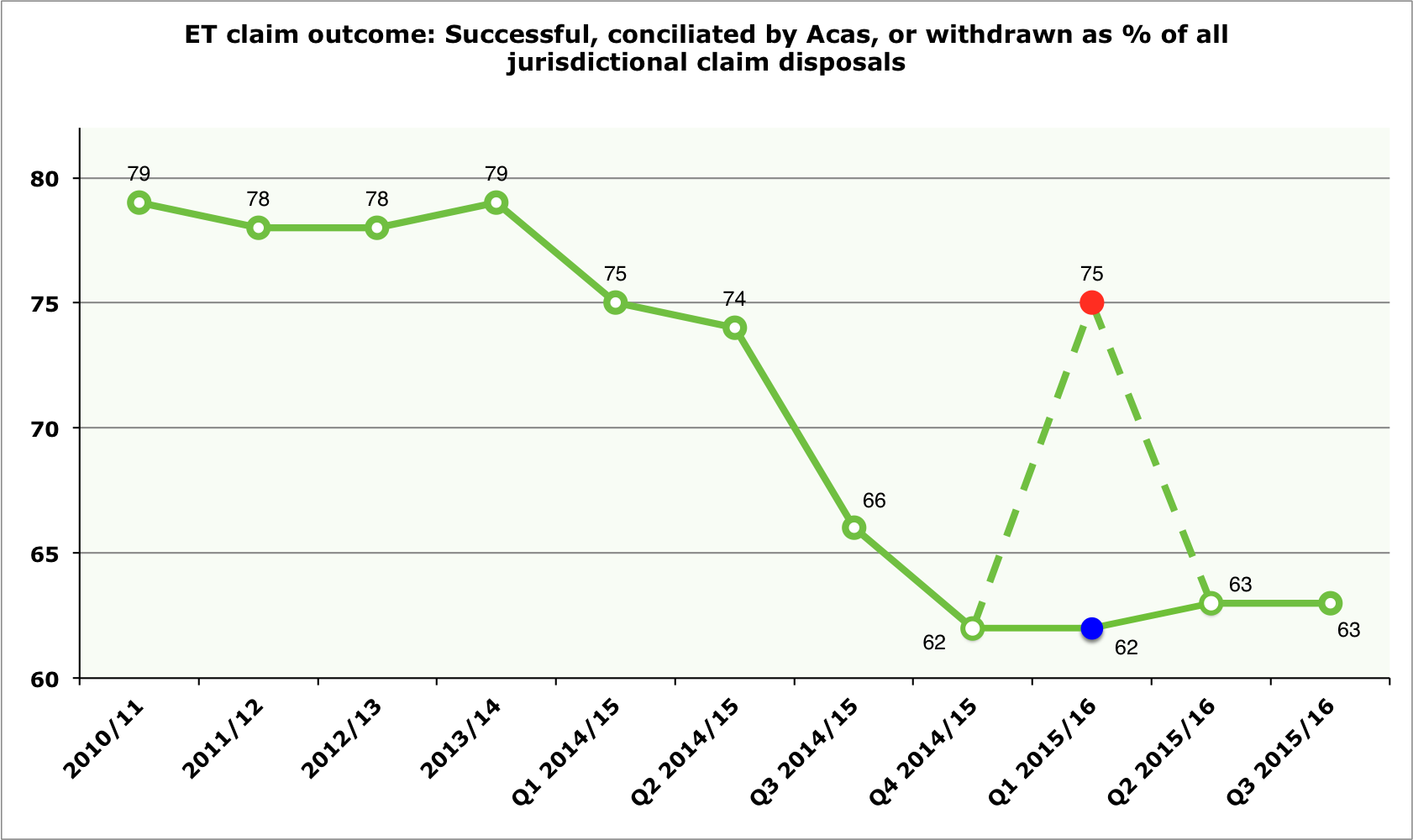
Once again, in what is the seventh quarter since we could first have expected to see the impact of fees reflected in the outcome figures, the overall success rate – that is, including claims conciliated by Acas, or withdrawn/settled – is well down on pre-fees levels, at 63%.

At 10%, the narrow measure of success is also significantly below pre-fees levels – and certainly is not zooming towards 100 per cent, as the Hancock Theorem predicts. And, at 37%, the proportion of unsuccessful claims is once again significantly up on pre-fees levels, despite all the weak and vexatious claims having been weeded out by fees.

success

outcomeall

Given that the Ministry statistics on which the above charts are based are highly selective, are taken in isolation and are 150 per cent out of context, I can’t really be arsed to explain the dotted lines in Q1 of 2015/16. But if your insomnia is really bad or you just really need to know, all is explained here.

Some 60,000 single ET claims/cases lost to fees since July 2013

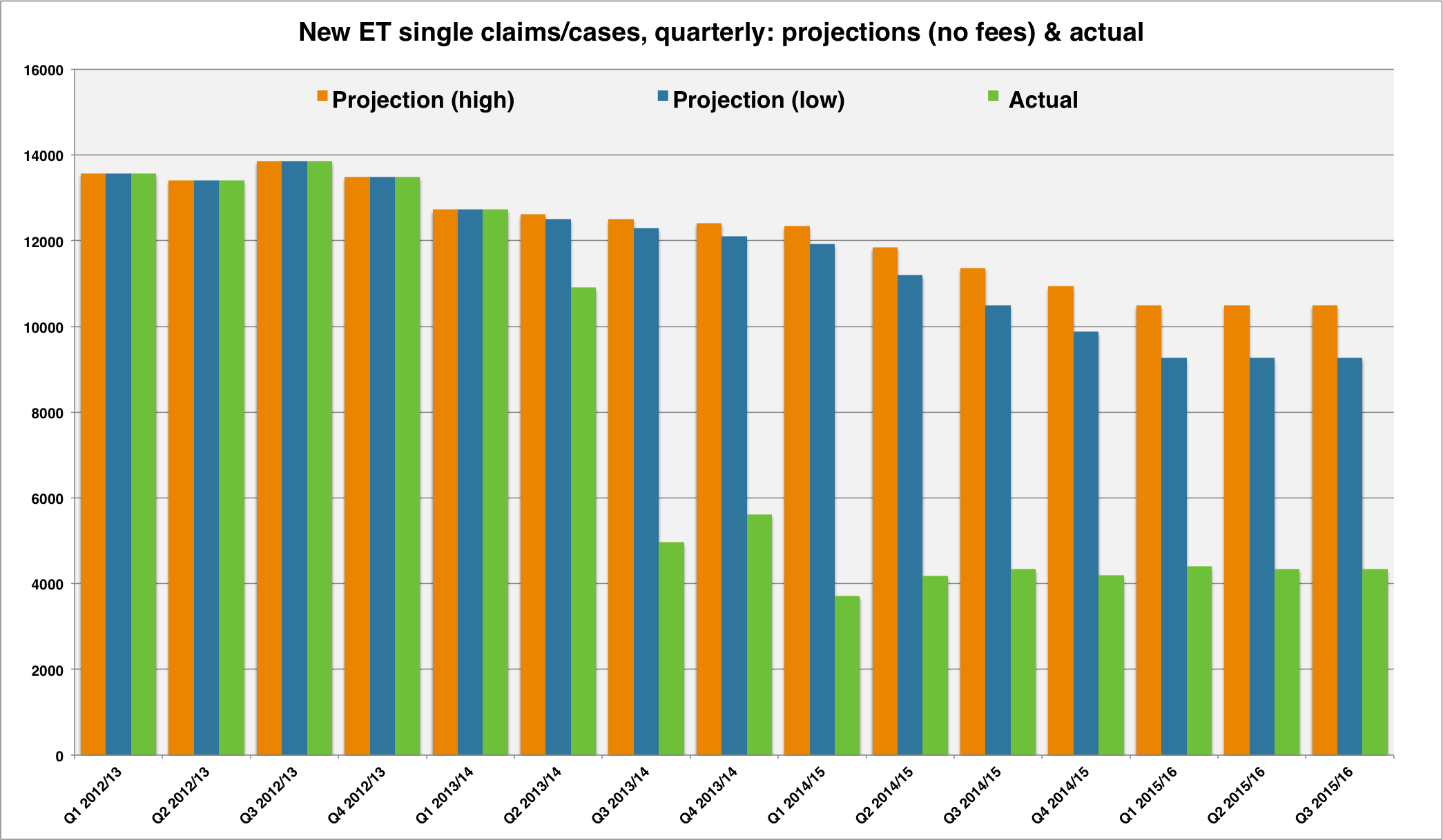
As of the end of December 2015, the number of single ET claims/cases ‘lost’ to fees since July 2013 was somewhere between 57,225 and 64,542. But then my projections are so selective and out of context. And, in any case, according to the Hancock Theorem, not one of those 57-64,000 claims would have been well-founded.

Yes, that’s right. For the famed Hancock Theorem to be correct, the Ministry of Injustice calibrated the level of their ET fees so precisely as to weed out up to 64,500 vexatious and otherwise unfounded ET claims without denying access to justice to one single exploited or unfairly treated worker. Not one.

projection

Posted in Justice | Tagged , , | 1 Comment

NMW enforcement: what the **** is going on, Mr Boles?

“Our policy of naming and shaming employers who ignore the law means there are consequences for their reputation as well as their wallets.”

So said BIS Minister Nick Boles in February, when naming & shaming another 92 employers for non-compliance with the National Minimum Wage. Though it’s questionable how much those reputations were damaged by a few reports in local media, and not much else.

But what about those wallets?

Well, the 92 employers certainly had to pay back some £1.873 million in NMW arrears to a total 3,352 workers. But £1.742m (93%) of that £1.873m was paid back to 2,519 (75%) of the 3,352 workers by just one of the 92 NMW rogues, Total Security Services Ltd, with a mere £131,056.59 paid back by the other 91 penny-pinching employers (an average of just£1,440 per employer). So, most of those corporate wallets took a pretty small hit.

But what about the financial penalties that the 92 NMW rogues would have paid to HM Government? Since March 2014, employers found by HMRC to have breached the NMW have had to pay a financial penalty to HMG equivalent to 100% of the total NMW arrears owed (previously, the penalty rate was just 50% of the arrears owed).

Which makes it somewhat surprising to learn – from the minister’s answer today to a parliamentary question by Caroline Lucas MP – that the 92 employers named & shamed in February were “issued with a combined total of over £629,000 in penalties”. Which is not – and Gem ‘The Doctor’ Reucroft can check my maths if she wants – 100% of £1.873m. It’s not even 50% of £1.873m. It’s just 33.6%.

Not only that but, if the 91 NMW rogues other than TSS Ltd were issued with 100% financial penalties on their combined arrears of £131,056.59, then TSS Ltd can only have been issued with a financial penalty of some £498,000. Which is not even 50% of £1.742m. In fact, it is just 28%.

So, what the fuck is going on, Mr Boles?

PS – Worth noting also that, according to the minister’s reply, eight of the 92 NMW rogues have not actually paid the financial penalty issued against them. However, this is not particularly surprising. Most of the 92 are economic minnows, who have a tendency to go out of business. I wouldn’t be surprised if at least some of the eight non-payers never pay the penalty (they probably haven’t paid the NMW arrears, either).

Posted in Workers' rights | Tagged , , | Leave a comment

Paying the (s16) penalty. Or not, as the case may be.

Back in January, I noted on this blog that, since the provision came into force in April 2014, only 11 penalties had been imposed on employers under section 16 of the Enterprise & Regulatory Reform Act 2013, and that only four of those penalties had actually been paid. It quickly turned out that the super-computer on which the Department for Business, Innovation & Skills (BIS) stores the relevant data had been having a bad day at the office in January, and that 12 penalties have been imposed, of which six remain unpaid. And, by that time, I had submitted a Freedom of Information request to BIS, asking for the names of the naughty employers who, as well as treating their employers especially badly, in the view of an employment judge, have failed to pay the resultant penalty to HM Government.

Somewhat to my surprise, BIS has now complied with my request (FOI2016/02199, 1 March 2016), and the six wicked employers are:

Titchfield Limited

Spring Digital

CE Table

Civil & Groundwork Contractors Ltd

Ecogum

SS Communication Ltd

Five of the six appear to be economic minnows, with little if any internet footprint. Spring Digital, for example, appears to have done very little since 2012, and CE Table Ltd may well have been struck off by now.

However, Ecogum – or Eco Removal Systems – is an active company providing “an ecological cleaning solution to a worldwide problem … [the removal of] chewing gum, oil, grease, adhesive labels, graffiti, and plain old dirt.” Its clients include Chelsea Football Club, the Twickenham (rugby union), Wembley (football) and Wimbledon (lawn tennis) stadia, and King’s College London. In the last few days, it has tweeted about its work cleaning the streets of Scotland. It believes that “customer satisfaction is totally essential”. But it seemingly doesn’t believe in promptly paying financial penalties imposed by an employment tribunal, in compliance with the law.

Screen Shot 2016-03-05 at 15.01.35

What, if anything, is BIS (or the Ministry of Injustice) doing about this? In late January – and again on 11 February – BIS minister Nick Boles stated that “enforcement action is currently being considered for the outstanding penalties”. Watch this space.

Posted in Justice, Workers' rights | Tagged , | Leave a comment

Ice-cold in Calais

This morning I was up early to accompany Green Party leader Natalie Bennett and London Assembly member Jenny Jones as they visited a ‘bunch of migrants’ (© David Cameron) in the Calais refugee ‘camp’ known – seemingly with good reason – as the Jungle. (Natalie and Jenny were following-up on their previous visit, in November last year).

Queen Mary I is supposed to have exclaimed “When I am dead and opened, you will find Calais written on my heart”. And I imagine there are a fair few Afghans, Eritreans, Iraqis and Syrians who have uttered something similar – though for very different reasons. For the Calais camp is simply a hell-hole. Think ‘Glastonbury at its wettest’ (without the music and the fun) meets Apocalypse Now (without the helicopters and the heat).

As Yvette Cooper noted last month, within this bleak, third-world shantytown on Britain’s doorstep, “scabies is rife, bronchitis too. Families sleep in flimsy tents in bitter cold. Children play in mud and rubbish. No one is doing assessments to identify refugees who need sanctuary. No one is delivering asylum. No one is enforcing immigration rules. And, most urgently of all, no one is making sure that vulnerable people – especially children – get basic humanitarian aid and protection to keep them safe.”

That last bit’s not strictly true, of course, as – in the striking (and shaming) absence of both governmental organisations and major aid agencies – an impressively-organised network of short- and long-term volunteers with French charity L’Auberge des Migrants and UK charitable fund Help Refugees provides aid to the 5,000 or more residents, including building shelters and providing material for migrants to build their own shelters, and distributing bedding, food and clothes.

Help Refugees began as a grassroots social media campaign (#HelpCalais) in August last year, aiming to take a single truck-load of aid to Calais. Seven months later, the L’Auberge/Help Refugees operation – based in a warehouse a few miles from the camp – and that of other small-scale, volunteer-led groups is pretty much all that France and Britain – two of the richest countries in the world’s strongest economic bloc – can muster in the way of humanitarian concern.

Living in this hell-hole, according to the L’Auberge/Help Refugees volunteers (most of them British), are “hundreds of unaccompanied children”. Kate – who draws sketches of residents and posts them on her Twitter account – showed us her sketch of a 12-year-old Afghan boy, whose aunt and uncle live in the UK; he’s been in the Calais camp for five months. Mary, a midwife, told us there are at least two babies, and at least six pregnant women. Earlier this week, in the Dunkirk camp some 20km along the coast – where, according to the volunteers, conditions are even worse – Mary had come across an Iraqi mother about to feed her baby from an unsterilised, barely even washed bottle.

We had too-sweet tea with Mustafa in the make-shift ‘cafe’ he has painstakingly constructed during his eight months in the camp. Tomorrow, or the day after, or sometime soon at least, Mustafa’s ‘cafe’ (also his ‘home’) is set to be bulldozed along with the rest of the ‘cafes’, ‘shops’ and even ‘restaurants’ that fill his ‘street’. Mustafa will be left with nothing but a small bag of clothes and other possessions.

Yet, as Yvette Cooper says, the most shocking thing about this festering insult to our collective humanity and self-respect is that “it’s not even too big to solve. Of the 1 million people who arrived in Europe last year, just 5,000 have ended up in the Jungle at Calais, and 3,000 more at Dunkirk. In contrast, 5,000 people arrive on the Greek island of Lesbos every day. Yet no one has a proper plan to sort it out. Not the French or British governments, the UN, or the big agencies.”

That simply has to change – and the British government could make an immediate start by acting on the call of the Green Party and others to take in all the unaccompanied children from the two camps.

In the meantime, you can support the L’Auberge/Help Refugees volunteers with a financial or other donation. Contact them via: calaisdonations@gmail.com (or, if you’d like to offer your time: volunteerincalais@gmail.com). And you could sign this open letter to David Cameron.


Posted in Refugees | Tagged , , | Leave a comment

Minimum wage enforcement, the Tory way

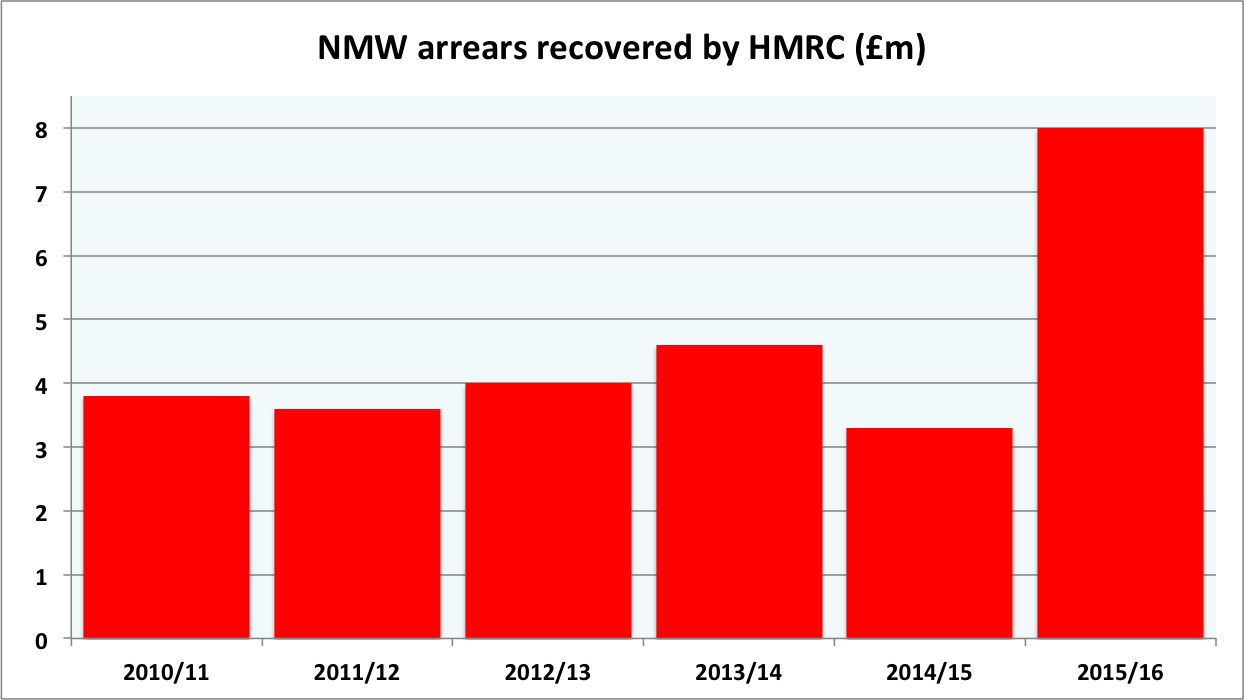
Something very unusual has been going on with enforcement of the national minimum wage. As the following table shows, over the past five years HMRC has recovered an average of £3.9 million in arrears for an average of 23,147 workers. And the figures for both arrears recovered and workers involved have been pretty steady, year on year. Certainly, no variation worthy of a Wonky graph (sorry, Gem).

FY Arrears recovered Workers covered
2010/11 £3.8m 22,919
2011/12 £3.6m 17,371
2012/13 £4.0m 26,519
2013/14 £4.6m 22,610
2014/15 £3.3m 26,318
Average £3.9m 23,147
Source: Table 13, Final Government evidence for the Low Pay Commission’s 2016 report, BIS, January 2016.

However, today, Treasury minister David Gauke MP stated – in answer to a written parliamentary question by Caroline Lucas MP – that, in the seven-month period “from April 2015 to November 2015”, HMRC “took action against over 500 businesses, identifying over £8 million [of arrears] for 46,000 workers.”

As the Minister helpfully added, “this is already the largest amount of arrears identified in any single year since the introduction of the NMW”. Indeed, despite the number of employers involved (“over 500”) being par for the course at this stage of the financial year – HMRC took action against 735 employers in 2014/15, 680 in 2013/14, and 736 in 2012/13 – that £8m (in seven months) is more than twice the average arrears recovered in recent years, and 46,000 workers (in seven months) is twice the average number of workers (23,147).

What’s more, in early September last year, BIS minister Nick Boles told MPs that “since 7 March 2014” – that is, over the previous 18 months – HMRC had recovered “almost £5.9m”. As HMRC recovered £3.3m in the financial year April 2014 to March 2015, that implies recovery of some £2.6m between April and August 2015 – a bit more than normal, for sure, but nothing extraordinary. And, set against David Gauke’s answer today, that in turn implies that HMRC recovered a whopping £5.4m in the three-month period September to November 2015.

Hold on Gem, that graph may be coming.

Earlier this month, we learnt that HMRC recovered no less than £1.74m of arrears from security firm TSS (Total Security Services) Ltd at some point in the past year or so. That is, by some distance, the largest (reported) sum ever recovered by HMRC from a single employer, yet still only covers 2,519 workers. This might explain that above average figure of £2.6m recovered between April and August 2015. Or it might be part of that £5.4m seemingly recovered between September and November 2015.

Even in the latter case, that leaves an as yet unexplained recovery of some £3.7m of arrears in just three months in the autumn of 2015. Together with an as yet unexplained 20-25,000 more workers than than we might reasonably expect over a seven-month period.

So, what is going on? Well, it might be relevant that, from late July last year to the end of January, BIS ran an effective ‘amnesty’ for NMW-breaching employers who self-reported themselves to HMRC. Since the expiry of that ‘amnesty’ on 31 January, the (one-page) webpage has been deleted, but in anticipation of that I took the following screenshots:

Screen Shot 2015-12-31 at 13.14.46


Screen Shot 2015-12-31 at 13.15.35


So, could it be that, in the autumn of 2015, one or two large employers took advantage of this effective ‘amnesty’ to cough up a total of some £3.7m in arrears (or some £5.4m, if TSS Ltd’s £1.74m is part of the £2.6m recovered earlier in the year) and so avoid as much as £3.5m (or £5.4m) in financial penalties – reduced by 50% for prompt payment – and BIS naming & shaming? As well as, it must be assumed (since it wasn’t mentioned on the ‘amnesty’ webpage), the possibility of criminal prosecution for ‘serious’ breaches of the NMW? How convenient.

And could one of those employers be Sports Direct, which – according to the Guardian – employs about 15,000 workers on low-paid, zero-hours contracts, together with another 4,300 low-paid agency workers? And which, following an undercover operation by Guardian journalists, suddenly announced in December that it is stumping up £10m per year from now on to ensure compliance with the NMW?

Or could it be that HMRC is finally getting to grips with the long-standing, systemic flouting of the NMW in the social care sector? Last month, for example, the BBC reported that “about 100 home care workers in Swansea and Carmarthenshire are to be paid up to £2,500 each” in NMW arrears, after MiHomecare had been found to have not been paying its employees to travel between clients. MiHomecare reportedly employs some 6,000 care workers nationally – and why would it have been paying its care workers in Swansea and Carmarthenshire any differently to those in other parts of the country?

Being a humble policy minion, I have no idea – and I’m told that Sports Direct employees know nothing of any NMW arrears that might be coming their way. But David Gauke and Nick Boles must know. And, if they are as committed to ensuring compliance with the NMW as they profess, they really ought to tell us. And explain this graph.

NMWarrears

Posted in Workers' rights | Tagged , , | 1 Comment