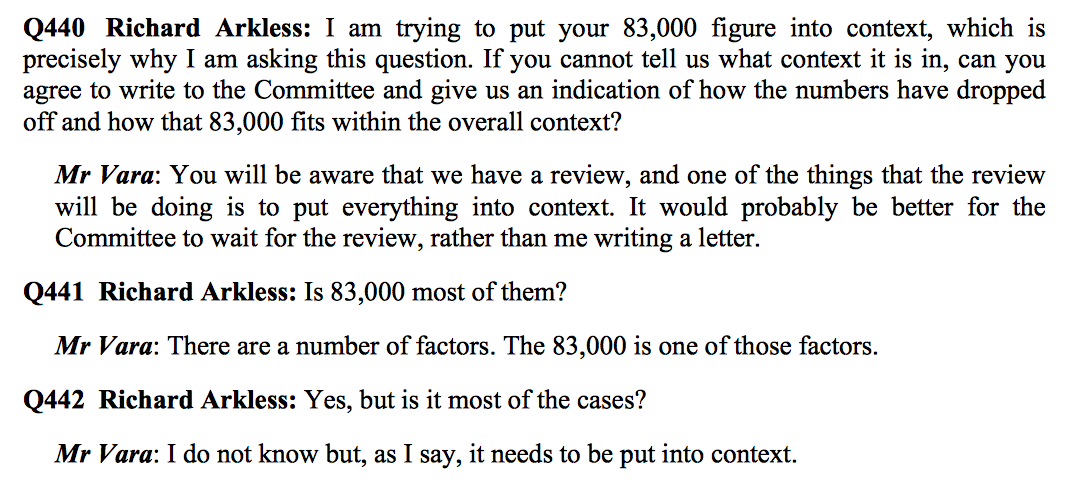
It is important to remember that, in the first 12 months of the ACAS conciliation procedure, ACAS handled some 83,000 cases. That is 83,000 cases which, alternatively, might well have ended up before the employment tribunal. Instead of people going to the employment tribunal, there is now a free service, which I hope this Committee would welcome, where people can go and try to resolve an issue in conciliation, rather than going to the employment tribunal.
It is [also] important to remember that, before the employment tribunal fees came into place, the trend of the number of cases going to tribunal had been going down. We also have to remember that the economy has been picking up, and employment is increasing. There have been changes to employment law. All those factors may well have contributed to the number of cases diminishing in the employment tribunal.
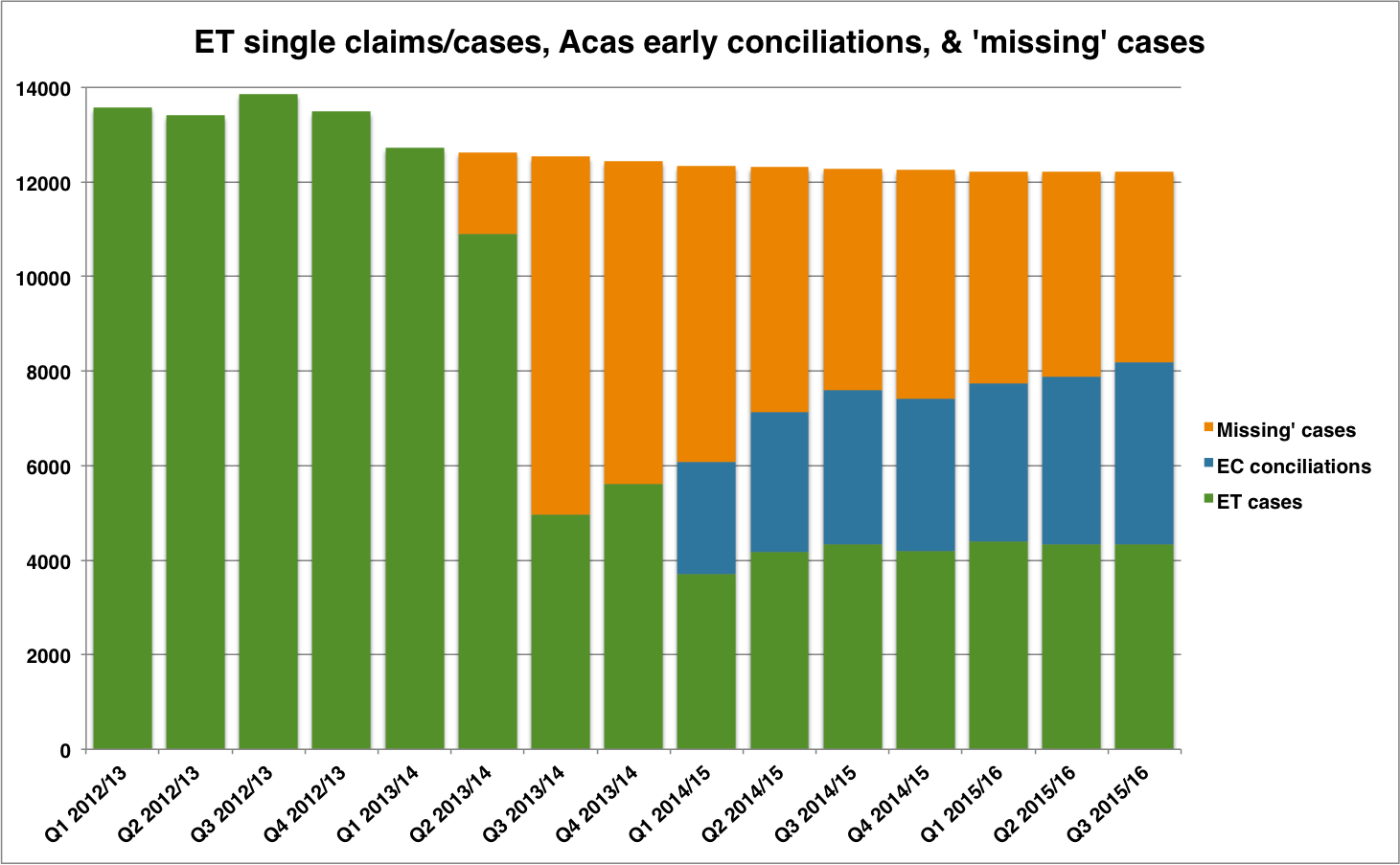
And it is true that, in 2014/15, Acas handled 83,423 early conciliation (EC) cases. However, according to Acas, “more than 4,000” of those 83,423 cases were multiple claimant cases. And it makes more sense, when examining trends in ET case numbers and the impact of ET fees, to focus on single claims/cases – even the Ministry of Injustice accepts that now. So, let’s deduct 4,200 (if anyone at Acas would like to give me the actual figure, please do so) from that 83,423. That gives us a figure of 79,223 single EC cases in 2014/15.
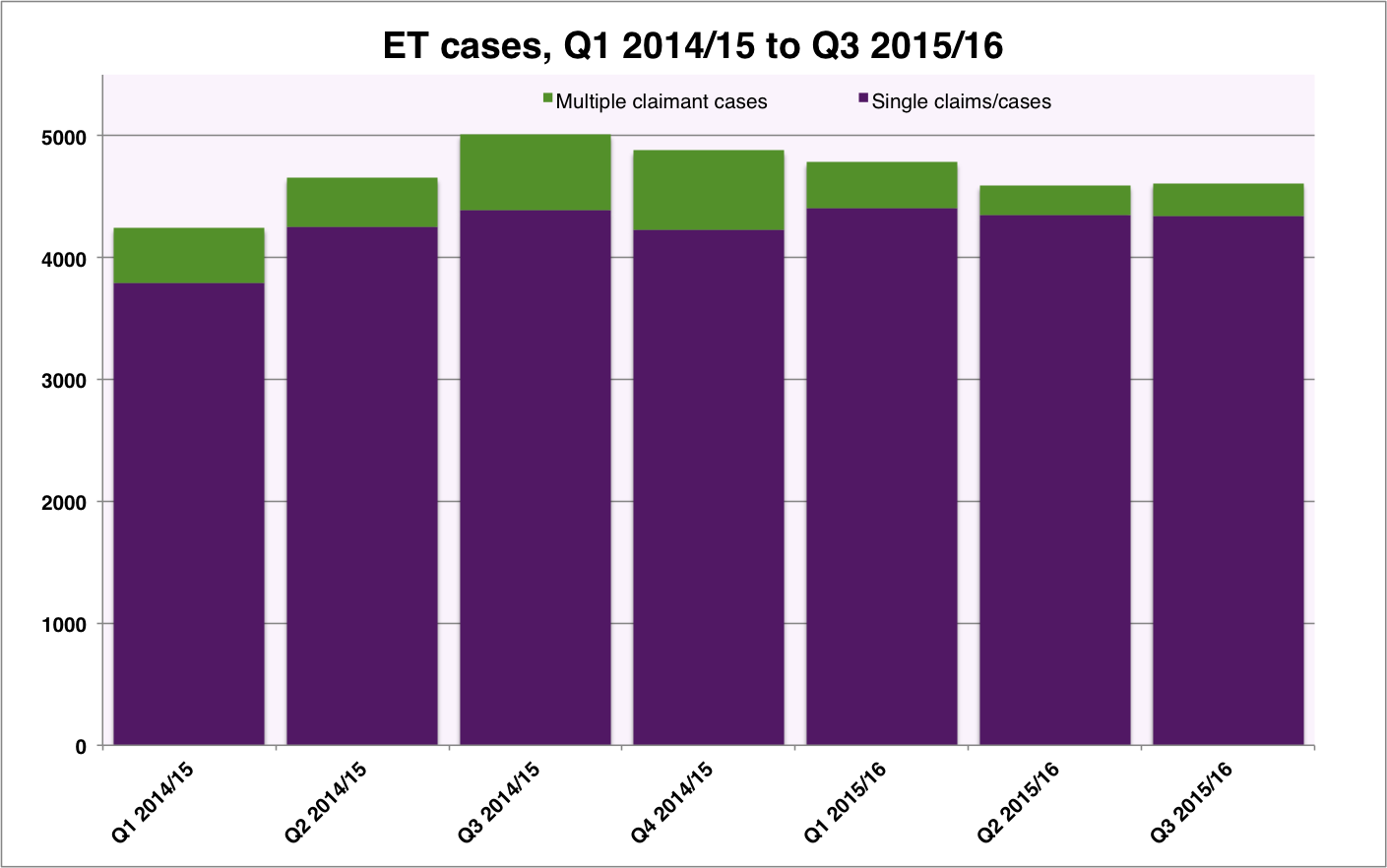
In that 12-month period, there were just 16,659 single ET claims/cases. So only 21% of the 79,223 single EC cases handled by Acas progressed to an ET claim. (That is very close to the 22% of all EC cases that Acas itself says progressed to an ET claim in the first three quarters of 2014/15 – for some reason, it appears not ever to have published the outcome figures for Q4 of 2014/15. So we’re all still on the same page, I think.)
Success! We can imagine Mr Vara doing a little jig around his Ministry of Injustice office when he was first presented with these figures. On second thoughts, maybe we shouldn’t.
At this point we need to note in passing that, when Mr Vara idiotically told the Committee that the 79,223 single EC cases handled by Acas in 2014/15 is 79,223 single cases “which, alternatively, might well have ended up before the employment tribunal”, he actually meant 62,564 single cases ‘which, alternatively, might have ended up before the employment tribunal’, as 16,659 of the 79,223 did end up before the employment tribunal.
However, that is only part of the picture. We also need to consider these figures in the context of how many single ET claim/cases there would have been, had both ET fees and Acas early conciliation not been introduced. As Mr Vara noted, “before the employment tribunal fees came into place, the trend of the number of cases going to tribunal had been going down”. Indeed it had, albeit only slowly. Between Q1 of 2012/13 and Q1 of 2013/14, the number of single claims/cases declined by 6.3%. If that rate of decline had continued – a highly questionable assumption, to which I will return – then in 2014/15 we could have expected 46,575 single ET claims/cases (or thereabouts, obvs).
And the first thing this tells us is that, in 2014/15, Acas handled 32,648 more single EC cases than it really needed to. In other words, 32,648 individual workers who would not have made an ET claim in 2014/15 nevertheless used Acas early conciliation. Which is not a bad thing – it’s always been the case that only a minority of all potential ET claims actually get made. So I for one am glad that the taxpayer paid for those 32,648 workers to have Acas attempt to conciliate their workplace dispute. But I’m not sure this was part of what ministers intended.
I haven’t been able to find any published figures for the annual expenditure by Acas on early conciliation, but 32,648 is a hefty chunk – 41.2% – of the total single EC caseload in 2014/15. And 32,648 is considerably more than the some 20,000 cases of pre-claim conciliation that Acas used to handle each year prior to the introduction the early conciliation process. As just noted, it is arguable that this additional expenditure of taxpayers’ money is unnecessary, even if it is to be welcomed, but at the very least it needs to be set against the fee income and operational cost savings enjoyed by the Ministry of Injustice as a result of the introduction of ET fees in July 2013. (On the hand, there have also been operational savings to Acas arising from the fall in ET case numbers caused by the fees, as there are fewer ET cases that go to post-claim conciliation by Acas.)
Furthermore, to that 41.2% we need to add the 21% of single EC cases in which the involvement of Acas was pretty much a total waste of taxpapers’ money, as the individual went on to issue an ET claim in any case. In other words, almost two-thirds of the single EC caseload was either unnecessary (at least in terms of the original policy aim, which was simply to reduce the number of ET cases) or wasteful.
But now we come to the important part. Pay close attention, advisers to Mr Vara.
As there were only 16,659 single ET claims/cases in 2014/15, but there would have been 46,575 such claims/cases, had both ET fees and Acas early conciliation not been introduced, we are missing 29,916 single ET claims/cases (you’ll have to excuse my spurious precision, just for the sake of my argument). And, as Acas managed to successfully conciliate only 15% of the 79,223 single EC cases it handled in 2014/15, just 11,883 (at most) of those 29,916 ‘missing’ single ET claims/cases were conciliated by Acas. (In fact, some of the 11,883 conciliations are likely to have been of cases among that extra, unnecessary caseload described above, but let’s not complicate matters).
In other words, even after allowing for both the downward trend in ET case numbers highlighted by Mr Vara in his oral evidence to the Justice committee, and for the impact of the (rather wasteful) Acas early conciliation, there are still at least 18,033 single ET claims/cases that were ‘lost’ to ET fees in 2014/15.
“Hang on”, chorus those advisers to Mr Vara, “we also have to remember that the economy has been picking up, and employment is increasing”. Indeed. And, the greater the number of people in employment, the greater the number of potential ET claims! Because ET claims aren’t just about redundancy, you numpties. So, my assumption, above – that the 6.3% decline in ET case numbers seen in the quarters up to Q1 of 2013/14 continued in subsequent periods – is highly questionable. It is far more likely that that slow decline (from the peak caused by the post-2008 recession) would have petered out, and that ET case numbers would have levelled out (or even started to increase).
So, let’s assume instead that the rate of decline slowed to just 3% between Q1 2013/14 and Q1 2014/15, and then to just 1% between Q1 2014/15 and Q1 2015/16. On that basis, we could have expected there to be 49,197 single ET claims/cases in 2014/15. And the number of such claims/cases ‘lost’ to ET fees, after allowing for the beneficial impact of Acas early conciliation, rises from 18,033 to 20,655.
That 20,655, not Mr Vara’s specious 83,000, is the figure that members of the Justice committee should have been asking the injustice minister about. Because that is the figure that cannot be explained away by the introduction of Acas early conciliation, and/or the pre-existing downward trend in ET case numbers, and/or the improving economy.
And, of course, that 20,655 is just the figure for 2014/15. There will be a similar figure for 2015/16, in which (according to my revised assumption about the downward trend) we could have expected 48,888 single ET claims/cases, but in which it is looking as if there were only about 17,500 such claims/cases, and in which Acas was on track (based on its figures for the first three quarters) to have successfully conciliated only about 14,400 single EC cases. So, it’s looking as if some 17,000 single ET claims/cases will have beeen ‘lost’ to fees in 2015/16 (I will run these numbers again in June, when the ET and Acas stats for Q4 of 2015/16 are published).
All together, then, some 37,000 single ET claims/cases were ‘lost’ to ET fees in the first two years of Acas early conciliation, even after allowing for the beneficial impact of that early conciliation. And let’s not forget those ET claims/cases ‘lost’ to fees between 29 July 2013 and April 2014, when of course there was no Acas early conciliation.
Of course, our undiscovered mathematical genius, Matthew Hancock MP, would say that all those 37,000 ‘lost’ ET claims/cases were vexatious or unfounded claims that should never have been brought in the first place. But if that were true, then removing such numbers of weak or hopeless cases from the system would have sent the overall success rate of ET claims shooting up towards 100 per cent. And, sadly for the Hancock Theorem, the very opposite has happened – the overall success rate has fallen since 2014.
Shailesh Vara … this is your context.

 Over the 18 months immediately prior to the introduction of the justice-denying fees of up to £1,200 in July 2013, there were 36,898 equal pay claims. And, in the 18 months after July 2013, there were just 11,586 such claims. Even after allowing for the fact that some of the missing 25,000 equal pay claims will have been conciliated by Sir Brendan’s Acas under the early conciliation scheme introduced a year later, that is a lot more equal pay claims than would be lost as a direct result of Brexit (that being: none, at least until Prime Minister Hannan enters Downing Street and the British public says nein danke to having paid holiday and the right to equal pay).