Brexit and workers’ rights: Give me a break!

OLYMPUS DIGITAL CAMERA

The already hyperbolic ‘debate’ around the likely impact of Brexit on UK workers’ rights got significantly sillier this week, with Labour leader Jeremy Corbyn using his Big Speech on Europe to warn of a “bonfire of [workers’] rights” should Britain vote ‘leave’ on 23 June, and the TUC cranking up the volume of its own scaremongering with a dire (in every sense) warning that “the principle of holiday rights for all could simply be abolished”.

In its press release, the TUC warns that

the hard-won right to holiday pay could be lost if Britain votes to leave the European Union, with many people at risk of losing some or all of their paid leave.

Well, yes, there must be a theoretical possibility that, following a ‘leave’ vote in June, Daniel Hannan MEP becomes leader of the Conservative party after David Cameron resigns to spend more time with his tax advisers, and the unlovely Daniel then goes into the next election on a platform of ‘Vote Tory, get no paid holiday!’. On Thursday’s BBC Question Time, the superficially clever but actually rather dim Daniel hinted that all was fine under Neville Chamberlain’s Holidays with Pay Act of 1938, which recommended (but did not require) that employers give their workers one week of paid holiday each year.

However, outside the TUC bunker and Jeremy Corbyn’s under-powered private office, no one seriously believes any of this would happen, should Brexit follow a ‘leave’ vote in June’s referendum. Because the EU-derived rights wouldn’t vanish in a puff of smoke with Brexit – future governments would have to actively legislate to remove them. And, whatever else leaving the EU might mean for such workplace rights (almost certainly ‘not very much’, for the vast majority of workers), the right to four weeks’ paid holiday plus Bank Holidays is the EU-derived right that is least at risk from post-Brexit Tory governments. And you don’t have to take my word for it.

Kirsten Cluer, of Cluer HR, notes “it is inconceivable that any UK Government would choose to repeal discrimination law or maternity leave just because it was no longer bound by EU rules … [and] it is difficult to see any government repealing the right to take paid annual leave”. Connie Cliff, Siobhan Bishop and Jonathan Chamberlain – no relation to Neville, as far as I know – of law firm Gowling WLG, note that “even the most fervent opponents of the Working Time Regulations 1998 would not suggest the wholesale removal of statutory annual leave rights”.

David Whincup of law firm Squire Patton Boggs notes that it is “hard to see” a Conservative government setting about “any material dismantling of the employment rights of the bulk of the electorate, wooing them with such temptations as longer hours, fewer and less-paid holidays, reduced freedom from discrimination, etc.”. And Mr Employment Law himself, barrister Daniel Barnett of Outer Temple chambers, is clear that, in the event of Brexit:

Most of the Working Time Regulations [would] remain. Paid holiday [would] certainly stay, and of course we gold-plated the European Union’s four weeks’ paid annual leave with 5.6 weeks.

Furthermore, as Kirsten Cluer notes, while it is not at all clear what price the EU would impose on an exited UK in return for favourable trading arrangements along the lines of Switzerland or Norway, the deal might well “include the UK having to maintain all existing European employment law so as not to skew the market. In which case, the UK will be back where it was.” Paul Callegari of global law firm K & L Gates says much the same:

Even if the UK leaves the EU, the desire to maintain some sort of free trade agreement with the EU (either by joining the EEA or negotiating bilateral agreements) will mean that the UK is still likely to be required by the EU to maintain minimum standards of employment protection to prevent the UK being able to undercut EU states through lower employment standards. Although the UK may be able to negotiate certain exemptions from the full range of EU laws, current EEA EFTA states (Norway, Iceland and Liechtenstein) are obliged to accept the majority of EU regulations without being part of the EU decision-making process, and the UK is unlikely to be much different if this is the path it chooses to follow.

So, please, give me a break from all this Brexit nonsense. Brexit would be disastrous for British workers (and non-workers), for all sorts of reasons. But even the Daniel Hannans of the Tory right would not abolish the principle of holiday pay for all.

Posted in Workers' rights | Tagged , , , , | Leave a comment

New research: 95% of journalists don’t know their **** from their elbow

Confirmation bias was much in evidence earlier this week, when a small tsunami of press and media reports of a new ‘research’ report by My Family Care on the little-loved Shared Parental Leave – and in particular the report’s headline ‘finding’ that there has been “just one per cent take-up so far” – had a lot of employment lawyers, wonks and HR specialists nodding along and tweeting their lack of surprise. Including me, initially. But then it was just after midnight when I read the Guardian article that had just appeared online, and I had drunk a certain amount of wine.

However, at about the same time, somewhere in Scotland, the former BIS employment relations minister and chief architect of SPL, Jo Swinson, was punching holes in walls and kicking the cat. NB: This may be an exaggeration. I don’t even know if Jo has a cat. She may well not have been in Scotland. But if spouting dubious ‘facts’ is good enough for My Family Care and the Women’s Business Council (who endorsed the ‘research’ report) it’s good enough for a humble blogger. Certainly, there was some wailing and gnashing of teeth in the Swinson household.

For Jo had immediately noticed what legions of journalists and news editors at the Guardian (“Tiny proportion of men are opting for shared parental leave“), the Independent (“Only 1% of fathers [sic] take opportunity to split time off“), Sky News (“just 1% of fathers [sic] have chosen to opt for Shared Parental Leave“), BBC Breakfast (“Shared parental leave: only 1 in 100 dads take what they’re entitled to“) and elsewhere failed to spot: that My Family Care’s ‘research’ is little more than garbage, and their ‘1%’ figure utterly bogus.

Screen Shot 2016-04-09 at 14.04.25

Because My Family Care’s 1% figure is not the percentage of ‘new fathers eligible for SPL’ who took SPL, or even the percentage of ‘fathers’ who took SPL, as suggested in the above self-congratulatory tweet by My Family Care. Rather, as is revealed on page 9 of the My Family Care report, it is the percentage of “all male employees” (in their sample of 200 employers) who took SPL. Which, as was quickly noted by Sarah O’Connor of the Financial Times – one of the few journalists to consistently apply journalistic scrutiny to the stream of press releases sent to her by PR agencies – is “nonsense”.

That is putting it mildly. It is in fact nonsense on stilts, and if there was any justice in the world My Family Care and the Women’s Business Council would now be spending a very, very long time on the naughty step. And a lot of journalists would be getting booked onto a refresher course at journalism school.

For, in any one year, the vast majority of male employees do not become a father, so simply cannot take shared parental leave, however much they might want to. As Jo Swinson later noted in the Financial Times, My Family Care might just as well have issued a ‘research’ report with a headline ‘finding’ that only a small minority of female employees take maternity leave.

According to the February 2013 BIS final impact assessment on SPL, there are about 540,000 maternities each year in which the mother has a partner who is a ‘male employee’ (i.e. she is not a lone parent, and her male partner is in employment). And it has been estimated by the TUC, Working Families and others that only about 60% of those 540,000 new fathers will actually qualify for SPL. So, in ‘SPL’s first year’, about 324,000 male employees became eligible for SPL.

And, according to the ONS, there are some 16.8 million males in employment in the UK. So, even if every single one of those 324,000 new fathers who were eligible for SPL in 2015/16 actually took SPL – that is, if take-up was 100% – that would still be only 1.9% of ‘all male employees’. (Yes, I know, not all ‘males in employment’ are ’employees’, but My Family Care don’t distinguish between employees, workers and self-employed contractors, so why should I?)

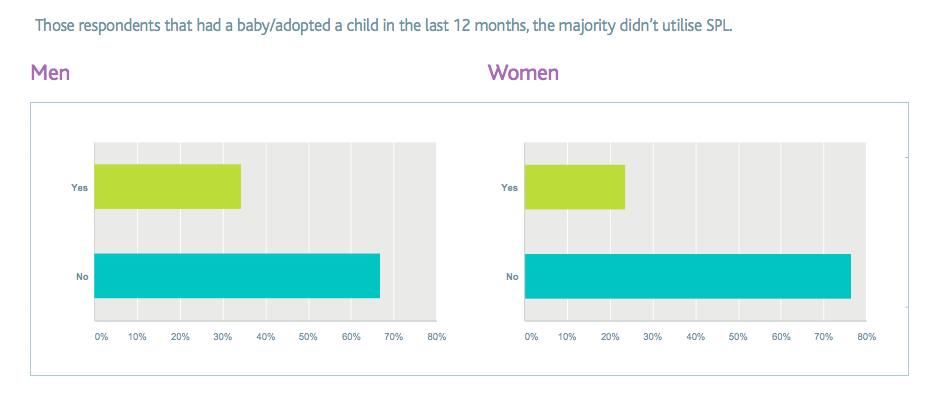
However, My Family Care’s 1% figure is not simply bogus – it also fails to reflect their own ‘research’ findings. Buried away on page 20 of the 26-page report is a chart showing that, among the (very small) number of male employees in their sample who had actually become a father in the last 12 months, more than 30% had taken SPL. More than 30%! Yes, the ‘research’ is so sloppy that My Family Care don’t even bother with the exact figure. Yet the Government’s own forecast (which we can safely say was optimistic) was just 2-8%.

Screen Shot 2016-04-07 at 13.58.31Which begs the question, should My Family Care and the Women’s Business Council have issued a press release headlined “Shared parental leave a stunning success!”? To which the short answer is: No. Because, as just noted, the size of the sub-sample of employees interviewed who were new fathers is far too small to be meaningful, and we have no idea whether the 200 employers they selected are in any way representative (My Family Care didn’t bother to include any explanation of their ‘research’ methodology, perhaps because that would simply have confirmed how shoddy the methodology was).

This is not the first time that someone has used the device of paper-thin ‘research’ on shared parental leave to get their organisation’s name in the paper – indeed, My Family Care have form. And, given the evident gullibility/stupidity of so many journalists and news editors, I don’t suppose it will be the last. But, as the employment team at law firm Lewis Silkin noted on Twitter yesterday, “until there is good data, all anyone can say on SPL take-up is that it is somewhere between 0% and 100%”.

Postscript: At least some at the BBC have recognised the error/laziness of their colleagues, with Radio 4’s “More or Less” describing My Family Care’s 1% figure as “massively misleading” and “one of the worst statistics we’ve ever reported on”.

Screen Shot 2016-04-10 at 13.31.21


Postscript 2 [26 April]: Clearly feeling that he hasn’t provided us with quite enough entertainment, Ben Black of My Family Care has now written an hilarious defence of the report and its promotion:

Screen Shot 2016-04-21 at 20.02.37

Posted in Equality | Tagged , | 3 Comments

Putting Shailesh Vara in context (condensed)

I’ve been feeling bad that my last post was a tad, well, unreadable. So this is the condensed version. With charts (see, I do love you, Gem).

So, the question is: Has the introduction of Acas early conciliation been (a) successful; and/or (b) a good thing for workers’ access to justice, to set against the justice-denying impact of the hefty employment tribunal fees introduced in July 2013?

Which begs a further question: What does ‘successful’ mean?

Fortunately, that further question is easy, as the Government has already answered it, on page 38 of its February 2014 Final Impact Assessment on the introduction of Acas early conciliation:

Early conciliation will have been a success if it can be shown that, at least in part, it has caused a reduction in employment tribunal claims and/or earlier resolution of workplace disputes and/or resolution of workplace disputes that lead to better satisfaction with dispute resolution services.

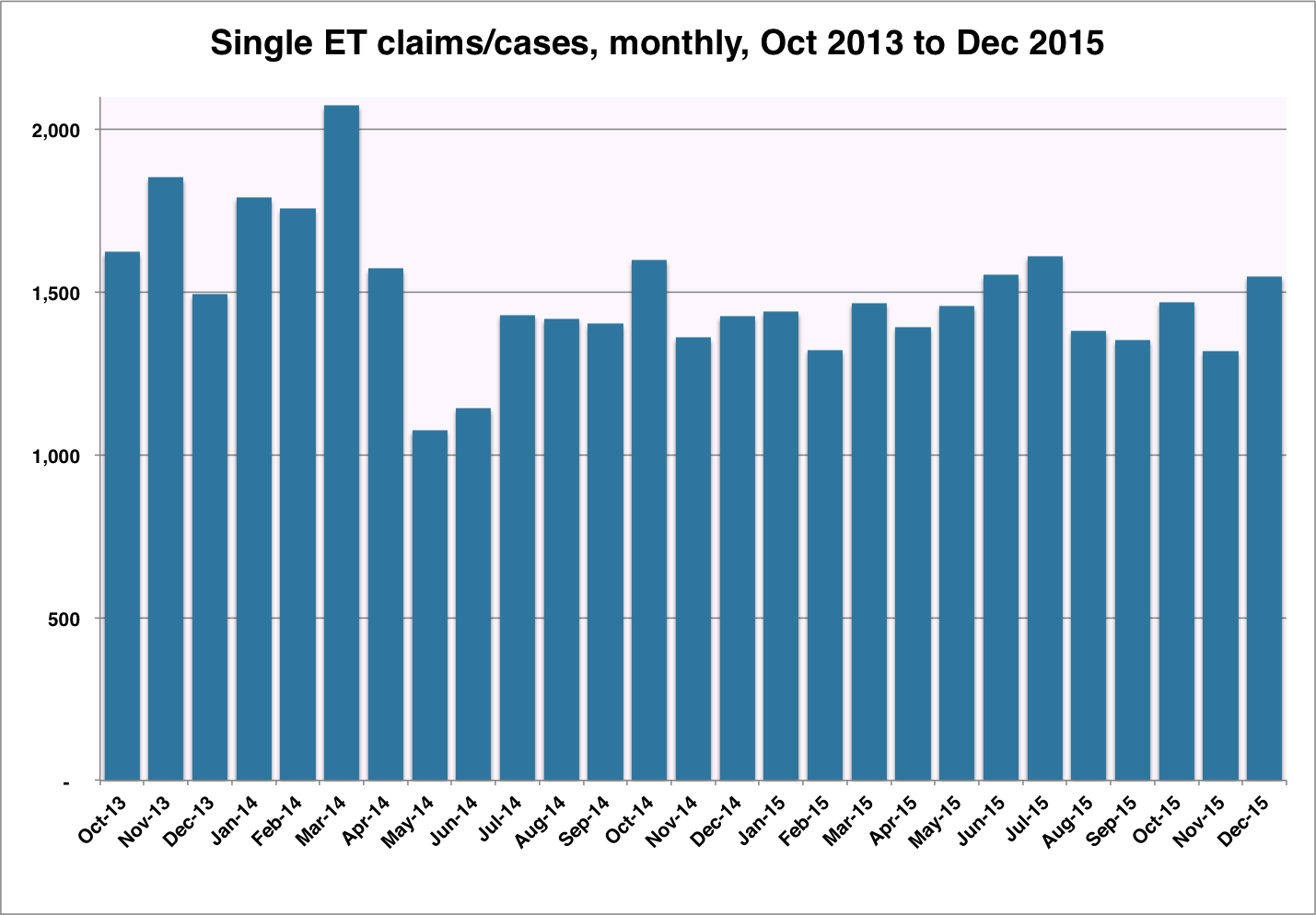
Has early conciliation caused a reduction in employment tribunal cases since its introduction in April 2014? As the following chart shows, there has indeed been a (relatively small) decline in the monthly number of single ET claims/cases since April 2014. If we ignore March 2014, when there seems to have been a rush of such cases to beat the introduction of early conciliation (just as there was in July 2013, to beat ET fees), the monthly average number of single claims/cases has fallen by 15 per cent, from 1,703 over the five-month period October 2013 to February 2014, to 1,447 over the most recent six months for which figures are available, July to December 2015.

postAcasSingles

According to that 2014 Impact Assessment, Acas early conciliation was supposed to bring about a 17% fall in ET case numbers. So, job done, everyone can go home.

Of course, just as junior injustice minister Shailesh Vara argues that the steep fall in ET case numbers from July 2013 was caused by factors other than the introduction of hefty ET fees in July 2013, it could be argued that the relatively small decline from April 2014 was caused by … oh, I don’t know, maybe global warming or something.

Whatever, since April 2014, Acas early conciliation has acquired a further objective, one not mentioned in that Impact Assessment: providing the Ministry of Injustice with a fig leaf for that sharp fall in ET case numbers from July 2013. There has been no denial of access to justice, says Mr Vara (in his oral evidence to the Justice committee of MPs, on 9 February this year), because everyone can go to Acas and have their potential ET claim conciliated. For free!

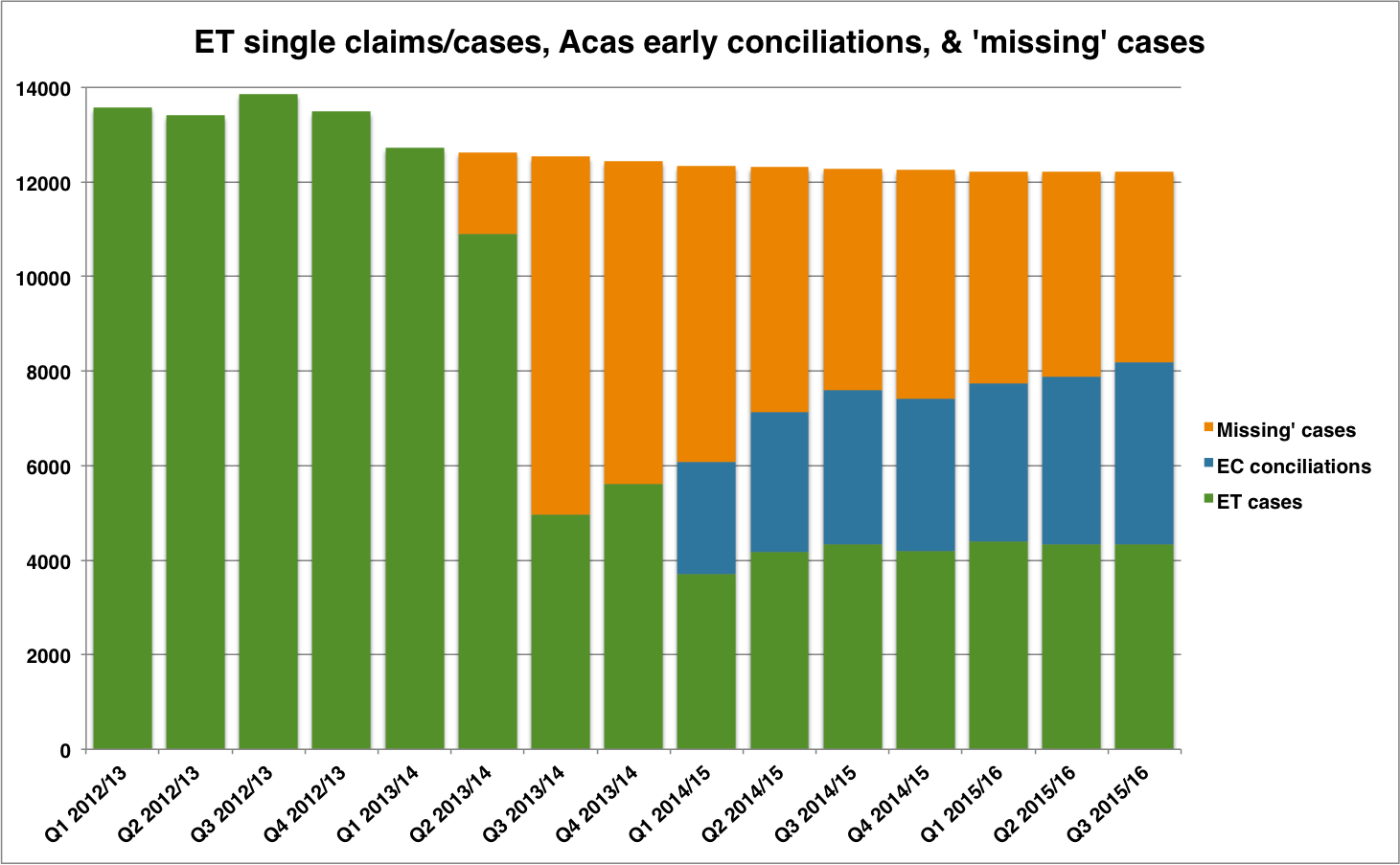
The problem is, not everyone does get their potential ET claim conciliated by Acas. We can see this in the following chart.

missingFor a full explanation of this chart and its assumptions, see my previous (unreadable) post. But, in a nutshell: the green area is the actual number of single ET claims/cases (by quarter); the blue area is the number of successful Acas conciliations of single cases; and the orange area is the number of ‘missing’ single ET claims/cases – that is, the difference between the actual number of such claims/cases plus the number of successful Acas conciliations, and my (conservative) projection of the number of single ET claims/cases we could have expected, had both ET fees and Acas early conciliation not been introduced. (And that projection allows for both the pre-existing, mild downward trend in ET case numbers, and the improving economy, each cited by Mr Vara as key factors in the sudden, sharp fall in ET case numbers from July 2013).

As of 31 December 2015, the total number of ‘missing’ single ET claims/cases – i.e. the number of ‘lost’ cases that cannot be explained away by the introduction of Acas early conciliation, and/or the pre-existing downward trend in ET case numbers, and/or the improving economy – is 49,937. And, if my projection is too conservative, then the number of ‘lost’ cases is even greater than 49,937.

In short, Acas early conciliation provides the naked Mr Vara with a less than adequate fig leaf for the justice-denying impact of ET fees. Yes, I know, that’s a truly horrible image.

At this point, Mr Vara would probably ask to ‘phone a friend’, and everyone’s favourite mathematical genius, Cabinet Office minister Matthew Hancock MP, would explain to us that all 49,937 ‘lost’ ET claims/cases were vexatious or otherwise unfounded claims that should never have been brought in the first place. He might even aver that all 49,937 workers went to Acas, only to be told that their potential ET claim was in fact a pile of pants.

However, if that were true, then removing such vast numbers of weak or hopeless cases from the ET system would have sent the overall success rate of ET claims rocketing up towards 100 per cent. And, sadly for the Hancock Theorem, the very opposite has happened – the overall success rate has fallen since mid-2014, when claims made post-July 2013 began to dominate the outcome statistics.

Sadly for him – and for anyone within sight – Mr Vara’s fig leaf is vanishingly small.

Posted in Justice, Workers' rights | Tagged , , | Leave a comment

Phantom menace: ET fees & Acas early conciliation

As previously noted on this blog, I have been resisting the urge to write about the feeble performance of the imbecilic junior injustice minister, Shailesh Vara MP, when giving oral evidence on the impact of employment tribunal (ET) fees to the Justice committee of MPs, and in particular his repeated citing of the 83,000 early conciliation (EC) cases handled by Acas in 2014/15. But it has to be done, as – however cretinous the minister’s line – he raises an important issue that needs to be fully understood. It’s just a tad more complicated than suggested by the minister, and his headline figure of 83,000 EC cases.

But before we put that figure in its proper context, it’s worth getting ourselves in the mood by noting what is said about the early conciliation process – introduced in April 2014 – in a new Acas research paper, Managing conflict in the contemporary British Workplace. Among the employment lawyers interviewed by the Acas-commissioned researchers

there was some scepticism as to whether early conciliation had resulted in more claims being settled than would have been the case under the previous system. Lawyers, in particular, doubted its benefits, as the following comments from a focus group illustrate:

Participant 1: “I found [early conciliation] totally irrelevant.

Participant 2: I don’t think [early conciliation] is necessarily settling claims that wouldn’t otherwise have been settled … There is no impetus to use it.

Participant 3: It’s just an additional hurdle.

Participant 4: I was going to say, acting for employers, you can wait and say, let’s wait and see … it doesn’t really change much, just pushes it back rather than bringing it forward.

Participant 5: You can also put a book on exactly how high the first number is going to be so it provides a little bit of amusement … But I don’t think it’s been a tremendously valuable feature.

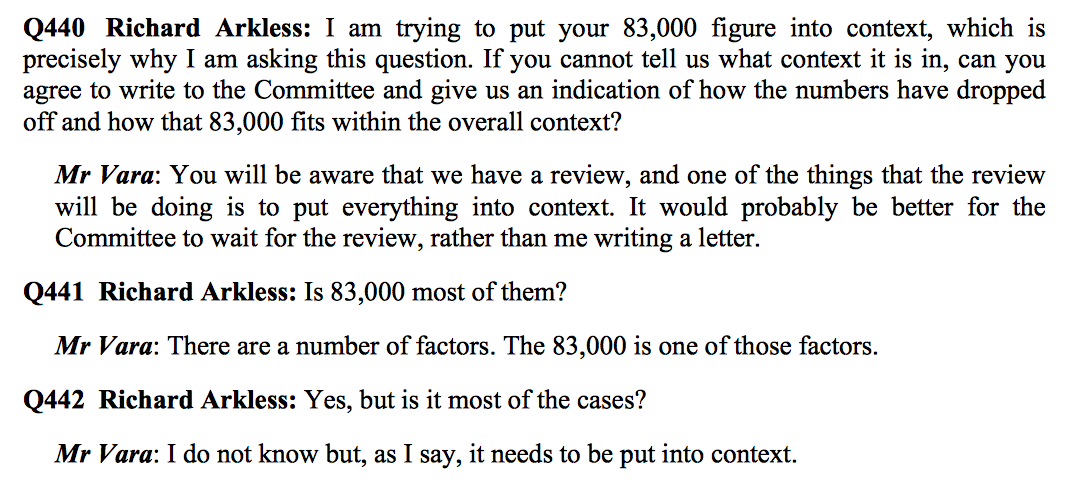
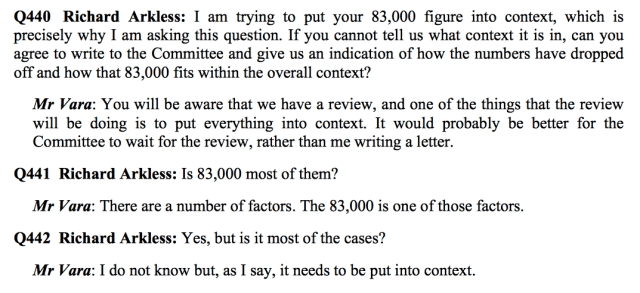
Hmm, they don’t really see it as transformational, do they? Whatever, this is what Mr Vara said to the Committee (before going on to mention the 83,000 figure a further four times, without ever attempting to put it in context – despite being pressed to do so by the SNP committee member Richard Arkless MP):

It is important to remember that, in the first 12 months of the ACAS conciliation procedure, ACAS handled some 83,000 cases. That is 83,000 cases which, alternatively, might well have ended up before the employment tribunal. Instead of people going to the employment tribunal, there is now a free service, which I hope this Committee would welcome, where people can go and try to resolve an issue in conciliation, rather than going to the employment tribunal.

It is [also] important to remember that, before the employment tribunal fees came into place, the trend of the number of cases going to tribunal had been going down. We also have to remember that the economy has been picking up, and employment is increasing. There have been changes to employment law. All those factors may well have contributed to the number of cases diminishing in the employment tribunal.

And it is true that, in 2014/15, Acas handled 83,423 early conciliation (EC) cases. However, according to Acas, “more than 4,000” of those 83,423 cases were multiple claimant cases. And it makes more sense, when examining trends in ET case numbers and the impact of ET fees, to focus on single claims/cases – even the Ministry of Injustice accepts that now. So, let’s deduct 4,200 (if anyone at Acas would like to give me the actual figure, please do so) from that 83,423. That gives us a figure of 79,223 single EC cases in 2014/15.

In that 12-month period, there were just 16,659 single ET claims/cases. So only 21% of the 79,223 single EC cases handled by Acas progressed to an ET claim. (That is very close to the 22% of all EC cases that Acas itself says progressed to an ET claim in the first three quarters of 2014/15 – for some reason, it appears not ever to have published the outcome figures for Q4 of 2014/15. So we’re all still on the same page, I think.)

Success! We can imagine Mr Vara doing a little jig around his Ministry of Injustice office when he was first presented with these figures. On second thoughts, maybe we shouldn’t.

At this point we need to note in passing that, when Mr Vara idiotically told the Committee that the 79,223 single EC cases handled by Acas in 2014/15 is 79,223 single cases “which, alternatively, might well have ended up before the employment tribunal”, he actually meant 62,564 single cases ‘which, alternatively, might have ended up before the employment tribunal’, as 16,659 of the 79,223 did end up before the employment tribunal.

However, that is only part of the picture. We also need to consider these figures in the context of how many single ET claim/cases there would have been, had both ET fees and Acas early conciliation not been introduced. As Mr Vara noted, “before the employment tribunal fees came into place, the trend of the number of cases going to tribunal had been going down”. Indeed it had, albeit only slowly. Between Q1 of 2012/13 and Q1 of 2013/14, the number of single claims/cases declined by 6.3%. If that rate of decline had continued – a highly questionable assumption, to which I will return – then in 2014/15 we could have expected 46,575 single ET claims/cases (or thereabouts, obvs).

And the first thing this tells us is that, in 2014/15, Acas handled 32,648 more single EC cases than it really needed to. In other words, 32,648 individual workers who would not have made an ET claim in 2014/15 nevertheless used Acas early conciliation. Which is not a bad thing – it’s always been the case that only a minority of all potential ET claims actually get made. So I for one am glad that the taxpayer paid for those 32,648 workers to have Acas attempt to conciliate their workplace dispute. But I’m not sure this was part of what ministers intended.

I haven’t been able to find any published figures for the annual expenditure by Acas on early conciliation, but 32,648 is a hefty chunk – 41.2% – of the total single EC caseload in 2014/15. And 32,648 is considerably more than the some 20,000 cases of pre-claim conciliation that Acas used to handle each year prior to the introduction the early conciliation process. As just noted, it is arguable that this additional expenditure of taxpayers’ money is unnecessary, even if it is to be welcomed, but at the very least it needs to be set against the fee income and operational cost savings enjoyed by the Ministry of Injustice as a result of the introduction of ET fees in July 2013. (On the hand, there have also been operational savings to Acas arising from the fall in ET case numbers caused by the fees, as there are fewer ET cases that go to post-claim conciliation by Acas.)

Furthermore, to that 41.2% we need to add the 21% of single EC cases in which the involvement of Acas was pretty much a total waste of taxpapers’ money, as the individual went on to issue an ET claim in any case. In other words, almost two-thirds of the single EC caseload was either unnecessary (at least in terms of the original policy aim, which was simply to reduce the number of ET cases) or wasteful.

But now we come to the important part. Pay close attention, advisers to Mr Vara.

As there were only 16,659 single ET claims/cases in 2014/15, but there would have been 46,575 such claims/cases, had both ET fees and Acas early conciliation not been introduced, we are missing 29,916 single ET claims/cases (you’ll have to excuse my spurious precision, just for the sake of my argument). And, as Acas managed to successfully conciliate only 15% of the 79,223 single EC cases it handled in 2014/15, just 11,883 (at most) of those 29,916 ‘missing’ single ET claims/cases were conciliated by Acas. (In fact, some of the 11,883 conciliations are likely to have been of cases among that extra, unnecessary caseload described above, but let’s not complicate matters).

In other words, even after allowing for both the downward trend in ET case numbers highlighted by Mr Vara in his oral evidence to the Justice committee, and for the impact of the (rather wasteful) Acas early conciliation, there are still at least 18,033 single ET claims/cases that were ‘lost’ to ET fees in 2014/15.

“Hang on”, chorus those advisers to Mr Vara, “we also have to remember that the economy has been picking up, and employment is increasing”. Indeed. And, the greater the number of people in employment, the greater the number of potential ET claims! Because ET claims aren’t just about redundancy, you numpties. So, my assumption, above – that the 6.3% decline in ET case numbers seen in the quarters up to Q1 of 2013/14 continued in subsequent periods – is highly questionable. It is far more likely that that slow decline (from the peak caused by the post-2008 recession) would have petered out, and that ET case numbers would have levelled out (or even started to increase).

So, let’s assume instead that the rate of decline slowed to just 3% between Q1 2013/14 and Q1 2014/15, and then to just 1% between Q1 2014/15 and Q1 2015/16. On that basis, we could have expected there to be 49,197 single ET claims/cases in 2014/15. And the number of such claims/cases ‘lost’ to ET fees, after allowing for the beneficial impact of Acas early conciliation, rises from 18,033 to 20,655.

That 20,655, not Mr Vara’s specious 83,000, is the figure that members of the Justice committee should have been asking the injustice minister about. Because that is the figure that cannot be explained away by the introduction of Acas early conciliation, and/or the pre-existing downward trend in ET case numbers, and/or the improving economy.

And, of course, that 20,655 is just the figure for 2014/15. There will be a similar figure for 2015/16, in which (according to my revised assumption about the downward trend) we could have expected 48,888 single ET claims/cases, but in which it is looking as if there were only about 17,500 such claims/cases, and in which Acas was on track (based on its figures for the first three quarters) to have successfully conciliated only about 14,400 single EC cases. So, it’s looking as if some 17,000 single ET claims/cases will have beeen ‘lost’ to fees in 2015/16 (I will run these numbers again in June, when the ET and Acas stats for Q4 of 2015/16 are published).

All together, then, some 37,000 single ET claims/cases were ‘lost’ to ET fees in the first two years of Acas early conciliation, even after allowing for the beneficial impact of that early conciliation. And let’s not forget those ET claims/cases ‘lost’ to fees between 29 July 2013 and April 2014, when of course there was no Acas early conciliation.

Of course, our undiscovered mathematical genius, Matthew Hancock MP, would say that all those 37,000 ‘lost’ ET claims/cases were vexatious or unfounded claims that should never have been brought in the first place. But if that were true, then removing such numbers of weak or hopeless cases from the system would have sent the overall success rate of ET claims shooting up towards 100 per cent. And, sadly for the Hancock Theorem, the very opposite has happened – the overall success rate has fallen since 2014.

Shailesh Vara … this is your context.
Screen Shot 2016-04-04 at 06.05.39

Posted in Justice, Workers' rights | Tagged , , , , | Leave a comment

ET cases: going down. ET awards: going up.

A new Acas research paper – Managing conflict in the contemporary British workplace, published this week – includes some interesting, if not entirely surprising, findings on the impact of the hefty employment tribunal (ET) claimant fees introduced in July 2013.

Apart from junior injustice minister Shailesh Vara MP, aka the nation’s slowest reader, and Cabinet Office minister Matthew Hancock MP, aka the nation’s greatest undiscovered mathematical genius, few will be surprised to learn that, among the employment lawyers interviewed by the Acas-commissioned researchers, there was

“a majority view that tribunal fees were a blunt instrument which could have the effect of deterring meritorious as well as weaker claims”.

Furthermore, the employment lawyers “agreed that the introduction of fees had changed the nature of cases that they were being asked to take”. Lower value claims are now much less common, as there is “little benefit” in workers pursuing such claims, given “the obligation to pay fees [as well as] the fear of retaliatory action, particularly for those with less than two years’ service”. Well, blow me down with an ET1 form.

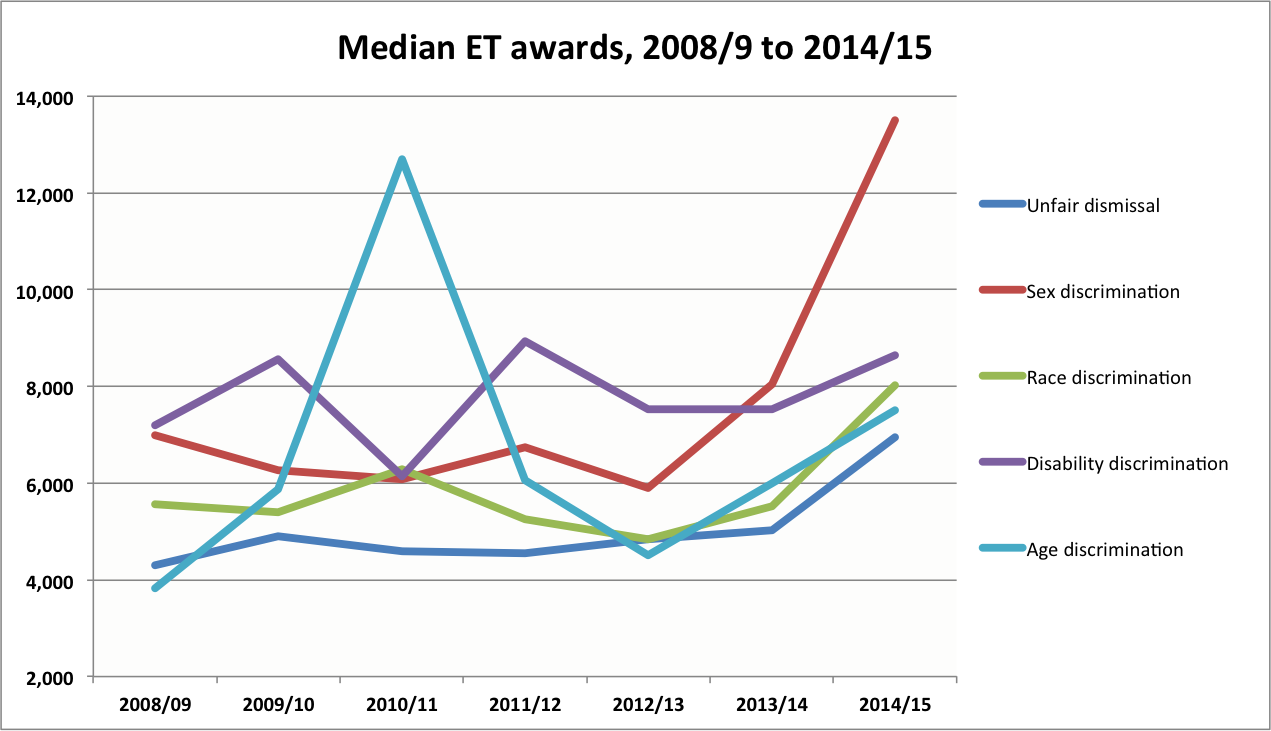
The HMCTS quarterly tribunal statistics confirm that relatively low-value ET claims for deductions of wages (aka ‘wage theft’) have “virtually disappeared”, but there is also evidence that fees have significantly changed the nature of higher value claims for unfair dismissal and discrimination. Just look at this chart, showing the median value (£) of ET awards for unfair dismissal and the principal discrimination jurisdictions.awardsmedian

I am an increasingly grey and wrinkled policy wonk, so I know we shouldn’t make too much of any change in just one time period. But I would be willing to bet a reasonable amount of my rather small salary on this chart showing the beginning of a sharply upward trend in the level of the median ET award for unfair dismissal or discrimination (the only jurisdictions for which the lackadaisical HMCTS bothers to record the relevant data). For the simple reason that, by eliminating lower value unfair dismissal and discrimination claims, the ET fees of up to £1,200 have forced the median value of such claims upwards.

But – duh, I almost forgot – there is no reason to worry. There is Acas early conciliation. Everything is hunky-dory. Though I do wish those Acas stats were a bit more transparent.

Posted in Justice | Tagged , , , | 1 Comment

Brexit & workers’ rights. Meh.

A few weeks ago, I turned down the offer of a freelance assignment: an article on the implications of Brexit for UK employment law. Well, the day job is pretty busy, and frankly the subject matter didn’t float my boat. Because I’m pretty sure a ‘leave’ vote in June’s referendum would have relatively little impact on workers’ rights in the UK – at least for the foreseeable future.

I wasn’t persuaded from that view by the publication, a few days later, of a 17-page TUC report on the issue. “Many rights accumulated over decades, including paid annual leave, time off for antenatal appointments and fair treatment for part-time workers, are ‘used every day by millions of workers’”, the Guardian reported the TUC as saying. But if the UK votes to leave the EU, “no one can say what will happen to these rights”.

A 17-page history of EU-derived workplace rights – some of them key, some of them fairly marginal to many workers’ lives – just to say “no one can say what will happen to these rights”. Well, yes, no one can say for certain. But, if we apply our minds to it – rather than just follow orders from Stronger In campaign HQ to scaremonger about our specialist area – we can probably say that the chances of Brexit leading directly to any significant erosion of those workplace rights are actually pretty slim, for several reasons.

Firstly, it would be a bold (or simply daft) Tory government that decided to cut the hardly over-generous statutory entitlement to paid holiday – just four weeks plus bank holidays – or to blatantly roll-back the scope of anti-discrimination law, or to slash (paper) maternity rights. These rights are now well-entrenched and, in most cases, extremely popular. So, even someone as tactically inept as George Osborne would surely see that “Vote Tory, get less holiday” is not a great campaign slogan.

Sure, some EU-derived rights are much less widely used, so would be less well protected by public support. For example, hardly anyone takes unpaid parental leave, for the simple reason that it is unpaid (though I did). But post-Brexit Tory governments would have many more pressing things to do with their parliamentary time than abolish or amend the largely forgotten parental leave provisions in the Maternity & Parental Leave Regulations 1999, at least for some considerable time. And who can say for sure that, 15 or 20 years from now, the EU itself won’t row back on such rights? Answer: no one.

The EU isn’t some kind of permanent, bleedin’ heart liberal institution. It’s made up of elected governments and politicians. Put more right-wing politicians in, and you get more right-wing (and fewer left-wing) policies out. Unfortunate, but that’s the way it is.

However, the principal reason Brexit would most likely have limited impact on workers’ rights in the UK is that Tory governments – including those aided and abetted by opportunistic if short-sighted Liberal Democrats – simply don’t need Brexit to erode and even destroy such rights. They manage perfectly well as things are.

The outcome of June’s referendum won’t make any difference to whether employment tribunal (ET) fees are abolished or lowered. Yet, by reducing the number of ET cases by 65%, those fees have given a green light to rogue or merely unscrupulous employers to mistreat and abuse their workers, in the almost certain knowledge that they will face no legal consequences. Rights on paper are worthless if they cannot be effectively enforced. And that applies to EU-derived workplace rights just as much as it does to domestically-generated rights. If proof of this were needed, just look at what’s happening with those partly EU-derived maternity rights.

Those justice-denying fees are arguably the single most important current issue when considering the threat to workers’ rights in the UK, yet this weekend Will Hutton failed even to mention them when writing in the Observer that “leaving the European Union – so suspending the array of protections it offers in the workplace – would erode what remains of British worker rights and entitlements.” That is a remarkable oversight. For what use is the ‘protection against detriment’ set out in Regulation 19 of the Maternity & Parental Leave Regulations 1999 if you cannot afford (or are simply not willing to risk) the £1,200 fees to pursue an ET claim against your rogue (former) employer?

A vote to remain in the EU won’t reverse the Coalition government’s erosion of the legal protection against unfair dismissal, or bring back legal aid for employment advice. Nor will it improve the currently pathetic enforcement of the national minimum wage, or reverse the shocking Tory assault on trade unions (and Labour Party funding) via the Trade Union Bill (which Will Hutton rightly describes as “one of the most pernicious pieces of proposed legislation in recent history”). And, against that background, it’s far from clear how it will help combat the growth in zero-hours contracts, bogus self-employment and other forms of precarious employment that has blighted so many workers’ lives.

None of which is to say that the EU-derived rights set out in the TUC’s report are unimportant, or that anyone should vote for Brexit (I certainly won’t be doing so). Apart from anything else, having a floor of basic workplace rights across the EU is crucial to ensuring a level playing field for British businesses (and their workers), whether the UK is in or out. And the European Court of Justice has in the past played an important role in driving forward and enhancing key workplace rights, not least that to equal pay.

Nor is it to deny that there might well be some impact of Brexit on workers’ rights. Darren Newman notes that Brexit could “raise some issues at the geeky margins [of employment law]” – what a wonderful phrase that is – and Michael Reed of the Free Representation Unit similarly suggests that discrimination law “might well drift at the margins”. As for geeky things like TUPE, David Whincup suggests – in his must-read blog earlier this month – that “any attempt to re-write TUPE would inevitably end up looking pretty much like TUPE”.

But to my mind the argument that Brexit would be “disastrous for rights at work” is thin and unconvincing, if not confected. Right now, the key battles over workers’ rights are wholly domestic. And they are mostly being lost.

Posted in Workers' rights | Tagged , , , | 2 Comments

How soon is now? Ministry of Injustice needs more time to work out the bleedin’ obvious.

Two months ago, I was daft enough to venture on this blog that Michael Gove – everyone’s favourite justice secretary – might be close to concluding his Ministry’s snail-like review of the justice-denying employment tribunal fees introduced in July 2013. The review report had by then been on Gove’s desk for four months, and it’s hardly a matter of rocket science. But I noted a teeny-weeny problem: the Ministry has no dosh to pay for a substantial reduction in the level of the fees, let alone full abolition.

Then, one month ago, I was tempted to write a blog post about the feeble performance of Gove’s junior minister, Shailesh Vara, when giving oral evidence on the impact of the fees to the Justice select committee of MPs, on 9 February. But then I found some drying paint to watch, and realised I couldn’t be bothered to count how many times the imbecilic Vara had told the MPs about the 83,000 early conciliation cases handled by Acas.

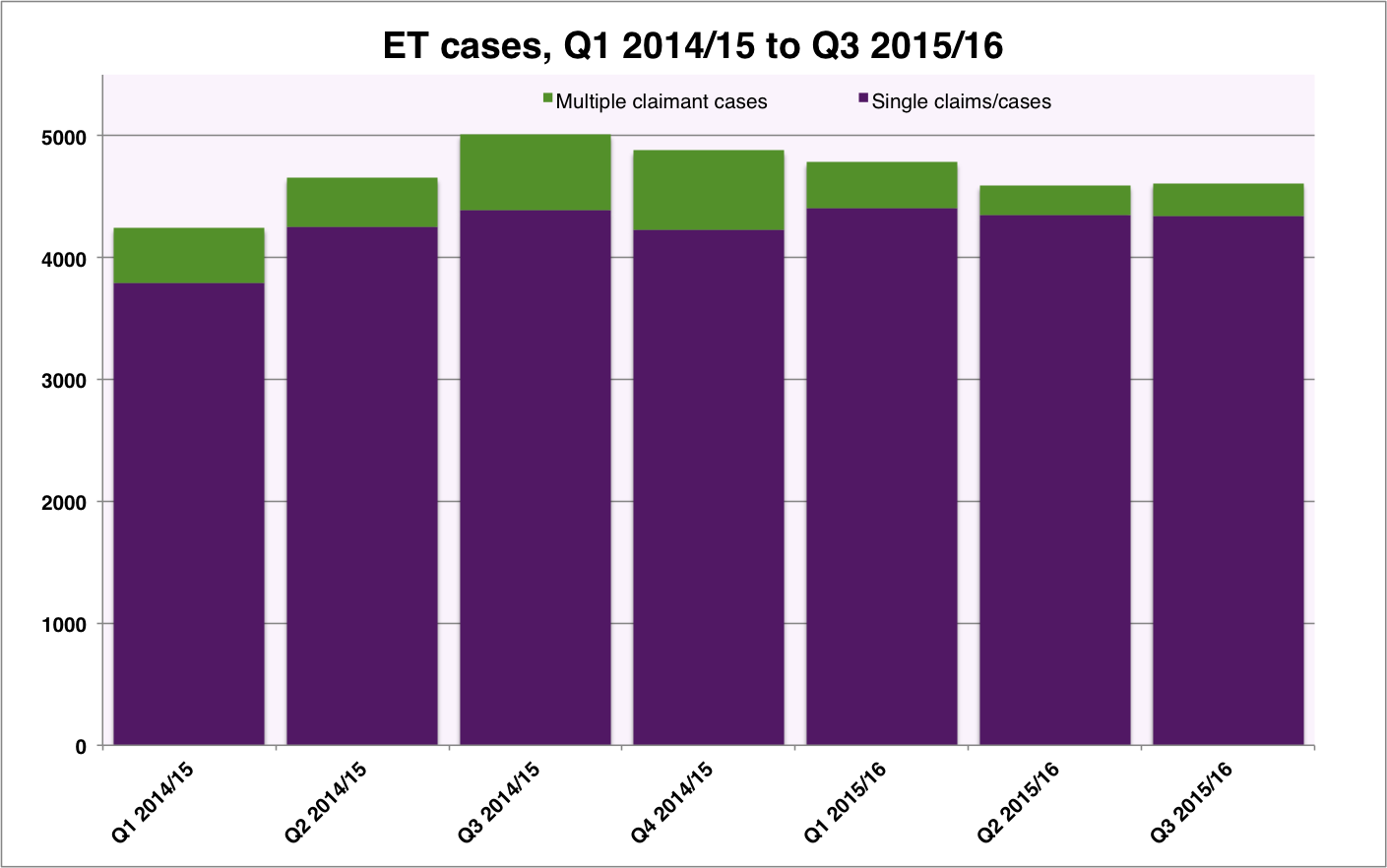
However, just in case you, dear reader, happen to be a member of that committee of MPs, here’s a chart showing how successful Acas early conciliation has been in cutting ET case numbers since its introduction in Quarter 1 of 2014/15 (that’s the column on the far left).

PostAcasECYes, that’s right. In each of the six quarters since the introduction of Acas early conciliation, the number of ET cases has been higher than when Acas early conciliation was introduced. And yet, according to Vara, it is Acas early conciliation that explains the 65% fall in ET case numbers since July 2013, when – by coincidence, obvs – his Ministry introduced claimant fees of up to £1,200.

Anyway, back to this week, and the long-delayed publication of the final reports of the joint BIS/EHRC investigation of pregnancy and maternity discrimination in the workplace. These reports should have been published in the autumn, and their non-appearance by the end of February caused the chair of the Women & Equalities committee of MPs, Maria Miller, to write to business secretary Sajid Javid to ask what the fuck was going on.

Whatever the fuck was going on, the final reports include an EHRC paper setting out ‘recommendations for change’. And among these was a frankly somewhat underwhelming recommendation that the Government, “in light of the findings of [the Ministry of Injustice’s] review, make changes to the employment tribunal fee system to ensure that fees are not a barrier to accessing justice for women experiencing pregnancy and maternity discrimination”.

Is this some kind of coded message? Has the EHRC seen the review report that’s been sitting on Michael Gove’s desk for the last six months? I have no idea. I’m just a policy wonk. I don’t do coded messages. That’s for the big girls and boys.

But I have read the Government’s equally pathetic response. You can too – they have so little shame they put it online. This states, in rejecting the EHRC’s effete recommendation that they “make changes” to the ET fees regime,  that “it is too soon to consider whether any action is needed here”.

Too soon? Not just to take action, but even to “consider whether any action is needed”. Yeah, like it’s too soon to consider whether England didn’t win the 2015 Rugby World Cup. The All Blacks may yet get disqualified en masse for being too big, and too good. It may yet emerge that Wales fielded players who don’t have a Welsh grandmother. Maybe the entire Australia team was on drugs. And Acas handled 83,000 early conciliation cases.

Yes, 83,000 early conciliation cases were handled by Acas. Eighty-three thousand. Did you know Acas handled 83,000 early conciliation cases? Early conciliation, 83,000 cases. Eighty-three thousand.

Have I mentioned Acas early conciliation?

Screen Shot 2016-03-22 at 18.20.52

Posted in Justice, Workers' rights | Tagged , , | Leave a comment

Workers thank their lucky stars for the Workers’ Party. Oh, hang on …

Every now and then, someone in the Labour Party has a pop at the Tories for not prosecuting enough employers for breaching the national minimum wage. When he was shadow business secretary, Chuka Umunna was not averse to skating on this very thin ice. In March 2015, the ‘Danger: Thin Ice’ warning signs were brazenly ignored by Stella Creasy and whoever was then running Labour’s twitter account. And, last weekend, tax law genius and all-round good guy Jolyon Maugham QC waded in, suggesting on Twitter – in response to a Citizens Advice report suggesting that wage theft by rogue employers has risen sharply in the past year – that “if you’re a business exploiting the most vulnerable, the Tories are a reliably sleepy policeman” and “there’s money to prosecute those who overclaim benefits; but none to prosecute those who underpay the minimum wage”.

Now, regular readers of this blog – Hello Gem! Hello Mum! – know that I’m not unwilling to have a pop at the Tory scumbags we are obliged to call Her Majesty’s Government. But in my humble opinion those two assertions by Jolyon need levelling with a few basic facts.

The first is that we shouldn’t get too carried away by what Citizens Advice has chosen to say about a single year-on-year change in its casework recording statistics, so as to get its name in the paper. I worked at Citizens Advice for 13 years, so I know how gnomic – and prone to unexplained fluctuations – those casework statistics can be. One or two CABx recruit enthusiastic new (volunteer) advisers, or send their existing ones on a training course, and suddenly you have a ‘surge’ in cases tagged as involving some particular third-tier problem that many advisers never bother to record. The following year, it’s gone. (It would have been helpful for Citizens Advice to include the figures for previous years, so we could see any trend, but they didn’t. Maybe they flunked Policy Wonk School.)

That said, an increase in the incidence of ‘unlawful deductions’ – or wage theft – by rogue and unscrupulous employers is exactly the kind of outcome that I and many others predicted for the justice-denying employment tribunal fees dreamed up by cuddly Ken Clarke, and introduced by the somewhat less cuddly Chris Grayling in July 2013. Even Michael Gove – everybody’s favourite justice secretary … ever! – has acknowledged this prediction as “a perfectly internally coherent theoretical argument”, while at the same time dismissing it on the grounds that he doesn’t see “evidence that employers are behaving in [such] an outrageous way”. Which is the kind of thing Tory scumbag politicians say when they’re thinking: “You’re right, of course, but I don’t give a fuck.”

However, ‘wage theft’ is not necessarily the same as ‘breaching the national minimum wage’. It is perfectly possible for a worker to be getting the minimum wage (if only just), while at the same time losing hundreds or thousands of pounds to wage theft by their employer. I saw hundreds of such cases during my 13 years at Citizens Advice. And, in such cases, enforcement of the law (via the ET system) falls to the individual worker concerned, not the government.

This was less than satisfactory even before the introduction of hefty ET fees, and I spent a lot of time and effort trying to get the Blair and Brown governments to do something about it. But they wouldn’t, and now the scumbag Tories are doing something that might help address the issue. If I were (still) a member of the Workers’ Party, I’d be a tad embarrassed about that. For an effective Fair Employment Agency could tackle the systemic but often hidden exploitation such as that in London’s hotels.

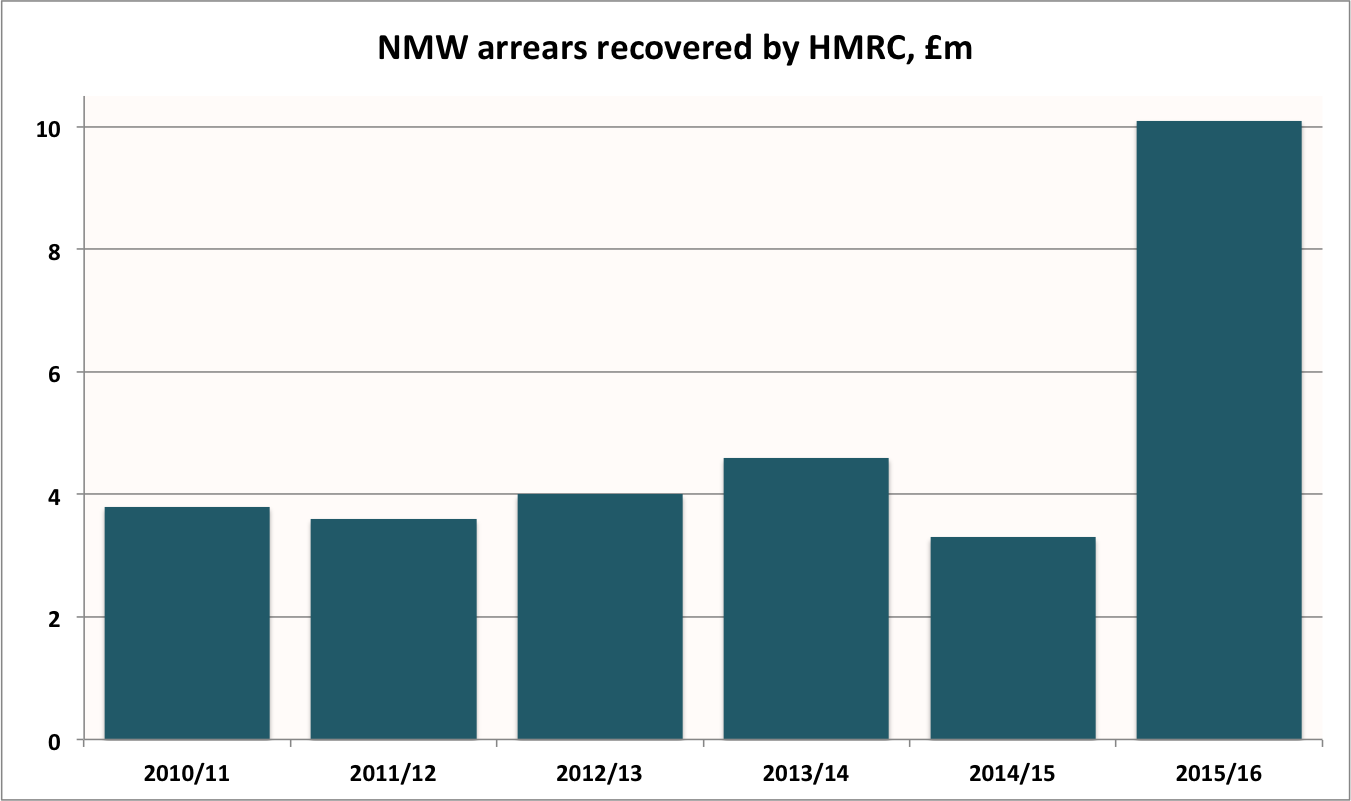
As for ‘money to enforce the minimum wage’, under the scumbag Tories the annual budget for NMW enforcement has reached a level that humble policy wonks like me could only dream of in the New Labour years. In the last year of Gordon Brown’s government, the budget reached £8.3m, up from £6.8m in 2007/08, and just £5.6m in 2005/06. It then stuck at £8.3m for each of the first three years of the Coalition – despite cuts of 25% or more to most departmental budgets – then increased to £9.2 in 2014/15, before rising again to £13.2m for 2015/16. In the last year of the Labour government the HMRC enforcement team had 140 full-time equivalent staff; it now has 224 FTE staff. And the enforcement budget is set to increase again in 2017/18.

Admittedly, very little if any of that £13.2m goes on criminal prosecutions of NMW rogues – there have been no such prosecutions since 2013. But then – as Chuka Umunna, Stella Creasy and others tended to overlook – it took Labour until 2006 to get around to introducing criminal offences in relation to the minimum wage. And then they only managed seven prosecutions before being booted out of office in 2010.

With criminal prosecutions costing an average of 27 times the average cost of an HMRC investigation and civil enforcement, I can’t see this changing while the Tories remain in power – though ministers have said that some of the increased funding will be used to “establish a new team of compliance officers in HMRC to investigate the most serious cases of employers not paying the NMW”, and that might well lead to some prosecutions. But if Labour want to do things differently, then they really need to spell out how that substantial extra cost would be met. The 2015 manifesto did not contain any pledge of extra funding for NMW enforcement, so a switch to criminal prosecutions would simply have led to a substantial reduction in the level of civil enforcement.

None of this is to say that the current level of civil enforcement of the NMW is adequate – it certainly isn’t, as I have said repeatedly and as today’s news of a successful legal challenge against care company MiHomecare reminds us. Nor is it to say there shouldn’t be some criminal prosecutions – I myself have recently questioned why the security firm found by HMRC to have thieved a whopping £1.742m from 2,500 of its workers hasn’t faced criminal prosecution. But the number of criminal prosecutions is not a reliable indicator of the level of NMW enforcement, and it’s disingenuous of anyone in Labour to suggest otherwise.

danger-thin-ice-sign-s-8286

Posted in Workers' rights | Tagged , , , , | Leave a comment

Oh look, another set of ET claim statisti …. zzzzzzzzzzz

Warning: This post contains selected statistics, taken in isolation and out of context         (© Shailesh Vara, junior injustice minister and officially the nation’s slowest reader)

So, today the Ministry of Injustice coughed up the latest set of quarterly employment tribunal (ET) statistics, covering the period October to December 2015 (Q3 of 2015/16). The days when each new set of these statistics was eagerly anticipated and swiftly pounced upon as evidence of the (predicted) impact of ET fees now seem an awfully long time ago, and it’s fair to say that, these days, the statistics amount to little more than a reasonably effective cure for insomnia. But I have to pursue my doomed quest to win the heart of Gem ‘The Doctor’ Reucroft somehow. So, here are a few charts.

ET case numbers are now really, really, really boring

Never mind the denial of justice, feel the stability! Great for HMCTS management planning. In Q3 of 2015/16, there were 4,338 single claims/cases, just seven fewer than in Q2, when there just 58 fewer than in Q1. Such uniformity is quite remarkable, and suggests ET claim/case numbers really have hit rock bottom.

casesQ

The Hancock Theorem really is a load of cock and bull

Armed with today’s set of statistics, we can hammer a few more nails into the coffin of that wonder of Tory intellectual thought, the Hancock Theorem of Vexatious ET Claims.

According to the second cleverest member of the Government – I’m sure Matthew Hancock himself would concede top place to that titan of intellect, injustice minister Shailesh Vara – the success rate of ET claims should by now be bobbing around at or just below 100 per cent, all the vexatious and otherwise unfounded claims having been cleverly weeded out by the hefty, upfront fees introduced by the also very clever Chris Grayling in July 2013.

Unfortunately – not that the Cabinet Office minister gives a flying fuck – the Hancock Theorem has not been supported by the Ministry of Injustice’s own figures, even when taken in context. These have so far indicated that, far from going through the roof, the success rate has in fact fallen significantly since mid-2014. Oops.

Once again, in what is the seventh quarter since we could first have expected to see the impact of fees reflected in the outcome figures, the overall success rate – that is, including claims conciliated by Acas, or withdrawn/settled – is well down on pre-fees levels, at 63%.

At 10%, the narrow measure of success is also significantly below pre-fees levels – and certainly is not zooming towards 100 per cent, as the Hancock Theorem predicts. And, at 37%, the proportion of unsuccessful claims is once again significantly up on pre-fees levels, despite all the weak and vexatious claims having been weeded out by fees.

success

outcomeall

Given that the Ministry statistics on which the above charts are based are highly selective, are taken in isolation and are 150 per cent out of context, I can’t really be arsed to explain the dotted lines in Q1 of 2015/16. But if your insomnia is really bad or you just really need to know, all is explained here.

Some 60,000 single ET claims/cases lost to fees since July 2013

As of the end of December 2015, the number of single ET claims/cases ‘lost’ to fees since July 2013 was somewhere between 57,225 and 64,542. But then my projections are so selective and out of context. And, in any case, according to the Hancock Theorem, not one of those 57-64,000 claims would have been well-founded.

Yes, that’s right. For the famed Hancock Theorem to be correct, the Ministry of Injustice calibrated the level of their ET fees so precisely as to weed out up to 64,500 vexatious and otherwise unfounded ET claims without denying access to justice to one single exploited or unfairly treated worker. Not one.

projection

Posted in Justice | Tagged , , | 1 Comment

NMW enforcement: what the **** is going on, Mr Boles?

“Our policy of naming and shaming employers who ignore the law means there are consequences for their reputation as well as their wallets.”

So said BIS Minister Nick Boles in February, when naming & shaming another 92 employers for non-compliance with the National Minimum Wage. Though it’s questionable how much those reputations were damaged by a few reports in local media, and not much else.

But what about those wallets?

Well, the 92 employers certainly had to pay back some £1.873 million in NMW arrears to a total 3,352 workers. But £1.742m (93%) of that £1.873m was paid back to 2,519 (75%) of the 3,352 workers by just one of the 92 NMW rogues, Total Security Services Ltd, with a mere £131,056.59 paid back by the other 91 penny-pinching employers (an average of just£1,440 per employer). So, most of those corporate wallets took a pretty small hit.

But what about the financial penalties that the 92 NMW rogues would have paid to HM Government? Since March 2014, employers found by HMRC to have breached the NMW have had to pay a financial penalty to HMG equivalent to 100% of the total NMW arrears owed (previously, the penalty rate was just 50% of the arrears owed).

Which makes it somewhat surprising to learn – from the minister’s answer today to a parliamentary question by Caroline Lucas MP – that the 92 employers named & shamed in February were “issued with a combined total of over £629,000 in penalties”. Which is not – and Gem ‘The Doctor’ Reucroft can check my maths if she wants – 100% of £1.873m. It’s not even 50% of £1.873m. It’s just 33.6%.

Not only that but, if the 91 NMW rogues other than TSS Ltd were issued with 100% financial penalties on their combined arrears of £131,056.59, then TSS Ltd can only have been issued with a financial penalty of some £498,000. Which is not even 50% of £1.742m. In fact, it is just 28%.

So, what the fuck is going on, Mr Boles?

PS – Worth noting also that, according to the minister’s reply, eight of the 92 NMW rogues have not actually paid the financial penalty issued against them. However, this is not particularly surprising. Most of the 92 are economic minnows, who have a tendency to go out of business. I wouldn’t be surprised if at least some of the eight non-payers never pay the penalty (they probably haven’t paid the NMW arrears, either).

Posted in Workers' rights | Tagged , , | Leave a comment