Previously on this blog, I have noted how, in March this year, HM Courts & Tribunal Service began to revise its previously published management information on the backlog of Employment Tribunal cases, and how this magical shrinkage of the ET backlog later accelerated. And the latest set of HMCTS management information, published yesterday, indicates that this downwards revision of previously published data continues.
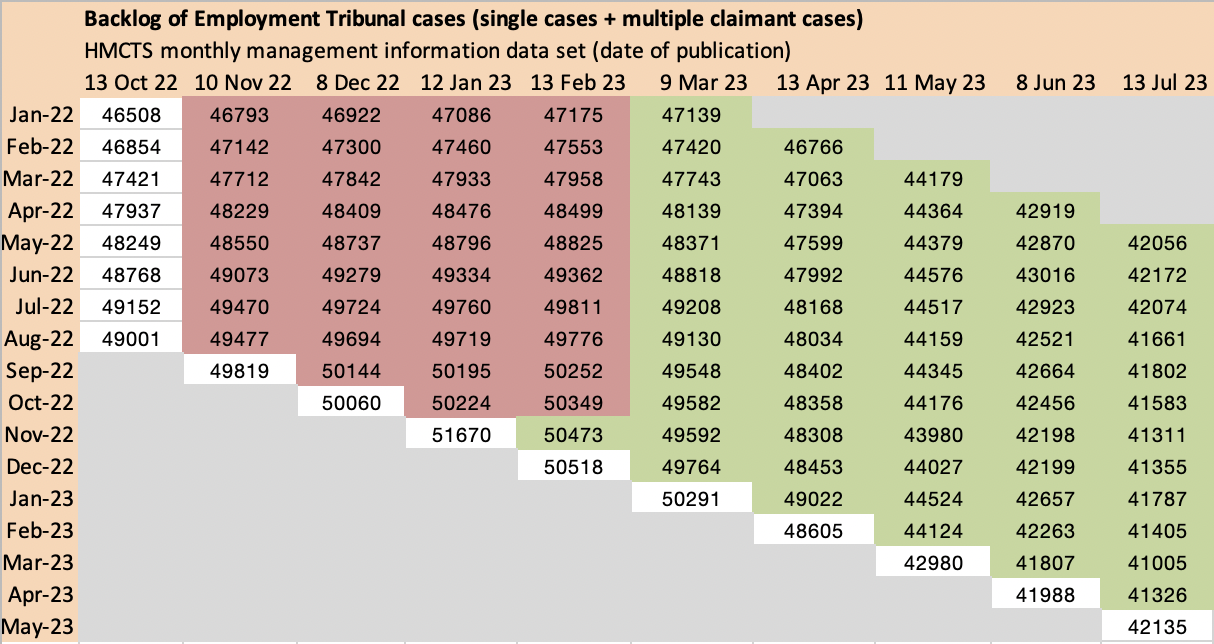
Until March this year, the previously published data was routinely revised in each new data set, but only minimally and invariably upwards. But from March the direction of revisions reversed, and the magnitude of the revisions increased significantly. So, for example, the backlog as of November 2022, which was 51,670 according to the data set published by HMCTS on 12 January 2023, has been steadily revised down to 41,311, according to the data set published yesterday – an overall downwards revision of 20%.
So, I’ve updated my chart showing the revisions, and added colour coding to make it easier to see the transition: red where the figure was revised upwards from the previous data set, and green where it was revised downwards.
The reasons for this revisionism remain unclear, but it goes without saying that a smaller backlog of ET cases is good news. The bad news is that, according to the data set published yesterday, the backlog has been stubbornly stuck at about 41-42,000 for the past year.
Maybe the Department for Business & Trade missed the memo about Father’s Day always being celebrated on the third Sunday in June, but they waited until 29 June to publish their response to the consultation on reform of parental leave and pay that they launched four years ago, in July 2019, with its gift to future new fathers of “more flexible” statutory paid paternity leave.
Yep, four long years of contemplating “high level options for reforming parental leave and pay”, and all that the DB&T wonks and their ministerial bosses have come up with is one minor reform to paternity leave. So, under this government at least, there will be no reform of the chronically failing Shared Parental Leave scheme, and no enhancement of the UK’s less than generous maternity leave and pay.
In short, four years have been utterly wasted. Because there is little if any demand for the one proposed reform: to “allow eligible fathers to take their Paternity Leave and Pay in two separate blocks of one week of leave (two weeks in total) at any point in the first year”.
The (somewhat ambiguous) question posed in the 2019 consultation (Q8) was:
How should the timing of when Paternity Leave can be taken be balanced between giving families choice and flexibility, and incentivising particular parental behaviours? For example, should fathers/partners be able to take Paternity Leave at any point in the first year or be required to take their leave when the mother has returned to work to incentivise solo parenting?
The Government’s consultation response states that “respondents tended to agree that Paternity Leave and Pay should be designed in a more flexible way so that fathers and partners could take it in a way that suits them best”. And, in Annex One, it states that:
64% of all respondents said the Government should provide more flexibility and allow fathers to take their [up to two weeks of paternity] leave within one year of the birth of their child. They also thought this would promote solo parenting by fathers.
However, it’s hard to find supporting evidence for these statements. Who were the 64%?
Paternity leave is, by definition, leave that is taken immediately after the birth. This should remain a separate entitlement to parental leave. Fathers and partners should be provided with paid parental leave which can be provided more flexibly, can be taken up to a year or 18 months from the birth and can be designed to incentivise solo parenting.
Paternity leave should be restricted to a shorter period of well paid leave at the time of the birth to enable new fathers and partners to spend time with their new baby and support the mother after the birth. In order to reduce complexity and scope for disputes we recommend that paternity leave should remain a two week block as at present.
The trade union Unite was also not among the 64%, as in their response they stated:
Paternity Leave is there for one purpose only and that is the need for fathers/partners/nominated carers to bond with the baby and support and care for the mother recovering from childbirth and her breastfeeding and therefore, it can be flexible but should be around the birth [emphasis added]. Parental Leave however, is a period of leave to be taken in the first 18 months to care for the child(ren).
Also not among the 64% were the Equality & Human Rights Commission and the TUC who, rather than address the specific questions set out in the consultation, simply set out their own proposals for policy reform. But nothing they said in their responses could be construed as support for ‘allowing fathers to take their existing paternity leave entitlement within one year of the birth of their child’.
Nor can I see any support – explicit or merely implicit – for ‘allowing fathers to take their existing paternity leave entitlement within one year of the birth of their child’ in the responses of Close the Gap (Scotland’s expert policy advocacy organisation on women’s labour market participation), the Women’s Budget Group, the British Medical Association (BMA), and the Chartered Management Institute (CMI).
Sure enough, Parental Pay Equality did call for “a minimum 12 weeks of paternity leave with a six-week portion paid at 90% to be taken at any time in the first 18 months and split into blocks”, but you’d have to be a bit desperate to count that as support for ‘allowing fathers to take their existing paternity leave entitlement within one year of the birth of their child’.
It goes without saying that, in general, flexibility in family leave provisions is a good thing, and no doubt there will be some new fathers who will be glad to be able to take one or even both of their two weeks of paternity leave later in the first year, rather than immediately after the birth. But I don’t think there will be many of them. Because one of the messages that comes out of the recent Centre for Progressive Policy/Pregnant Then Screwed report is that some new mothers want their partner to be at home, supporting them after the birth, for longer than two weeks. (Which is precisely why, under the 6+6+6 model of maternity and parenting leave proposed by Maternity Action since 2019 – but which both the CPP and PTS have declined to support – fathers would be able to use some – or even all – of their six-month entitlement to paid parenting leave to extend their two weeks of paternity leave). So the ability to forsake paternity leave at the time of birth in favour of taking two weeks off to solo parent once the birth mother has returned to work would appear to me to have extremely limited value.
So, why do it? Well, my guess is that ministers felt they had to come up with something – four years is a long time to think about an issue and then do nothing. And they do have an outstanding manifesto commitment from December 2019 to “make it easier for fathers to take paternity leave”. They can now claim to have ticked that box (assisted by helpful headlines in the robotic specialist press), and the employer lobby groups will settle for the consultation not having led to anything more significant.
Whatever, the quest for a more equitable and ‘father inclusive’ system of parental leave that properly reflects the different purposes of maternity, paternity and parenting leave goes on. Will the Labour Party deliver? Let’s just say I’m not holding my breath.
Earlier this week on this blog, I noted the traditional attempts by policy wonks to exploit the commercial confection that is Father’s Day to call for reform of statutory paternity leave, including a new joint report by the think tank Centre for Progressive Policy (CPP) and the campaign group Pregnant Then Screwed (PTS). And, now that I’ve stopped tearing my hair out, I’m ready to set out a few thoughts on that report.
The report’s key policy recommendation is: “increase the length of non-transferable paternity leave to a minimum of six weeks and pay it at 90% of income in line with current statutory maternity pay”. Because the CPP’s analysis of OECD data from 1975 to 2021 finds that “a paid entitlement of at least six weeks [in OECD countries] is associated with a decreased incidence of both gender wage gaps and labour force participation gaps, by 4.0 and 3.7 percentage points respectively”. The CPP and PTS then conclude from this that “increasing the length of paternity leave [from two to six weeks] has the potential [sic] to reduce inequalities in pay, career progression, employment, and the provision of childcare”. And, apparently, this would only cost up to £1.6 billion a year – that is, a mere 43% increase in the current total spend on statutory maternity, paternity and other parental pay of some £3.7 billion per year, and a 32-fold increase in the current annual spend on statutory paternity pay of just £50 million a year.*
Memo to self: breathe, Wonky, breathe.
Yes, increasing paid paternity leave from two to six weeks, and paying it at 90% of earnings instead of the current, ludicrously low flat rate of £172 per week, might reduce the UK’s gender pay and labour force participation gaps. Or it might not – correlation does not imply causation, and there might well be other reasons why those OECD countries with better paternity leave provision than the UK also have smaller gender pay and labour force participation gaps.
Indeed, the CPP/PTS report concedes that “parental leave policies are far from the only barrier to mothers’ participation in the labour market – with the accessibility of childcare, gender norms and workplace culture also being highly influential”, and that “the countries that offer longer periods of paid paternity leave could be significantly different from those that don’t, and these differences may be correlated with [the lower] gender gaps in the labour market.”**
So it is possible – or even probable, given what we know about the UK’s totally shit childcare system, gender norms and workplace culture – that increasing paid paternity leave from two to six weeks and paying it at 90% of previous earnings would have very little if any impact on the UK’s gender pay and labour force participation gaps.
In short, the CPP and PTS want the Government to gamble up to £1.6 billion a year on the reliability of the CPP’s heterogeneous difference-in-differences regression model.
On the other hand, we can say with near certainty that increasing paid paternity leave from two to six weeks and paying it at 90% of previous earnings would not deliver the policy goal of more equal parenting – which, as the report notes, is “critical to women’s empowerment and increased earnings”. Because six weeks of paid paternity leave is still only six weeks. And only four weeks more than we have now.
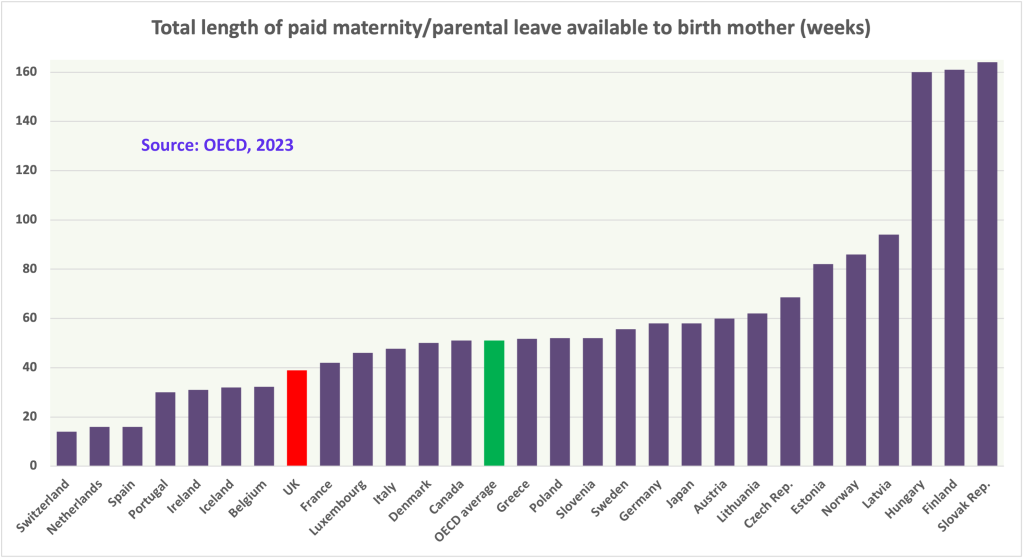
We have known for years, from the government’s own research, that – for very good reasons, including the need to recover physically and mentally from nine months of pregnancy and giving birth – the average new mother takes 39 weeks of maternity leave (that is, her full entitlement to paid maternity leave). And that’s very unlikely to change just because the child’s father can be at home with the mother for up to six weeks immediately after the birth, instead of just one or two weeks. Because that 39 weeks is not excessively long. In fact, as the following chart shows, 39 weeks of paid leave is short by international standards.
So, even if the average new father were to take the full six weeks of paid paternity leave proposed by the CPP and PTS, he would still only be taking 13% of all the paid parental leave taken by his family, with the birth mother taking 87%. And, as paternity leave is tied to the time immediately after the child’s birth, he’d be taking all of his leave when the child’s mother is also at home. So, unlike the child’s mother, he wouldn’t be doing any solo caring or parenting. As the Fatherhood Institute noted in 2019, in their response to the Government’s still not concluded consultation on reform of parental leave, “leave taken by the father/ partner at this point does not offer the family flexibility or choice, or incentivise particular parental behaviours”.
Perhaps the CPP and PTS think that the Fatherhood Institute is wrong on this point, and hope that more fathers taking more paternity leave immediately after the birth would lead to greater take up by fathers of parental leave later in the child’s first year, under the chronically failing Shared Parental Leave (SPL) regime introduced in 2015. As the report acknowledges, analysis by Maternity Action indicates that a mere 2% of new mothers who start on statutory paid maternity leave use the SPL scheme to transfer some of that paid leave to the child’s father. But if that is their hope, they don’t say so in the report. And, given the (well known and understood) reasons for the failure of the SPL scheme, it would in my view be wildly optimistic to think that increasing paid paternity leave would lead to significantly greater use of the SPL scheme.
Whatever, the CPP and PTS policy recommendations would leave the chronically failing SPL scheme in place, and unreformed. Which to my mind is yet another lost opportunity to make the case for scrapping the SPL scheme and creating a more equitable and ‘father inclusive’ system of parental leave that properly reflects the different purposes of maternity, paternity and parenting leave. As I’ve said elsewhere, any such system should deliver an individual (non-transferable) right to a significant period of parenting leave for fathers (and other second parents), while protecting and ideally enhancing the existing statutory rights of birth mothers.
None of which is to say that our paid paternity leave provision should not be more generous than it is now. Given the ‘health and safety’ purpose of paternity leave – to support the mother at and immediately after the birth – there is a very strong case for it to be paid at 90% of earnings, just like the first six weeks of maternity leave, rather than at the ludicrously low basic rate. Furthermore, eligibility needs to be widened – at the very least, it should be a Day One right (as the Labour Party already proposes). And, under the 6+6+6 model of maternity, paternity and parenting leave proposed by Maternity Action, fathers would be able to use some (or even all) of their entitlement to six months of paid parenting leave to extend their two weeks of paternity leave, should they want to do so.
Furthermore, it goes without saying that all parental leave should be (much) better paid. In March, an important new report by the Fabians Society, In Time of Need, highlighted that the UK’s average income replacement rate for maternity leave is the third lowest in the OECD: “Almost every other European country pays an earnings-related maternity (or parental) payment for most or all of the duration of statutory leave [and] replacement rates are high, almost always falling between 75% and 100% of earnings”. But in the UK the earnings replacement rate is just 29.5%. The Fabian Society propose that all statutory maternity, paternity and parenting pay be paid at 50% of previous earnings, subject to a cap.
So, frankly, it is deeply disappointing to see the CPP and PTS call on the Government to spend up to £1.6 billion a year on a minor legal reform that would most likely not deliver the claimed economic benefits, and would certainly not deliver the overall policy goal of more equal parenting. We’ve wasted an entire decade on the chronic policy failure of Shared Parental Leave, and now think tanks and campaign groups are wasting more time and energy on performative dad dancing.
* I can’t find an explanation of the “up to £1.6 billion” costing cited in the Guardian article anywhere, but my own (quick and dirty) number crunching indicates the total extra cost would be up to £1.4 billion. This assumes (a) male median weekly pay of £683 (ONS, April 2022) and (b) 100% take-up of the full six-week entitlement among 400,000 new fathers, and it allows for the current (near negligible) spend on statutory paternity pay. Clearly, in practice, take-up would not be 100%. But then the claimed economic benefits would of course be diminished too.
** If you want to read about “time-invariant unobserved heterogeneity”, there is a technical appendix to the report that seeks to explain how they have cleverly wonked away the possibility that they are just presenting correlation as causation. But £1.6 billion is one helluva gamble to take on a think tank’s heterogeneous difference-in-differences regression model.
[Update: Business minister Kevin Hollinrake’s answer to a recent parliamentary question suggests he has not been wowed by the CPP/PTS report. And, in related news, on 29 June the Department for Business & Trade finally published both its response to the above-mentioned Good Work Plan: Proposals to support families consultation, and the evaluation of the Shared Parental Leave scheme that it started in early 2018. Needless to say, the SPL evaluation report is not worth the 163-pages of paper it is printed on, and the similarly underwhelming consultation response proposes just one reform to paternity leave: subject to legislative change, this will no longer be tied to the time of birth, and will be available to take at any point throughout the child’s first year. Which may or may not be a good thing.]
Father’s Day is approaching, so naturally paternity leave is back in the news – or, at least, back in the Independentnewspaper – thanks to a “damning” new TUC survey finding that “the low level of statutory paternity pay stops one in five dads/partners from taking paternity leave at all”.
No one, least of all the Independent newspaper, appears to have spotted that this take-up rate of 80% is considerably better than the 33% previously and repeatedly bemoaned, year after year after year, by the Independent newspaper and (many) others.
One reason for this is that the TUC doesn’t bother to tell us whether its ‘one in five’ figure relates to all new working fathers, or only to the proportion of such new fathers who qualify for statutory paid paternity leave. Indeed, the TUC press release makes only passing reference to the fact, previously bemoaned by the TUC, that one in four new working fathers are not even eligible for statutory paid paternity leave.
Whatever, the TUC calls on the Government to:
Increase statutory paternity pay: Statutory paternity pay needs to increase to at least the level of the real living wage, to make it feasible for dads/partners to take time out to care for their new-borns.
Extend parental leave: Both parents need a stand-alone right to their own individual period of well-paid parental leave – which is not dependent on the other partner sacrificing some of their leave (as it is in the current shared parental leave system).
Give parental leave and pay rights to all from day one: Parental leave and pay rights should be accessible to all, regardless of employment status – including those who are self-employed, agency workers or on zero-hours contracts. Qualifying periods for parental leave and pay rights should be scrapped and they should be available from day one in a job.
It’s unclear whether the TUC’s policy wonks have heard of the Equal Pay Act, but there’s certainly no mention here of statutory maternity pay, and the shocking impact of the ludicrously low rate at which it is paid. So we don’t know from their press release whether the TUC also wants parental leave for mothers to be “well-paid”, or just parental leave for fathers/partners. Nor do we know how long the TUC thinks these “individual period[s] of well-paid parental leave” should be. One month? Three months? Six months? It’s all a bit vague, frankly.
Back in 2019, the Fatherhood Institute suggested six months of paid parental leave for fathers (and other second parents). Which is also the duration suggested by Maternity Action, with the backing of the Fabian Society. But now the Fatherhood Institute seems to have settled for a period of just four weeks (plus the existing two weeks of paternity leave). Which is confusing, and disappointing.
Apparently, the campaign group Pregnant Then Screwed is about to come out with a new parental leave proposal of its own, which may or may not align with proposals already on the table, including Pregnant Then Screwed’s previous call for “a minimum of six weeks paid leave at 90% of their salary” for fathers/partners. But if ministers in the next government are to be persuaded of the case for pumping billions of pounds of extra spending into legal reform to enable and support more equal parenting, we need to stop this ‘dad dancing’ and focus on clear, concrete proposals for a shift – over ten or even 15 years – to a new, more equitable and ‘father inclusive’ system that delivers a significant new entitlement to parenting leave for fathers (and other second parents), while protecting and indeed enhancing the existing statutory rights of mothers.
Update, 15 June: The Pregnant Then Screwed report – actually a joint report with the Centre for Progressive Policy – is out today, and it recommends that:
Paternity leave policy in the UK is reformed based on the principles of improving statutory pay, guaranteeing non-transferable leave, sufficient time for non-transferable leave, and enhancing existing maternity rights; and
The Government increase the length of non-transferable paternity leave to a minimum of six weeks and pay it at 90% of income in line with current statutory maternity pay.
According to the Guardian, the report estimates that this would cost “between £1 billion and £1.6 billion a year”, though I can’t actually find this estimate in the report. Which would be an increase of between 27% and 43% in the current total spend on statutory maternity, paternity and other parental pay of some £3.7 billion a year.
So, I have questions. And some thoughts. Which I may put into a blog, when I’ve stopped banging my head on my desk.
Back in March, I noted on this blog how HM Courts & Tribunal Service had begun to revise its previously published management information on the backlog of Employment Tribunal cases, and how this had started to shrink the size of the previously ever-growing backlog. And the latest set of monthly data, published yesterday, indicates that this magical process has not only continued, but has accelerated.
So, for example, the backlog as of April 2022, which was 48,499 according to the HMCTS data set published on 13 February 2023, but which had been shrunk to 48,139 and then to 47,394 in the data sets published on 9 March and 13 April, has now been revised down to just 44,364. And the backlog as of November 2022, which was 51,670 according to the data set published on 12 January 2023, but which had been shrunk to 50,473, 49,592 and 48,308 in the data sets published on 13 February, 9 March and 13 April, has now been revised down to just 43,980 (an overall downwards revision of 15%).
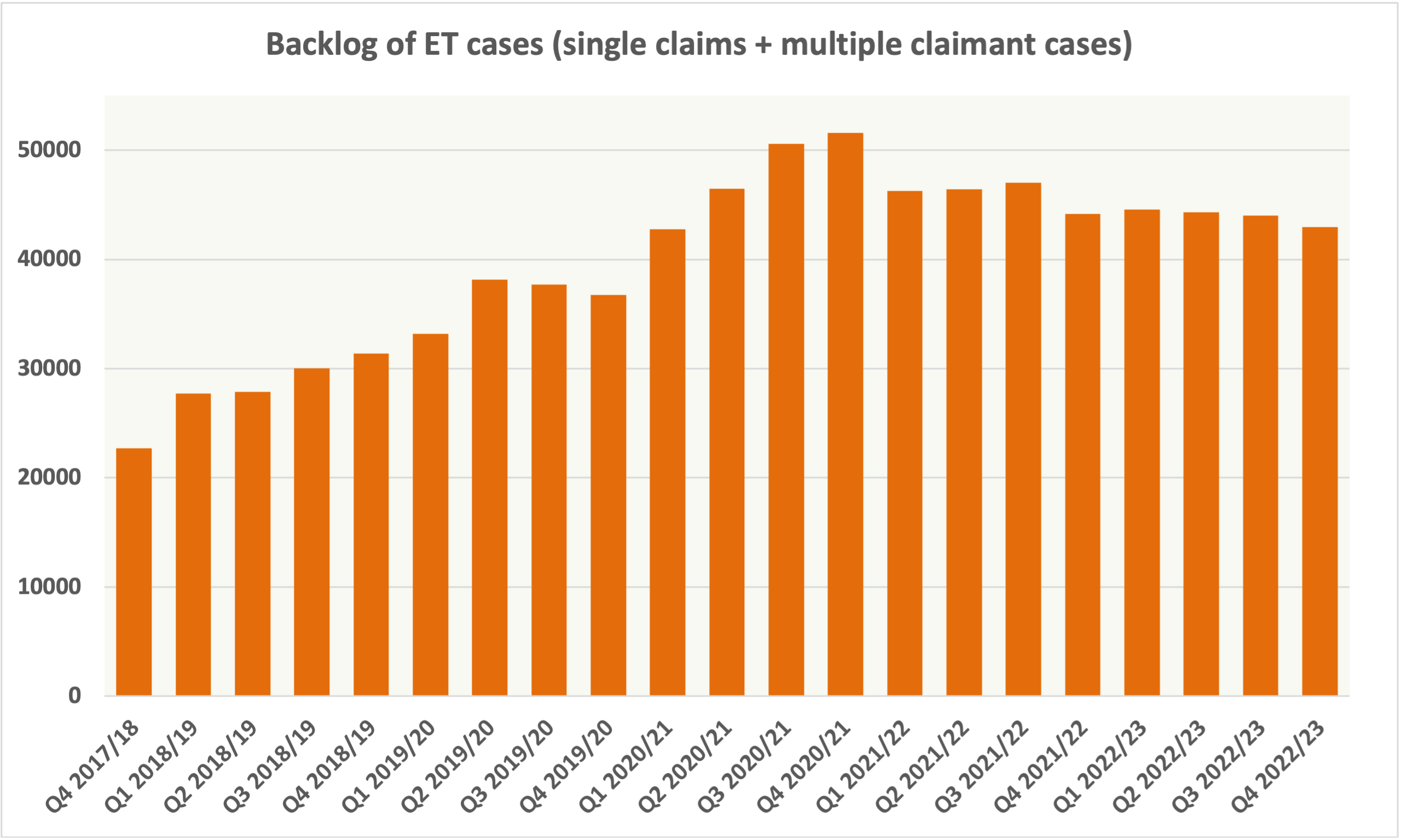
According to this latest data set, and in marked contrast to the previous data sets, the backlog has been under 45,000 since at least March 2022. And, as of March 2023, it stood at a mere 42,980.
Which is very good news, and means that my chart of the backlog since March 2018 now looks like this:
On a cold, grey day in early 2009, I was summoned to a meeting with officials at the headquarters of the Ministry of Justice in Petty France. A few months previously, in response to a series of reports I had written for Citizens Advice since 2004 about the widespread non-payment of Employment Tribunal awards supposedly ‘won’ by CAB clients, the officials had commissioned independent research on the extent of such non-compliance. And they had not hidden from me that they had only done so in full expectation that the research findings would crush my impertinent suggestion, set out in my October 2008 report on the issue, that as many as “one in ten” of all ET awards were not paid in full, and bring an end to my five-year campaign on the issue. Because pretty much everyone, including the TUC, had unhelpfully declared that non-payment of awards was ‘not a problem that we see’. So I entered the building with a heavy heart.
Unfortunately for the officials, the independent research – eventually published in May 2009 – had found that almost five in ten ET awards – 47% – were not paid in full (8% were only part paid, and 39% were not paid at all). And, through gritted teeth, they told me that ministers had concluded that they now had no choice but to act to address this obvious injustice. On my way back to the office, I bought a very big box of chocolates to share with my Citizens Advice colleagues.
Unfortunately for me and the thousands of ET claimants each year who were ‘winning’ their claim only to never see a penny of their award, ministers and officials had no idea how to address this injustice, especially as ministers had made it clear there would be “no new money”. And by 2012 it was clear that the low cost ‘solution’ that we helpfully suggested to them and which they introduced in April 2010 – enforcement of unpaid ET awards by High Court Enforcement Officers under a new Fast Track mechanism – was simply not working anywhere near well enough.
All was not lost, however, as by then the baton had been taken up by Liberal Democrat MP and junior business minister Jo Swinson, who in 2013 commissioned further independent research (essentially repeating that conducted for the Ministry of Justice in late 2008). And, once again, the research found that about half – 51% – of all ET awards were not paid in full (16% were only part paid, and 35% were not paid at all).
This confirmation gave Jo Swinson the leverage she needed to insert into the then Small Business, Enterprise & Employment Bill (later the 2015 Act) provisions that I had first proposed to Coalition ministers in 2012, to no avail, during the passage of the then Enterprise & Regulatory Reform Bill (later the 2013 Act). And between April 2016 and January 2020 the resultant section 150 penalty regime recovered more than £2.5 million worth of previously unpaid ET awards.
Ironically, by the time of the Small Business, Enterprise & Employment Bill in 2014 the ‘policy problem’ of unpaid awards had been largely massaged away by the ET fees regime introduced in July the previous year, as the hefty fees pretty much eradicated the very kind of relatively low-value claim which had tended to result in non-payment of the award. But in July 2017 the fees regime was abolished by a ruling of the Supreme Court, and claim numbers began to bounce back (though not to previous levels – see below).
Also in July 2017, the Taylor Review of Modern Working Practices recommended that, while the section 150 penalty regime established in April 2016 “is a free and successful [sic] route as a first step in prosecuting unpaid ET awards”, employers who do not pay an ET award within a reasonable time should be publicly ‘named and shamed’. And, in December 2018, having accepted this recommendation, the Government established a naming scheme, under which employers would be named by means of “approximately quarterly” press releases.
However, more than four years on, there have been no such press releases and not one employer has been publicly named under the naming scheme. In November 2022, in response to a Freedom of Information request (FoI 2022/27704), the then BEIS (now the Department for Business & Trade) could say only that “naming [employers] is being kept under consideration by the Government”. Yet the Department is stillasking ‘successful’ ET claimants who have not received their award to report the employer so that they can be “fined and named online by the Government”.
Furthermore, it is far from clear that the section 150 penalty regime is a “successful route” for enforcing unpaid awards, as suggested by Matthew Taylor in his 2017 report (which, as noted above, was written when the problem had in fact been largely massaged away by the ET fees regime). In response to recent Parliamentary Questions in both the House of Lords and the House of Commons, the Government has declined to provide data on the number of warning and penalty notices issued to employers, and the number and value of unpaid awards successfully enforced, since April 2016. But the above-mentioned BEIS response to a Freedom of Information request states that just 1,123 unpaid awards (worth a total of £6.5 million) were “recovered for claimants” between April 2016 and November 2022.
That Freedom of Information response further states that, as of November 2022, financial penalties with a total value of some £2.3 million had been issued to 1,230 employers since 2019/20. So, how much of that £2.3 million has the Department actually received from employers? And what has it been spending that money on, if not quarterly press releases ‘naming & shaming’ the employers in question?
Extract from BEIS FoI response 2022/27704, dated 28 November 2022
Unfortunately, there is no available official data on the total number of ET awards made in each year since 2016/17 that could be used to establish the proportion of all awards that have required enforcement action under the s150 penalty regime, even if the Department for Business & Trade were willing to provide data on the number of warning and penalty notices issued to employers. HMCTS only publishes data on the number of awards made in seven jurisdictions: unfair dismissal, and race, sex, disability, religious, sexual orientation and age discrimination. However, this limited data does suggest that the total number of awards has fallen somewhat since the time of my reports on unpaid awards for Citizens Advice.
The annual number of unfair dismissal awards, for example, has plummeted from an average of 2,510 in the four years prior to the introduction of ET fees in 2013, to an average of just 575 in the four years up to and including 2021/22. Similarly, the average annual number of sex discrimination awards has fallen from 150 to 34, the average annual number of race discrimination awards has fallen from 62 to 26, and the average annual number of age discrimination awards has fallen from 25 to 14.
These figures no doubt reflect a number of factors, not least the introduction of mandatory Acas early conciliation in 2014, a long-term decline in the number of new ET cases since 2010, and an associated decline in the number of ET claims that are successful at a hearing or result in a default judgment, which is probably the best available proxy for the total number of monetary awards (though we also have to allow for some of those successful claimants having won claims in more than one jurisdiction – a point to which I return below). In 2022 there were just 32,790 new ET cases (single claims/cases + multiple claimant cases), little more than half the 59,977 in 2012. In the financial year 2009/10 there were 71,300 single claims/cases alone (at that time, HMCTS did not publish data for the number of multiple claimant cases).
As well as a decline in the annual number of new ET cases (and therefore the number of disposals), there has also been a significant fall in the proportion of jurisdictional claims (or ‘complaints) that are successful at a hearing or result in a default judgment, from an average of 18% in the four years prior to the introduction of ET fees in 2013, to an average of 14% in the four years up to and including 2020/21 (data for 2021/22 is not yet available). As a result, the number of jurisdictional complaints that are successful at a hearing or result in a default judgment has fallen significantly, from an average of 42,275 in the four years prior to the introduction of ET fees in 2013, to an average of 13,453 in the four years up to and including 2020/21.
Not every jurisdictional complaint that is successful at a hearing or results in a default judgment will involve a monetary award, but in the absence of official data for monetary awards in jurisdictions other the seven noted above, this is probably the best available proxy for the total number of jurisdictional complaints that result in a monetary award. And we then need to divide this number by the number of jurisdictional complaints per claimant, which in the 27 quarters from April 2016 to December 2022 averaged 1.6 (down from an average of 2.0 in the 12 quarters from January 2013 to December 2015), to arrive at an estimate of the number of claimants who win a monetary award (Row B in the table below).
The most recent government-commissioned research on the non-payment of monetary ET awards – that commissioned by Jo Swinson and published in November 2013 – found that 51% of awards were not paid in full. And, if we apply that proportion to the number of claimants who win a monetary award in each year since 2016/17 (Row B), we get figures for the potential number of ET awards not paid in full (so liable to enforcement action) in each year (Row C in the following table). Note that, in line with the analysis above, these figures are a fraction of the 15,000 figure used in my 2008 report.
In summary, in the period April 2016 to November 2022, there were possibly some 26,000 ET awards that were not paid in full (assuming 4,000 in 2021/22, and 2,000 in April to November 2022). We don’t (yet) know how many warning and penalty notices were sent out by the Department for Business & Trade in this period, but we do know that only 1,123 unpaid awards were recovered for the claimant. Which – if my figures in Row C of the table above are in the right ball park (which they may well not be, for several reasons) – is an enforcement rate of less than 5%.
And if, as the Department suggests in its November 2022 Freedom of Information response, the 1,123 successfully enforced awards were worth a total of £6.5 million, then the some 24,880 unpaid awards that were not enforced were collectively worth as much as £151 million to the workers in question.
Come back you High Court Enforcement Officers, all is forgiven. Indeed, another thing we don’t know is how many people have paid the £71 fee to use the Fast Track enforcement mechanism – which still sits alongside the section 150 penalty regime – since the latter was established in 2016. It seems reasonable to assume that most people will have opted to use the free section 150 penalty mechanism, but we don’t actually know that [see update, below].
On Tuesday 25 April, the Employment Legal Advice Network (ELAN) is holding an online knowledge sharing event on this issue. If you have experience of unpaid ET awards, or would just like to learn more about the issue, please do join us.
Update, 19 May: In answer to a written Parliamentary Question tabled by shadow employment rights minister Justin Madders MP, the justice minister has provided data for 2019-21 confirming that, generally speaking, ET claimants with an unpaid award (or Acas settlement) are not using the Fast Track (High Court Enforcement Officers) enforcement mechanism. Why would they, when they have to pay a £71 fee to do so, but the s150 penalty regime operated by DB&T is free to access? Accordingly, what matters is the effectiveness of the s150 penalty regime operated by DB&T.
So, according to the Minister’s answers to a series of Parliamentary Questions tabled by Angela Rayner, the shiny new Employment Tribunal case management system that HMCTS introduced – presumably at some expense – in March 2021 is unable to generate data on ‘average age at disposal’ (that is, how long it takes the ET system to process a case, on average). The old ET case management system used to generate such data for single claims/cases and multiple claimant cases, and until March 2021 the figures were routinely included in the quarterly tribunal statistics published by HMCTS. And every now and then I would produce a chart.
However, the figures have been absent from the quarterly tribunal statistics since March 2021 and, in his answers of 28 February and 13 March to the PQs tabled by Angela Rayner, justice minister Mike Freer has confirmed that this is because such ‘average age at disposal’ data is not available from the new case management system. Which, given what we know about the growth in the backlog of ET cases since March 2021, may be less a bug than a feature, from the Minister’s point of view.
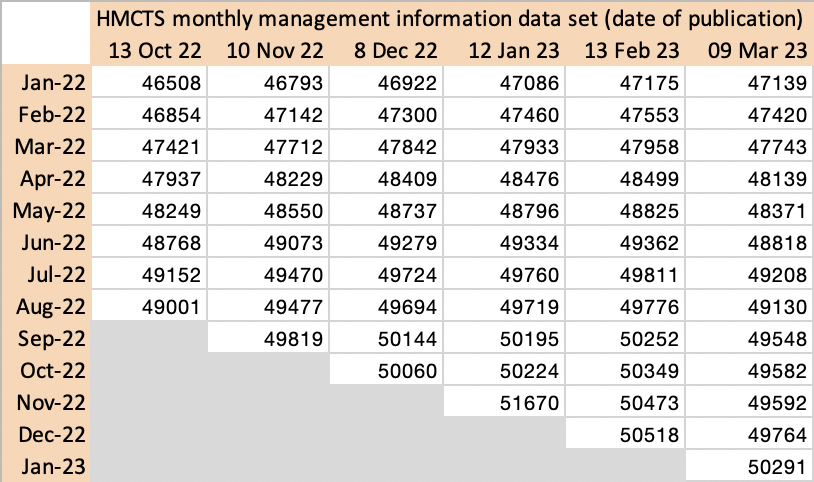
Another bug – or feature – in the new case management system is that it seems unable to generate reliable data on that backlog of ET cases. The following table shows the backlog (single cases + multiple claimant cases) at the end of each month since January 2022, as reported in each of the six monthly data sets of HMCTS management information published since October 2022.
In each of the four data sets published between 10 November 2022 and 13 February 2023, the figure for the backlog (i.e. outstanding caseload) at the end of each month since January 2022 was almost invariably revised (slightly) upwards, with the data set published on 13 February indicating that the backlog was more than 50,000 at the end of every month from September to December 2022. However, in the data set published on 9 March, every figure for the backlog has been revised (slightly) downwards, with the result that the backlog did not exceed 50,000 until January 2023.
Time will tell whether this bug – or feature – in the new ET case management system will keep the backlog of ET cases below 50,000 indefinitely, but in the meantime my chart of the backlog now looks like this:
Update, 13 April: According to the latest set of HMCTS management information, published earlier today, the backlog of ET cases was not only below 50,000 at the end of February 2023, but never actually reached 50,000, as had been indicated by the four previous sets. So, definitely more a feature than a bug.
Back in May, as we waited to see whether the Queen’s Speech would include the repeatedly promised Employment Bill, I noted on this blog that the Government had no fewer than 12 outstanding key pledges on workers’ rights, some of which had been outstanding for some time. Seven of the 12 pledges had featured in the December 2019 Conservative manifesto and, as we approach the third anniversary of that general election, now seems a good time to review what progress has been made since May.
Two of the 12 pledges – the red ones in the chart above – have been abandoned. In July, the Government announced that it will not be progressing the pledge, first made in February 2018, to legislate to improve the clarity of the ’employment status’ tests. And BEIS officials have made it very clear that, despite the establishment of an Advisory Board on Pregnancy & Maternity Discrimination in late 2021, the Government will not be producing the Action Plan to make it easier for pregnant women and new mothers to stay in work that it promised in July 2019. Which may or may not be why BEIS expelled Maternity Action from the Advisory Board after just one meeting.
As noted on this blog in October, five of the pledges – the orange ones in the chart – are currently being progressed through Government bills masquerading as Private Members’ Bills (PMBs), introduced by Labour, Liberal Democrat, SNP and Conservative backbench MPs in June. And there is enough time for most if not all of these PMBs to reach the Statute Book before the end of the current parliamentary session in April or May next year: all five have already had their Committee stage, and are set to complete their passage through the House of Commons by early February, at which point they will go to the House of Lords.
However, Ernest Hemingway warned us not to confuse movement with action. There is no guarantee that each of the PMBs will reach the Statute Book – the necessary parliamentary time remains in the gift of ministers, who could pull the plug at any point, should they decide that it would be politically advantageous to them to hold the reforms back as ready-made manifesto commitments for a May 2024 general election. There are already suggestions that, as things stand, Rishi Sunak faces the prospect of going into that general election with “precious little to say”.
Furthermore, while Stuart McDonald’s Neonatal Care (Leave and Pay) Bill would amend the Employment Rights Act 1996 and the Social Security Contributions and Benefits Act 1992 to require the Secretary of State to make Regulations creating a statutory right to paid neonatal leave, and Wendy Chamberlain’s Carer’s Leave Bill would similarly amend the Employment Rights Act 1996 to require the Secretary of State to make Regulations creating a statutory entitlement to unpaid carer’s leave, Dan Jarvis’s Redundancy Protection (Pregnancy and Family Leave) Bill would only give the Secretary of State the power to make Regulations extending the scope of the existing MAPLE Regulation 10 protections. The Secretary of State would remain free to not use that power (or to do so only at a time of his or her choosing).
Since Dan Jarvis’s PMB was introduced in June, it has emerged that Ministers are proposing to include, in the necessary Regulations, a six-week qualifying period for the protection that would be extended to new parents after their return to work from a period of leave. However, this proposal – which would set a worrying policy precedent – has not yet been publicly set out in writing, and the Minister somehow failed to mention it during both the Second Reading and the Committee stage debates.
During the latter debate, on 2 November, Dan Jarvis assured MPs that BEIS are consulting members of the above-mentioned Advisory Board – that is, the Advisory Board from which BEIS expelled Maternity Action – about this qualifying period (and the PMB’s impact assessment, published in August, wrongly implies that at least some such consultation had by then already taken place). However, it is not at all clear why such consultation, on an important point of policy, should be confined to the members of the Advisory Board, and be conducted behind closed doors. But that’s the kind of thing that happens when you’re a backbencher and you introduce a PMB that you didn’t write yourself, and over which you have no control.
A sixth Government bill masquerading as a PMB – Yasmin Qureshi’s Employment Relations (Flexible Working) Bill – would amend the Employment Rights Act 1996 to make a number of welcome but relatively minor reforms of the administrative process underpinning the existing right to request flexible working (such as allowing employees to make two flexible working requests in any 12-month period, instead of the one currently allowed). But it would not make the right to request flexible working a Day One right – as the Government proposed in its September 2021 consultation paper – let alone deliver the Government’s December 2019 manifesto pledge to make flexible working the default. It seems we have to await the Government’s response to the 2021 consultation to learn whether ministers plan to make the right to request a Day One right, and during the PMB’s Second Reading debate on 28 October the minister could say only that the Government will bring forward that response “shortly” (which may or may not be more imminent than ‘in due course’).
As for the other four outstanding pledges, they remain, well, outstanding. Evaluating the Shared Parental Leave scheme remains “an important part of the policymaking process”, according to the Minister, but it is now more than five years since the evaluation was first announced to MPs, and we are still waiting for the evaluation report. Apart from anything else, this means that the 2019 BEIS/DWP Maternity & Paternity Rights Survey – part of a series that has been conducted since the late 1970s, and which was last conducted in 2009/10 – remains under wraps, despite the survey fieldwork having been completed by November 2019. Because, for reasons known only to BEIS ministers, the Survey report cannot be published until the Shared Parental Leave evaluation report is published.
There are no signs of the Government introducing the new right to request a more predictable and stable contract that was first promised in February 2018, despite the Minister confirming as recently as late October that the Government “remains committed” to this pledge. Similarly, there are no signs of any progress on the December 2019 pledge to “make it easier for fathers to take paternity leave”. And there’s been no real news on the promised Single Enforcement Body since June 2021.
Furthermore, these are only the most significant commitments on workers’ rights that the Government has made, and which remain outstanding. For example, on 24 November, a coalition of organisations wrote to business secretary Grant Shapps, urging the Government to act on its March 2022 commitment to remove the ‘family worker exemption’ from the National Minimum Wage Regulations.
In December 2019, the Tories sought to portray themselves as the workers’ party, with a raft of broadly welcome manifesto commitments on workers’ rights. In 2024, they may well want to do so again. So watch this space.
So, with the “new era” of Liz Truss and Kwasi Kwarteng having lasted all of seven weeks, Rish! Sunak is back in Downing Street. And, shortly before being clapped through the lobby of Number 10 by the waiting officials and advisers, the shiny new Prime Minister used his first address to the nation to claim as his own the electoral mandate secured by Boris Johnson in December 2019:
The mandate my party earned in 2019 is not the sole property of any one individual, it is a mandate that belongs to and unites all of us. And the heart of that mandate is our manifesto. I will deliver on its promise.
Which, to this employment policy wonk at least, begs the question: Will Rish! Sunak deliver on the outstanding 2019 manifesto promises on workers’ rights, perhaps through an Employment Bill?
And why not? Dominic Raab is back at the Ministry of Injustice, searching through the bins for a discarded copy of his almost palindromic Bill of Rights Bill. Suella Braverman is back at the Home Office, searching for the miraculous policy that will ‘reduce net migration to tens of thousands’. And Jacob Rees-Mogg is back on the backbenches, where he belongs. So, why can’t we have the repeatedly promised Employment Bill back?
When I posed this question on Twitter earlier today, Daz Newman was quick to point out that some of those 2019 manifesto promises on workers’ rights are currently “making their way through Parliament as Government-sponsored Private Members’ Bills”. And it is indeed the case that, days after the (third) shelving of the Employment Bill in May this year – and as anticipated on this blog – the Government whips worked hard to sell a number of Government hand-out bills to some of the MPs who had just ‘won’ a top slot in the annual Private Members’ Bill (PMB) ballot. As a result, on 15 June no fewer than six Government Bills masquerading as PMBs were introduced by Labour, Liberal Democrat, SNP and Conservative backbench MPs.
The three-hour Second Reading debate of Dan Jarvis’s Redundancy Protection PMB was notable for the number of MPs who expressed support for the Bill while at the same time making it clear they much prefer the so-called German model of redundancy protection repeatedly proposed by Maternity Action, Maria Miller MP and many others since 2016, and which is the stated policy (and 2019 manifesto commitment) of Dan Jarvis’s own Labour Party. As Maternity Action noted in their briefing for MPs, Dan Jarvis’s PMB will “simply entrench a broken system that does not work and does not protect women”, while the so-called German model is – in the words of Bob Stewart MP – “flipping good”.
The Second Reading debate of Wendy Chamberlain’s Carer’s Leave PMB was somewhat shorter – under an hour – while that of Wera Hobhouse’s Worker Protection PMB was so short – a mere 20 minutes – that, apart from Ms Hobhouse, the shadow minister and the minister, only one MP got to speak. Welcome to Democracy 2022.
However, even if these Government Bills masquerading as PMBs make it as far as the Statute Book – and most stand a very good chance of doing so, now that a snap General Election seems to be out of the question – that still leaves the following 2019 manifesto promises outstanding:
Create a single enforcement body to “crack down on any employer abusing employment law”. As previously noted on this blog, in June 2021 the Government confirmed this commitment “as set out in the Government’s manifesto. The new body will not just bring together three existing bodies into a single, recognisable organisation, it will deliver a significantly expanded remit. As a result, more vulnerable workers across the country will receive money that is owed to them.” This is arguably the most significant of all the 2019 manifesto commitments on workers’ rights. But then I would say that, as the creation of a single enforcement body was my idea.
Establish a new right for workers to “request a more predictable contract and other reasonable protections”. Just this week, business minister Dean Russell confirmed to MPs that the Government “remains committed” to introducing such a right. [Update, October 2023: On 18 September, the Workers (Predictable Terms and Conditions) Act 2023 – originally a Private Members’ Bill introduced by Conservative MP Scott Benton in February 2023 – received Royal Assent, having been sped through its Commons and Lords stages with cross-party support. The Act amends the Employment Rights Act 1996 to establish a right for workers to “request more predictable terms and conditions of work”, but Darren Newman has questioned whether this new ‘right to request’ more predictable terms and conditions is worth the 4,800-word draft Acas code of practice on handling such requests. On 20 October, in answer to a written parliamentary question, business minister Kevin Hollinrake stated that the Government plans to bring the Act into force “in Autumn 2024”.]
Look at ways to make it easier for fathers to take paternity leave. As noted recently on this blog, almost three years on, there is no evidence of ministers having since done any such ‘looking’, and certainly no policy proposals have been forthcoming.
In addition, the 2019 manifesto promised a consultation on making flexible working the default and, while that consultation was undertaken in late 2021, we await the outcome and any progress towards the promised goal (Yasmin Qureshi’s Flexible Working PMB will simply make a number of welcome but relatively minor changes to the existing right to request flexible working). [Update: During the 90-minute Second Reading debate of Qureshi’s Flexible Working PMB on Friday, the Minister indicated that the Government will publish its response to the 2021 consultation “shortly” – which may or may not be more imminent than ‘in due course’. Significantly, perhaps, of the 11 MPs – other than Qureshi herself, the Minister and the shadow minister – who contributed to the debate, ten were Conservatives. It’s almost as if the PMB reaching the Statute Book matters more to the Conservatives than it does to Qureshi’s own Party.]
And then there’s the things that weren’t in the 2019 manifesto, but should (and indeed might) have been in the Employment Bill, such as reform of the chronically failing Shared Parental Leave scheme, and the extension of the Employment Tribunal time limit recommended by the Law Commission in April 2020.
So, yeah, come on Rish!, take us back to the future of December 2019!
[Update: On 28 October, during his first public outing as Prime Minister – a visit to Croydon University Hospital – Sunak the Sensible repeated his pledge to deliver “on the promise of the manifesto that we were elected on, with very strong support, in 2019”.]
“Only a third of eligible fathers taking paternity leave” (People Management)
“Just a third of eligible fathers take paternity leave” (HR News)
“Only one in three fathers take paternity leave, research suggests” (Daily Mail)
“Just a third of eligible new fathers took paternity leave in the last year” (HR Magazine)
“Only a third of eligible new fathers are taking paternity leave” (Jersey Evening Post)
If these headlines – all from July this year – feel a bit familiar to you, that’s because you have seen them before. You saw them last year, and the year before that, and the year before that. Because, as previously noted on this blog, they are all based on a press release that law firm EMW regurgitates every summer. Admittedly, EMW do throw in a bit of variation: one year it’s ‘Only one third of fathers are taking paternity leave!’, and the next year it’s ‘Two thirds of fathers are not taking paternity leave!’ Clever!
So, for example, here are the Independent and HR News in the summer of 2019, reporting that “fewer than [a] third of new fathers take paternity leave”. And here are the Telegraph and HR News in the summer of 2020, reporting that “two thirds of new fathers are still not taking paternity leave”. How great it must feel to be a ‘journalist’ at HR News.
Things got a little more interesting in 2021, when the impact of the Covid19 pandemic and the £65bn furlough scheme allowed EMW to rebrand the same set of raw HMRC data, obtained by an annual Freedom of Information request, as “paternity leave take-up drops to lowest level in 10 years”. This secured headlines in the Independent, and in the specialist journals Personnel Today and People Management. The ‘journalists’ at HR News must have been on furlough, or something.
However, with new fathers no longer able to choose between taking one or two weeks of statutory paternity leave on £150 per week or continuing on furlough on 80-100% of their normal wages, the number of statutory paternity pay claimants has bounced back, and this summer EMW reverted to “Only a third of eligible new fathers are taking paternity leave”. Which, as well as securing the headlines above, seemingly led the Fatherhood Institute to note that “latest figures suggest that only a third of fathers take paternity leave”.
Which is a little odd, because in a 2017 report the Fatherhood Institute noted that “large surveys covering a range of employment sectors consistently show between two-thirds and three-quarters of eligible fathers taking some statutory paternity leave, with 55% taking at least [sic] their full ten days”. Indeed, in June 2014, research by the Institute for Public Policy Research (IPPR) concluded that “55% of fathers take the full two weeks off work when their child is born”.
So, what is the rate of take-up of statutory paid paternity leave? Well, to answer that question, we need two bits of information: the number of new fathers who take statutory paid paternity leave (the numerator): and the number of new fathers who are eligible to take statutory paid paternity leave (the denominator).
The numerator is easy: HMRC has routinely provided the data in response to numerous Freedom of Information requests by the law firm EMW and others, including yours truly. [Update: The data is now publicly available in this Answer to a Parliamentary Question.] Here’s a table:
(It’s worth noting that these figures include both ‘fathers’ and a small number of same-sex partners of the birth mother. In 2021/22, for example, 2,200 (1.1%) of the 204,200 claimants were female. However, this detail has never troubled EMW or any of the ‘journalists’ who have typed up EMW’s press releases since 2019, so I am parking it too. Furthermore, the figures include a degree of double counting: HMRC has confirmed that “where a given spell of [statutory paternity pay] extends across [the boundary between] two years, the claimant will be included in both years’ figures”. However, this double counting matters more when we consider the number of SMP claimants – see below.)
The denominator, however, is tricky, as no one knows how many new fathers are eligible to take statutory paid paternity leave each year [and, since I posted this blog, the new BEIS minister, Kevin Hollinrake, has confirmed that the Government has not made any estimate of the number]. To arrive at their take-up rate of ‘one third’, EMW have assumed that the number of eligible new fathers is the same as the number of new mothers who start on statutory paid maternity leave, which – based on the raw data provided to them by HMRC – EMW have taken as 654,000 in 2018/19, 649,000 in 2019/20, 652,000 in 2020/21, and 636,000 in 2021/22.
As previously noted on this blog, there are several reasons why this assumption is not necessarily valid, but it is certainly one of several approaches to estimating the number of fathers who are eligible for statutory paternity leave that are available to us. Though we need to add to the figures in the previous paragraph at least some of the 50-60,000 new mothers who start on Maternity Allowance each year, as the HMRC figures used by EMW are only for Statutory Maternity Pay (SMP).
However, the raw HMRC figures for SMP used by EMW do not show the number of women who started on SMP in that year. Because – as explained previously on this blog – the raw HMRC figures include a significant amount of double counting.
Furthermore, if our starting point is the partners of women who start on statutory paid maternity leave (on either Maternity Allowance or SMP), then we have to allow for the fact that a significant proportion of those fathers are not eligible for statutory paid paternity leave. In some cases, this is because the father is not in employment (in recent years, the employment rate in the 25-34 and 35-49 age groups has been about 85%), and in others it is because the father is working, but has not worked for their current employer for long enough (at least 26 continuous weeks) or is self-employed.
The Fatherhood Institute cites a 2017 analysis by the TUC that it says indicates that “two out of five working fathers [i.e. 40%] are ineligible either because they are self-employed or because they have not worked for their employer for long enough”. In fact, the TUC itself suggested that 25% – not 40% – of working fathers are ineligible.
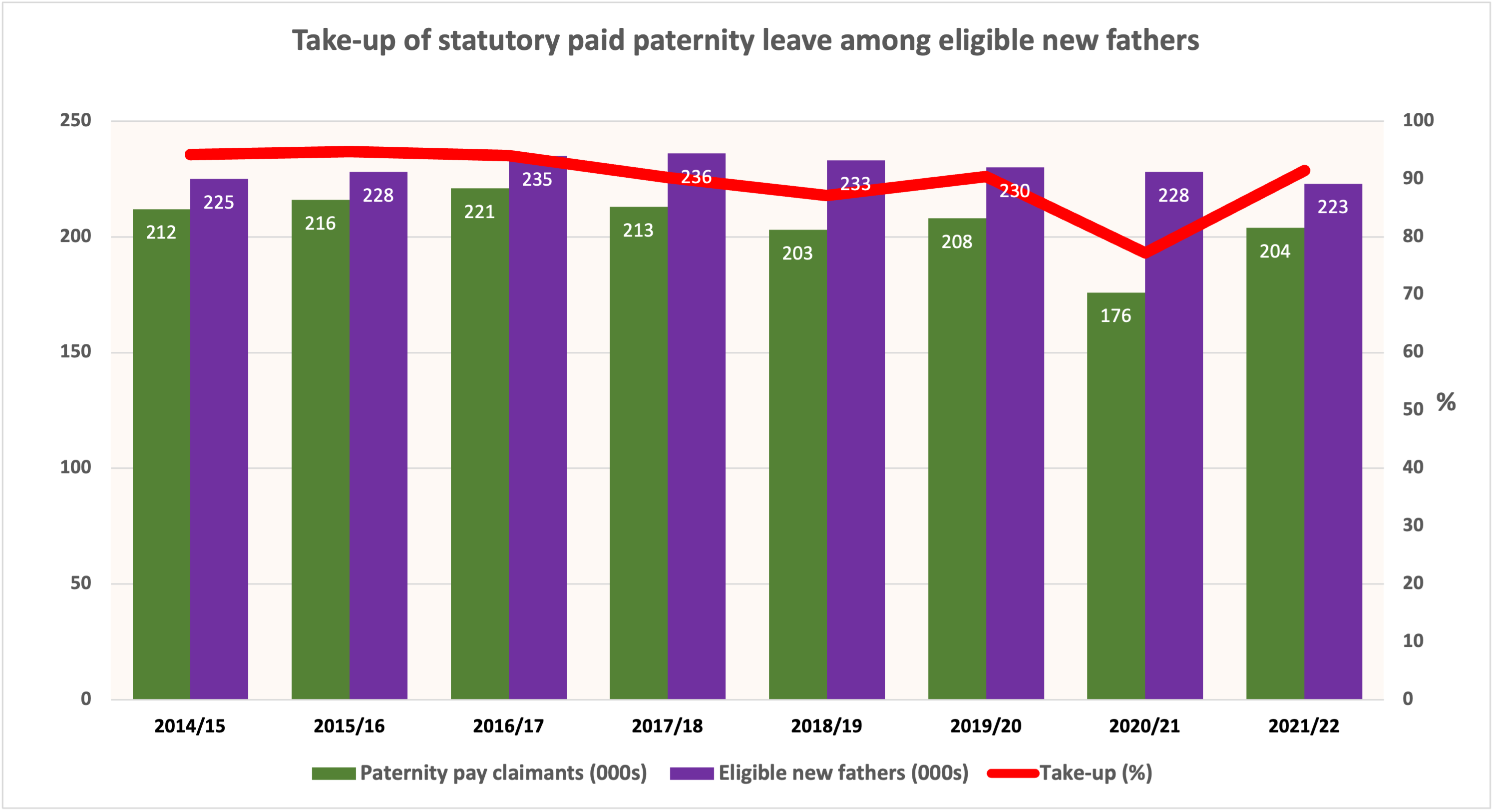
And, if we (i) adjust the raw HMRC data on SMP starts for double counting; (ii) add Maternity Allowance starts; (iii) apply the male employment rate (85%); and (iv) apply the TUC’s ineligibility rate of 25%, we get a chart showing ‘take-up of statutory paid paternity leave among eligible fathers’ that looks like this:
Now, I’m going to stick my neck out and suggest there is something wrong here. I don’t think take-up of statutory paid paternity leave among eligible fathers averages 92% (after excluding the atypical year 2020/21). One possibility is that the TUC’s suggestion that 25% of working fathers are ineligible for statutory paid paternity leave is wide of the mark. And another is that the number of women who start on statutory paid maternity leave is not as good a starting point for estimating take-up of statutory paid paternity leave among eligible fathers as EMW and everyone who cites their figures thinks it is. Yes, I’m looking at you, HR News.
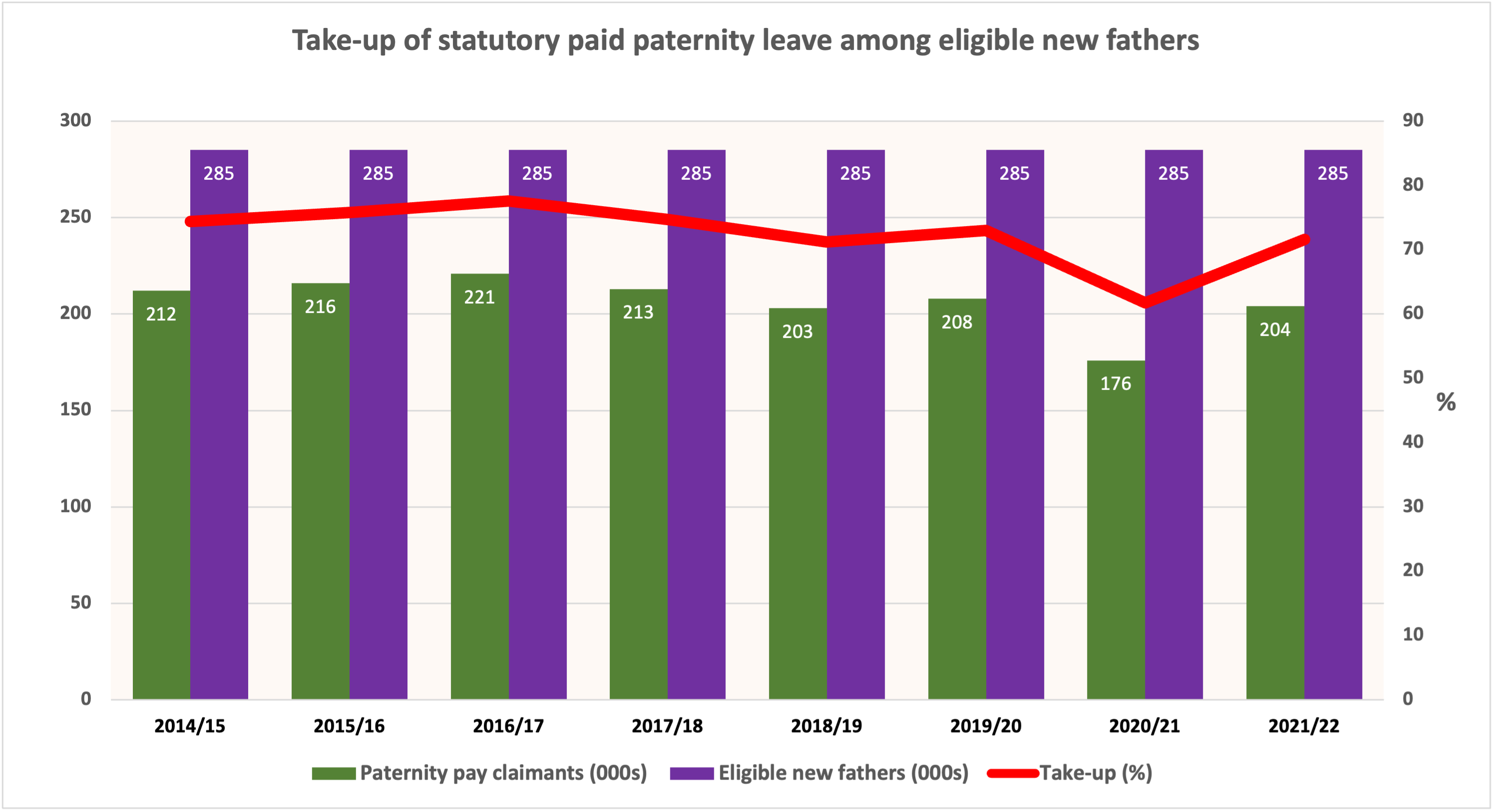
An alternative proxy for the number of new fathers who are eligible for statutory paid paternity leave might be the number of new fathers who are eligible for shared parental leave. We don’t know the latter number either, but we do at least have an official Government estimate of it (see p29), which is a maximum of 285,000 per year. There are a number of reasons why the number of new fathers who are eligible for statutory paid paternity leave is likely to be different to the number who are eligible for shared parental leave, but using that 285,000 as a proxy does give us a somewhat less ridiculous-looking chart (note the slight change of scale on the right-hand side, made for aesthetic reasons):
Yes, that’s an annual average (excluding the atypical 2020/21) of at least 74% (it will be higher, if the actual number of eligible fathers is less than the maximum of 285,000 estimated by the Government). And 74% is a bit more than ‘one third’.
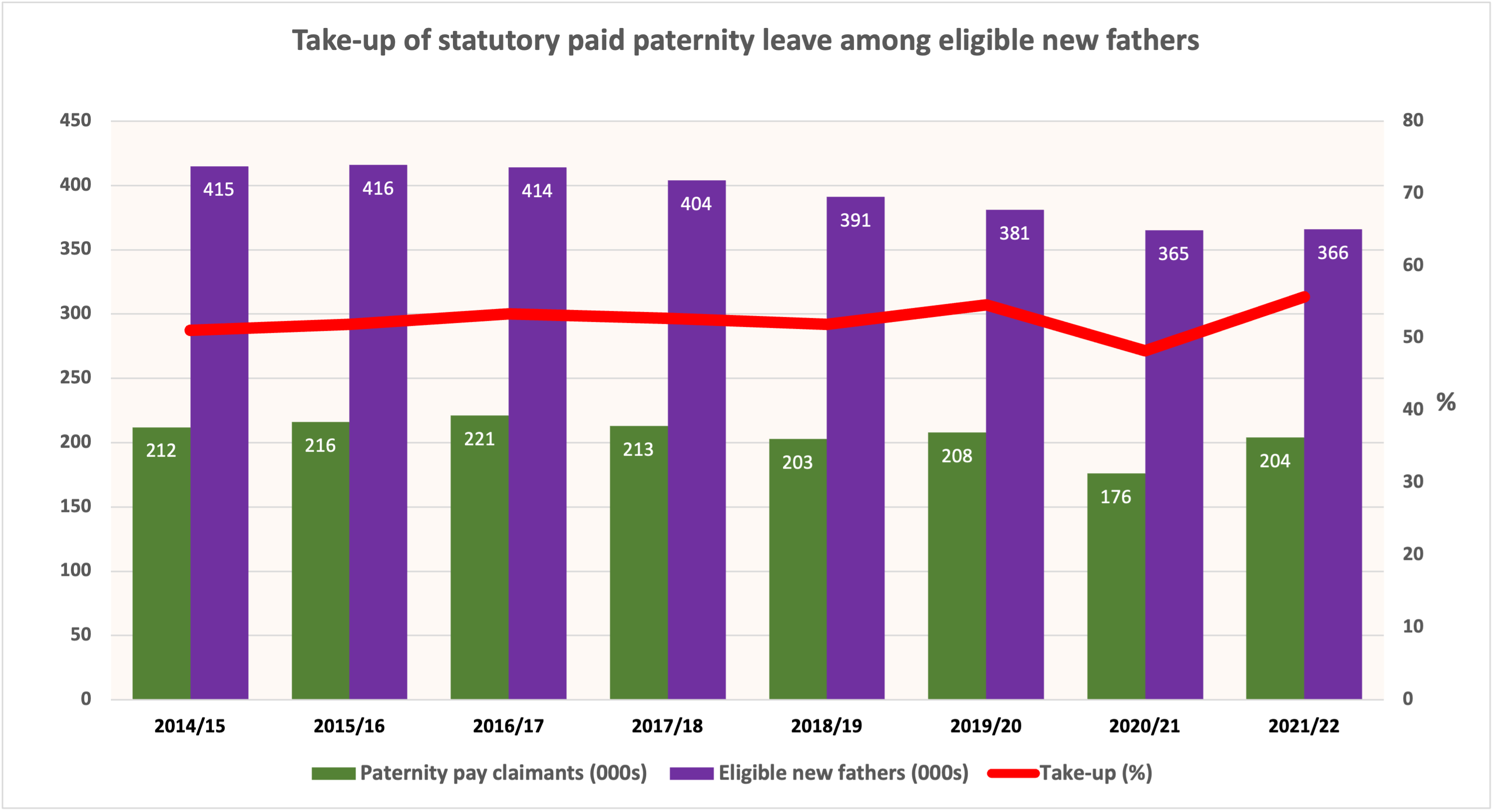
But if you don’t like that approach, I have others! One would be to start with the number of live births, reduce that by the proportion of new mothers who are single parents (BEIS has used 16%, but this may be out of date), apply the male employment rate (85%), and then apply the TUC’s ineligibility rate of 25%. This gives us a chart that looks like this (again, note the slight change of scale on the right hand side of the chart):
Excluding the atypical 2020/21, that’s an annual average of 53%. And there’s good news! Thanks to the falling number of live births, the trend is upwards: in 2021/22, by this measure, take-up was 56% – that is, much the same as the 55% suggested by that IPPR research in 2014. Which is quite a bit less than 74%, obviously. But still quite a bit more than ‘one third’.
If I had to put money on it, I’d say that take-up of statutory paid paternity leave among eligible fathers is probably somewhere between 53% and 74%, and most likely in the region of 60%. Which (a) is closer to the findings of those large surveys cited by the Fatherhood Institute; and (b) is not bad, when you consider the pitiful rate at which such statutory leave is paid (currently, just £156.66 per week, equivalent to less than half of the National Minimum Wage). Given the ‘health and safety’ purpose of such leave – to enable the father or other second parent to support the birth mother at and immediately after the birth – there is a very strong case for it to be paid at 90% of average weekly earnings, like the first six weeks of Statutory Maternity Pay, rather than at the flat rate.
That would help push take-up among eligible fathers towards 100% (in 2014, the IPPR suggested that it would raise take-up to 70%). But we also need to shrink that 25% of working new fathers (or whatever the proportion is) who are not even eligible for statutory paid paternity leave.
In December 2019, the Conservative general election manifesto committed the now lamented Boris Johnson-led Government to “look at ways to make it easier for fathers to take paternity leave”. However, three years on, there is no evidence of ministers or officials having since done any such ‘looking’, and certainly no policy proposals have been forthcoming. Maybe in due course.
On the other hand, in its September 2021 Green Paper on employment rights, the Labour Party committed the next Labour government to “extending statutory maternity and paternity leave”, which I am reliably informed means ‘extending eligibility’ to those who currently miss out on such entitlements, including by making them ‘Day One’ rights.
The way things are going, that next Labour government could be along quite soon. But let’s at least make 2023 the year when everyone throws EMW’s annual press release about take-up of paternity leave straight in the bin. Because it’s pretty clear that, whatever it may be, the rate of take-up of statutory paid paternity leave is not “only a third”.








 Labour Pains