Four months ago on this blog, I posed the question: How many women start on statutory paid maternity leave in the UK each year?
You’d think this would be a well-known and widely used official statistic, freely available on some government website. But you’d be wrong.
As I noted back in September, there is a figure – about 650,000 – that is widely used (or at least relied upon) by academic researchers, journalists, supposedly expert campaign groups such as Pregnant Then Screwed, employment lawyers and even the TUC. But that widely used figure is wrong.
We have known for some years that the figure must be wrong, because there are two sets of official data on recipients of Statutory Maternity Pay (SMP): one unpublished but provided by HMRC in response to numerous Freedom of Information requests in recent years, which is where the figure of ‘about 650,000’ comes from, and one published by the Department for Work & Pensions (DWP). And, as the following chart shows, the figures in those two data sets are not just different – they are very different:
This matters. Because, without knowing how many new mothers start on statutory paid maternity leave each year, we cannot, for example, estimate what proportion of such new mothers use the chronically failing Shared Parental Leave scheme to transfer some of their paid leave to the child’s father (a more meaningful measure of the success or otherwise of the SPL scheme than the rate of take-up among the limited pool of eligible fathers).
Furthermore, as I noted in my September blog post about take-up of statutory paid paternity leave, the DWP’s data set is published under the terms of a Memorandum of Understanding with the Office for Budget Responsibility (OBR), and reflects the Government’s financial delivery plans. So, if it’s wrong, the Chancellor’s annual Budget is also a pile of pants.
Accordingly, late last summer, I set out to get to the bottom of the glaring discrepancy between the two sets of data.
Soon after my September blog post, HMRC confirmed to me (in response to my Freedom of Information request FOI2021/20932), that the figures in their data set are inflated by double counting. In short, where a spell of SMP extends across the boundary between two financial years, the recipient is counted twice (once in each financial year). And, with the average new mother taking nine months of SMP (see below), there are a lot of spells of SMP that extend across the boundary between two financial years. So, there is a lot of double counting in the HMRC data set.
Then, in late October, the DWP confirmed to me (in response to my Freedom of Information request FOI2021/79684) that their data on SMP caseload understates the number of women who start on SMP each year, as the data is average caseload at any point in time, not total caseload over the year.
Fortunately, armed with this information, it is a relatively simple task to adjust the two data sets accordingly. Assuming the average duration of a spell on statutory maternity leave to be nine months (as is suggested by BEIS research, by a statement by BEIS minister Paul Scully to MPs in June 2020, and by the DWP’s quarterly statistics on Maternity Allowance grants), we can adjust the HMRC figures down by a factor of 4/7, and adjust the DWP figures up by a factor of 4/3, to generate a new chart:
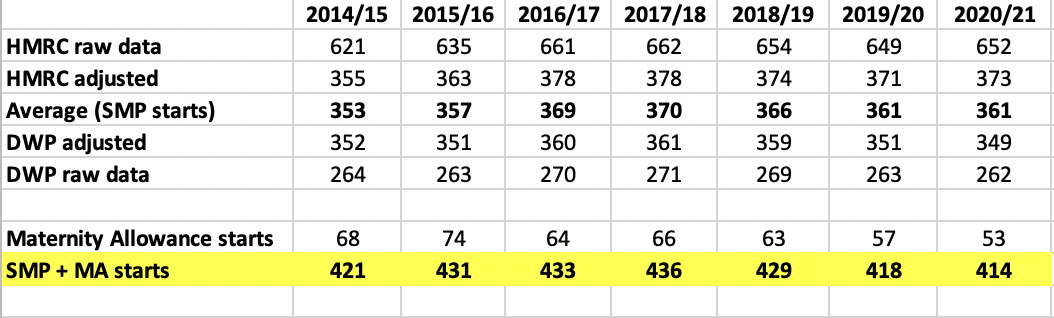
We can then (a) average out the remaining small difference between the two sets of data, and (b) add the some 60,000 Maternity Allowance starts each year (from the DWP’s quarterly statistics), to give us figures for the number of women who start on statutory paid maternity leave each year:
You’re welcome.
(Incidentally, I did ask policy officials in the BEIS family rights team – the team that works on e.g. maternity leave and SPL policy – to assist with my reconciliation of the HMRC and DWP data sets, and later to comment on my adjusted figures, but they repeatedly declined to do so. Make of that what you will.)
Just over two years ago, in October 2019, I wrote on this blog about the long and difficult gestation of the Government’s proposed Single Enforcement Body for employment rights, to “tackle the deeply fragmented enforcement landscape”. And it is now more than 20 years since yours truly, then a lowly employment policy wonk at Citizens Advice, first proposed a consolidation of the three main enforcement bodies – the HMRC minimum wage enforcement team, the Employment Agency Standards Inspectorate, and the then Gangmasters Licensing Authority (now the Gangmasters & Labour Abuse Authority) – into “a single Fair Employment Agency fit for the 21st century, with the legal powers and resources to ‘root out the rogues’ without imposing unnecessary regulatory burden on the great majority of compliant employers”.
Back in October 2019, we were just weeks away from a General Election campaign in which the Conservatives, Labour and the Liberal Democrats would all pledge to establish such a single enforcement body, should they form the next government. You wait 18 years for a manifesto pledge to implement your great policy idea, and then three come along at once. But on 14 December 2019, it was Boris Johnson who triumphantly returned to Downing Street with a manifesto commitment to “get a single enforcement body done”. Or something.
They say every cloud has a silver lining and, as far as this policy wonk is concerned, they are right. Because, later that month, a Brexit-focused Queen’s Speech promised an Employment Bill that will “strengthen workers’ ability to get redress for poor treatment by creating a new, single enforcement body”, as well as “offer greater protections for workers by prioritising fairness in the workplace, and introducing better support for working families”. That is definitely my kind of silver lining.
Needless to say, the promised Bill did not materialise in 2020, and was then surprisingly omitted from the Government’s second Queen’s Speech, in May 2021.
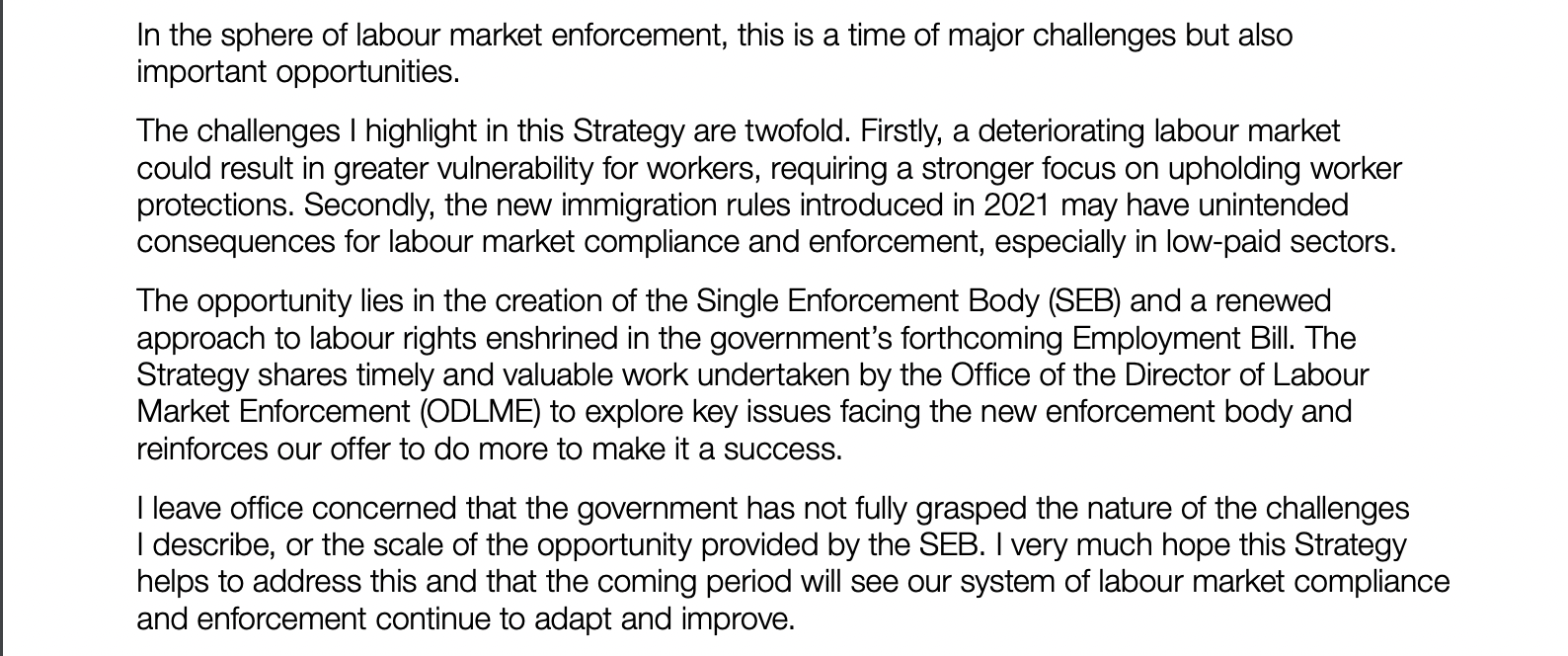
Worse still, in January 2021 a somewhat disgruntled Matthew Taylor – Interim Director of Labour Market Enforcement and a committed and persuasive advocate of a Single Enforcement Body since his July 2017 Taylor Review of Modern Working Practices – had come to the end of his contract, and had exited muttering under his breath that the Johnson-led Government has not “fully grasped the scale of the opportunity provided by the [single enforcement body]” (an opinion reported as early as February 2021, and confirmed earlier this month by the much delayed publication of Taylor’s Labour Market Enforcement Strategy 2021 to 2022).
Matthew Taylor, in the Foreword to his Labour Market Enforcement Strategy 2021 to 2022, submitted to Government on 30 January 2021 and published on 13 December 2021
However … in June 2021 the Government published its response to the high level consultation it had conducted between July and October 2019, and this confirmed the Government’s commitment “to create [a single enforcement body], as set out in the Government’s manifesto. The new body will not just bring together three existing bodies into a single, recognisable organisation, it will deliver a significantly expanded remit. As a result, more vulnerable workers across the country will receive money that is owed to them.” And the response suggested, in words I could have written myself anytime between 2001 and 2013, that as well as the benefit to workers:
Employers – large and small – will benefit from the creation of a more level playing field, with less risk of being unfairly undercut by an unscrupulous or criminally exploitative competitor, and from the availability of more practical, and better co-ordinated, business support services.
Actually, no, those are words I did write myself, in a 2004 Citizens Advice pamphlet setting out the case for a single enforcement body. What the Government’s June 2021 response said is:
This body will not just protect workers, it will also help to provide a level playing field for the majority of employers who respect the law, and who also lose out when unscrupulous businesses cut corners and exploit workers. In these challenging economic times, it is more important than ever that we take action against such behaviour and support responsible businesses to flourish and level-up all areas of the country. The body will also provide more support for businesses to understand their obligations and get things right, in part by bringing three separate organisations together into a single body.
It’s fair to say that, since then, not a lot seems to have happened (other than that, in September, the Labour Party reiterated that it would also “establish and properly fund a single enforcement body to enforce workers’ rights”). And, for sure, there is still no sign of the promised Employment Bill. Hopefully, the Government is quietly getting on with “developing more detailed plans for the body in partnership with the existing enforcement bodies” – one of the key ‘next steps’ set out in June. Whatever, just yesterday, a BEIS spokesperson reiterated that:
Protecting and enhancing workers’ rights is an absolute priority for the Government, which is why we have committed to establishing a single enforcement body to protect vulnerable workers across the UK.
I guess the Government has absolute priorities, and absolute priorities. However, despite its omission from the Queen’s Speech in May, there is nothing to stop ministers bringing forward the Employment Bill in the current parliamentary session (i.e. before the Government’s third Queen’s Speech, expected in May 2022), and with a General Election in May 2023 looking increasingly likely they do need to get a wiggle on if they are to progress what is set to be a mahoosive and complex Bill onto the Statute Book by then.
So, sorry kids, we are not nearly there yet. But we are over half way!
While a rampant stomach bug is reported to have caused most competitors in last month’s six-day, 250km Marathon Des Sables in the Sahara a nasty bout of the runs, officials at Kwasi Kwarteng’s Department for Business, Energy & Industrial Strategy (BEIS) face the opposite problem: their marathon evaluation of the chronically failing Shared Parental Leave scheme is stuck fast in the bowels of the Department.
First announced in March 2017 and underway by April 2018, the BEIS evaluation has now been in progress for 43 months, or some 1,300 days. I’ve seen dead snails move more quickly.
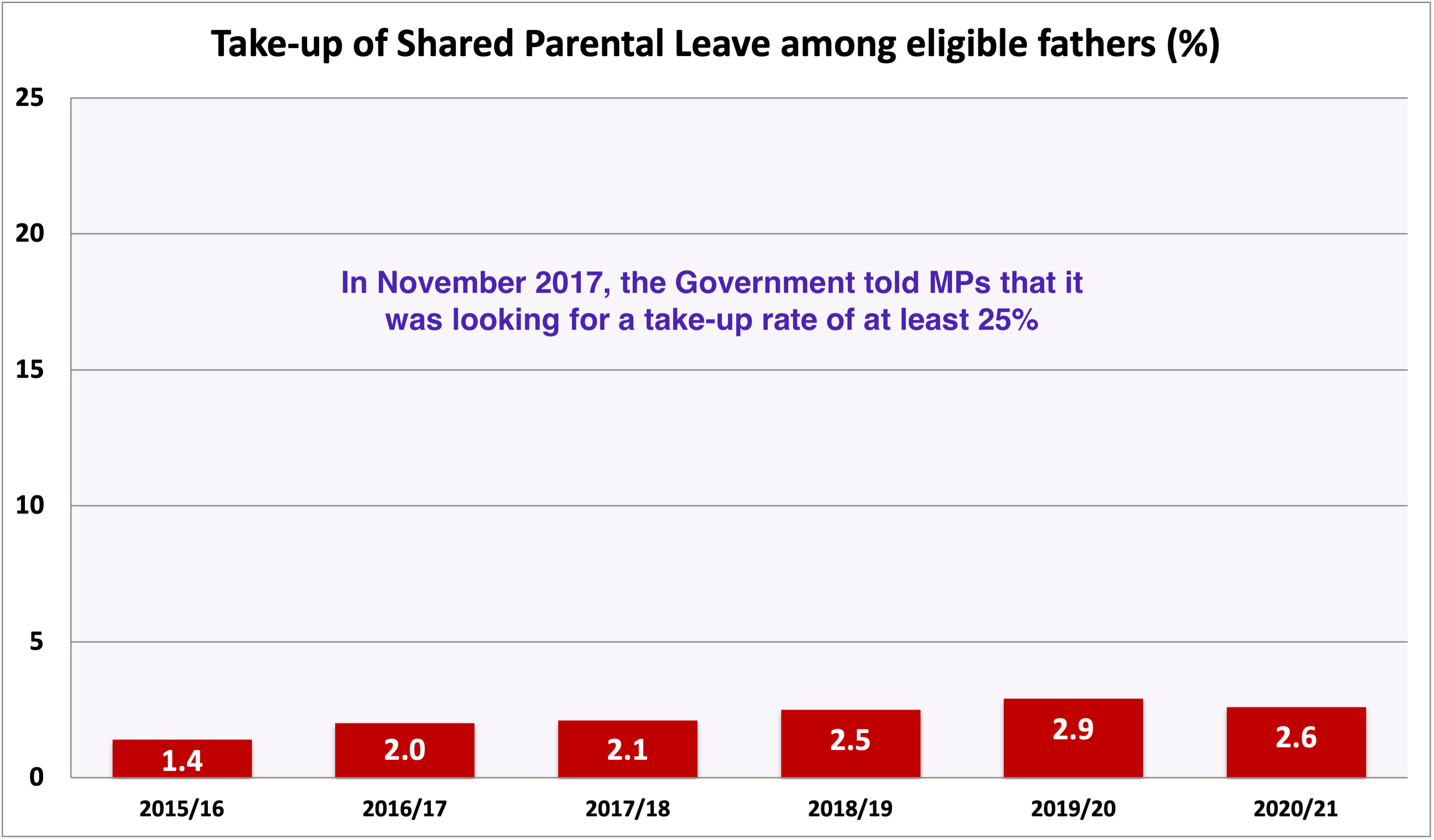
Way back in November 2017, the then business minister told MPs on the Women & Equalities Committee that the evaluation would be carried out “next year” – the clear implication being that it would be complete by the end of 2018. And the minister indicated it was already clear that the policy was failing. Asked about take-up by eligible fathers, she candidly stated:
“Take‑up is disappointing. It is under 10%. I would regard 25% as successful. I would regard anything over 20% as very encouraging. We are not going to see those figures, so [our evaluation] is going to demonstrate that we have a lot more to do.”
Four years on, my latest analysis of the relevant HMRC and DWP data indicates that just 1.5% of the 2.6 million new mothers who started on statutory paid maternity leave since April 2015 used the Shared Parental Leave scheme to transfer some of that paid leave to the child’s father. In 2019/20, the fifth year of the scheme, just 8,370 (2%) of the 418,000 such mothers did so. That is simply not enough to help bring about the societal shift to more equal parenting that we need to see if we are ever to eradicate the gender pay gap.
No wonder no one at BEIS is reaching for the Senokot. Because, should they ever release their evaluation report, they will have to tell us what – if anything – they plan to do to remedy this colossal policy failure. And such policy remedies don’t come cheap.
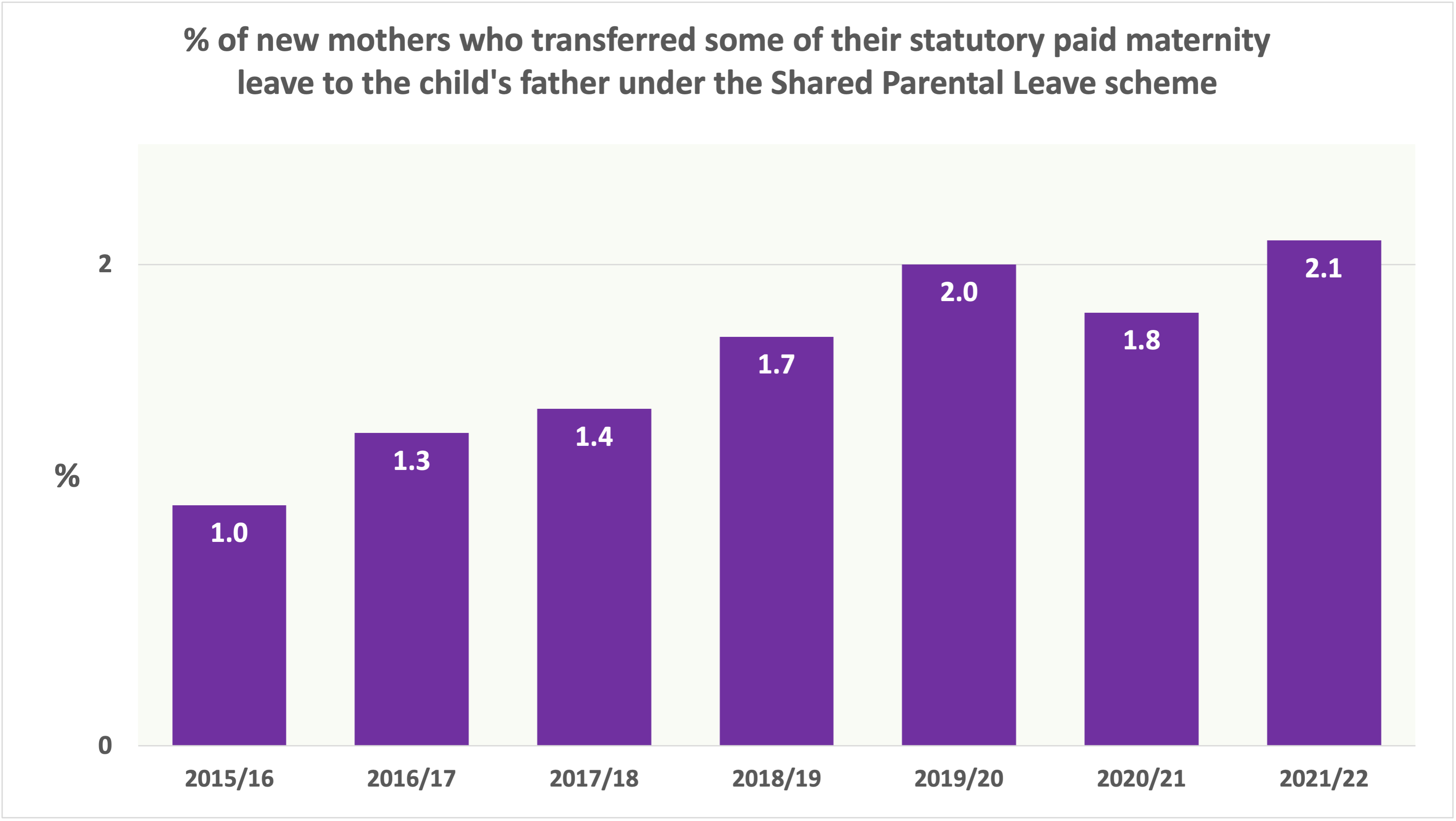
Update 21 June 2022: HMRC has now provided (in response to a FoI request) the relevant raw data for 2021/22, and this indicates that, while use of the SPL scheme by new mothers on statutory paid maternity leave has bounced back from a Covid-induced dip in 2020/21, it is now flatlining at a less than impressive 2%:
So, after a gap of eight months – due to the going live, in March, of a shiny new (and no doubt expensive) Case Management System that it seems cannot reliably count the number of cases it is managing – HM Courts & Tribunals Service has finally (and quietly) published some data on Employment Tribunal receipts.
The most recent employment tribunal data covers the period up to March 2021. This is because [the employment tribunal system] has moved to a new case management system, and HMCTS is currently working to incorporate the new IT system alongside longer-established data sources to provide a more complete and consistent data set for this jurisdiction.
However, late last week we learnt (from the minutes of the most recent ET National User Group meeting) that, just four days previously, on 14 October, HMCTS had quietly published a new set of management information on “workload and timeliness for HMCTS criminal, civil and family courts, and tribunals”. And this set of management information includes data on Employment Tribunal receipts (but not disposals) up to August 2021. Maybe someone should have told minister Cartlidge.
Whatever, is this a precious moment? Or do we employment policy nerds have to suffer and cry the whole night through a bit longer?
Well, the following chart adds the new data (for the months March to August 2021) to the previously published figures for the period January 2017 to February 2021. And maybe the number of new ET cases really did plummet by 42% between November 2020 and May 2021, to a level not seen since before the abolition of ET fees in July 2017.
Or maybe some new cases got ‘lost’ while the new Case Management System was being taught how to count the number of cases that it is managing. You decide.
[Update, 14 April 2022: In its latest monthly data release, setting out data up to February 2022, HMCTS has omitted the questionable figures for ET receipts in the period March to August 2021.]
Earlier this month, I wrote here about the law firm EMW and their narrative – eagerly sucked up by a few so-called journalists – about the supposedly low take-up of statutory paternity leave. I suggested that EMW’s narrative is little more than a pile of pants. And today, in response to my Freedom of Information request, HM Revenue & Customs have confirmed that EMW’s narrative is indeed, as the never knowingly understated Independent might report it, “broken”.
In short, EMW have for years based their narrative on HMRC figures for (a) the number of claimants (new fathers, mostly) paid statutory paternity pay, and (b) the number of claimants (new mothers) paid statutory maternity pay. Using the latter as a proxy for the number of fathers who are eligible for statutory paid paternity leave is highly questionable, but in any case it turns out those HMRC figures are inflated by a lot of double-counting. As HMRC confirm:
The number of claimants is the total number of individuals in receipt during that year, irrespective of when the payment first started. Where a given spell of [statutory maternity pay, statutory paternity pay or statutory shared parental pay] extends across two years, the claimant will be included in both years’ figures.
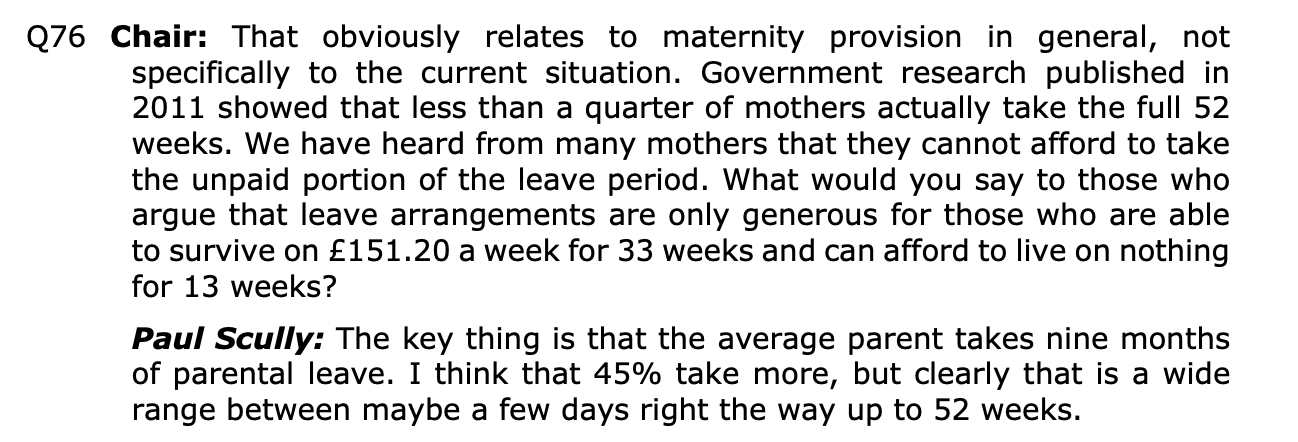
In the case of statutory maternity pay, this inflationary effect is substantial: up to 75%, if we assume (as seems to be the case – see image below) that, on average, women take nine months of SMP (i.e. their full entitlement). But with statutory paternity pay, the inflationary effect is negligible (because claimants can only take one or two weeks of paternity leave).
BEIS minister Paul Scully, giving oral evidence to the Petitions Committee of MPs on 11 June 2020
Maybe this doesn’t matter very much – the few press reports that EMW secured last month with their annual press release about the same set of HMRC data haven’t sparked a national debate about reform of paternity leave. Interestingly, however, EMW are also responsible for another take-up figure that frequently does feature in policy debate.
Only today, I received a document that states “the current UK [shared] parental leave scheme has a very poor uptake, with only around 1% of fathers using the scheme”. And, like many before them, the author of this document was almost certainly thinking of this news release from the TUC in April 2019:
The TUC is today calling for an overhaul of shared parental leave.
Last year only 9,200 new parents took shared parental leave – just 1% of those eligible to do so.
The TUC believes take-up is low because the scheme is so low-paid (£145.18 per week) making it unaffordable for most fathers.
A ‘note to Editors’ at the bottom of the news release states: “the University of Birmingham found that only 9,200 new parents (just over 1% of those entitled to take it) took SPL in 2017/2018”. However, the University of Birmingham’s short September 2018 report makes clear (see Reference 3) that it simply lifted the 1% figure from a (since deleted or moved) press release from … the law firm EMW.
Furthermore, it’s clear (including from a later EMW press release that has not been deleted) that EMW got to that 1% figure (1.4%, to be precise) by dividing HMRC’s figure for the number of claimants paid statutory shared parental pay in 2017/18 (9,200) by HMRC’s figure for the number of women paid statutory maternity pay that year (662,000) – that is, in the same way they calculated the take-up rate for paternity leave.
However, we now know that figure for the number of women paid SMP is inflated (by up to 75%) by HMRC’s double-counting. And in any case EMW are wrong to assume that the number of women who went onto statutory maternity pay is the same as the number of fathers who are eligible to take shared parental leave. In 2013, in its impact assessment of the new policy (see Table 7 on p29), the Department for Business, Energy & Industrial Strategy assumed the maximum number of eligible fathers to be just 285,000 (a figure BEIS has never felt the need to revise).
Whatever, now that HMRC have confirmed how their raw annual figures are inflated by double-counting, and using that BEIS figure of 285,000 eligible fathers, we can adjust those HMRC figures, to remove the likely double-counting in respect of shared parental pay, and so arrive at new estimates for the rate of take-up of shared parental leave among eligible fathers since 2015/16. (Note that we also need to adjust the HMRC figures to allow for the fact that, as confirmed in Footnote 5 of this Answer to a Parliamentary Question by Ed Miliband in February 2021, at least 20% of HMRC’s claimants for statutory shared parental pay are mothers who have converted their maternity leave to shared parental leave, as they must do before the father can access statutory shared parental leave and pay.)
I have previously suggested that SPL take-up among eligible fathers was as ‘high’ as 3.6% in 2019/20. But I didn’t know then that HMRC’s annual figures for the number of shared parental pay claimants include the double-counting that HMRC have now confirmed. I should have known better, frankly, but for what it’s worth here are my new estimates of SPL take-up:
[NB: If you are a nerd and would like to see how I arrived at these figures, just ask and I’ll send you a spreadsheet]
How many women go on statutory maternity pay in the UK each year?
Go on, have a guess. Or maybe you know the number?
Perhaps you do. Or maybe you only think you do.
According to news reports last month in the Independent newspaper – headline: “Parental leave system is broken: number of fathers taking paternity leave plunges to 10-year low” – and the supposedly specialist journals Personnel Today and People Management, it’s about 650,000:
Only 27% of eligible fathers took time off last year; 176,000 men took paternity leave and claimed statutory paternity pay in the 12 months to 31 March 2021 compared with 652,000 women who took maternity leave over the same period.
The data was released by HM Revenue & Customs following a Freedom of Information request by law firm EMW.
All three news reports were based on a press release by law firm EMW. Indeed, in recent years, EMW have been admirably effective at getting press coverage out of pretty much the same story, based on the same (updated) set of HMRC data: here they are in the Independent and Management Today in July 2019, and the Telegraph and HR News in August 2020. One year it’s ‘Only one third of fathers are taking paternity leave!’, and the next it’s ‘Two thirds of fathers are not taking paternity leave!’ Well done, law firm EMW.
We can only guess how EMW would have framed this unchanging story last month, had the Covid19 pandemic not come along in 2020. This provided them with the somewhat over-dramatic “paternity leave take-up has hit a 10-year low, with only approximately a quarter ofeligible fathers (27%) taking paternity leave after the birth of their child” hook, to the excitement of sub-editors at the Independent and the usual suspects such as Pregnant Then Screwed. But then it is hardly surprising, given how much of the workforce was on furlough for much of 2020/21, that some 30,000 new fathers decided to continue at home on furlough, on 80-100% of their normal wages, rather than take one or two weeks of statutory paternity leave on just £150 per week.
Whatever, here’s that HMRC data in full, showing that – *checks notes* – the paternity leave system is broken:
However, there are several problems with this narrative, and the HMRC data on which it is based.
The first problem is the assumption by EMW that the number of fathers (and other second parents) who are eligible to claim statutory paternity pay (i.e. the denominator for their paternity leave take-up rate) is the same as the number of women who started statutory paid maternity leave. There are a number of reasons why this is not the case, but to be fair it’s probably the best proxy available, so we can probably let this one pass.
The second problem is that, if we do assume that the number of fathers (and other second parents) who are eligible to claim statutory paternity pay is the same as the number of women who started statutory paid maternity leave, then we probably need to include in that latter number at least some of the 60,000 women who go on Maternity Allowance, rather than SMP, each year. The legal eagles at EMW seem to have forgotten about Maternity Allowance, but adding the 40,000 employed new mothers who get Maternity Allowance to their base figure of (about) 650,000 would make the paternity leave system look even more “broken”: it would, for example, indicate a paternity leave take-up rate of just 30% in 2019/20, not 32% as suggested by EMW.
However, the third – and biggest – problem with EMW’s narrative is that the number of women who start statutory maternity pay each year is not (about) 650,000, or anywhere near that number.
For a start, according to ONS data, in 2018 there were only 649,626 maternities in England and Wales, plus about 60,000 in Scotland. And a significant proportion of those 710,000 mothers (plus those in Northern Ireland) will not have been in employment (in March 2019, the Department for Business, Energy & Industrial Strategy estimated the employment rate of ‘women of child bearing age’ to be 73%). So it’s just not credible that pretty much all of the 710,000 went onto either SMP or Maternity Allowance.
More to the point, every year the DWP publishes data for benefits expenditure and caseload, including for SMP and Maternity Allowance. This data is published under the terms of a Memorandum of Understanding with the Office for Budget Responsibility (OBR), and reflects the Government’s financial delivery plans. So, if it’s wrong, the Budget is a pile of pants. And, according to this data, between 2012/13 and 2020/21, the average number of women going on to SMP was just 268,000 (within a range of 262,000 to 275,000).
The DWP also publishes quarterly data for Maternity Allowance starts, including a breakdown by employment status (’employed’ or ‘self-employed’), so we can add the some 40,000 employed women who started on Maternity Allowance each year to the OBR-approved number of women who started on SMP. (Note that, in 2020/21, there was also a pandemic-related dip in the number of employed women who started on Maternity Allowance, from 40,000 to 30,000. Believe it or not, neither law firm EMW nor Pregnant Then Screwed have yet made a fuss about this.)
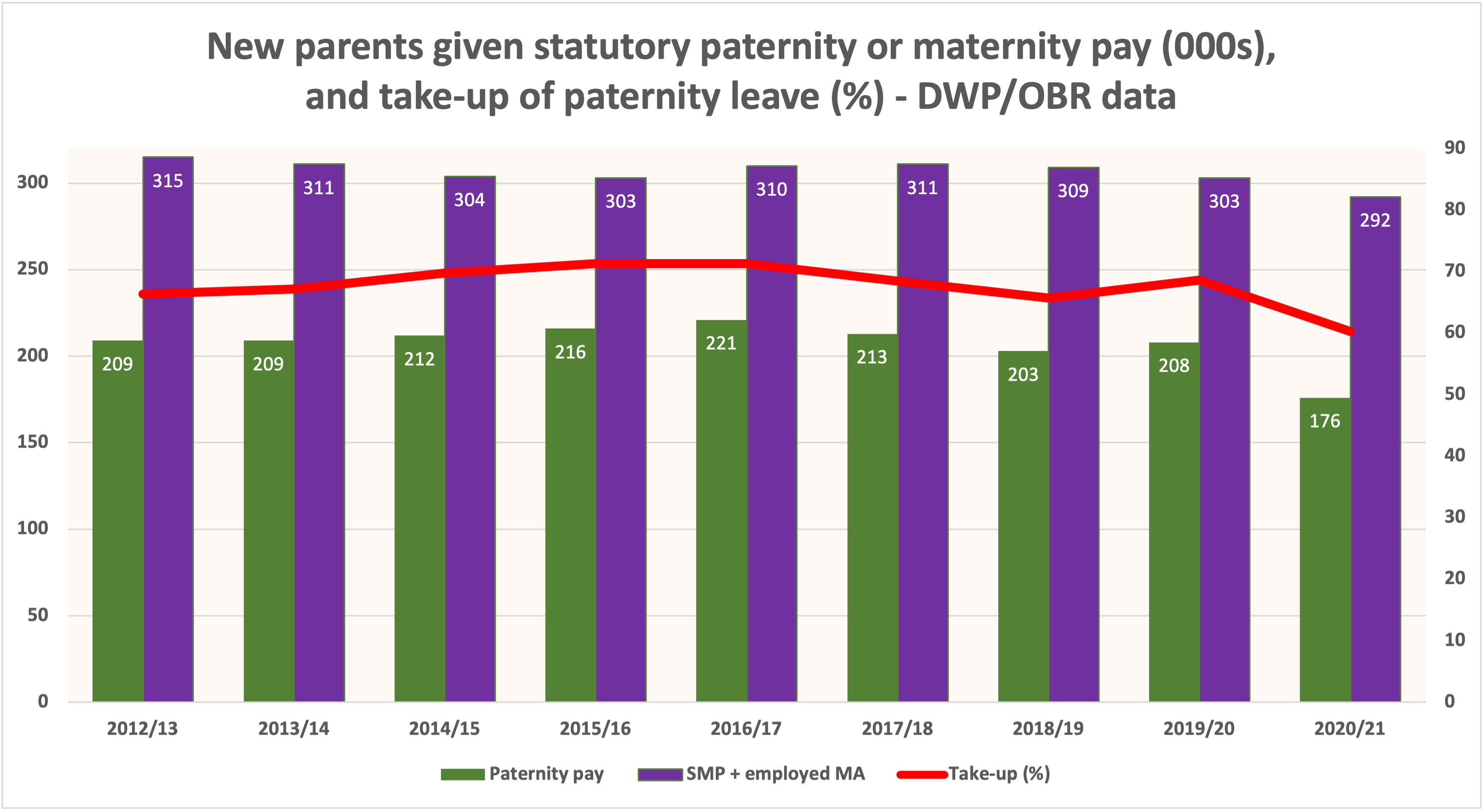
This combined data gives us a significantly different denominator (for calculating the take-up rate of paternity leave) to the HMRC data relied upon by law firm EMW and their friendly (but somewhat uninformed) journalists, and so a rather different picture of the take-up of statutory paternity leave:
Now you might still argue that even this data shows the paternity leave system to be ‘broken’. But I would suggest that a take-up rate of about 70% is not that bad, really, given the stupidly low rate at which such leave is paid and the other barriers to take-up, not to mention the fact that a good chunk of the ‘missing’ 30% will be new fathers who are self-employed, so are not even entitled to statutory paid paternity leave. Indeed, this is one of the reasons why, as mentioned above, law firm EMW are wrong to assume that the number of new fathers who are eligible to take statutory paternity leave is the same as the number of new mothers who start statutory paid maternity leave.
So, which set of data on SMP is correct, and why the discrepancy between the two? Well, at the time of writing, there’s no definitive answer to that, but this recent Answer by Treasury minister Jesse Norman to a Parliamentary Question by Kirsten Oswald MP strongly suggests (a) that the Government favours the OBR-certified data in the DWP’s annual Benefit Expenditure & Caseload tables; and (b) that one reason for the discrepancy is that the HMRC data on SMP provided to law firm EMW (and others) via Freedom of Information requests includes a lot of double counting, because it “includes claimants in each year in which they received statutory payments”.
In other words, a woman who took nine months of statutory maternity leave on SMP from October 2019 to June 2020, say, will have been counted twice by HMRC, first in its figure for 2019/20, and then in its figure for 2020/21. With women taking nine months of statutory paid maternity leave, on average, this means the HMRC data overstates the true figure by up to 75%. (There may well be such double counting in HMRC’s figures for statutory paternity pay, too, but as claimants take only one or two weeks of such pay, the inflationary effect will be negligible.)
Allowing for this double counting would reduce the HMRC figure of some 650,000 SMP starts a year to as little as 370,000 (which would increase EMW’s paternity leave take-up rate for 2019/20, from 32% to 56%). But that still leaves a significant discrepancy between the HMRC data and that published by the DWP as part of the OBR-certified Benefit Expenditure & Caseload tables.
I’m awaiting a response from HMRC to a Freedom of Information request seeking an explanation of the discrepancy, so maybe everything will yet become clear. Or, more likely, it won’t. But watch this space.
(For the record, none of the above is to dispute that our parental leave system is broken. It is very broken, and I have written extensively about just how broken it is. But paternity leave is the least important part of that system and, while it should be better paid and be a Day One right for all workers, including the self-employed, there are much bigger fish to fry in this policy area.)
Update (27 September): In its response to my FoI request, HMRC has confirmed that the figures provided to the law firm EMW (and others) include lot of double-counting:
The number of claimants is the total number of individuals in receipt during that year, irrespective of when the payment first started. Where a given spell of [statutory shared parental leave pay, statutory maternity pay or statutory paternity pay] extends across two years, the claimant will be included in both years’ figures.
So, EMW’s narrative about the take-up rate of statutory paternity leave is indeed ‘broken’.
With the release this morning of the latest set of quarterly Employment Tribunal (ET) statistics, covering Q4 of 2020/21 (Jan – Mar 2021), and with last week having seen the latest farcical performance of the ‘spot a quirk in the ET stats and get our name in the papers’ PR party trick – this time by Stuart Lewis of Rest Less and Patrick Thomson of the Centre for Ageing Better – I thought it might be interesting to check on how the oh-so-confident predictions of previous performers of the trick have actually turned out.
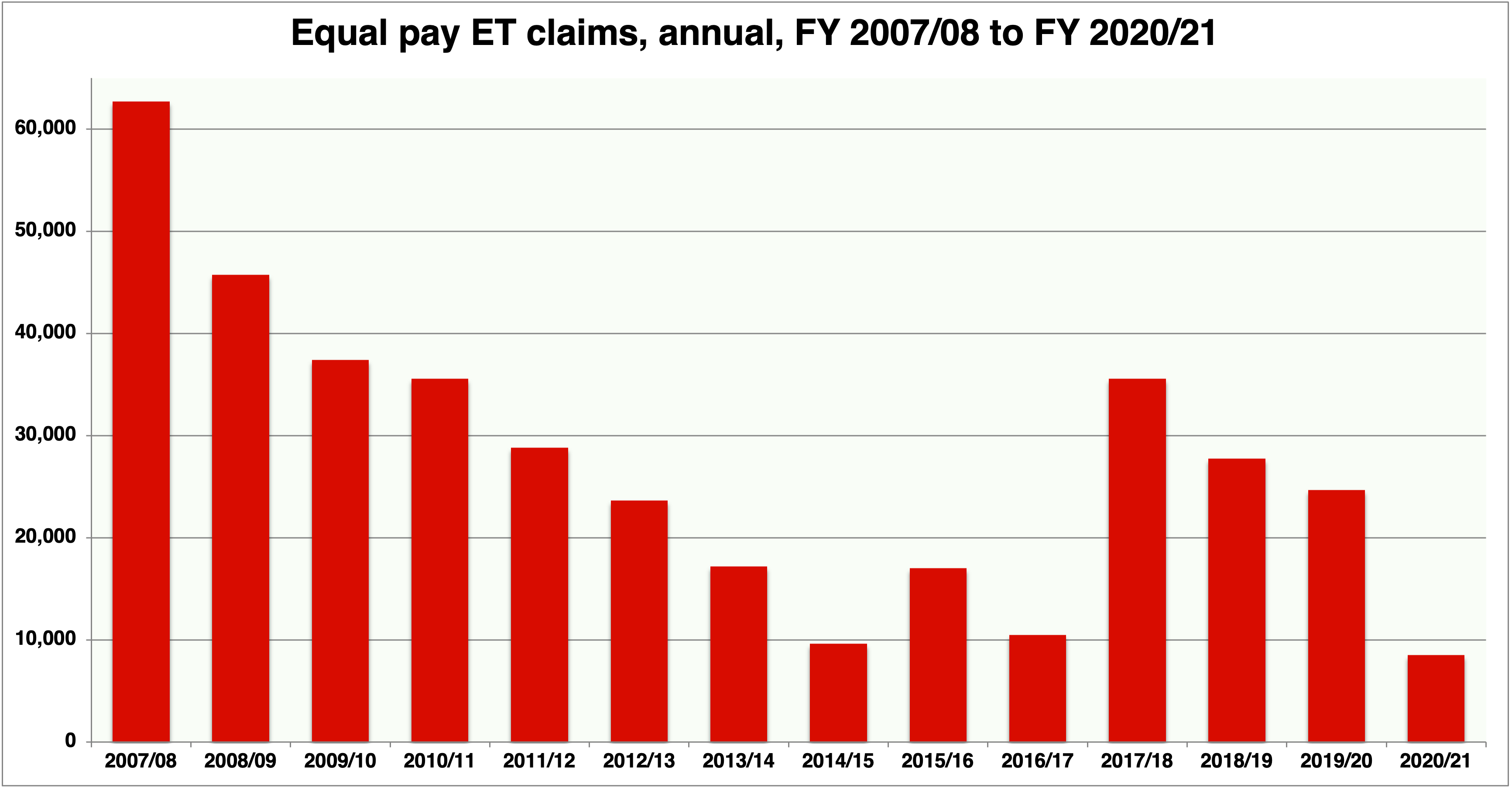
The first of our past performers is DLA Piper’s legal eagle – but statistical sparrow – Jane Hannon, who in May 2020 secured a nice little piece in the Guardian, under the headline “29,000 claims a year despite 50 years since Equal Pay Act”. This ‘revealed’ that “a consistently high number of workers are alleging that their employers are illegally paying them less than colleagues in similar roles”, and that “the number of claims brought to employment tribunals [is] showing no sign of decreasing”.
Unfortunately for Ms Hannon – who really should have gone to Specsavers – a slightly more than cursory analysis of the ET statistics showed the somewhat inconsistent number of claims decreasing in no fewer than ten of the previous 12 years, including in each of the two most recent years, 2018/19 and 2019/20.
And today, the latest set of statistics confirms that this downwards trend continued in 2020/21, with the number of equal pay claims decreasing by another 65%, to its lowest level in at least the last 16 years. But hey, who could possibly have seen the signs?
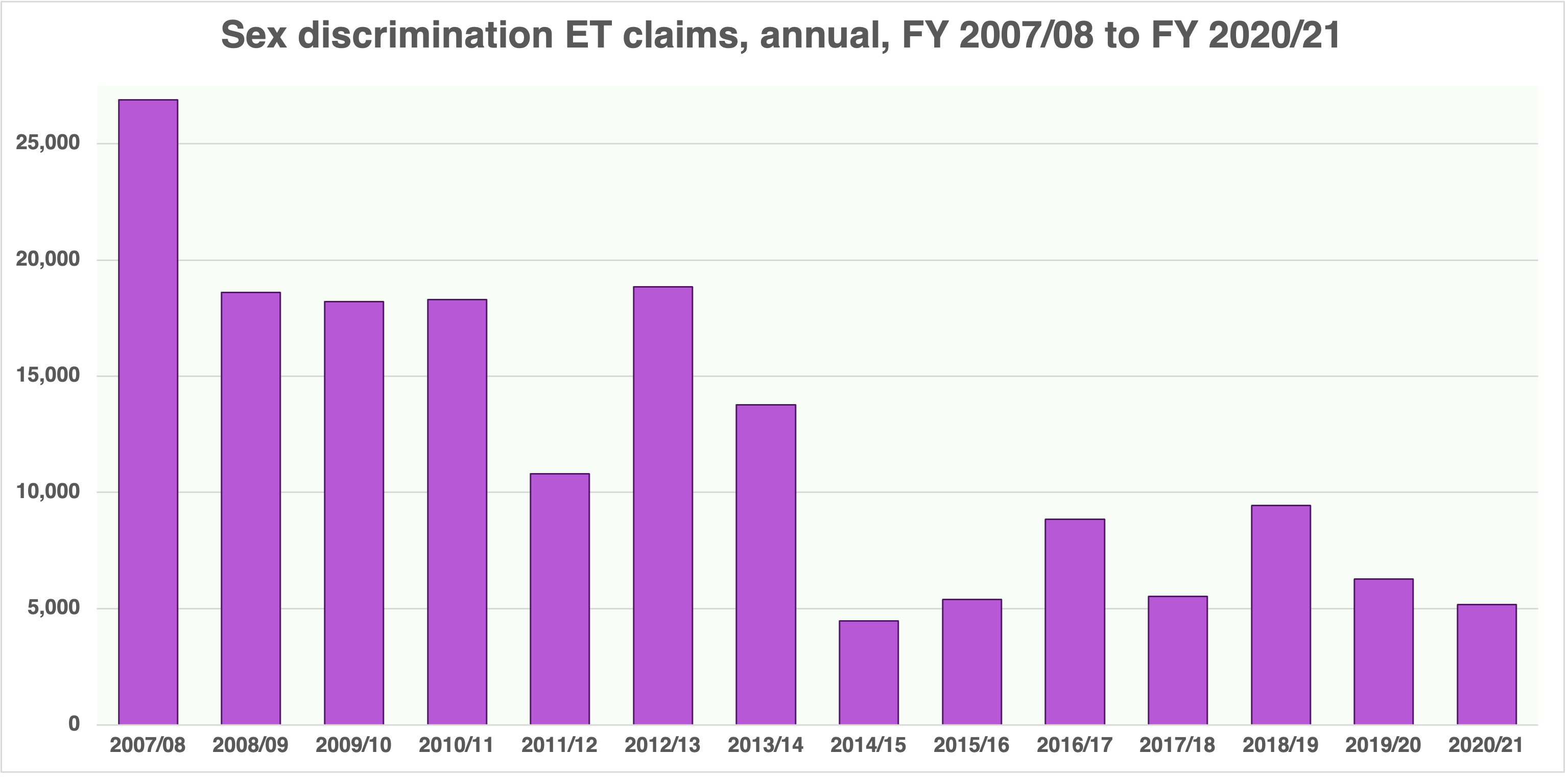
Next up in our rogues’ gallery of past performers is Hannah Mahon, a partner at GQ Littler, which modestly describes itself as “the world’s leading employment law firm”. In July 2019, Ms Mahon secured near-identical articles in the Financial Times, the Daily Fail, the Metro and the Times about a 69% “spike” in the number of sex discrimination claims in 2018/19. Ms Mahon attributed this to “a big increase in the public airing of sexual harassment claims” in the era of #MeToo: “It’s a much more public thing now. People are starting to understand their rights and feeling less shy about speaking out.”
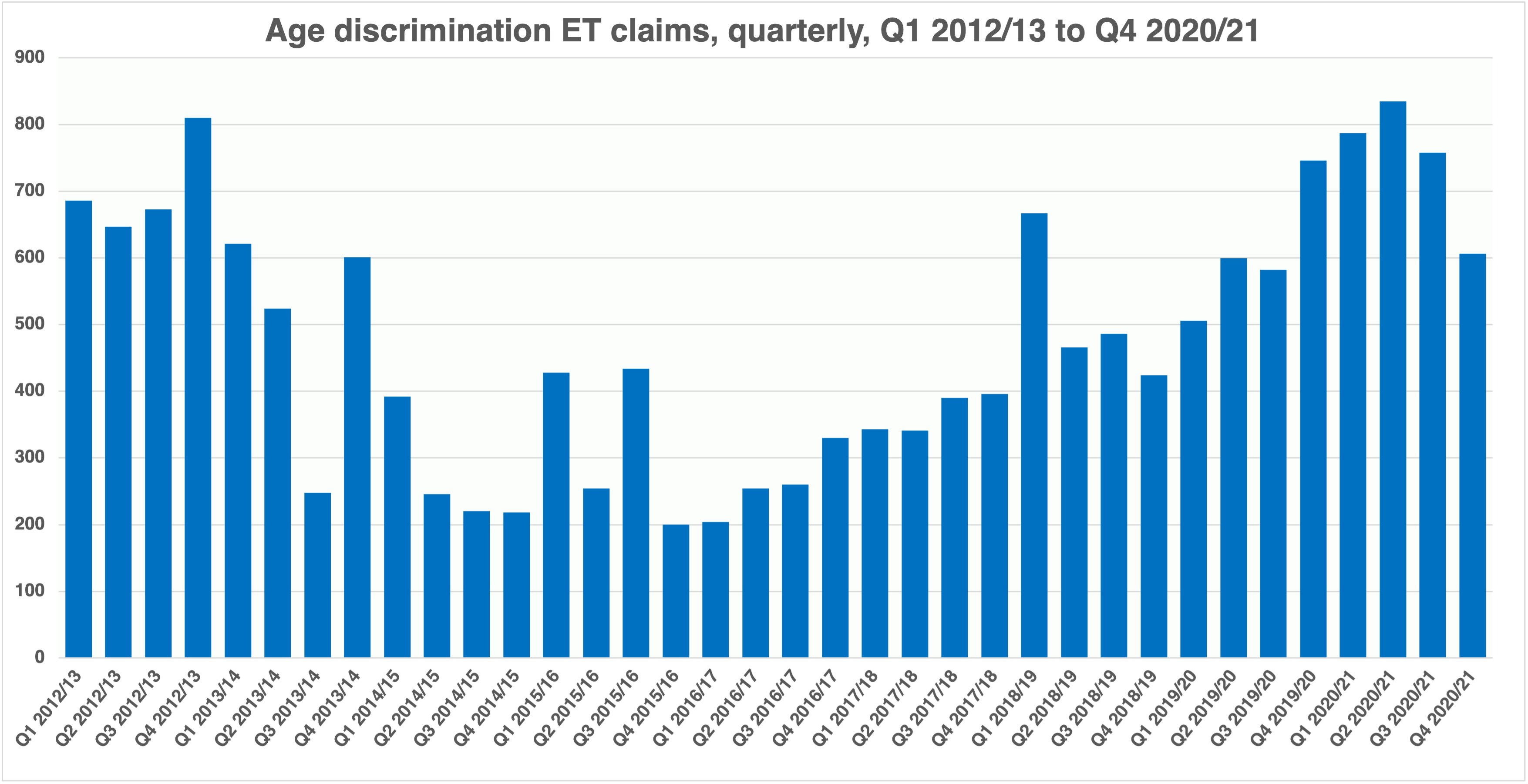
Unfortunately for Ms Mahon, a slightly more than cursory analysis of the ET statistics showed that pretty much all of the 69% spike had occurred in Scotland, and only in the two months June and August 2018. In England & Wales, the number of sex discrimination claims had actually fallen, by 8%. Ms Mahon would probably get on well with Stuart Lewis of Rest Less and Patrick Thomson of the Centre for Ageing Better, who failed to spot (or deliberately overlooked) the rather obvious fact that most of their 176% explosion in age discrimination claims in Q3 of 2020/21 occurred only in Scotland, only in October 2020, and had nothing whatsoever to do with firms ditching older staff during the pandemic.
And today, the latest set of statistics suggests that the #MeToo movement has yet to impact on women’s understanding of their rights, or their shyness about speaking out about sexual harassment at work, as the number of sex discrimination claims has fallen by 45% since 2018/19, and is now at a diminutive level rarely seen over the last 14 years.
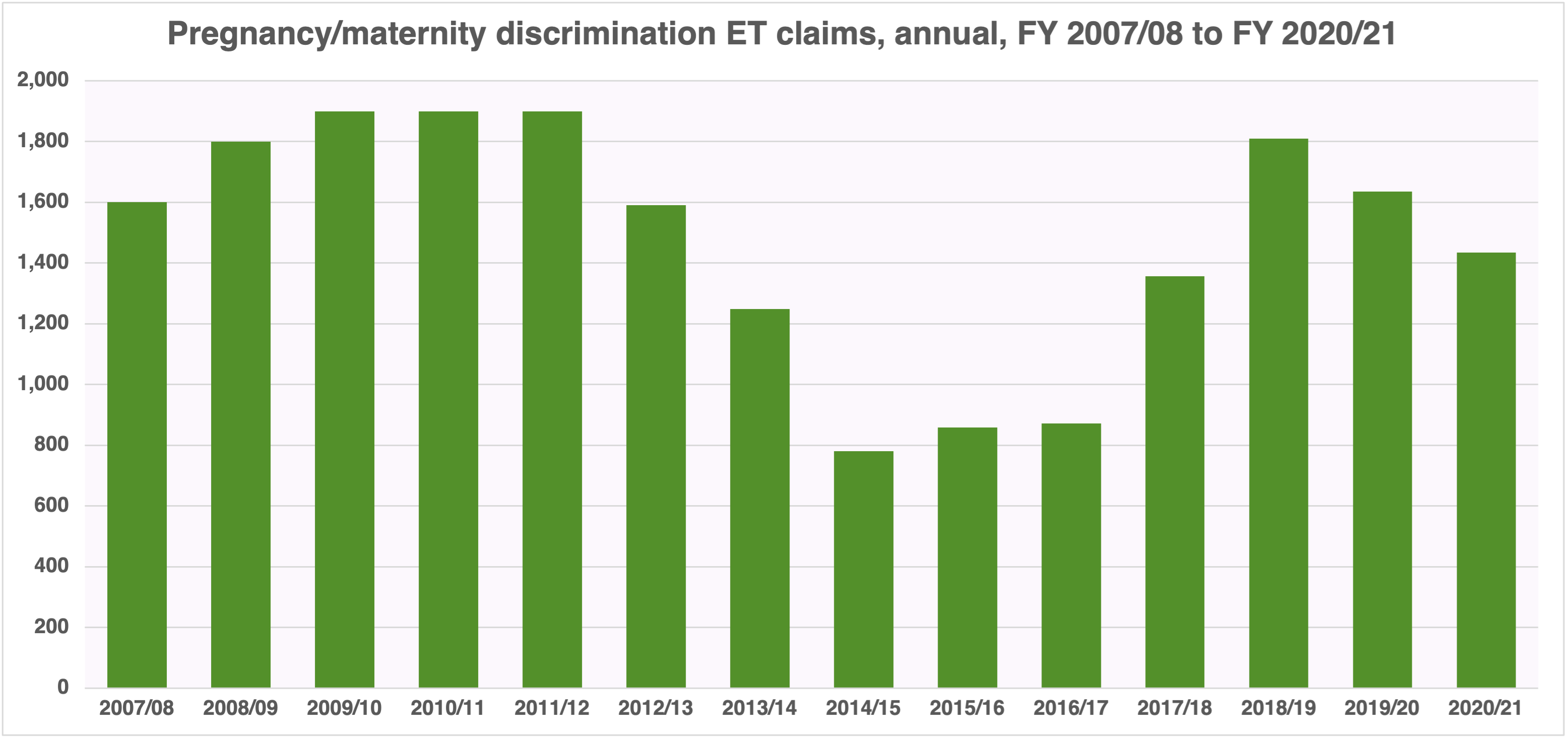
Next up is Sophie Vanhegan, another partner at GQ Littler, who in June 2019 secured a lengthy piece in People Management – the official journal of the CIPD – about a 56% increase in pregnancy/maternity discrimination claims in 2017/18. Vanhegan attributed this ‘spike’ to the #MeToo movement making women more aware of unacceptable behaviour, especially related to pregnancy: “Things that may have simply just been accepted in the past are now being seen as unacceptable and people are feeling more confident in being able to challenge them” by bringing an ET claim.
Vanhegan was supported by Claire McCartney, a senior policy adviser at the CIPD, who said that “while the removal of tribunal fees may have accounted for some of the increase, there has also been a greater awareness of maternity and paternity rights, and an increased willingness to make claims”. And campaign group Pregnant Then Screwed were quick to jump on the bandwagon, tweeting that “the number of women experiencing discrimination has definitely risen but this [56% increase] is more about women feeling empowered to do something about it – all our hard work feels like it’s paying off.”
Leaving aside the rather obvious point that the #MeToo movement didn’t even start, on the other side of the Atlantic, until half-way through 2017/18, a slightly more than cursory analysis of the ET statistics showed that the 56% increase in pregnancy/maternity discrimination claims was entirely in line with the 60% increase in the number of new ET cases due to the abolition of ET fees in July 2017, just three months into 2017/18.
And today, the latest set of statistics confirms that, if the #MeToo movement has had any lasting impact on the willingness of pregnant women and new mothers in the UK to bring a pregnancy/maternity discrimination claim, it has been in the wrong direction. For, having bounced back to just short of its pre-ET fees level in 2018/19, the number of pregnancy/maternity discrimination claims has since fallen by 21%. Clearly, Pregnant Then Screwed need to be working a little harder.
Who knows, maybe last week’s performance of the PR party trick by Rest Less and the Centre for Ageing Better will prove to be the exception to the rule, and they will secure a footnote in employment policy history as the discoverers of a sustained, upwards trend in the number of age discrimination claims linked to Covid19 and the associated lockdowns. Maybe employment lawyers and policy wonks will sit around talking reverentially about the Lewis-Thomson Theorem, and nodding sagely.
Time will tell. But today’s set of employment statistics doesn’t bode well for the Lewis-Thomson Theorem. After removing another obvious multiple claimant case (in Scotland, in February 2021, with some 1,400 claimants), we find that age discrimination claims have fallen by 27% over the two most recent quarters. Have employers stopped ditching older staff because of the pandemic already? I have no idea. Ask Stuart Lewis at Rest Less.
The number of age discrimination claims taken to Employment Tribunals has increased dramatically in Scotland since Covid lockdown, according to analysis of Ministry of Injustice data.
Claims increased by 1,049% over the year, with a stonking 13,043% increase in October 2020, compared with the same month the year before.
News of the steep increase comes against a backdrop of it being a Bank Holiday weekend, and a resultant shortage of proper journalists on newsdesks throughout Fleet Street.
“We know that this increase has absolutely nothing to do with Covid, and tells us nothing about how employers have responded to the lockdowns”, said Stuart Lewis, the founder of Rest Less, a jobs site in desperate need of a higher public profile. “But these journalists don’t, so we can get our name in their papers for nothing!”
Patrick Thomson, a senior programme manager at the Centre for Ageing Better, said: “I haven’t got a clue what’s going on, to be honest, but they said if I provide a meaningless quote we will get our name in the papers too. This is the #MeToo moment for wrinklies. Or something.”
A Ministry of Injustice spokesperson said: “Hahahaha! Hahahaha!”
Several dozen employment lawyers said: “Are you joking me? In the Guardian???”
Note (only read if you are a nerd): Across England, Scotland & Wales, there was a 74% increase in the number of age discrimination ET claims in 2020, compared to 2019. And there was a 176% increase in Oct-Dec 2020, compared to the same quarter in 2019. But that was mostly due to a 13,043% increase in Scotland in October 2020 (when there were 920 claims), compared to October 2019 (when there were 7 claims).
Strip out the figures for Scotland (shown in the chart above), and there was a 30% increase in England & Wales in 2020 (when there were 2,662 claims), compared to 2019 (2,021 claims), and a 21% increase in Oct-Dec 2020 (when there were 672 claims), compared to the same quarter in 2019 (555 claims). And it is really only that three-month period Oct – Dec 2020 that we need to focus on, as that is the first quarter in which we can expect to see any impact of Covid and the associated lockdowns on the number of ET discrimination claims. Why else would Rest Less, the Centre for Ageing Better and their pet journalists have focused on it in their garbage articles, eh? [Yes, yes, I know.]
To put that 21% rise in context, in Oct-Dec 2020, across England, Scotland & Wales the total number of new ET single claims/cases (arguably the best benchmark in this context, but see below) rose by 25%, compared to the same quarter in 2019; unfair dismissal claims were up 28%, sex discrimination claims were up 13%, and both disability discrimination and pregnancy/maternity discrimination claims were up 8%. The number of age discrimination claims is very small, relative to major ET jurisdictions such as unfair dismissal, so only a numpty gets super excited about percentage changes in the number, which goes down as well as up.
For example, the 3,668 age discrimination claims in England, Scotland & Wales in 2020 is way down on 2017, when there were 6,704 claims, on 2016, when there were 7,498 claims, and on 2015, when there were 12,654 claims. Why did the Guardian, the Telegraph, the Express, the Daily Fail, Personnel Today, the Yorkshire Post and People Management not mention this steep decline? Surely Rest Less and the Centre for Better Ageing should be celebrating this long-term downward trend?
All this data has been freely available on the MoJ website since 11 March 2021, so it’s not really ‘news’ on 1 June. And the October 2020 figure in Scotland appears to reflect the lodging of a single multiple claimant case (with some 900+ claimants) by the Scottish Police Federation, in respect of changes to police and other civil service pensions made by the Government in 2015 – so, nothing to do with Covid or the lockdowns.
Spotting a quirk in the ET statistics and then claiming this proves something your organisation gives a shit about is an old PR trick that I have written about here and, even longer ago, here.
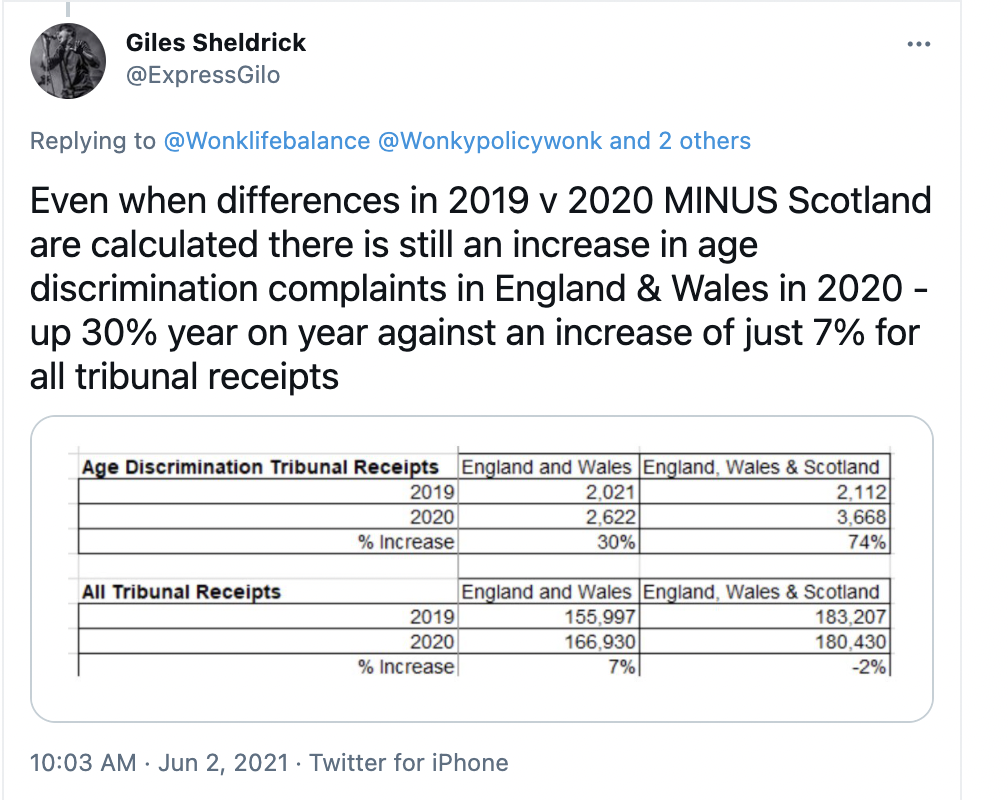
On Twitter, Giles Sheldrick of the Daily Express has sought to defend his numptiness by (a) conceding that age discrimination claims rose by just 30% in England & Wales in 2020, not 74% as stated in his article; and (b) asserting that the total number of jurisdictional complaints [sic] rose by 7%, whereas in his article he stated that this number (which he wrongly referred to as “overall cases”) had fallen from 183,207 to 180,430 (a drop of 2%). In short, in just 24 hours he’s gone from contrasting an increase of 74% with a decrease of 2% (a difference of 76 percentage points), to contrasting an increase of 30% with an increase of 7% (a difference of just 23 percentage points).
Leaving aside the question of whether Giles would have got his article in the paper if he’d used the 30% and 7% figures he now relies on, the total number of jurisdictional complaints is the least meaningful of the several different ways of measuring ‘overall cases’. A much more meaningful benchmark is the total number of claims, as that is also the total number of claimants, each of whom can make a claim in more than one jurisdiction. And, across England, Scotland & Wales, that number rose by 8%, from 108,592 in 2019, to 117,446 in 2020. But of course Rest Less and the Centre for Ageing Better chose to contrast the number of age discrimination claims with the total number of jurisdictional complaints, because of that convenient 2% fall.
Furthermore, some (including me) would argue that the most meaningful benchmark in this context is the total number of claims made by individual workers (i.e. the number of single claims/cases), as – unlike the total number of claims – that number is not subject to the distortions caused by multiple claimant cases brought by law firms and trade unions on behalf of sometimes very large groups of workers (e.g. that multiple claimant case with some 900 claimants in Scotland in October 2020). And, across England, Scotland & Wales, the total number of single claims/cases rose by 13%, from 39,966 in 2019, to 45,245 in 2020.
So, you can see why Rest Less, the Centre for Ageing Better and their pet journalists chose not to use the total number of single claims/cases as their benchmark. But, if we do use it as the benchmark, the statistics show that, in Oct – Dec 2020, the number of age discrimination claims in England & Wales rose by 21%, compared to the same period in 2019, and the number of single claims/cases rose by 27% (from 9,743 to 12,337). Those are really the only two percentages that matter here, and I doubt that even a future Pulitzer Prize-winning newshound like Giles Sheldrick could get a story out of them.
UPDATE (7 June): So, the numpties at People Management (the voice of the CIPD) have seen fit to add a corrective to their original article. This states:
“Since publishing, People Management has learned there was a spike of 920 age discrimination complaints made in Scotland in October 2020 – accounting for a quarter of all age discrimination complaints made last year – which could be attributed to coordinated public sector claims following a 2018 Court of Appeal ruling on pensions.
In response, Rest Less noted that excluding the figures from Scotland, England and Wales had still seen a 30 per cent rise in claims for age discrimination last year, whereas the total number of [jurisdictional] claims for all reasons only increased by 7 per cent.
Stuart Lewis, founder of Rest Less, said: “While some of the rise can be attributed to a specific case based in Scotland, the underlying trend of age discrimination claims is clearly up year on year and we know that the pandemic has exacerbated age discrimination in both the workplace and the recruitment process.“
Leaving aside the question of whether Stuart Lewis of Rest Less would have got quite so many numpty journalists to copy out his press release if he’d used the 30% and 7% figures, rather than 74% and -2%, this still begs the question: so fucking what?
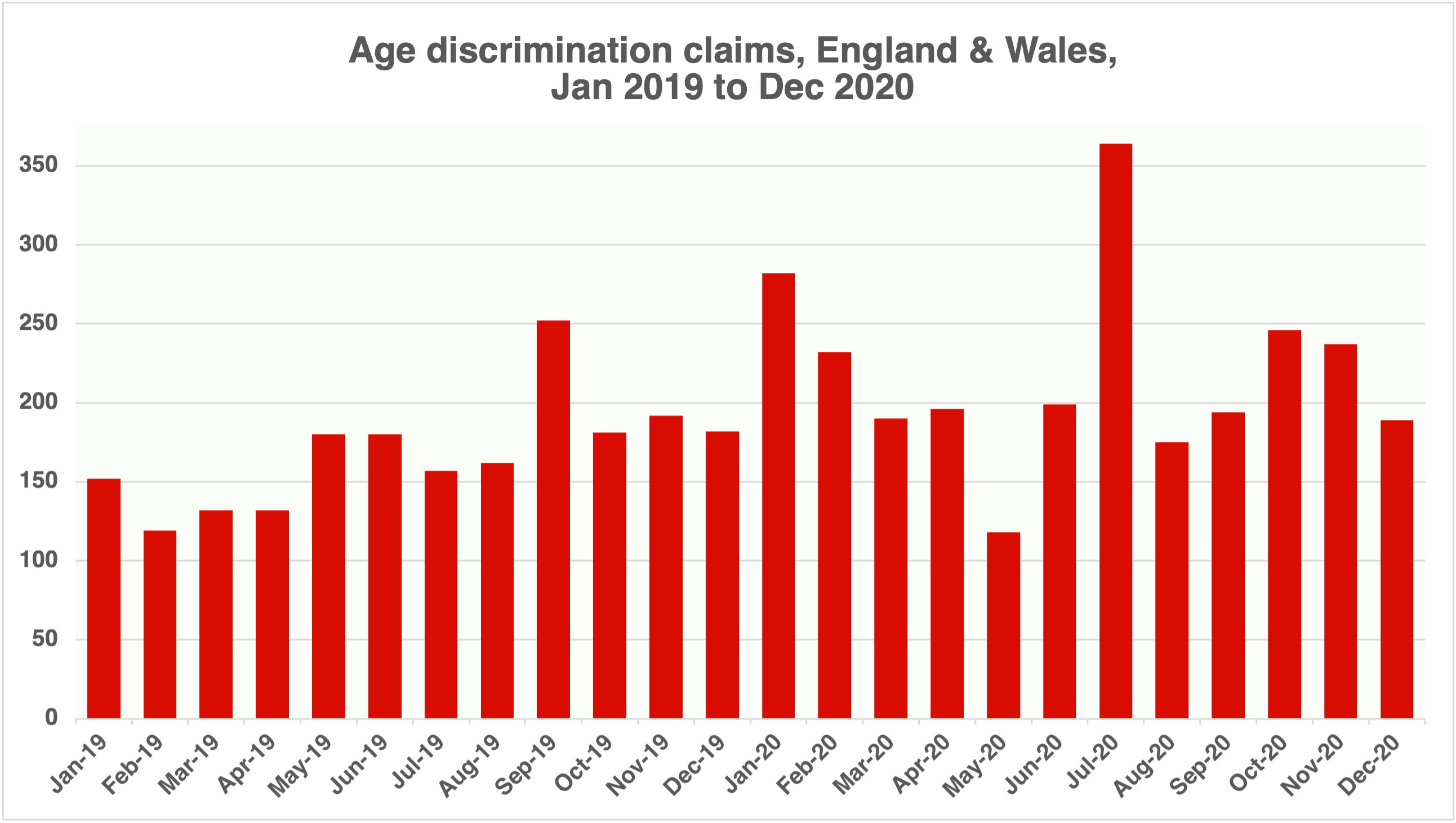
Because, if we look at what happened, month by month, in England & Wales in 2019 and 2020, we can see that much of that 30% increase occurred in January, February and July 2020. And there certainly won’t have been any impact of Covid and the lockdowns on the number of age discrimination claims in January and February 2020, as the first lockdown only started on 23 March.
As for July 2020, that is still a bit too early to expect to see much if any impact of Covid and the first lockdown on the number of ET claims, given the need for any would-be ET claimant to go through statutory Acas early conciliation before being able to lodge an ET claim. The spike that month seems more likely to be due to the lodging of a multiple claimant case somewhere. And – lo! – if we look at the data for July 2020, we find that 208 (57%) of the 364 age discrimination claims in England & Wales were lodged in just one region: London. The month before, there were just 22 such claims in London region (out of a total of 199), in August there were 64 (out of a total of 175), and in December – when employers were busy ditching older workers by the thousand, according to Rest Less and the Centre for Ageing Better – there were 26 (out of a total of 189).
So, if we compare the last five months of 2020 with the same period in 2019, we find that age discrimination claims in England & Wales increased by just 7%, from 969 to 1,041. Which I suggest is no big deal, and certainly doesn’t merit feverish coverage in four national newspapers, a regional newspaper and two supposedly specialist journals.
Update (10 June): So, ten days after I wrote to the Guardian‘s Readers’ Editor to request a correction, the Guardian has today amended its original article, to reflect the 30% and 7% figures on which Stuart Lewis of Rest Less now relies.
With apologies to Chaka Khan, the latest set of weekly HMCTS management information on the backlog of Employment Tribunal (ET) cases – which the Ministry of Injustice has been publishing since the fourth month of the pandemic, alongside that for other courts and tribunals – suggests the Government’s repeatedly promised Employment Bill may not be the only thing to have gone missing recently.
Since the start of the year, this weekly management information had suggested that, due to a steady decline in the number of new ET single claims/cases, the ET system had finally got on top of the backlog of such claims/cases – which has ballooned by 48% since the onset of the pandemic – and had even started to reduce it: the backlog peaked at 45,376 in late February, then fell by 1,034 over the first three weeks of March.
And the latest set of this management information, published this morning, should have set out the data on new claims/cases and disposals in the five weeks ending 28 March, 4 April, 11 April, 18 April and 25 April. However, the relevant cells in the spreadsheet for the latter four weeks are blank, and a note at the top of the spreadsheet states:
The workload information for April is not included in this release, as the work of the Employment Tribunal transfers to a new case management system. The figures for April will be updated in [a] future release of this [Management Information].
Which is understandable, perhaps, but does leave us with the rather odd fact that, according to the published HMCTS management information up to 28 March, the weekly number of new single claims/cases fell from more than 1,000 in each of 13 of the last 15 weeks of 2020 (an average of 1,067), to just over 900 in mid-January, then to an average of 822 in February, to 623 in mid-March, and an almost microscopic 360 in the week ending 28 March (see the table, below).
Now, it is possible that the number of new ET single claims/cases has fallen by 66% over the first three months of 2021, to a level not seen since the 2013-17 era of ET fees. But it doesn’t seem very likely. In late 2020, the trend was (mildly) upwards.
But wait! In tiny print, at the bottom of the spreadsheet of HMCTS data, is a somewhat cryptic footnote. This states:
The Employment Tribunal is moving onto a new case management system [CMS] for the administration of work from March 2021. HMCTS is currently working to incorporate the data from this new IT system alongside longer-established data sources to provide complete management information for this jurisdiction. While this work is ongoing, figures shown [in this spreadsheet] are only from the longer-established data sources and do not include all the cases being administered using the new system. As a result, the figures may show declining trends, but will be incomplete and reflect the transition in case management systems.
Could it be that new ET claims/cases administered under the new CMS – perhaps including in January, February and March as the new system was being piloted and/or live tested, before going fully live from 1 April – have, in effect, gone missing from the published HMCTS data? That is, the decline in new claims/cases shown in the published data isn’t real. In which case, it may well be that the ET system has not yet got on top of the (possibly still growing) backlog, after all.
Perhaps we should be told. Whatever, as the Low Pay Commission notes in a new report on enforcement of the minimum wage, the average waiting time for an ET hearing is now “over 12 months”.
Yes, as you will know unless you are spending #Lockdown3 on Mars, on Monday the Times newspaper and its Investigations Editor Dominic Kennedy went Back to the Future of 2011, with not one but four articles straight out of the Adrian Beecroft playbook. Yes, the Thunderer has ‘discovered’ that not every Employment Judge learnt their trade at the Institute for Economic Affairs, and – shock horror! – has even found two – TWO!!! – weak claims from the last three or four years that Employment Tribunals rightly dismissed. And all this for the annual salary of an Investigations Editor.
I don’t get paid anything like the salary of an Investigations Editor – and I’m writing these words pro bono – so in this blog I’m not going to respond to all four articles (employment barrister Jason Braier has done a very good job on the one in which the Times sets out its favoured options – not all of them entirely loopy, it has to be said – for reform of the ET system). All you’re getting here is my random thoughts – paragraph by tedious paragraph – on the pathetically one-sided opinion piece masquerading as objective journalism, in which Dominic Kennedy sets out what we must regard as the thesis of whoever it was who fed him their garbage.
Tribunal system chaos: No experience necessary to be a judge in hearings free-for-all
Inexperienced judges who have never heard a case have been hired to clear an avalanche of employment claims from sacked and aggrieved workers.
Comment: Gosh, tell me more, Dominic.
Trade union and town hall lawyers are among 59 new faces judging cases at tribunals, where battles can cost millions of pounds in compensation and legal bills. In the biggest simultaneous recruitment of judges for nearly 400 years, appointees are being hired at annual salaries of £113,000.
Comment: Trade unions! Boo! Town halls! Boo! 400 years? Are we sure it’s not 500 years? Just don’t ask what the annual salary of an Investigations Editor is. As for “millions of pounds in compensation”, in 2019/20 the median ET award for race discrimination was £8,040; for age discrimination it was £11,791; for disability discrimination it was £13,000; and for sex discrimination it was £14,073. There are also not many such awards: in 2019/20, there were just 28 awards for race discrimination, 71 for disability discrimination, 10 for age discrimination, and 46 for sex discrimination. Substantially larger awards are extremely rare: the last time there was a discrimination award of more than £1 million was in 2015/16.
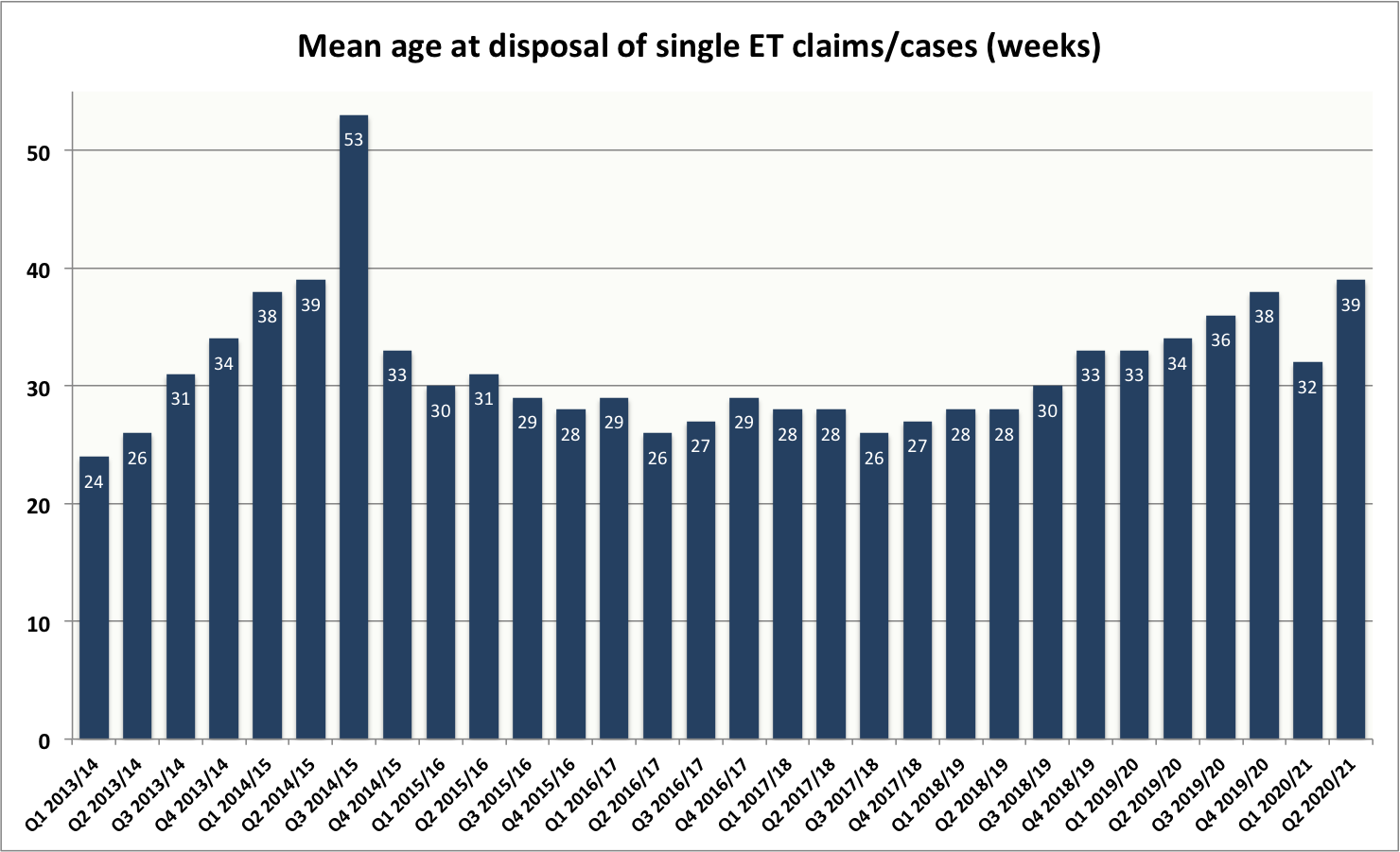
An investigation by The Times shows that the tribunal system is in chaos with a record backlog of 40,000 cases. The average waiting time from a case being received to its conclusion now drags on for 39 weeks.
Comment: It didn’t require an investigation by the Times or any other newspaper to show that the ET system currently has a backlog of 44,479 (single) claims/cases, as of 27 December, because the figure has been freely available on the gov.uk website since 14 January. And the ‘average waiting time’ figure of 39 weeks has been freely available, as part of the most recent set of quarterly ET statistics, since 10 December. And here’s a chart, putting that 39 weeks figure in context.
Employment judges appear to have been making a power grab, telling law chiefs that they should hear all equality cases, not just workplace disputes.
Comment: A power grab! How thrilling. *gets more popcorn*
Even employers who win their cases must expect to lose out financially every time they receive a claim for discrimination because the system is stacked against them. Judges rarely reject equality cases without a full hearing and there is usually no way to recover costs from the losing side.
Comment: This assertion that the ET system is stacked against employers is no more than subjective opinion, unsupported by any actual evidence of the kind you might expect to have been unearthed by an ‘investigation’ by a major newspaper. One could just as easily assert – many people do – that the system is stacked against claimants, all but a handful of whom can only dream of making claims costing their (no doubt former) employer “millions of pounds in legal bills”. And we’ve been waiting since 1785 for the Times to propose a model system for resolving legal disputes that is above and beyond the odd complaint from one side or another.
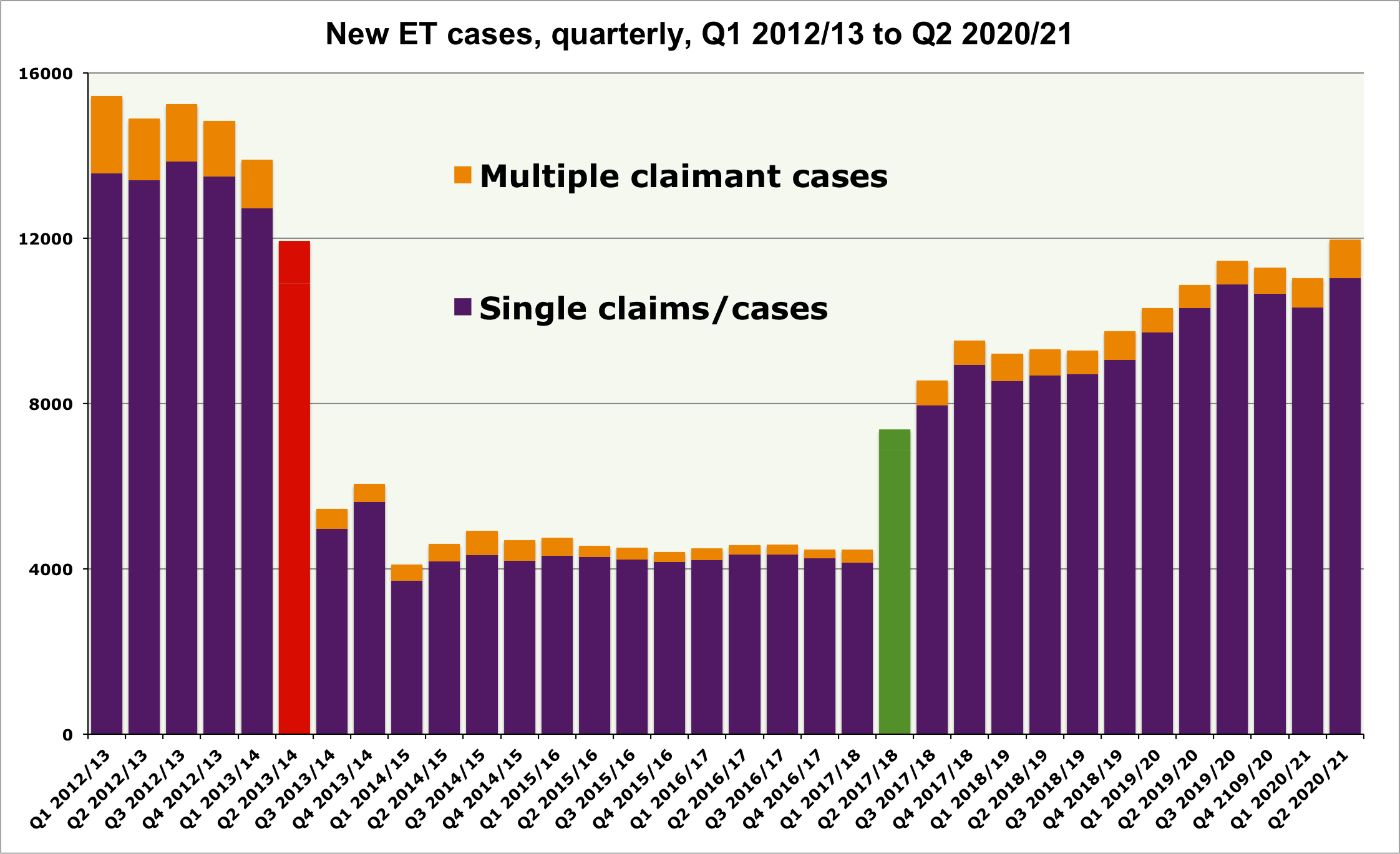
Tribunals are struggling to cope with a surge in demand since the Supreme Court ruled in 2017 that the fees to bring cases were set at a level which was unlawful because it denied access to justice. The resulting free-for-all has seen claims pouring in at more than double the rate before charges were abolished.
Comment: Well, yes, it is hardly news that, at least until late 2019, by which time most if not all of the “59 new faces” had come on stream, the ET system struggled to cope with the inevitable rise in claim numbers that followed the July 2017 ruling of the Supreme Court (that the justice-denying fees regime introduced in July 2013 was unlawful). And the unlawfulness of that fees regime is entirely the fault of incompetent government ministers, who – cheered on by the Times – repeatedly ignored warnings from low paid idiots like me that the hefty fees they were proposing were, well, unlawful.
Furthermore, that the ET system initially struggled to cope is also the fault of incompetent government ministers, who – having gleefully slashed the system’s judicial, staff and other resources during the era of fees – were laggardly in approving the clearly necessary reversal of those budget cuts.
Finally, as the following chart shows, while the number of new claims is indeed “more than double the rate before [fees] were abolished” (the green bar), it is still well below the rate before fees were introduced in 2013 (the red bar), and was actually falling slightly before the onset of Covid19 led to a new rise in claims.
The rise has been almost entirely fuelled by unrepresented claimants rather than those whose cases have been brought by lawyers or trade unions. While some have merit, others seem extraordinary. Cases employers have recently [sic] had to defend include the dismissal of a van driver who called his young female colleague an “ugly pikey”. He complained that his sacking was sexual discrimination. In another, a Chinese man demanded £781,000 for failing to get a security job, claiming that he was racially discriminated against for liking table tennis.
Comment: This paragraph contains the only two case examples in the entire article. Yet neither case justifies the main thrust of the article and its contentious headline. For, in the (not-so-recent) case of the ‘van driver’, the ET claim was made in January 2017 and heard by an ET in February 2018, long before the recruitment of the “59 new faces” that causes the Times such concern. Contrary to the impression given by the paragraph’s opening sentence, this claimant was legally represented at the hearing, and it is worth noting that he would have paid fees of £1,200 to pursue his claim. Similarly, in the case of the “Chinese man” (actually a British man), the ET claim was made in July 2018, and was heard in June 2019 by an EJ who has sat as an EJ since at least 2013. Both claims were dismissed, which could be seen as the ET system working as intended.
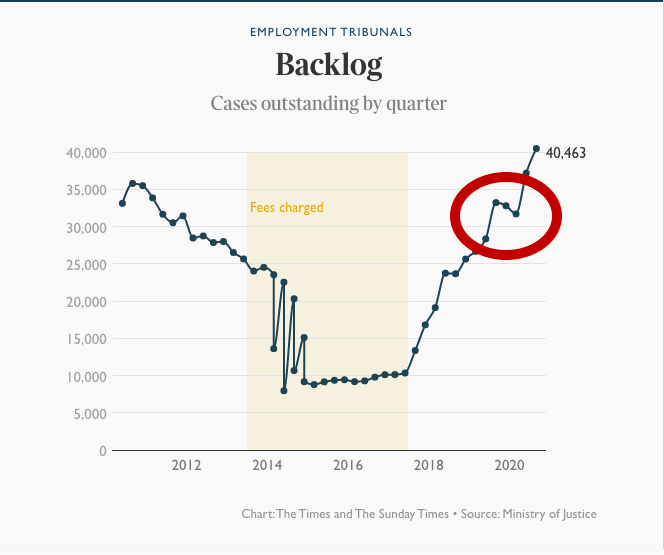
At this point the article includes a chart showing how the backlog of outstanding (single) claims fell both before and during the era of fees – when the number of new claims was a fraction of the pre-fees level – and has since risen to exceed the 2010 peak that followed the 2008 financial crisis and consequent economic recession. And in that chart we can actually see the impact on the backlog of the extra “59 new faces” decried by the Times (annotation added by me).
Indeed, based on the HMCTS weekly data for early March 2020, the backlog was then falling at a rate of about 7,500 per year – enough to return the backlog to its late 2017 level within two years. Aided by the modest decline in new case numbers already identified, above, this turnaround was largely thanks to those “59 new faces” that the Investigations Editor bores on about.
But then Covid 19 hit.
To cope with the extra workload, rather than streamlining its procedures or throwing out weaker cases, the tribunals have embarked on the mass hiring of judges, increasing their annual salary bill by nearly £6 million. To fill so many new posts, the bar was lowered on the standards demanded of recruits, opening the contest for the first time to candidates without judicial experience.
Comment: The ET system’s budget for 2020/21 was provisionally £71m. So, speaking as a taxpayer, “nearly £6m” (59 x £113K) to deal with “claims pouring in at more than double the rate before [fees] were abolished” seems like quite good value to me.
As for the ‘bar being lowered’, the Times does not present a single shred of evidence of poor decision-making by the “59 new faces”. As noted above, only two case examples are cited in the entire article, and both were heard by EJs of long standing. For all we know, the “59 new faces” might be making better decisions than their supposedly more experienced peers. Maybe the Times should, you know, do an investigation?
Previously, full-time judges were chosen from the ranks of part-time judges who would have to hear cases for about 30 days a year. “In the latest round that wasn’t a requirement,” a judicial source told the Times. “Some people have been appointed who have never sat before. It was certainly a departure. It is quite a stretch for somebody to be thrown in immediately as a full-time judge.”
Comment: Heaven forbid that the Ministry of Justice should do something slightly different to what it’s done for the last 400 years, in order to deal – a little more rapidly than its usual speed of a dead snail – with a crisis of its own making. And how do we know that this ‘judicial source’ isn’t just some bitter old piece of dead wood with a chip on their shoulder?
Nearly half the new recruits have no judicial experience on brief biographies issued by the Ministry of Justice. A spokeswoman for the judiciary said: “Where appointments are made without pre-judicial experience candidates will have met the selection criteria with material equal to that of their judicial colleagues. Regardless of previous background all judges receive extensive, high-quality training incorporating local orientation and induction training as well as a two-day cross- jurisdictional course for all new judges. In addition, all judges complete an annual mandatory two-day course.”
Comment: Once again for those at the back, there is not a shred of evidence – in this ludicrous Times article or elsewhere – of poor decision-making by the “59 new faces”.
Employment tribunals were created by Tony Blair to replace industrial tribunals. They now hear more than 90 types of case, including complaints about unauthorised deductions from wages, breaches of working hours limits, unfair dismissal and discrimination.
Comment: That’s right, when you’re really struggling to make your case, just throw in the name of someone universally reviled. Works every time – if your readership left their brains at the golf club. This is just silly.
Also, as any fule kno, Tony Blair did not ‘create’ Employment Tribunals. He just renamed what were previously known as Industrial Tribunals. That’s the kind of ‘modern and cost-free’ thing that New Labour did.
Discrimination cases take longer to hear than other cases and even the Council of Employment Judges, representing most judges, told the Law Commission that “sometimes it is fair criticism that too much time is given” to equalities issues.
Comment: Oh no, not the Council of Employment Judges! (As you can probably tell, my will to live is slipping away now.)
Guided by rulings from the upper courts, employment judges are reluctant to weed out weaker cases without a hearing, although this would reduce the workload. Employment Judge Russell told East London Employment Tribunal in 2019: “Those occasions on which a strike-out should succeed before the full facts have been established are rare, particularly so where the claim is one of discrimination.”
Comment: Apparently, the Times wants EJs to throw cases out before they’ve ascertained whether they are weak, or not. No, me neither.
Judges may also allow irrelevant evidence to be heard, dragging out cases. Employment Judge Goodman concluded a six-day discrimination case at London Central Employment Tribunal last year by saying that it had involved 2,500 pages in evidence bundles and much else that did “not directly concern the 12 allegations of detriment”.
Comment: Two cases, two comments by two judges. How long did this Times investigation take? But yeah, let’s scrap Employment Tribunals.
David Cameron doubled the qualification period for unfair dismissal from one to two years in employment. Lawyers warned that this might incentivise sacked workers to claim instead for discrimination or whistleblowing because employees retained the right to bring such claims from their first day at work. The latter cases take longer to hear than unfair dismissals.
Comment: Were those trade union lawyers? Or town hall lawyers? Have any of them since become one of the “59 new faces”? One minute, lawyers are bad, and the next minute they’re credible and quotable. It’s so hard to keep up.
Several claimants who brought discrimination cases and lost have told the Times that they genuinely believed they had been unfairly dismissed and would have claimed for that if the qualification time had been shorter.
Comment: Several people have told me that they genuinely believe that the Times is a paper of record.
Many employers settle discrimination cases out of court rather than pay lawyers and risk reputational damage. Latest figures show that while 22 per cent of all tribunal cases result in early settlements negotiated by the conciliation service Acas, that rises to 46 per cent of sexual orientation claims, 41 per cent for disability and 36 per cent for sex discrimination.
Comment: Tribunal statistics may not mean what you think they mean. And, if you’re the Investigations Editor at the Times, they definitely don’t mean what you think they mean.
Employers are vulnerable to law suits launched to taint their image. Employment Judge Crosfill told East London Employment Tribunal in 2019: “Claims can be brought purely for the purpose of embarrassing another party.”
Comment: Show me a legal system for resolving disputes anywhere in the world that isn’t vulnerable to such action.
Employment judges have been seeking to expand their empire by requesting powers to hear all cases brought under equality law including disputes about goods, services, education and housing which are currently heard by county courts. The Council of Employment Judges formally pointed out to the Law Commission, which considers reforms, that they regarded themselves as “very experienced with equalities issues. Disability, for example. We are experienced in making disability work at the workplace, learning what disabled people can do, with reasonable adjustments. Think Paralympics. That experience is portable to other areas of equalities litigation.”
Comment: First Tony Blair, now the Paralympics.
The move raises the prospect that, as with employment issues, claimants could launch claims without having to pay the other side’s costs if they lose, resulting in a surge in complaints of discrimination against shops, landlords, hospitals, schools and universities.
Comment: On the other hand, this article raises no prospect of Dominic Kennedy winning an award for investigative journalism. Who knows, we might even see a repeat of what happened the last time I challenged an article in the Times about Employment Tribunals.









 Labour Pains