Employment Tribunal fees: Stop me if you think you’ve heard this one before

A ripple of excitement ran through ’employment law & policy’ X (formerly ’employment law & policy’ Twitter) yesterday, when the Ministry of Justice unexpectedly presented us with an opportunity to dust off a much-used hashtag from the past: #ETfees

It was once said of the (fabulous) Smiths’ song Stop me if you think you’ve heard this one before that it “speaks of where the mind goes at the most desperate and desolate of times”. And the consultation paper issued by the Ministry of Justice yesterday certainly seemed to take a lot of trade unionists, employment lawyers and legal journalists back to one of the Ministry’s most desperate and desolate of times: the justice-denying and ultimately doomed #ETfees regime of 2013-17, dreamt up by cuddly Ken Clarke in 2011 and implemented under Failing Grayling in July 2013.

However, the proposed fees regime set out in the consultation paper – a nominal £55 fee for claimants, and for appellants to the EAT – is very different to that belatedly struck down by the Supreme Court in July 2017, after the supposedly mega-brained judges of the High Court and Court of Appeal had somehow failed to grasp the rather obvious point that fees of up to £1,200 “are in practice unaffordable by some people, and prevent even people who can afford them from pursuing claims for small amounts and non-monetary claims”. The consultation paper laudably states:

The Ministry of Justice recognises that the fees introduced in 2013 did not strike the right balance between meeting the policy objective for claimants to meet some of the costs of the ET and EAT and protecting access to justice. Therefore, in developing the fee proposal subject to this public consultation, careful consideration has been given to the lessons learned following the Supreme Court judgment, especially in relation to affordability, proportionality and simplicity as the three key principles underpinning a fair and balanced approach to setting fees in the ET and the EAT.

The issue of ensuring affordability is particularly acute in the ET given the limited time available to claimants to bring a claim and pay any fee. Claimants have up to 3 months to submit their claim (or 6 months for claims about redundancy or equal pay). The issue of proportionality is equally important when considering the overall level of fee as the remedies sought through the ET and EAT are varied and include numerous non-monetary remedies. The 2018 Survey of Employment Tribunals Applications (SETA) found that for claimants who had been successful at employment tribunal and were awarded a sum of money, 4% were awarded less than £500, with the overall median value of financial compensation received by claimants successful at a hearing being £5,000. Other claimants however sought non-monetary awards. Therefore, it is critical that fees are not set at a level that could render pursuing low value or non-monetary claims irrational and futile.

Given the dire state of public finances, and the fact that the Supreme Court explicitly left the door open for a fees regime based on modest fees (see paragraphs 86 and 87 of the judgment), it was inevitable that ministers would one day come back with a more modest fees regime, and I am somewhat surprised it has taken them six years to do so. And, even if the current bunch of squabbling ministers had not done so, there is a very good chance that incoming Labour ministers would take up the mantle. (Let’s not forget that it was Tony Blair’s Nu Labour government that first tried to introduce ET fees, in 2001, and which later created – in section 42 of the Tribunals, Courts & Enforcement Act 2007 – the extraordinary power subsequently exploited by Tory/Fib Dem Coalition ministers to introduce ET fees by way of secondary legislation in 2013.)

As the trade union UNISON was bemoaning only yesterday: “Libraries, children’s centres and youth services are being closed. Care and services for schools, vulnerable and disabled people are slashed to almost non-existent in some areas.” So, unless and until someone locates the money tree, there is a good case for ET users to make a (modest) financial contribution to the (significant) cost of the ET system. In the words of the Supreme Court (paragraph 86 of the judgment):

Fees paid by litigants can, in principle, reasonably be considered to be a justifiable way of making resources available for the justice system and so securing access to justice.

Is £55 an unaffordable sum? To put that sum in perspective, it costs £82.50 to renew or replace a UK passport. A provisional GB driving licence costs £34, and a TV licence costs £159 per year. A one-day ticket to Alton Towers costs £35, entry to the Tower of London costs £33.60, and the cheapest ticket to watch Manchester City at the Etihad Stadium costs £58. In the Small Claims Court, the issue and hearing fees for a claim worth less than £300 total £62, while those for a claim worth between £500 and £1,000 total £155.

For someone working 35 hours per week on the legal minimum wage (i.e. with an annual salary of £18,964), membership of the trade union UNISON costs £138 per year, basic membership of the trade union Unite costs £112 per year, and membership of the trade union GMB costs £175 per year.

Whatever, as I argued in 2012 and 2013, with the introduction of mandatory Acas early conciliation from 2014, respondent employers are as much ‘users’ of the ET system as claimants, because the State has already provided them with an opportunity to resolve the issue, at taxpayers’ expense. So, if workers are to pay a fee to pursue an ET claim, employers should also pay a fee to defend an ET claim.

Both parties paying the same modest fee would double the total fee income to HMCTS, or allow for an even lower level of fee for everyone, and/or a lower fee or (my preference) no fee at all for those claimants making simple, low-value claims for unpaid wages or missing pay slips. As my good friend Audrey Ludwig of Suffolk Law Centre noted earlier today, such claimants can struggle to make evidenced applications for fee remission.

Furthermore, why should the tens, hundreds or thousands of claimants in a multiple claimant case only pay one £55 fee between them? They are all users of the ET system, and if their case is successful they will all benefit accordingly. Maybe they should each pay a smaller fee, but there is no good reason why they should be able to use the ET system for a couple of pounds each, while single claimants have to fork out £55 (based on 2022/23, the average claimant in a multiple claimant case would pay just £2.58). And, again, the fee income from multiple claimant cases would then allow for a lower level of fee all round, and/or exemption for simple, low-value claims.

Sadly, the consultation paper does not explore or seek views on such alternative fee regimes. But the proposed fees are not due to come into force until November this year, by which time we might have a new, Labour government. And, if they are not simply to scrap the proposed fees for claimants, the new Labour ministers really ought to give serious consideration to those alternative options. Which means shadow ministers should be doing so now.

So it was disappointing, though not surprising, to see a typically dumb, knee-jerk response from the TUC and others yesterday. If all the Tory cuts to the NHS, libraries, children’s centres, and services for schools, vulnerable and disabled people are not to be quickly corrected by an incoming Labour government – and, let’s face it, they won’t be – why should the ET system remain free to its users?

The days when taxpayers shoulder the entire cost of the ET system, without any contribution from users, are gone – at least for the time being. The challenge, therefore, is to devise a fees regime that is fair and does not create a barrier to justice. So the TUC and trade unions need to do more than stamp their feet and yell that “these fees are just an invitation for bad bosses to ride roughshod over workers”.

Shadow ministers need to get some grown-ups in the room.

Posted in Employment tribunals, Justice, Workers' rights | Tagged , , | 2 Comments

Employment Tribunal cases: the new normal

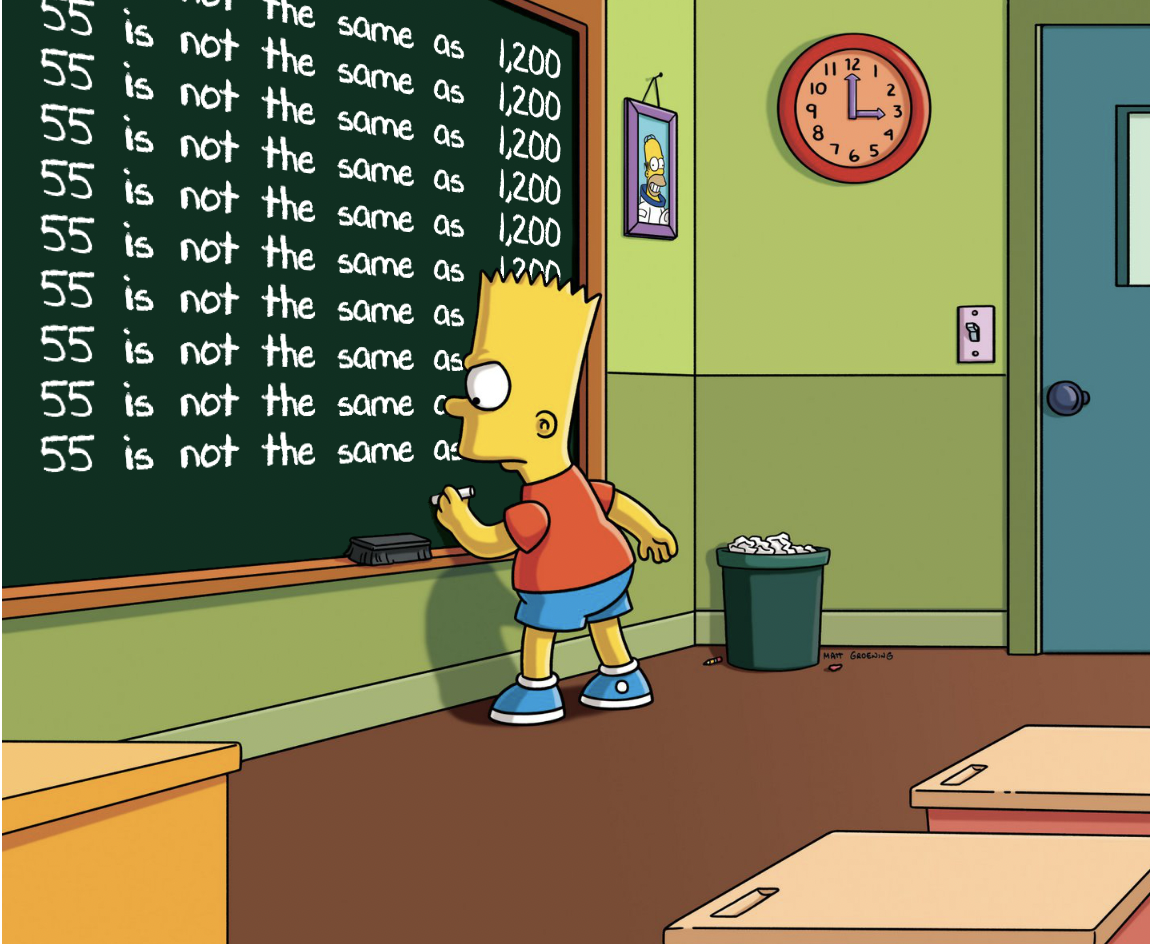
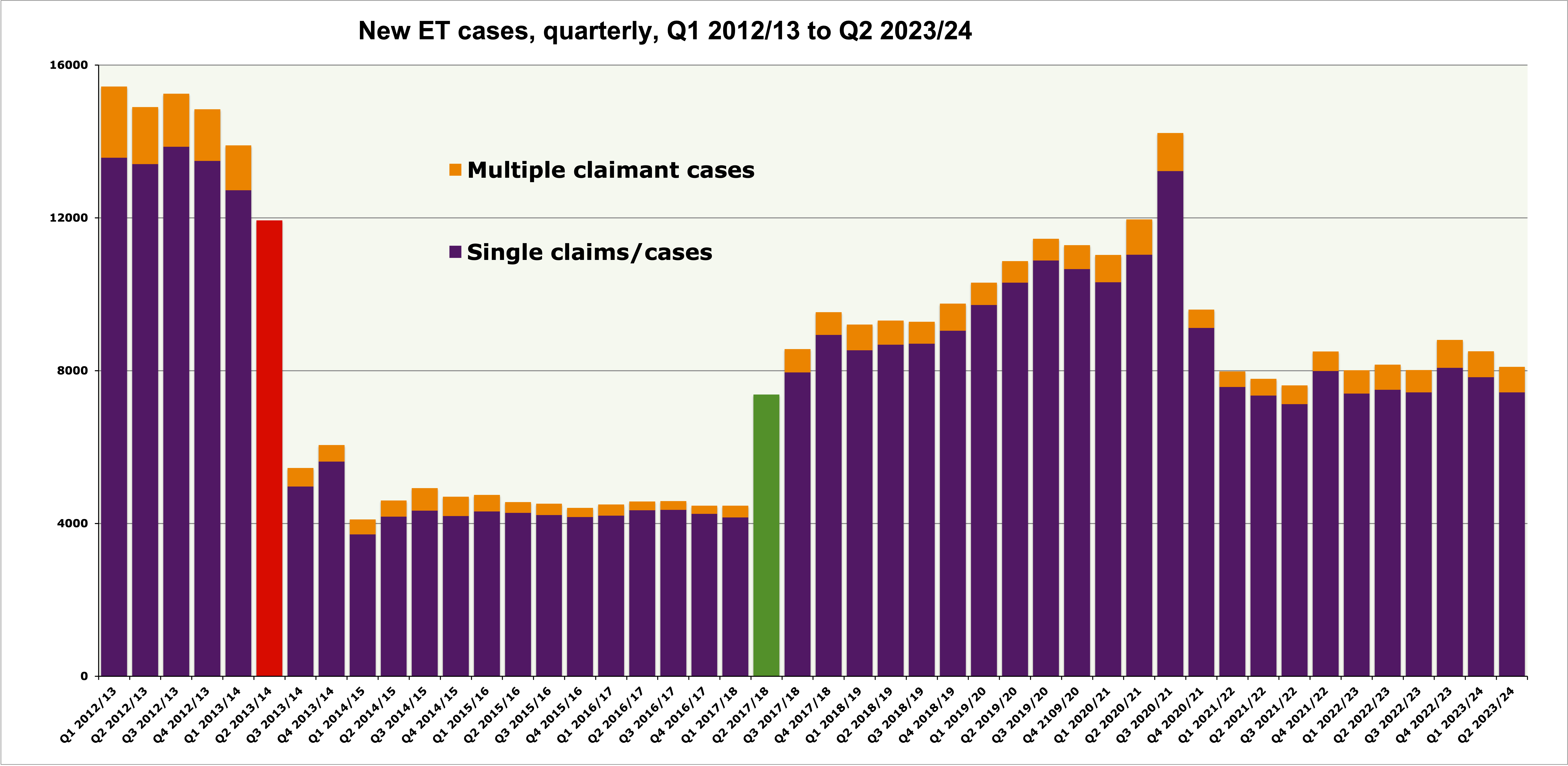
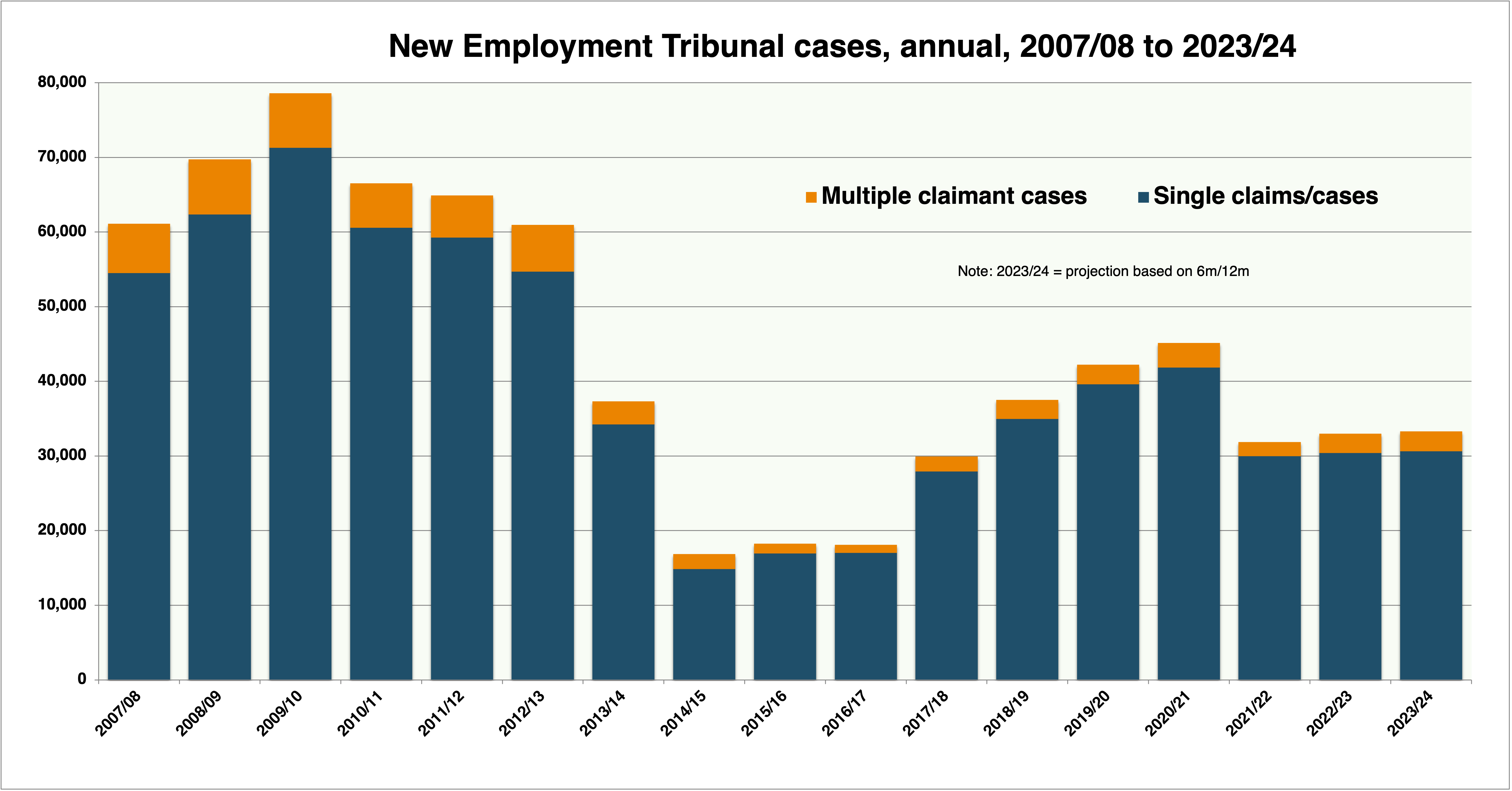
The latest set of quarterly Tribunal statistics – published last week – indicates that, having risen steadily from mid-2017 (when fees were abolished) to a Covid-induced peak in late 2020, the number of new Employment Tribunal cases has now settled down at just over half (55%) the pre-fees level seen in 2012/13. While the introduction by HM Courts & Tribunals Service of a new case management system in March 2021 means that comparisons with previous periods may be problematic, the new normal does seem to be about 8,000 new cases per quarter, or about 32,000 new cases per year.

To put this new normal in historical perspective, from 2007/08 until 2012/13 the number of new ET cases exceeded 60,000 every year, and in 2009/10 there were 71,280 single claims and 7,339 multiple claimant cases. The number of multiple claimant cases has now settled down at about 40% of the level seen prior to the introduction of fees in 2013.

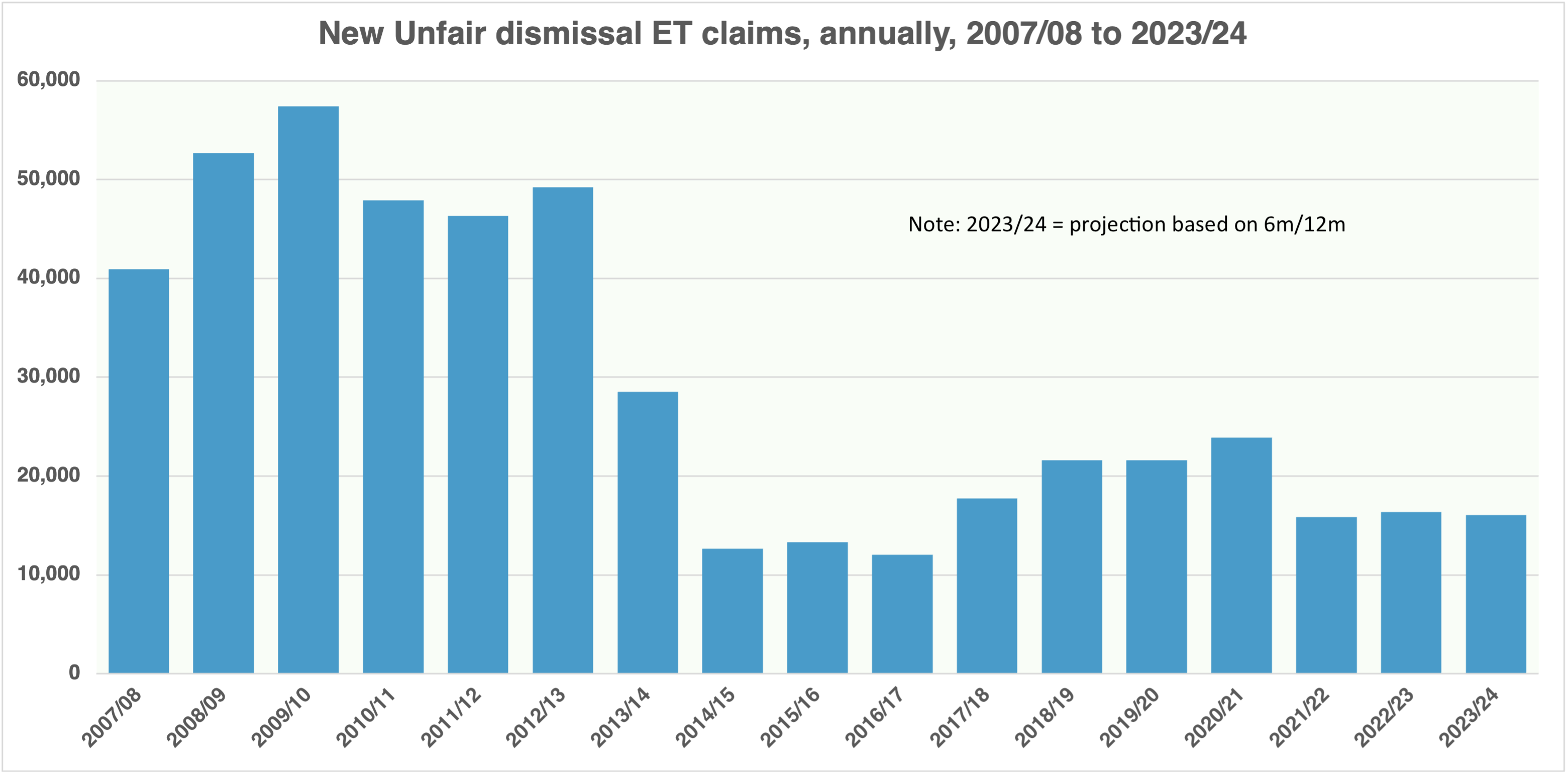
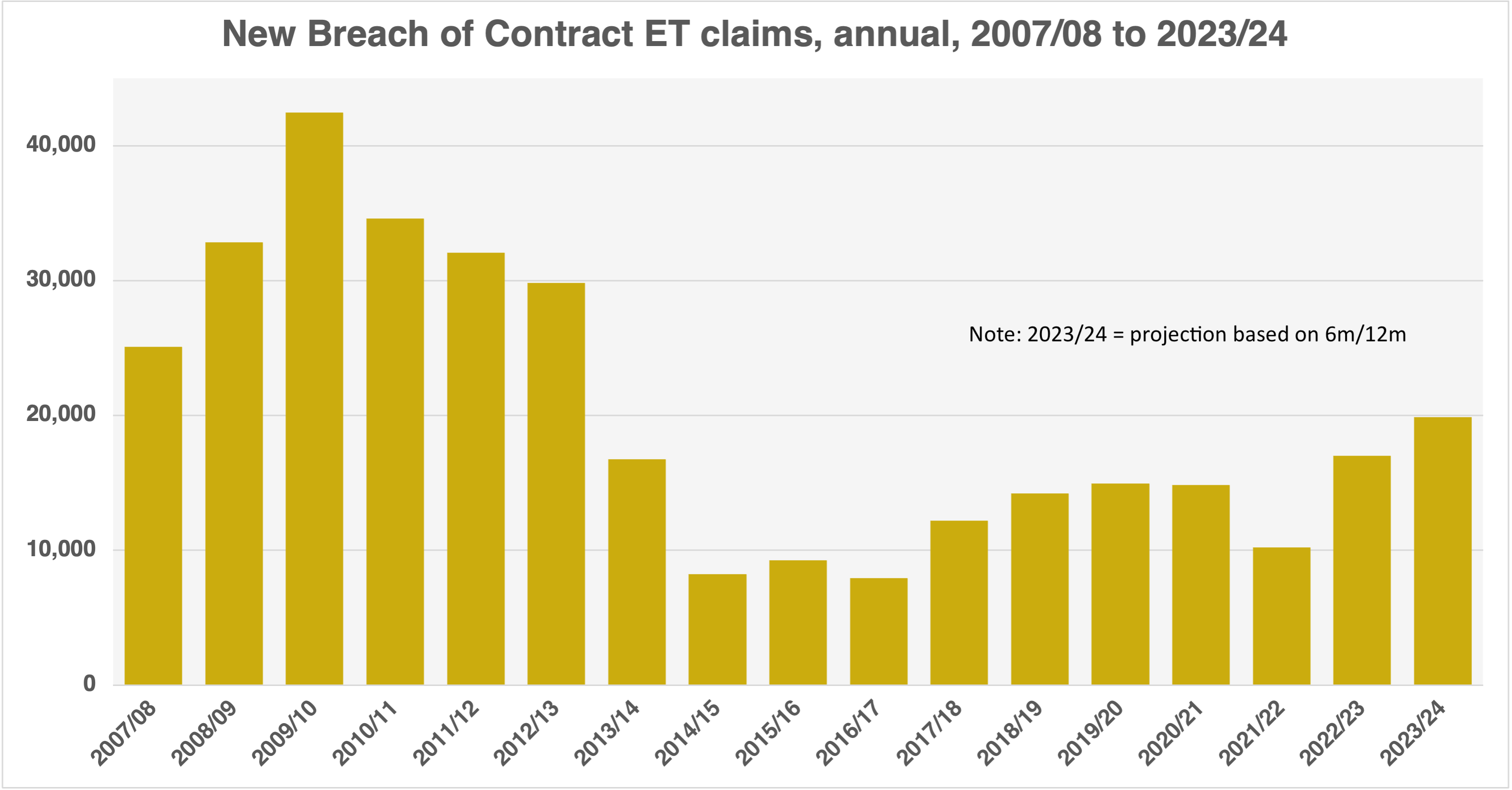
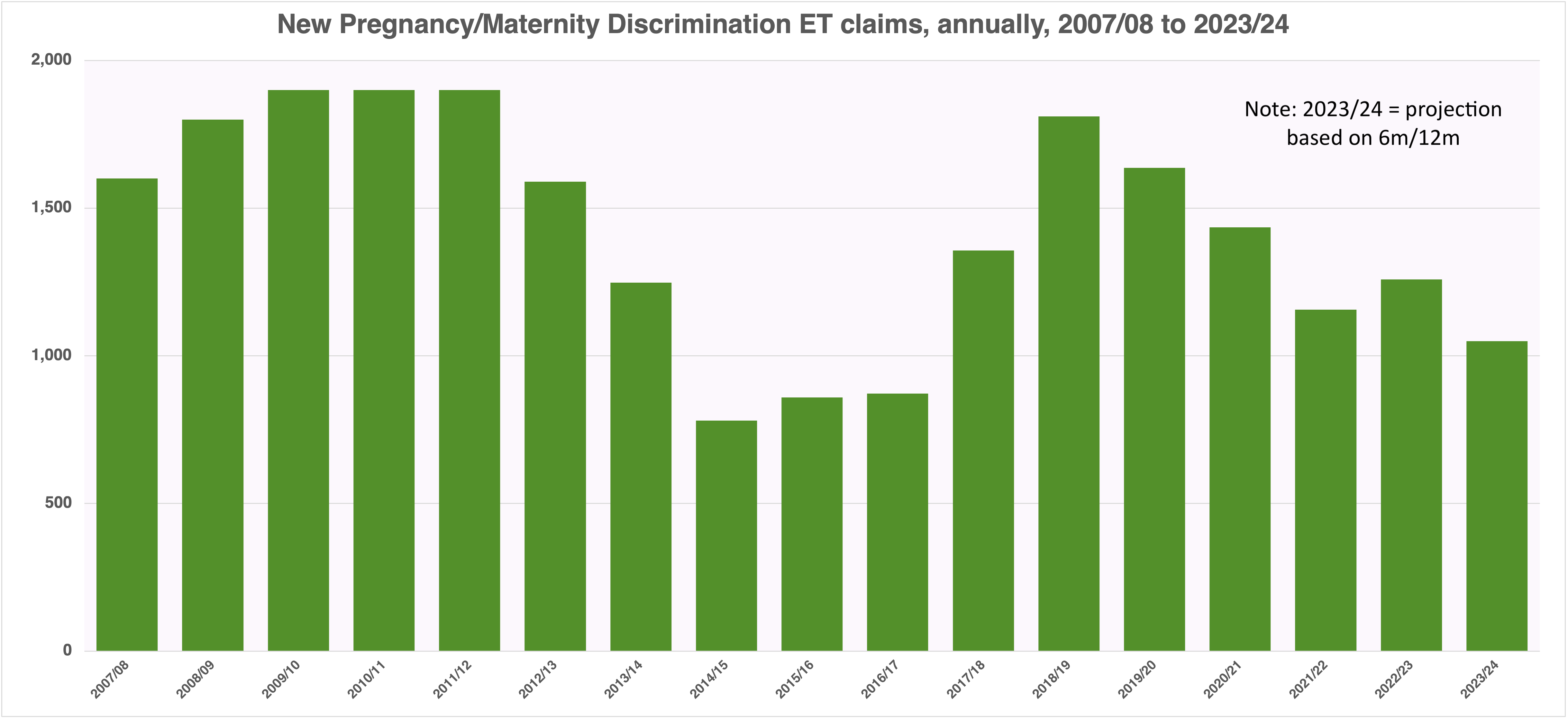
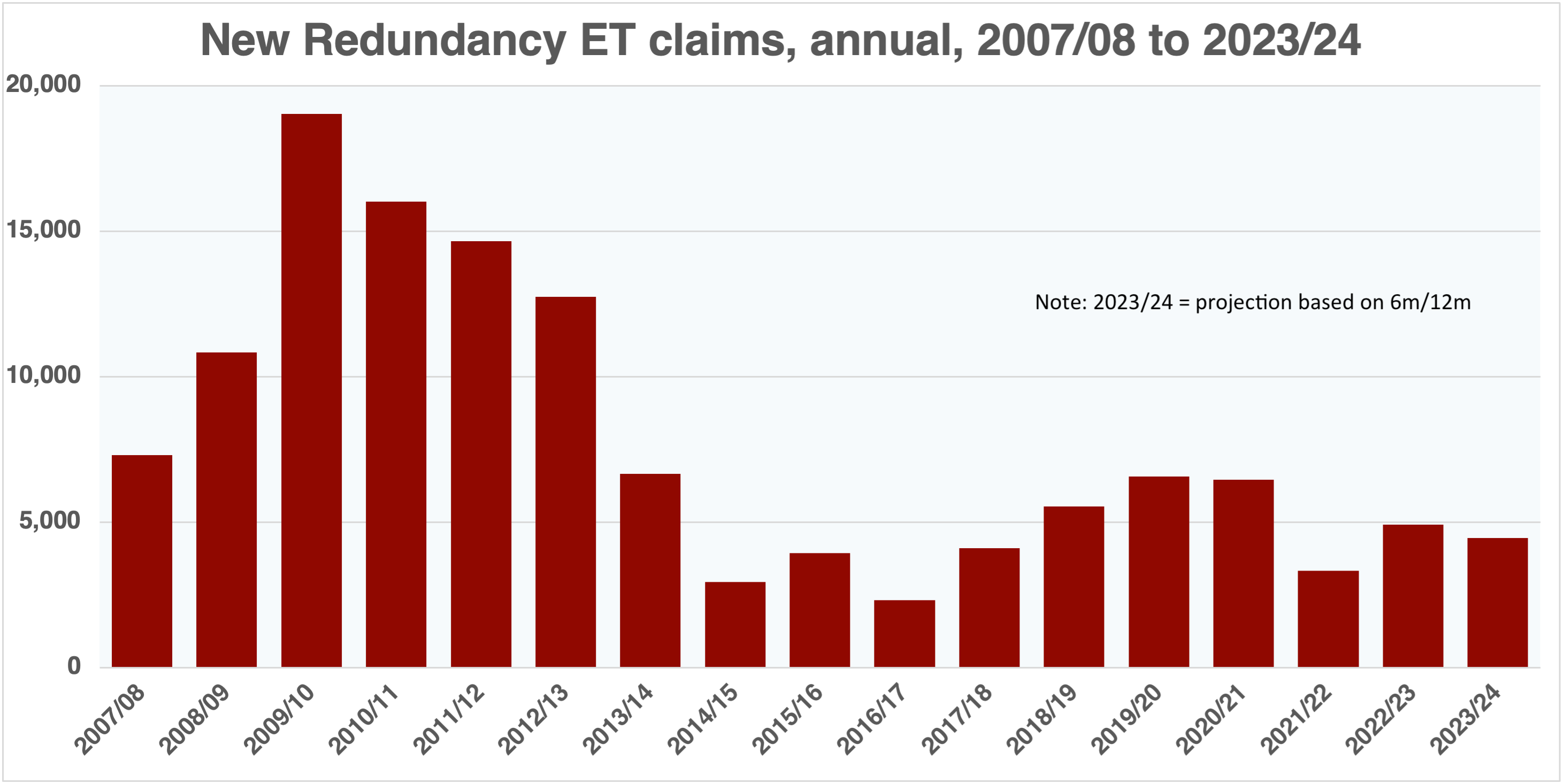
In some jurisdictions, such as Unfair Dismissal, Breach of Contract, Pregnancy/Maternity Discrimination, and Redundancy, the number of new (jurisdictional) claims broadly matches the overall pattern shown in the chart above. And in some of these jurisdictions the new normal is well below the level seen in 2012/13 (though this is probably due in part to the impact of the post-2008 economic recession on the number of claims in 2012/13, especially in the case of Redundancy claims).

But in some of the smaller jurisdictions the number of new claims has bounced back to pretty much the level seen prior to the introduction of fees in 2013.

In contrast, however, a number of once magnificent employment law gravy trains now appear to be providing only a relatively limited service.

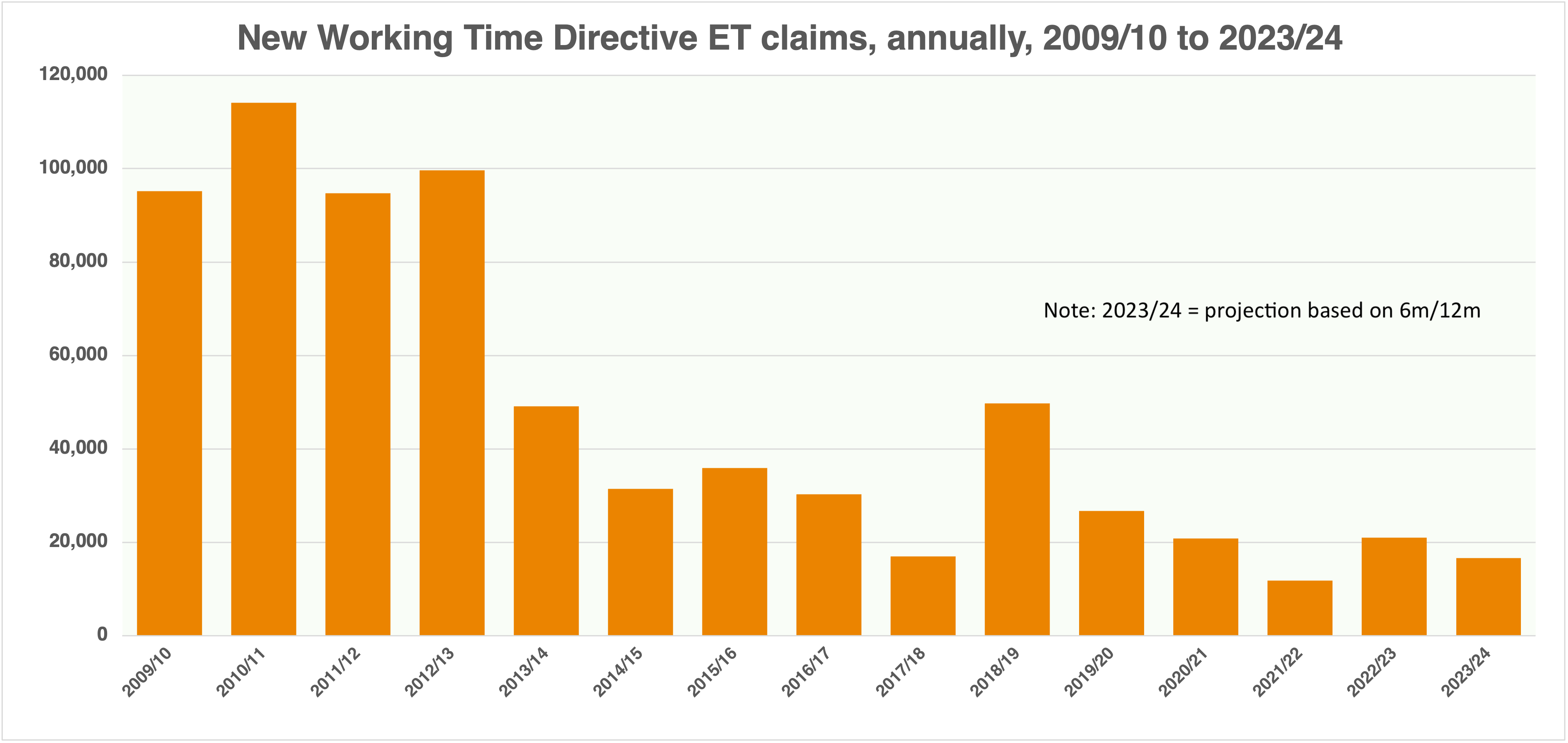
However, some enthusiasts are hoping to restore the Working Time Directive gravy train locomotive to working order in the near future, thanks to a grant from the Employment Rights (Amendment, Revocation & Transitional Provision) Regulations 2023.

Posted in Employment tribunals | Tagged , , , | Leave a comment

Employment Tribunal backlog: Down in the MoJ at midnight

In June this year – and then again in July for good measure – junior justice minister Mike Freer MP – who almost certainly doesn’t smell of pubs and Wormwood Scrubs and too many right wing meetings – told the House of Commons that the Employment Tribunal backlog “has decreased from 48,000 in February to 41,000 in March this year”. Which, if true, would be deeply impressive. At that rate of progress, the backlog would have been reduced to next to nothing by September – that is, two months ago.

Reader, the Employment Tribunal backlog did not decrease from 48,000 in February to 41,000 in March this year. And the backlog was not cleared by September.

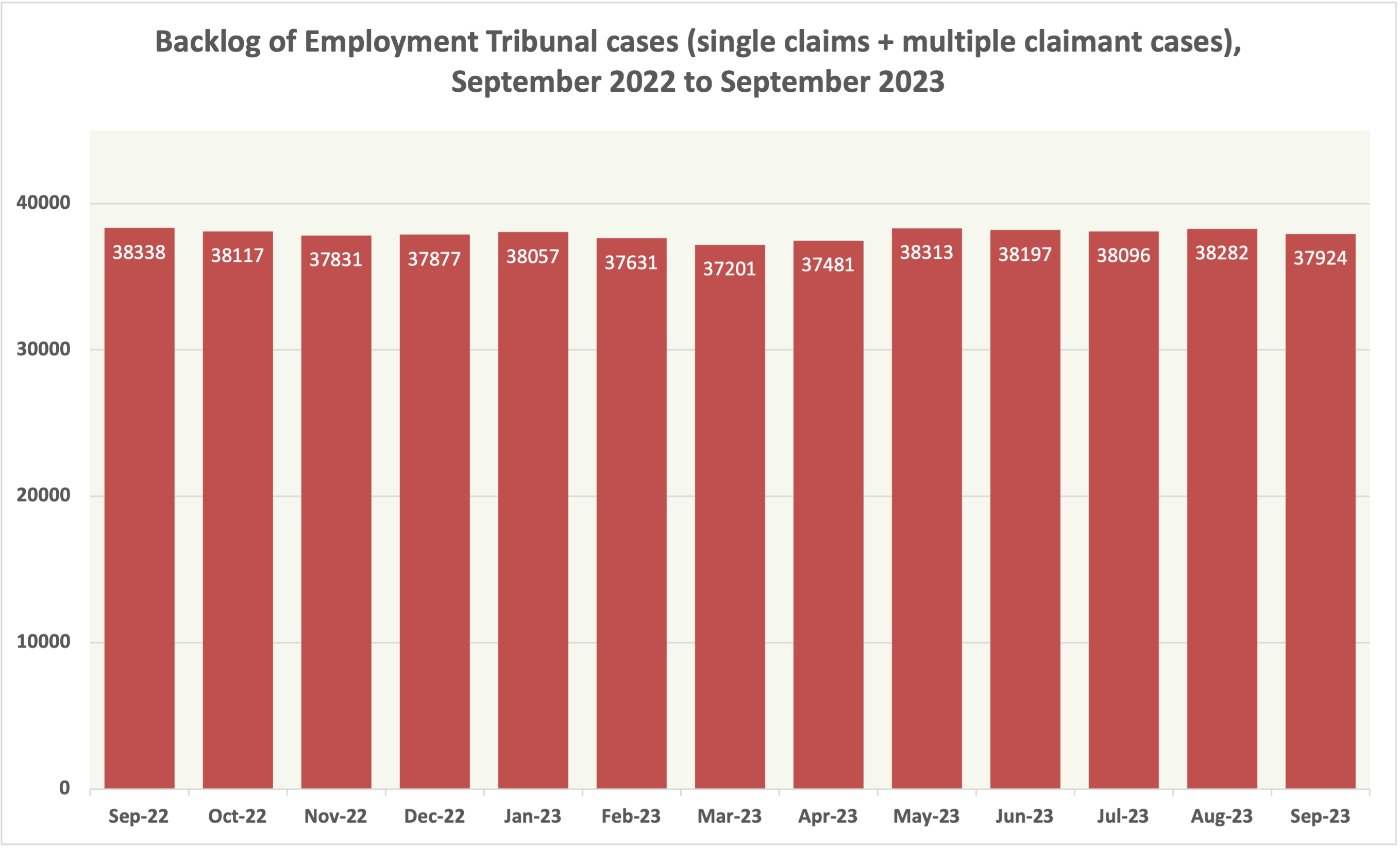
We know this because, this morning, the Ministry of Justice published the latest set of HM Courts & Tribunal Service monthly management information, covering up to September. And, as can be seen from the following chart, this shows that the Employment Tribunal backlog was 37,631 in February, 37,201 in March, and 37,924 in September.

Maybe the Employment Tribunal backlog is just ‘the wrong crisis’ for Minister Freer’s skillset. But you do not have to have won the Chern Medal to understand that a reduction from 37,631 to 37,201 is not as impressive as a reduction from 48,000 to 41,000. Or that an increase from 37,631 in February to 37,924 in September is even less prideworthy.

So, where did the clueless Minister Freer get his meaningless (and misleading) figures of 48,000 and 41,000? The short answer is that, since February this year, HM Courts & Tribunals Service have been engaging in some statistical alchemy, magically shrinking their previously published figures for the backlog. And Minister Freer – or whoever drafted his statements for him – was a bit, well, disingenuous in their selection from the various modified figures for February and March. If you’re feeling a bit nerdy, the full story is set out here, here and here on this blog.

The good news, of course, is that the Employment Tribunal backlog is not as big as – not so long ago – we thought it was. Indeed, at 37,924 it’s down to the level it was (stated to be) at in early 2020, before Covid and the lockdowns pushed it to more than 50,000 in early 2021.

Then again, at 37,924 the backlog is still a lot bigger than it was (stated to be) in April 2018, nine months after the abolition of the Ministry’s justice-denying tribunal fees regime, when it stood at just 22,689. But with the mathematically-challenged Minister Freer in charge, it will probably vanish entirely soon. Indeed, by now there may even be a negative backlog. Or something.

Posted in Justice, Workers' rights | Tagged , | Leave a comment

Employment Tribunal backlog: Getting freer with the data

Previously on this blog, I have noted how, since February this year, HM Courts & Tribunal Service has been magically shrinking the backlog of Employment Tribunal cases, by retrospectively revising downwards its previously published monthly management information (MI). The backlog as of December 2022, for example, was 50,518 according to the MI data set published by HMCTS on 13 February 2023, but has been steadily revised down to 40,098 in the data set published on 10 August – an overall revision of 21%.

And this week a curious ‘news’ article in the Daily Mirror about Employment Tribunal waiting times – based on figures released by justice minister Mike Freer a full six months ago, and already two years out of date – led me to an interesting correction by Minister Freer, in July, of an answer he had given to Labour MP Chris Elmore during oral justice questions in June.

On 27 June, asked by Elmore about average Employment Tribunal waiting times, Freer had stated:

Following a merger of IT systems, there is no current data on average waiting times, but the outstanding caseload has reduced from 48,000 in February to 41,000 in March this year because of an increase in the number of sitting days. As well as the increased sitting day allocation, we continue to support and reform the employment tribunals process and to make progress in reducing the backlog.

But on 3 July, this answer was corrected by the Minister to say:

Following a merger of IT systems, there is no current data on average waiting times, but the outstanding caseload has reduced from 48,000 in February to 41,000 in March this year, in part because of an increase in the number of sitting days. As well as the increased sitting day allocation, we continue to support and reform the employment tribunals process and to make progress in reducing the backlog.

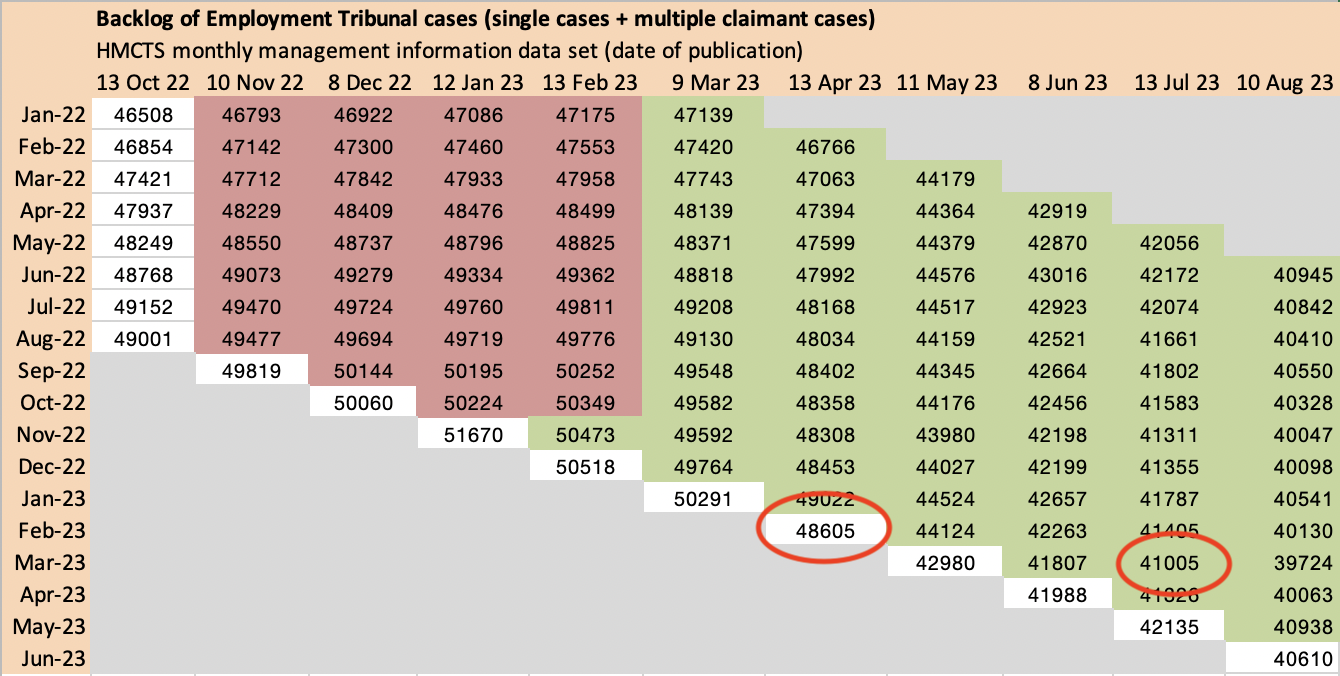
And with good reason. Because a reduction of 7,000 cases in just one month is pretty impressive – at that rate, we could expect the backlog to have evaporated completely at some point in the next few weeks. However, as can be seen from the following table, the backlog was reduced by 7,600 cases (16%), from 48,605 in February to 41,005 in March, only by the HMCTS’s retrospective revision of the data between the MI data set published on 13 April 2023, and the data set published on 13 July that was presumably available to Minister Freer (and whoever drafted his answer for him) on 27 June.

In fact, according to the most recent MI data set, published by HMCTS on 10 August, the backlog fell from 40,130 in February, to 39,724 in March – a fall of just 1% – before increasing to 40,938 in May, and then falling marginally to 40,610 in June. Which is just 335 cases fewer than in June last year, when – according to this most recent data set – the backlog stood at 40,945.

And, at the time that Minister Freer corrected his previous answer to Chris Elmore, on 3 July, he would have known that, according to the then latest (but not yet published) data set, the backlog had fallen from 41,405 in February, to 41,005 in March – a reduction of just 400 cases, not 7,000 as claimed in the Minister’s answers.

In short, over the past year the (welcome and clearly much needed) increase in sitting days would appear to have reduced the backlog by a mere 335 cases (0.8%). Everything else is just data alchemy. And Minister Freer has been a bit, well, free with his parliamentary answers.

Here is what has actually happened with the backlog of Employment Tribunal cases over the past year, according to the latest set of monthly HMCTS management information, published on 10 August. If you can spot where the backlog shrank by 7,000 cases in the space of one month in early 2023, as claimed by Minister Freer last month, then all I can say is you should have gone to Specsavers.

Posted in Justice | Tagged , | 1 Comment

Employment Tribunals: the incredible shrinking backlog

Previously on this blog, I have noted how, in March this year, HM Courts & Tribunal Service began to revise its previously published management information on the backlog of Employment Tribunal cases, and how this magical shrinkage of the ET backlog later accelerated. And the latest set of HMCTS management information, published yesterday, indicates that this downwards revision of previously published data continues.

Until March this year, the previously published data was routinely revised in each new data set, but only minimally and invariably upwards. But from March the direction of revisions reversed, and the magnitude of the revisions increased significantly. So, for example, the backlog as of November 2022, which was 51,670 according to the data set published by HMCTS on 12 January 2023, has been steadily revised down to 41,311, according to the data set published yesterday – an overall downwards revision of 20%.

So, I’ve updated my chart showing the revisions, and added colour coding to make it easier to see the transition: red where the figure was revised upwards from the previous data set, and green where it was revised downwards.

The reasons for this revisionism remain unclear, but it goes without saying that a smaller backlog of ET cases is good news. The bad news is that, according to the data set published yesterday, the backlog has been stubbornly stuck at about 41-42,000 for the past year.

Posted in Justice | Tagged , | 4 Comments

More bad dad dancing?

Maybe the Department for Business & Trade missed the memo about Father’s Day always being celebrated on the third Sunday in June, but they waited until 29 June to publish their response to the consultation on reform of parental leave and pay that they launched four years ago, in July 2019, with its gift to future new fathers of “more flexible” statutory paid paternity leave.

Yep, four long years of contemplating “high level options for reforming parental leave and pay”, and all that the DB&T wonks and their ministerial bosses have come up with is one minor reform to paternity leave. So, under this government at least, there will be no reform of the chronically failing Shared Parental Leave scheme, and no enhancement of the UK’s less than generous maternity leave and pay.

In short, four years have been utterly wasted. Because there is little if any demand for the one proposed reform: to “allow eligible fathers to take their Paternity Leave and Pay in two separate blocks of one week of leave (two weeks in total) at any point in the first year”.

The (somewhat ambiguous) question posed in the 2019 consultation (Q8) was:

How should the timing of when Paternity Leave can be taken be balanced between giving families choice and flexibility, and incentivising particular parental behaviours? For example, should fathers/partners be able to take Paternity Leave at any point in the first year or be required to take their leave when the mother has returned to work to incentivise solo parenting?

The Government’s consultation response states that “respondents tended to agree that Paternity Leave and Pay should be designed in a more flexible way so that fathers and partners could take it in a way that suits them best”. And, in Annex One, it states that:

64% of all respondents said the Government should provide more flexibility and allow fathers to take their [up to two weeks of paternity] leave within one year of the birth of their child. They also thought this would promote solo parenting by fathers.

However, it’s hard to find supporting evidence for these statements. Who were the 64%?

Well, not the Fatherhood Institute, who baldly stated (in their response to the consultation) that the above question “does not make sense”, before noting the OECD’s definition of paternity leave: “employment-protected leave of absence for employed fathers at or in the first few months after childbirth“. And not Maternity Action, who stated (in their response to the consultation):

Paternity leave is, by definition, leave that is taken immediately after the birth. This should remain a separate entitlement to parental leave. Fathers and partners should be provided with paid parental leave which can be provided more flexibly, can be taken up to a year or 18 months from the birth and can be designed to incentivise solo parenting.

Paternity leave should be restricted to a shorter period of well paid leave at the time of the birth to enable new fathers and partners to spend time with their new baby and support the mother after the birth. In order to reduce complexity and scope for disputes we recommend that paternity leave should remain a two week block as at present.

The trade union Unite was also not among the 64%, as in their response they stated:

Paternity Leave is there for one purpose only and that is the need for fathers/partners/nominated carers to bond with the baby and support and care for the mother recovering from childbirth and her breastfeeding and therefore, it can be flexible but should be around the birth [emphasis added]. Parental Leave however, is a period of leave to be taken in the first 18 months to care for the child(ren).

Also not among the 64% were the Equality & Human Rights Commission and the TUC who, rather than address the specific questions set out in the consultation, simply set out their own proposals for policy reform. But nothing they said in their responses could be construed as support for ‘allowing fathers to take their existing paternity leave entitlement within one year of the birth of their child’.

Nor can I see any support – explicit or merely implicit – for ‘allowing fathers to take their existing paternity leave entitlement within one year of the birth of their child’ in the responses of Close the Gap (Scotland’s expert policy advocacy organisation on women’s labour market participation), the Women’s Budget Group, the British Medical Association (BMA), and the Chartered Management Institute (CMI).

Sure enough, Parental Pay Equality did call for “a minimum 12 weeks of paternity leave with a six-week portion paid at 90% to be taken at any time in the first 18 months and split into blocks”, but you’d have to be a bit desperate to count that as support for ‘allowing fathers to take their existing paternity leave entitlement within one year of the birth of their child’.

It goes without saying that, in general, flexibility in family leave provisions is a good thing, and no doubt there will be some new fathers who will be glad to be able to take one or even both of their two weeks of paternity leave later in the first year, rather than immediately after the birth. But I don’t think there will be many of them. Because one of the messages that comes out of the recent Centre for Progressive Policy/Pregnant Then Screwed report is that some new mothers want their partner to be at home, supporting them after the birth, for longer than two weeks. (Which is precisely why, under the 6+6+6 model of maternity and parenting leave proposed by Maternity Action since 2019 – but which both the CPP and PTS have declined to support – fathers would be able to use some – or even all – of their six-month entitlement to paid parenting leave to extend their two weeks of paternity leave). So the ability to forsake paternity leave at the time of birth in favour of taking two weeks off to solo parent once the birth mother has returned to work would appear to me to have extremely limited value.

So, why do it? Well, my guess is that ministers felt they had to come up with something – four years is a long time to think about an issue and then do nothing. And they do have an outstanding manifesto commitment from December 2019 to “make it easier for fathers to take paternity leave”. They can now claim to have ticked that box (assisted by helpful headlines in the robotic specialist press), and the employer lobby groups will settle for the consultation not having led to anything more significant.

Whatever, the quest for a more equitable and ‘father inclusive’ system of parental leave that properly reflects the different purposes of maternity, paternity and parenting leave goes on. Will the Labour Party deliver? Let’s just say I’m not holding my breath.

Posted in Parental rights, Workers' rights | Tagged , | Leave a comment

Policy in the lurch: parental leave reform

Earlier this week on this blog, I noted the traditional attempts by policy wonks to exploit the commercial confection that is Father’s Day to call for reform of statutory paternity leave, including a new joint report by the think tank Centre for Progressive Policy (CPP) and the campaign group Pregnant Then Screwed (PTS). And, now that I’ve stopped tearing my hair out, I’m ready to set out a few thoughts on that report.

The report’s key policy recommendation is: “increase the length of non-transferable paternity leave to a minimum of six weeks and pay it at 90% of income in line with current statutory maternity pay”. Because the CPP’s analysis of OECD data from 1975 to 2021 finds that “a paid entitlement of at least six weeks [in OECD countries] is associated with a decreased incidence of both gender wage gaps and labour force participation gaps, by 4.0 and 3.7 percentage points respectively”. The CPP and PTS then conclude from this that “increasing the length of paternity leave [from two to six weeks] has the potential [sic] to reduce inequalities in pay, career progression, employment, and the provision of childcare”. And, apparently, this would only cost up to £1.6 billion a year – that is, a mere 43% increase in the current total spend on statutory maternity, paternity and other parental pay of some £3.7 billion per year, and a 32-fold increase in the current annual spend on statutory paternity pay of just £50 million a year.*

Memo to self: breathe, Wonky, breathe.

Yes, increasing paid paternity leave from two to six weeks, and paying it at 90% of earnings instead of the current, ludicrously low flat rate of £172 per week, might reduce the UK’s gender pay and labour force participation gaps. Or it might not – correlation does not imply causation, and there might well be other reasons why those OECD countries with better paternity leave provision than the UK also have smaller gender pay and labour force participation gaps.

Indeed, the CPP/PTS report concedes that “parental leave policies are far from the only barrier to mothers’ participation in the labour market – with the accessibility of childcare, gender norms and workplace culture also being highly influential”, and that “the countries that offer longer periods of paid paternity leave could be significantly different from those that don’t, and these differences may be correlated with [the lower] gender gaps in the labour market.”**

So it is possible – or even probable, given what we know about the UK’s totally shit childcare system, gender norms and workplace culture – that increasing paid paternity leave from two to six weeks and paying it at 90% of previous earnings would have very little if any impact on the UK’s gender pay and labour force participation gaps.

In short, the CPP and PTS want the Government to gamble up to £1.6 billion a year on the reliability of the CPP’s heterogeneous difference-in-differences regression model.

On the other hand, we can say with near certainty that increasing paid paternity leave from two to six weeks and paying it at 90% of previous earnings would not deliver the policy goal of more equal parenting – which, as the report notes, is “critical to women’s empowerment and increased earnings”. Because six weeks of paid paternity leave is still only six weeks. And only four weeks more than we have now.

We have known for years, from the government’s own research, that – for very good reasons, including the need to recover physically and mentally from nine months of pregnancy and giving birth – the average new mother takes 39 weeks of maternity leave (that is, her full entitlement to paid maternity leave). And that’s very unlikely to change just because the child’s father can be at home with the mother for up to six weeks immediately after the birth, instead of just one or two weeks. Because that 39 weeks is not excessively long. In fact, as the following chart shows, 39 weeks of paid leave is short by international standards.

So, even if the average new father were to take the full six weeks of paid paternity leave proposed by the CPP and PTS, he would still only be taking 13% of all the paid parental leave taken by his family, with the birth mother taking 87%. And, as paternity leave is tied to the time immediately after the child’s birth, he’d be taking all of his leave when the child’s mother is also at home. So, unlike the child’s mother, he wouldn’t be doing any solo caring or parenting. As the Fatherhood Institute noted in 2019, in their response to the Government’s still not concluded consultation on reform of parental leave, “leave taken by the father/ partner at this point does not offer the family flexibility or choice, or incentivise particular parental behaviours”.

Perhaps the CPP and PTS think that the Fatherhood Institute is wrong on this point, and hope that more fathers taking more paternity leave immediately after the birth would lead to greater take up by fathers of parental leave later in the child’s first year, under the chronically failing Shared Parental Leave (SPL) regime introduced in 2015. As the report acknowledges, analysis by Maternity Action indicates that a mere 2% of new mothers who start on statutory paid maternity leave use the SPL scheme to transfer some of that paid leave to the child’s father. But if that is their hope, they don’t say so in the report. And, given the (well known and understood) reasons for the failure of the SPL scheme, it would in my view be wildly optimistic to think that increasing paid paternity leave would lead to significantly greater use of the SPL scheme.

Whatever, the CPP and PTS policy recommendations would leave the chronically failing SPL scheme in place, and unreformed. Which to my mind is yet another lost opportunity to make the case for scrapping the SPL scheme and creating a more equitable and ‘father inclusive’ system of parental leave that properly reflects the different purposes of maternity, paternity and parenting leave. As I’ve said elsewhere, any such system should deliver an individual (non-transferable) right to a significant period of parenting leave for fathers (and other second parents), while protecting and ideally enhancing the existing statutory rights of birth mothers.

None of which is to say that our paid paternity leave provision should not be more generous than it is now. Given the ‘health and safety’ purpose of paternity leave – to support the mother at and immediately after the birth – there is a very strong case for it to be paid at 90% of earnings, just like the first six weeks of maternity leave, rather than at the ludicrously low basic rate. Furthermore, eligibility needs to be widened – at the very least, it should be a Day One right (as the Labour Party already proposes). And, under the 6+6+6 model of maternity, paternity and parenting leave proposed by Maternity Action, fathers would be able to use some (or even all) of their entitlement to six months of paid parenting leave to extend their two weeks of paternity leave, should they want to do so.

Furthermore, it goes without saying that all parental leave should be (much) better paid. In March, an important new report by the Fabians Society, In Time of Need, highlighted that the UK’s average income replacement rate for maternity leave is the third lowest in the OECD: “Almost every other European country pays an earnings-related maternity (or parental) payment for most or all of the duration of statutory leave [and] replacement rates are high, almost always falling between 75% and 100% of earnings”. But in the UK the earnings replacement rate is just 29.5%. The Fabian Society propose that all statutory maternity, paternity and parenting pay be paid at 50% of previous earnings, subject to a cap.

So, frankly, it is deeply disappointing to see the CPP and PTS call on the Government to spend up to £1.6 billion a year on a minor legal reform that would most likely not deliver the claimed economic benefits, and would certainly not deliver the overall policy goal of more equal parenting. We’ve wasted an entire decade on the chronic policy failure of Shared Parental Leave, and now think tanks and campaign groups are wasting more time and energy on performative dad dancing.

* I can’t find an explanation of the “up to £1.6 billion” costing cited in the Guardian article anywhere, but my own (quick and dirty) number crunching indicates the total extra cost would be up to £1.4 billion. This assumes (a) male median weekly pay of £683 (ONS, April 2022) and (b) 100% take-up of the full six-week entitlement among 400,000 new fathers, and it allows for the current (near negligible) spend on statutory paternity pay. Clearly, in practice, take-up would not be 100%. But then the claimed economic benefits would of course be diminished too.

** If you want to read about “time-invariant unobserved heterogeneity”, there is a technical appendix to the report that seeks to explain how they have cleverly wonked away the possibility that they are just presenting correlation as causation. But £1.6 billion is one helluva gamble to take on a think tank’s heterogeneous difference-in-differences regression model.

[Update: Business minister Kevin Hollinrake’s answer to a recent parliamentary question suggests he has not been wowed by the CPP/PTS report. And, in related news, on 29 June the Department for Business & Trade finally published both its response to the above-mentioned Good Work Plan: Proposals to support families consultation, and the evaluation of the Shared Parental Leave scheme that it started in early 2018. Needless to say, the SPL evaluation report is not worth the 163-pages of paper it is printed on, and the similarly underwhelming consultation response proposes just one reform to paternity leave: subject to legislative change, this will no longer be tied to the time of birth, and will be available to take at any point throughout the child’s first year. Which may or may not be a good thing.]

Posted in Parental rights, Workers' rights | Tagged , | 1 Comment

Dad dancing: reform of parental leave

Father’s Day is approaching, so naturally paternity leave is back in the news – or, at least, back in the Independent newspaper – thanks to a “damning” new TUC survey finding that “the low level of statutory paternity pay stops one in five dads/partners from taking paternity leave at all”.

No one, least of all the Independent newspaper, appears to have spotted that this take-up rate of 80% is considerably better than the 33% previously and repeatedly bemoaned, year after year after year, by the Independent newspaper and (many) others.

One reason for this is that the TUC doesn’t bother to tell us whether its ‘one in five’ figure relates to all new working fathers, or only to the proportion of such new fathers who qualify for statutory paid paternity leave. Indeed, the TUC press release makes only passing reference to the fact, previously bemoaned by the TUC, that one in four new working fathers are not even eligible for statutory paid paternity leave.

Whatever, the TUC calls on the Government to:

  • Increase statutory paternity pay: Statutory paternity pay needs to increase to at least the level of the real living wage, to make it feasible for dads/partners to take time out to care for their new-borns. 
  • Extend parental leave: Both parents need a stand-alone right to their own individual period of well-paid parental leave – which is not dependent on the other partner sacrificing some of their leave (as it is in the current shared parental leave system).
  • Give parental leave and pay rights to all from day one: Parental leave and pay rights should be accessible to all, regardless of employment status – including those who are self-employed, agency workers or on zero-hours contracts. Qualifying periods for parental leave and pay rights should be scrapped and they should be available from day one in a job. 

It’s unclear whether the TUC’s policy wonks have heard of the Equal Pay Act, but there’s certainly no mention here of statutory maternity pay, and the shocking impact of the ludicrously low rate at which it is paid. So we don’t know from their press release whether the TUC also wants parental leave for mothers to be “well-paid”, or just parental leave for fathers/partners. Nor do we know how long the TUC thinks these “individual period[s] of well-paid parental leave” should be. One month? Three months? Six months? It’s all a bit vague, frankly.

Back in 2019, the Fatherhood Institute suggested six months of paid parental leave for fathers (and other second parents). Which is also the duration suggested by Maternity Action, with the backing of the Fabian Society. But now the Fatherhood Institute seems to have settled for a period of just four weeks (plus the existing two weeks of paternity leave). Which is confusing, and disappointing.

Apparently, the campaign group Pregnant Then Screwed is about to come out with a new parental leave proposal of its own, which may or may not align with proposals already on the table, including Pregnant Then Screwed’s previous call for “a minimum of six weeks paid leave at 90% of their salary” for fathers/partners. But if ministers in the next government are to be persuaded of the case for pumping billions of pounds of extra spending into legal reform to enable and support more equal parenting, we need to stop this ‘dad dancing’ and focus on clear, concrete proposals for a shift – over ten or even 15 years – to a new, more equitable and ‘father inclusive’ system that delivers a significant new entitlement to parenting leave for fathers (and other second parents), while protecting and indeed enhancing the existing statutory rights of mothers.

Update, 15 June: The Pregnant Then Screwed report – actually a joint report with the Centre for Progressive Policy – is out today, and it recommends that:

  • Paternity leave policy in the UK is reformed based on the principles of improving statutory pay, guaranteeing non-transferable leave, sufficient time for non-transferable leave, and enhancing existing maternity rights; and
  • The Government increase the length of non-transferable paternity leave to a minimum of six weeks and pay it at 90% of income in line with current statutory maternity pay.

According to the Guardian, the report estimates that this would cost “between £1 billion and £1.6 billion a year”, though I can’t actually find this estimate in the report. Which would be an increase of between 27% and 43% in the current total spend on statutory maternity, paternity and other parental pay of some £3.7 billion a year.

So, I have questions. And some thoughts. Which I may put into a blog, when I’ve stopped banging my head on my desk.

Posted in Parental rights, Workers' rights | Tagged , | 1 Comment

The incredible shrinking ET backlog

Back in March, I noted on this blog how HM Courts & Tribunal Service had begun to revise its previously published management information on the backlog of Employment Tribunal cases, and how this had started to shrink the size of the previously ever-growing backlog. And the latest set of monthly data, published yesterday, indicates that this magical process has not only continued, but has accelerated.

So, for example, the backlog as of April 2022, which was 48,499 according to the HMCTS data set published on 13 February 2023, but which had been shrunk to 48,139 and then to 47,394 in the data sets published on 9 March and 13 April, has now been revised down to just 44,364. And the backlog as of November 2022, which was 51,670 according to the data set published on 12 January 2023, but which had been shrunk to 50,473, 49,592 and 48,308 in the data sets published on 13 February, 9 March and 13 April, has now been revised down to just 43,980 (an overall downwards revision of 15%).

According to this latest data set, and in marked contrast to the previous data sets, the backlog has been under 45,000 since at least March 2022. And, as of March 2023, it stood at a mere 42,980.

Which is very good news, and means that my chart of the backlog since March 2018 now looks like this:

Rejoice!

Posted in Uncategorized | 2 Comments

A hollow victory? Enforcement of unpaid ET awards

On a cold, grey day in early 2009, I was summoned to a meeting with officials at the headquarters of the Ministry of Justice in Petty France. A few months previously, in response to a series of reports I had written for Citizens Advice since 2004 about the widespread non-payment of Employment Tribunal awards supposedly ‘won’ by CAB clients, the officials had commissioned independent research on the extent of such non-compliance. And they had not hidden from me that they had only done so in full expectation that the research findings would crush my impertinent suggestion, set out in my October 2008 report on the issue, that as many as “one in ten” of all ET awards were not paid in full, and bring an end to my five-year campaign on the issue. Because pretty much everyone, including the TUC, had unhelpfully declared that non-payment of awards was ‘not a problem that we see’. So I entered the building with a heavy heart.

Unfortunately for the officials, the independent research – eventually published in May 2009 – had found that almost five in ten ET awards – 47% – were not paid in full (8% were only part paid, and 39% were not paid at all). And, through gritted teeth, they told me that ministers had concluded that they now had no choice but to act to address this obvious injustice. On my way back to the office, I bought a very big box of chocolates to share with my Citizens Advice colleagues.

Unfortunately for me and the thousands of ET claimants each year who were ‘winning’ their claim only to never see a penny of their award, ministers and officials had no idea how to address this injustice, especially as ministers had made it clear there would be “no new money”. And by 2012 it was clear that the low cost ‘solution’ that we helpfully suggested to them and which they introduced in April 2010 – enforcement of unpaid ET awards by High Court Enforcement Officers under a new Fast Track mechanism – was simply not working anywhere near well enough.

All was not lost, however, as by then the baton had been taken up by Liberal Democrat MP and junior business minister Jo Swinson, who in 2013 commissioned further independent research (essentially repeating that conducted for the Ministry of Justice in late 2008). And, once again, the research found that about half – 51% – of all ET awards were not paid in full (16% were only part paid, and 35% were not paid at all).

This confirmation gave Jo Swinson the leverage she needed to insert into the then Small Business, Enterprise & Employment Bill (later the 2015 Act) provisions that I had first proposed to Coalition ministers in 2012, to no avail, during the passage of the then Enterprise & Regulatory Reform Bill (later the 2013 Act). And between April 2016 and January 2020 the resultant section 150 penalty regime recovered more than £2.5 million worth of previously unpaid ET awards.

Ironically, by the time of the Small Business, Enterprise & Employment Bill in 2014 the ‘policy problem’ of unpaid awards had been largely massaged away by the ET fees regime introduced in July the previous year, as the hefty fees pretty much eradicated the very kind of relatively low-value claim which had tended to result in non-payment of the award. But in July 2017 the fees regime was abolished by a ruling of the Supreme Court, and claim numbers began to bounce back (though not to previous levels – see below).

Also in July 2017, the Taylor Review of Modern Working Practices recommended that, while the section 150 penalty regime established in April 2016 “is a free and successful [sic] route as a first step in prosecuting unpaid ET awards”, employers who do not pay an ET award within a reasonable time should be publicly ‘named and shamed’. And, in December 2018, having accepted this recommendation, the Government established a naming scheme, under which employers would be named by means of “approximately quarterly” press releases.

However, more than four years on, there have been no such press releases and not one employer has been publicly named under the naming scheme. In November 2022, in response to a Freedom of Information request (FoI 2022/27704), the then BEIS (now the Department for Business & Trade) could say only that “naming [employers] is being kept under consideration by the Government”. Yet the Department is still asking ‘successful’ ET claimants who have not received their award to report the employer so that they can be “fined and named online by the Government”.

Furthermore, it is far from clear that the section 150 penalty regime is a “successful route” for enforcing unpaid awards, as suggested by Matthew Taylor in his 2017 report (which, as noted above, was written when the problem had in fact been largely massaged away by the ET fees regime). In response to recent Parliamentary Questions in both the House of Lords and the House of Commons, the Government has declined to provide data on the number of warning and penalty notices issued to employers, and the number and value of unpaid awards successfully enforced, since April 2016. But the above-mentioned BEIS response to a Freedom of Information request states that just 1,123 unpaid awards (worth a total of £6.5 million) were “recovered for claimants” between April 2016 and November 2022.

That Freedom of Information response further states that, as of November 2022, financial penalties with a total value of some £2.3 million had been issued to 1,230 employers since 2019/20. So, how much of that £2.3 million has the Department actually received from employers? And what has it been spending that money on, if not quarterly press releases ‘naming & shaming’ the employers in question?

Extract from BEIS FoI response 2022/27704, dated 28 November 2022

Unfortunately, there is no available official data on the total number of ET awards made in each year since 2016/17 that could be used to establish the proportion of all awards that have required enforcement action under the s150 penalty regime, even if the Department for Business & Trade were willing to provide data on the number of warning and penalty notices issued to employers. HMCTS only publishes data on the number of awards made in seven jurisdictions: unfair dismissal, and race, sex, disability, religious, sexual orientation and age discrimination. However, this limited data does suggest that the total number of awards has fallen somewhat since the time of my reports on unpaid awards for Citizens Advice.

The annual number of unfair dismissal awards, for example, has plummeted from an average of 2,510 in the four years prior to the introduction of ET fees in 2013, to an average of just 575 in the four years up to and including 2021/22. Similarly, the average annual number of sex discrimination awards has fallen from 150 to 34, the average annual number of race discrimination awards has fallen from 62 to 26, and the average annual number of age discrimination awards has fallen from 25 to 14.

These figures no doubt reflect a number of factors, not least the introduction of mandatory Acas early conciliation in 2014, a long-term decline in the number of new ET cases since 2010, and an associated decline in the number of ET claims that are successful at a hearing or result in a default judgment, which is probably the best available proxy for the total number of monetary awards (though we also have to allow for some of those successful claimants having won claims in more than one jurisdiction – a point to which I return below). In 2022 there were just 32,790 new ET cases (single claims/cases + multiple claimant cases), little more than half the 59,977 in 2012. In the financial year 2009/10 there were 71,300 single claims/cases alone (at that time, HMCTS did not publish data for the number of multiple claimant cases).

As well as a decline in the annual number of new ET cases (and therefore the number of disposals), there has also been a significant fall in the proportion of jurisdictional claims (or ‘complaints) that are successful at a hearing or result in a default judgment, from an average of 18% in the four years prior to the introduction of ET fees in 2013, to an average of 14% in the four years up to and including 2020/21 (data for 2021/22 is not yet available). As a result, the number of jurisdictional complaints that are successful at a hearing or result in a default judgment has fallen significantly, from an average of 42,275 in the four years prior to the introduction of ET fees in 2013, to an average of 13,453 in the four years up to and including 2020/21.

Not every jurisdictional complaint that is successful at a hearing or results in a default judgment will involve a monetary award, but in the absence of official data for monetary awards in jurisdictions other the seven noted above, this is probably the best available proxy for the total number of jurisdictional complaints that result in a monetary award. And we then need to divide this number by the number of jurisdictional complaints per claimant, which in the 27 quarters from April 2016 to December 2022 averaged 1.6 (down from an average of 2.0 in the 12 quarters from January 2013 to December 2015), to arrive at an estimate of the number of claimants who win a monetary award (Row B in the table below).

The most recent government-commissioned research on the non-payment of monetary ET awards – that commissioned by Jo Swinson and published in November 2013 – found that 51% of awards were not paid in full. And, if we apply that proportion to the number of claimants who win a monetary award in each year since 2016/17 (Row B), we get figures for the potential number of ET awards not paid in full (so liable to enforcement action) in each year (Row C in the following table). Note that, in line with the analysis above, these figures are a fraction of the 15,000 figure used in my 2008 report.

In summary, in the period April 2016 to November 2022, there were possibly some 26,000 ET awards that were not paid in full (assuming 4,000 in 2021/22, and 2,000 in April to November 2022). We don’t (yet) know how many warning and penalty notices were sent out by the Department for Business & Trade in this period, but we do know that only 1,123 unpaid awards were recovered for the claimant. Which – if my figures in Row C of the table above are in the right ball park (which they may well not be, for several reasons) – is an enforcement rate of less than 5%.

And if, as the Department suggests in its November 2022 Freedom of Information response, the 1,123 successfully enforced awards were worth a total of £6.5 million, then the some 24,880 unpaid awards that were not enforced were collectively worth as much as £151 million to the workers in question.

Come back you High Court Enforcement Officers, all is forgiven. Indeed, another thing we don’t know is how many people have paid the £71 fee to use the Fast Track enforcement mechanism – which still sits alongside the section 150 penalty regime – since the latter was established in 2016. It seems reasonable to assume that most people will have opted to use the free section 150 penalty mechanism, but we don’t actually know that [see update, below].

On Tuesday 25 April, the Employment Legal Advice Network (ELAN) is holding an online knowledge sharing event on this issue. If you have experience of unpaid ET awards, or would just like to learn more about the issue, please do join us.

Update, 19 May: In answer to a written Parliamentary Question tabled by shadow employment rights minister Justin Madders MP, the justice minister has provided data for 2019-21 confirming that, generally speaking, ET claimants with an unpaid award (or Acas settlement) are not using the Fast Track (High Court Enforcement Officers) enforcement mechanism. Why would they, when they have to pay a £71 fee to do so, but the s150 penalty regime operated by DB&T is free to access? Accordingly, what matters is the effectiveness of the s150 penalty regime operated by DB&T.

Posted in Workers' rights | Tagged , , | 1 Comment