
Last week, I was slightly perturbed to realise that it is three years since I last blogged here about the Employment Tribunal backlog, an issue on which, in the distant past, I was selected to bore for Great Britain at consecutive Wonk Olympics. Yes, really. You should see my trophy cabinet.
Back in November 2023, on this blog, I was having a pop at then junior justice minister, Mike Freer, over his highly selective use of ever-changing figures from the HM Courts & Tribunals Service’s monthly management information dataset to repeatedly claim, in the summer of 2023, that the previously spiralling backlog of Employment Tribunal cases had miraculously fallen from 48,000 in February that year, to 41,000 just one month later.
And I was doing so because, by November 2023, the latest HMCTS management information dataset was indicating that the backlog of ET cases had in fact fallen from 37,631 in February that year, to … er … just 37,201 one month later, before rising to 37,924 in September 2023. Call me picky, but a fall of 430 in the ET backlog is not as impressive as a fall of 7,000. Especially when it gets wiped out within months.
But I’m not here to rehash the reason for the shape-shifting HMCTS statistics. You can, if you like, read the explanation that won me a bronze medal at the 2024 Wonk Olympics in Narnia. But you’ve probably got some drying paint to watch instead.
Reader, the point I’m here to make today is that, according to the latest HMCTS management information dataset, published on 12 November, by September this year the ET backlog stood not at 38,000, or 41,000, or even 48,000, but … 84,543.
Which is – and I’m sorry to use technical, policy wonk language – quite a big increase.
Moreover, according to the same HMCTS dataset, the ET backlog was just 53,674 in September last year. Which, if those figures are correct – and I’d bet my entire sculpture collection that they will be revised in next month’s dataset – means it has increased by 58% in just 12 months. And the trend is, well, not good. Or, as we Wonk Olympians say, ‘Minister, you have a problem’.
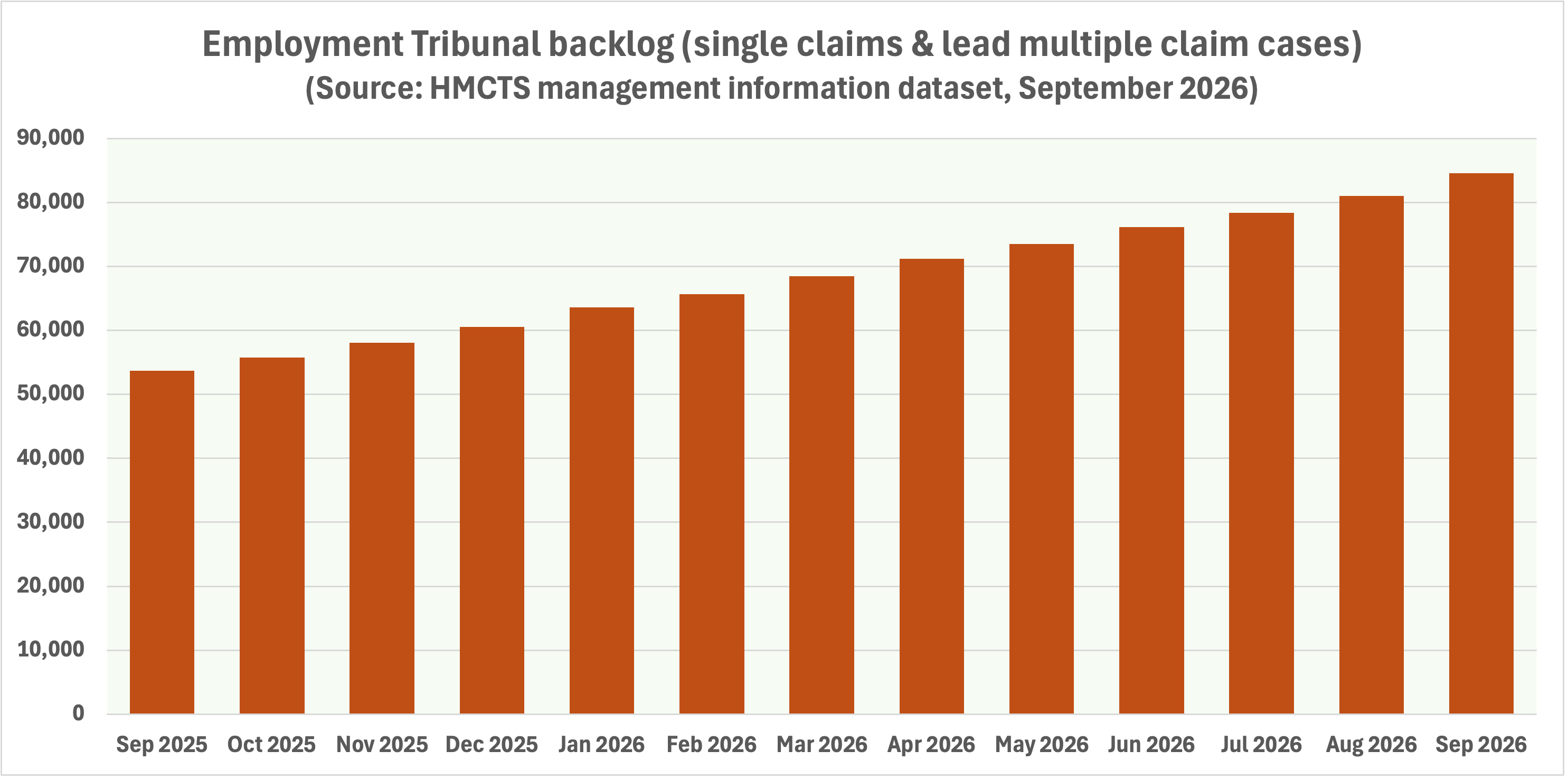
This ‘problem’ matters. It really matters. Because it means workers are having to wait as long as three years to get justice if they have been exploited or mistreated by their employer. And, as they say, justice delayed is justice denied. Furthermore, as also demonstrated in my past performances at the Wonk Olympics, even a ‘win’ at an Employment Tribunal after three years might well not deliver justice.
Maybe the solutions to these issues are some of the ‘everyday fixes‘ that Andy Burnham has lined up for us. But somehow I doubt it. Indeed, I think it more likely that we will soon see some kite-flying in relation to the re-introduction of ET fees. Because I don’t think there are many leaves on the Labour Government’s Magic Money Tree marked ‘More ET judges’ or ‘Better enforcement of unpaid ET awards’.
In short, Burnham’s supposedly ‘pragmatic’ Labour Government might soon need to give serious consideration to asking users of the ET system – including the employers who fail to use the (free) services of Acas to resolve the dispute with their worker(s) – to make a modest contribution to the system’s not insignificant cost to taxpayers (the vast majority of whom will never use the ET system).
Maybe ministers could call it ‘Share the justice, not the exploitation and mistreatment in English workplaces’. Once they’ve dealt with music and speakerphone audio played without headphones on English buses and trains, obvs.
Manchesterism, innit. Like socialism, but smaller. A lot smaller.


