
(With apologies to Radiohead)
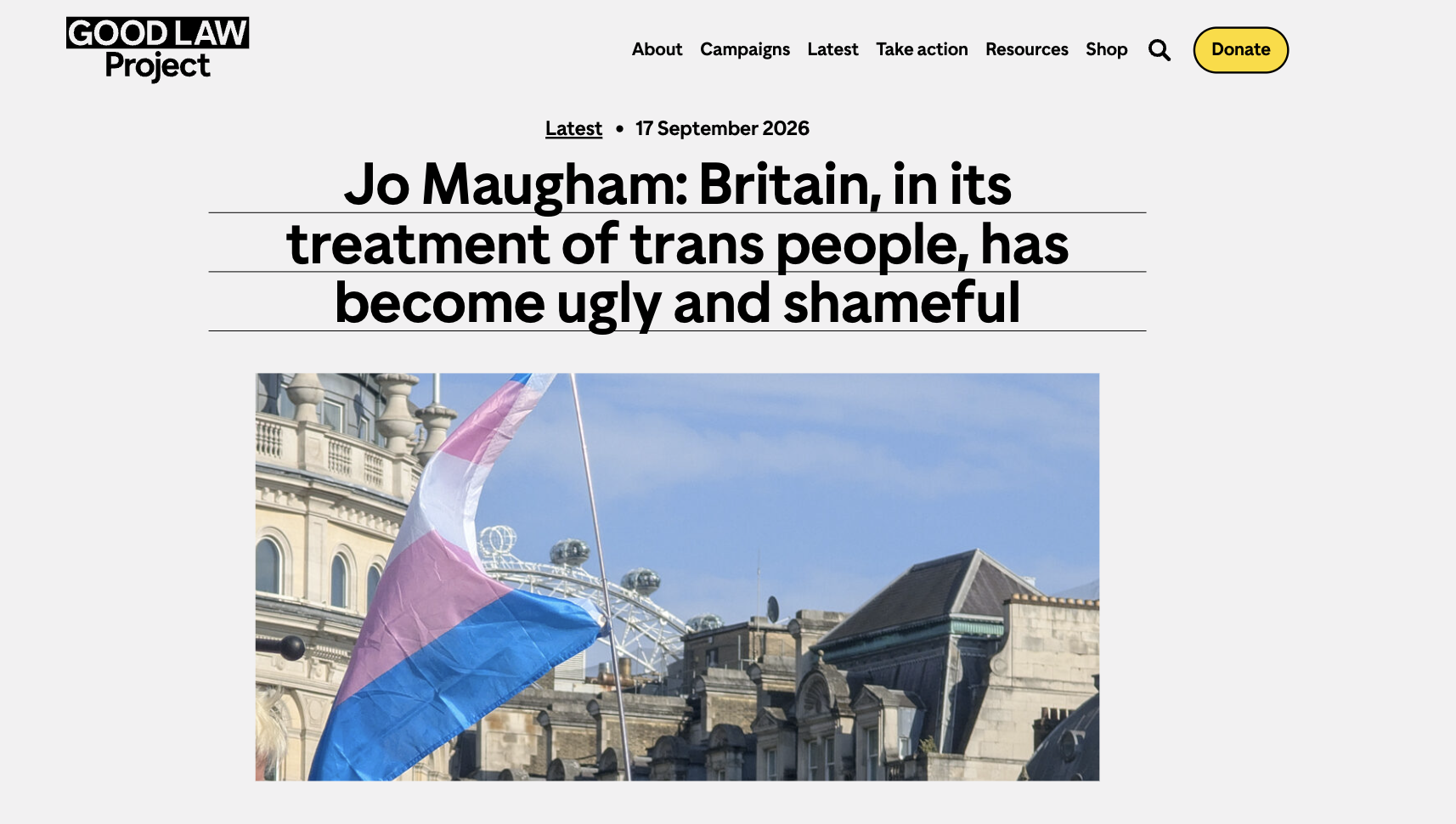
Early last month, wealthy activist tax lawyer Jolyon Maugham KC had a little rant about “the so-called justice system”, and how “English judges tell us time and time again that they do not want to listen to trans people”. And a couple of weeks later he had another, this time about how “Britain, in its treatment of trans people, has become ugly and shameful”, with the “notorious” Supreme Court ruling in For Women Scotland simply “emblematic of the hostility towards trans people in much of the so-called justice system”.
So at least Maugham will not have been surprised when, on Thursday, the Court of Appeal threw a big bucket of cold water over the Good Law Project’s attempt to appeal the legal spanking they were given in February, when the High Court comprehensively dismissed their legal challenge to the EHRC’s Interim Update about the Supreme Court’s landmark April 2025 ruling in For Women Scotland.
Yes, Lady Justice Andrews of the Court of Appeal did grant the three individual claimants an oral permission hearing. But, in doing so, she didn’t sound terribly convinced about the merits of their appeal:
I am not currently persuaded that any of the grounds [of appeal] advanced has a real prospect of success; the [High Court] Judge’s reasoning, particularly at [paragraph 79], appears compelling. However in the interests of fairness and open justice, and bearing in mind the nature of the issues involved and their importance to the applicants, I consider that they should be afforded an opportunity to persuade the court orally that they do.
The parties are encouraged to liaise to agree a timetable, bearing in mind that the hearing is a permission hearing only and will take no more than half a day.
And, in a separate Order, Lady Justice Andrews dismissed the GLP’s attempt to appeal the High Court’s ruling in February that, unlike the three individual claimants, the GLP lacked standing to bring the claim:
Swift J [the High Court judge] refused the applicant (“GLP”) permission to proceed with a claim for judicial review on grounds of lack of standing. In my judgment the appeal against that decision has no reasonable prospect of success and there is no other compelling reason for the matter to be heard.
The question whether GLP had a sufficient interest to bring this claim was a value judgment for the Judge, of a type with which an appellate court will rarely interfere. He applied the correct legal test and he did so in the light of all the circumstances of this case. There is no basis for any suggestion that he failed to have regard to any relevant evidence or applied some elevated threshold. The evaluation of whether GLP had a reasonable concern in this particular matter was fact-sensitive and the Judge decided, for good and sufficient reasons, that it did not, irrespective of its track record in other contexts of supporting trans issues.
The Judge was in the best possible position to evaluate the evidence and his decision was reasonably open to him on the facts. It is not “plainly wrong”. He was entitled to conclude that a campaigning body such as GLP which was not directly affected by the [EHRC Interim Update] did not have a sufficient interest to claim judicial review. It must be borne in mind that the [Interim Update] was no longer operational. It is clear from the skeleton argument that the grounds amount to little more than a disagreement with the Judge’s evaluation.
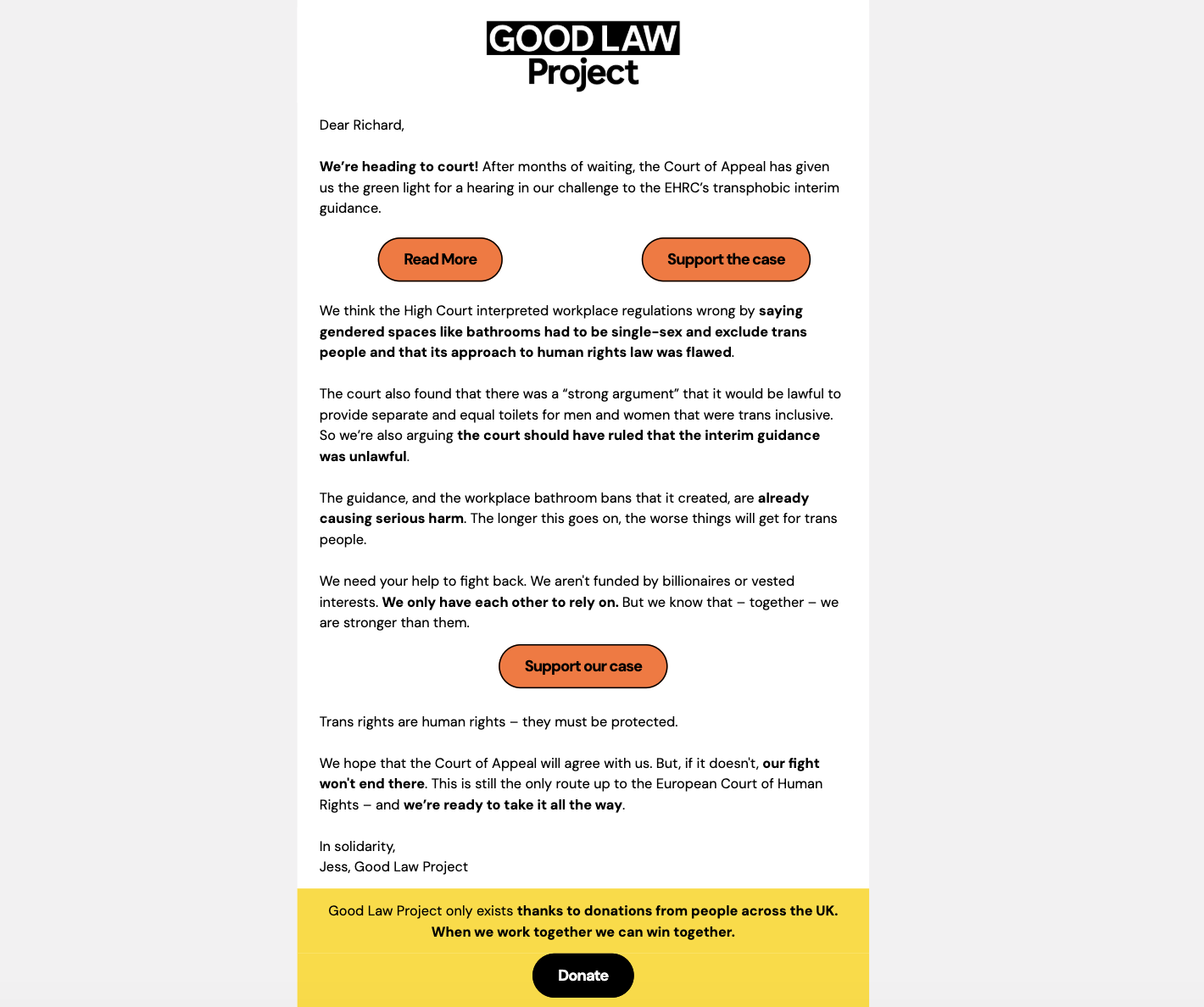
So, not much for the GLP to crow about. Nevertheless, the GLP’s ‘trans rights’ lead, Jess O’Thomson, promptly put out an upbeat but less than candid email to some or all of the “nearly one million people” in the GLP’s database. And within 24 hours the GLP’s previously moribund crowdfunder in support of their appeal had harvested some 450 new donations totalling £22,600. Ker-ching!
That wave of new donations takes the total sum that Maugham and the GLP have crowdfunded from the ‘trans community’ and its allies for their supposedly swaggerdocious legal challenge to the EHRC’s long since defunct Interim Guidance to a stonking £622,779 (made up of the £489,858 raised by the original crowdfunder, launched in late April 2025, and the £132,921 now raised by the appeal crowdfunder, launched in February 2026).
Yet, apart from 18 months of (false) hope, all that the more than 15,800 donors have so far got for their average donation of some £39 is the prospect of a half-day oral permission hearing before a clearly somewhat sceptical Court of Appeal judge. I’m not sure you’d call that ‘value for money’.


