Two months ago on this blog, I welcomed the (partial) return of both the quarterly ET statistics and the monthly HMCTS management information on ET receipts and disposals. And last week the latest set of the latter gave us the broad picture to June 2022, i.e. up to the end of Q1 of 2022/23.
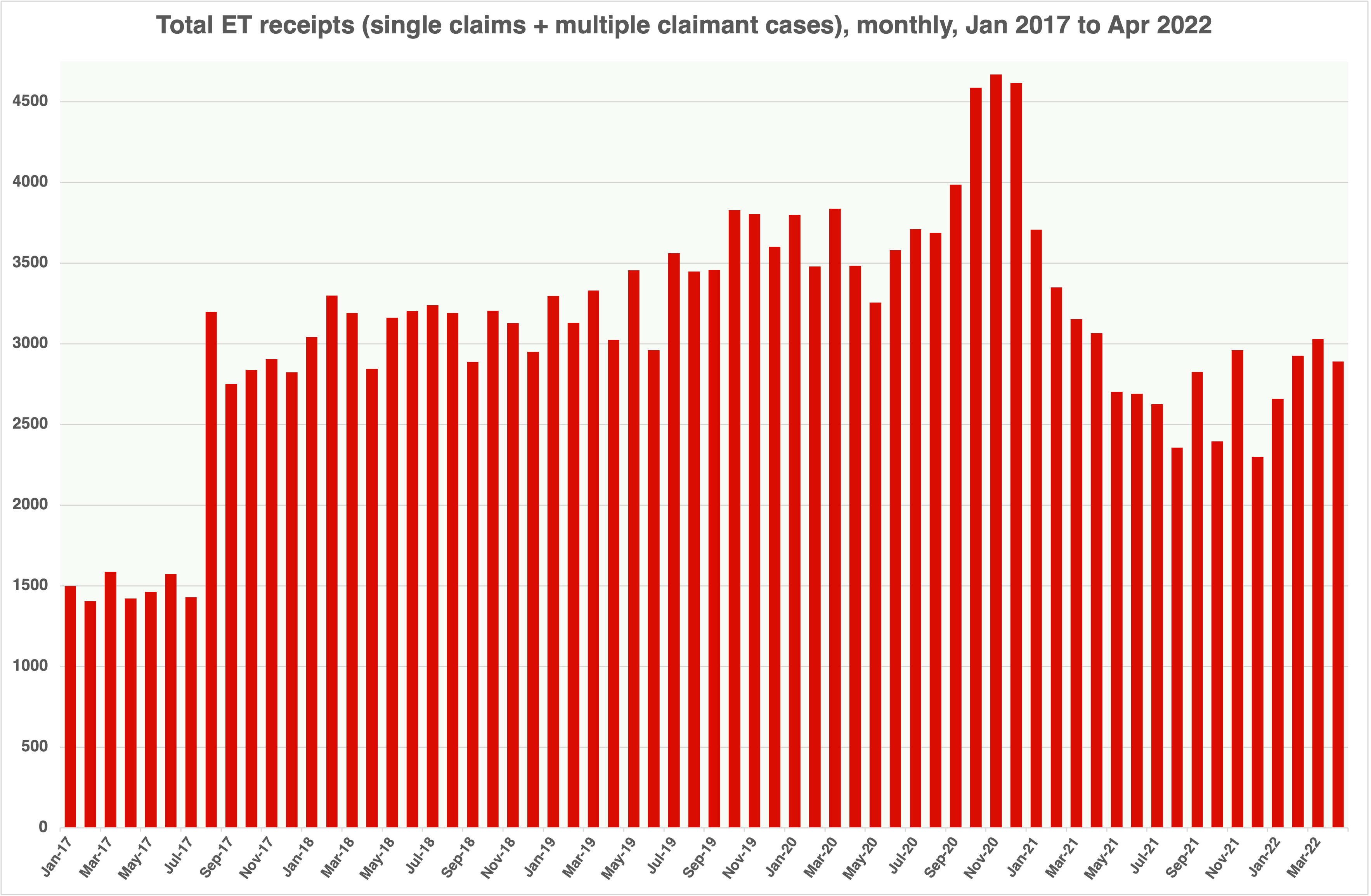
As the following chart shows, total ET receipts (single claims + multiple claimant cases) continue to run at just under 60% of the peak level seen in late 2020, and at 75% of the level seen in the last three quarters before the onset of the Covid pandemic in March 2020.
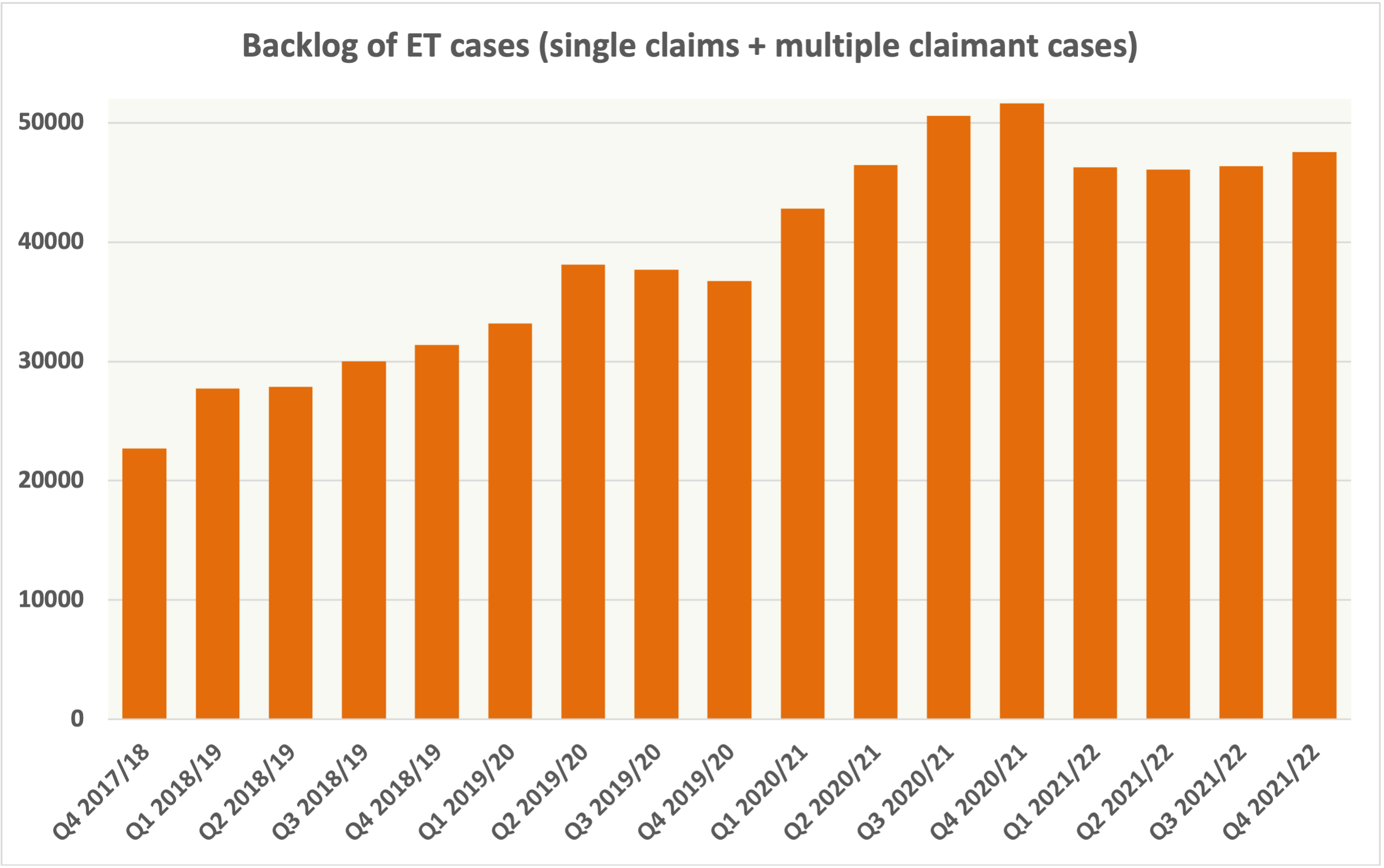
However, even at a level not seen since before the abolition of ET fees in July 2017, receipts continue to exceed the number of disposals, and accordingly the backlog of cases is now creeping back towards the peak seen in early 2021.
Yes, it’s the Silly Season, which Wikipedia helpfully defines as “the period lasting for a few summer months typified by the emergence of frivolous news stories in the media”. So, naturally, a ‘news story’ that the Covid-related trend towards working from home (WFH) and hybrid working has led to a massive increase in the number of employment tribunal claims for bullying is all over the supposedly specialist Human Resources media.
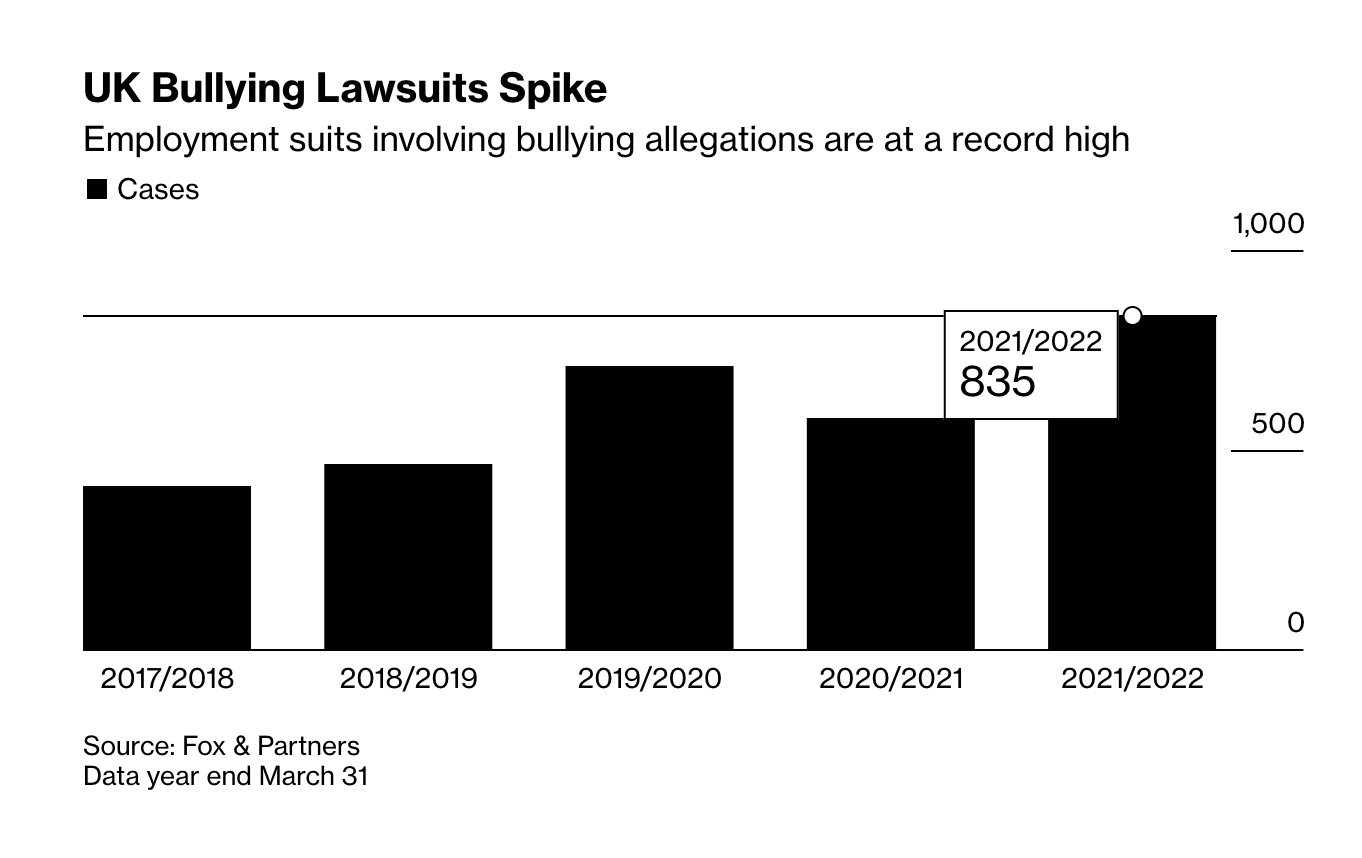
The number of employment tribunal claims lodged [sic] citing allegations of bullying has increased by 44 per cent over the past 12 months, reaching record highs, new research has revealed. The analysis, conducted by law firm Fox & Partners, found that bullying claims [sic] increased from 581 to 835 between March 2021 and March 2022. The firm dubbed the findings a “canary in the mine” moment for many organisations, suggesting this may signal that leadership teams are failing to address a growth in toxic work cultures. People Management(the voice of the CIPD)
Ivor Adair, partner at Fox & Partners, said: “Tackling workplace bullying is no easy task, particularly in changing work environments. The record number of bullying claims [sic] is a worrying sign that some leadership teams have struggled to maintain healthy workplaces during the shift to hybrid working.” Personnel Today
Research from law firm Fox and Partners found there were 835 tribunals relating to bullying in 2021/22, up 44% from the previous year. The number of claims [sic] has more than doubled since the 412 recorded in 2017/18. Hybrid working environments, the report suggested, have brought new forms of bullying to the workplace, such as leaving colleagues out of remote meetings, comments over video calls, and gossiping over messaging platforms.HR magazine
“WFH may not be working for everyone. A record number of bullying claims [sic] have featured in lawsuits at the UK’s employment courts over the past year, in a sign that while working from home is welcomed by many, it’s also contributing to tensions for others.”Bloomberg UK
There is just one teeny weeny problem with this story: neither Fox & Partners nor anybody else know how many employment tribunal claims citing allegations of bullying were made in each year since 2017/18, as ‘bullying’ is not a jurisdiction identified in the official tribunal statistics published by the Ministry of Injustice (and the Ministry has not yet published any breakdown of new tribunal claims by jurisdiction for 2021/22). And, if we do not know how many claims there have been, we cannot say that there has been any increase. And we certainly cannot ascribe that increase to WFH or hybrid working.
No, all that Fox & Partners have done is conduct a word search for ‘bullying’ on the HMCTS online register of employment tribunal decisions. But the ET decisions on the register are only a small proportion – about one in eight – of all ET claims made, as the great majority of claims are settled or withdrawn without a tribunal decision. For example, in 2017/18 there were 110,098 ET claims, but only 13,560 ET decisions were published on the register. And in 2020/21 there were 117,926 claims, but only 14,579 decisions were published on the register.
Furthermore, the number of ET decisions containing any particular word or phrase such as ‘bullying’ or ‘numpty employment lawyer’ is of course influenced by the total number of ET decisions, which goes up and down (in 2021/22, just 12,680 decisions were published on the register, down from 25,895 in 2019/20). In other words, what would matter (if it mattered at all) is not the number of decisions containing that word or phrase, but the proportion of all decisions containing that word or phrase.
So, while the Fox & Partners ‘research’ (which I replicated in about five minutes on the register earlier today) tells us that the number of decisions including the word ‘bullying’ increased from 412 in 2017/18 to 708 in 2019/20, it overlooks or deliberately ignores the fact that the total number of decisions published on the register also nearly doubled, from 13,560 in 2017/18, to 25,895 in 2019/20. So what is presented as a 72% increase, from 412 to 708, was actually a decrease, from 3.04% to 2.73%.
In any case, an ET decision can of course include the word ‘bullying’ without the ET claim having had anything to do with the Covid pandemic, working from home, or hybrid working. Indeed, it can include the word ‘bullying’ without the claim having involved any allegation(s) of bullying – it could just be an incidental reference to the employer’s Harassment & Anti-Bullying Policy, for example. (Between 2019/20 and 2021/22 there was a 1,494% increase in the number of ET decisions containing the word ‘hybrid’, but … well, I’ll leave you to think about why that was). If you don’t believe me, take a look at the first few decisions that come up if you do a word search for ‘bullying’ in 2021/22. And do feel free to let me know how many decisions you can find in which the claim related to leaving colleagues out of remote meetings, making comments over video calls, or gossiping over messaging platforms.
Fox & Partners would have needed to read through each of the 835 decisions in 2021/22 that include the word ‘bullying’, and those in other years, and tell us how many of the associated claims actually involved allegations of bullying linked to WFH or hybrid working. But they haven’t done that. Because that would have taken (a lot) more than five minutes.
All Fox & Partners have done is spot a random and meaningless increase in the number of ET decisions (not claims) containing the word ‘bullying’, and then assert a link to the pandemic-related trend towards WFH and hybrid working. But that ‘link’ is entirely spurious. Fox & Partners have not identified any upward trend in the number of ET claims citing allegations of bullying, let alone any upward trend in the number of ET claims citing allegations of bullying linked to WFH or hybrid working. So the resultant media coverage is not just frivolous, but entirely bogus.
Fox & Partners may just as well have asserted a link between the trend towards WFH and the 73% increase in the number of ET decisions containing the word ‘chocolate’ in 2021/22. Or the 46% increase in the number of ET decisions containing the word ‘penis’. Well, it stands to reason, doesn’t it? The trend towards WFH is allowing everyone to get their dick out during office hours.
WE INTERRUPT THIS BLOG TO BRING YOU AN IMPORTANT PUBLIC SERVICE ANNOUNCEMENT: CORRELATION DOES NOT IMPLY CAUSATION
Yes, as any regular reader(s) of this blog will have spotted, this is just another variant of the old ‘Get Our Law Firm’s Name in The Papers in The Hope of Drumming-up Some Much-needed Business by Issuing a Press Release With an Eye-catching But Totally Rubbish Story About ET Claim Numbers’ trick.
And, as documented on this blog, numpty journalists fall for it every time, mindlessly typing out the law firm’s press release and hitting the ‘publish’ button. My favourite is still the 13,000% increase in age discrimination claims in Scotland in October 2020, which got typed up by numpty journalists at the Guardian, Daily Express, Telegraph, Daily Mail and Yorkshire Post, as well as at People Management and Personnel Today. Fox & Partners are regular performers of the trick, as are GQ Littler, who did a similar search for ‘flexible working’ on the register of ET decisions in January (you can even just tick a box to search decisions for ‘flexible working’).
The Silly Season will soon be over. But unscrupulous employment lawyers will continue to use this tired trick, and numpty journalists will continue to fall for it.
Update, November 2023: Sadly, Minister Scully did not get to do much, if any, levelling-up as Minister of State at the DLUHC, as in October 2022 he was demoted back to Parliamentary Under-Secretary of State and moved to the Department for Digital, Culture, Media & Sport. In February 2023 he was shunted to the newly-created Department for Science, Innovation and Technology. And on 13 November he was finally given what he calls “the Spanish Archer” by Rishi Sunak.
Further update: On 4 March 2024, Mr Scully announced on social media that he will stand down as an MP at the coming General Election. His parting gift to politics was to assert that mainstream politicians can “work with the bell curve or become the bell-ends”. Amen to that.
As noted previously on this blog, the introduction of a new Case Management System in March 2021 has led to a dearth of official statistics on Employment Tribunal receipts and disposals. And, in January this year, the President of the Employment Tribunals in England & Wales, Judge Barry Clarke, noted that this ongoing ‘data silence’ was “a cause of immense frustration to the leadership judges of the Employment Tribunals. For obvious reasons, the lack of reliable data was significantly impairing operational and strategic decision-making.”
In October, HMCTS did release some limited data on Employment Tribunal receipts (but not disposals) for the period August 2020 to August 2021, but this simply led some – including yours truly – to question whether it was credible that the number of new cases had fallen by 42% between November 2020 and May 2021 – that is, just when the new Case Management System was being introduced.
Well, yesterday HMCTS not only included some data on both Employment Tribunal receipts and disposals in the latest set of quarterly tribunal statistics, up to March 2022, but also published some new monthly management information up to April 2022. And this confirms not only that the number of new cases did indeed fall by 42% between November 2020 and May 2021, but that it continued to fall further: in December 2021, the number of new cases (2,298) was 51% down on that in November 2020 (4,669). And we have to assume that HMCTS is now pretty confident of the reliability of these figures – so, sorry for doubting you, HMCTS peeps.
In the first few months of 2022, the number of new cases has bounced back a bit, but the new data confirms that the number of new cases has fallen significantly since late 2020, and is now running somewhat below pre-Covid levels.
Anyway, that’s the good news. The bad news is that, with disposals also down slightly, this pretty dramatic fall in new case numbers has not (yet) been matched by a significant fall in the deeply problematic backlog of cases, which – after receding from its Covid-induced peak in late 2020 – has flatlined over the last four quarters. This needs to change.
In recent years, BEIS minister Paul Scully – a strong contender for the hotly-contested title of Most Idiotic Minister in the Johnson Government – has repeatedly and brazenly claimed that “the UK’s maternity leave system is one of the most generous in the world”. Here he is in June 2020, for example, defending the Government’s claim that “the UK’s maternity leave offer is among the most generous in the world” while giving oral evidence to the Petitions Committee of MPs. And here he is two years later, in February 2022, mindlessly regurgitating that claim in the House of Commons.
And, last week, Minister Scully was at it again. In Answer to a Parliamentary Question tabled by Labour’s shadow employment rights minister Justin Madders MP, the Minister boldly asserted that “the UK’s maternity leave entitlement is one of the most generous in the world, with employed women entitled to 52 weeks of maternity leave, of which 39 [weeks] are paid”.
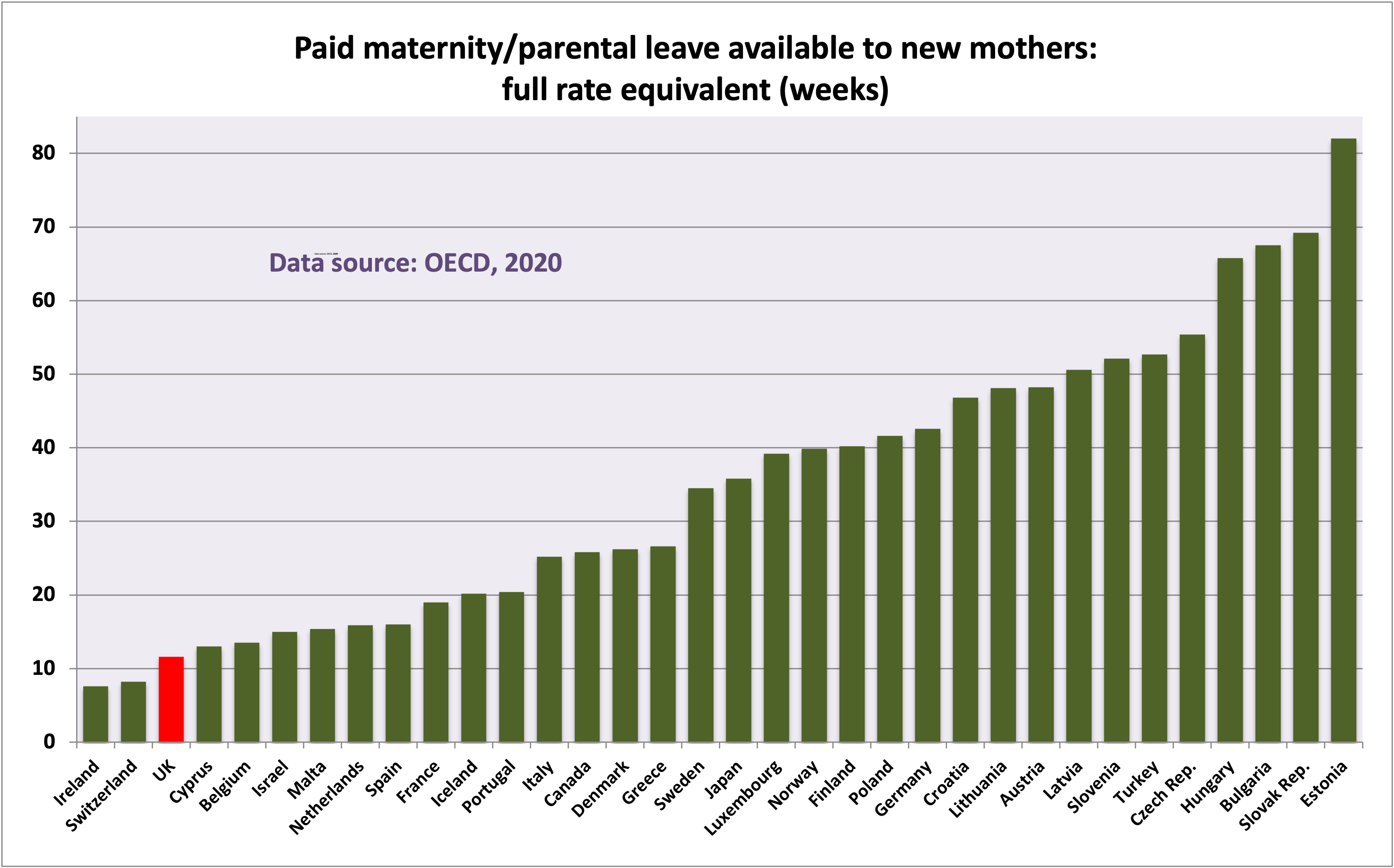
Doh! The UK’s paid maternity leave entitlement is only “one of the most generous in the world” if you overlook the teeny-weeny fact that, in most other comparable countries, most of the statutory paid leave available to working women who have just given birth is called parental leave, not maternity leave. And, in the UK, new mothers get no paid parental leave. Zilch. Nada. Rien. Here’s a chart that even Minister Scully should be able to get his head around.
Yes, in terms of the duration of paid maternity/parental leave available to new working mothers, the UK’s maternity leave system is more generous than that in Belgium, Iceland, Ireland, Malta, Portugal and Switzerland. But it is less generous than that in Austria, Bulgaria, Canada, Denmark, Estonia, France, Germany, Hungary, Italy, Japan, Latvia, Norway, Poland, Romania, Sweden … need I go on?
And do new mothers in Austria, Canada, the Czech Republic, Denmark, Estonia, Finland, France, Germany, Hungary, Italy, Japan, Latvia, Lithuania, Norway, Poland, Romania, Slovenia and Sweden feel hard done by because they get fewer weeks of paid maternity leave than women in the UK? Of course they don’t.
So, if the UK’s maternity leave system isn’t “one of the most generous in the world” in terms of the duration of the paid leave available to new mothers, maybe Minister Scully had another measure in mind? Because, of course, the overall ‘generosity’ of any system of paid leave is a combination of the length of the leave entitlement, and the rate at which it is paid.
The OECD uses two alternative measures of the overall ‘generosity’ of paid maternity/parental leave. The first of these is the average payment rate, i.e. the % of previous earnings replaced over the length of the paid maternity/parental leave entitlement for a woman earning 100% of average national full-time earnings. And, as the following chart clearly shows, on this measure the UK’s maternity leave system is very far from being “one of the most generous in the world”.
The second measure of the ‘generosity’ of paid maternity/parental leave used by the OECD is full-rate equivalent, i.e. the duration of paid maternity/parental leave in weeks if it were paid at 100% of previous earnings. And, as the following chart shows, some countries (Finland, Hungary, Latvia, the Netherlands) do better under this measure than they do under ‘average payment rate’. But the UK … not so much.
In short, Minister Scully’s claim that “the UK’s maternity leave offer is among the most generous in the world” is as delusional as the Prime Minister’s defence of his attendance at boozy parties in Downing Street during lockdown. The Covid regulations did not allow ‘work leaving dos’ or ‘morale-boosting speeches by the boss’, and at less than half of the legal minimum wage the UK’s statutory maternity and parental pay of just £156.66 per week is not going to secure the UK a top slot in international league tables.
But with a new parliamentary e-petition calling (somewhat modestly) for that pitiful rate of pay to be increased in line with the cost of living heading towards the threshold for a Westminster Hall debate of 100,000 signatures, it may not be long before Minister Scully is back in the House of Commons, telling MPs that the UK’s maternity leave offer is already among the most generous in the world. And – who knows? – by then the Minister may be able to tell us the outcome of the review of the UK’s chronically failing Shared Parental Leave scheme that his officials started more than four years ago.
The Terms of Reference for the Warman Review appear to have been written by an intern at the Cabinet Office. On their first day in the job. But that doesn’t matter because, thanks to an interview that the Prime Minister gave to the Daily Fail on Friday, we already know that the Review will conclude that working from home involves far too much making coffee and walking slowly to the fridge to hack off a piece of Beaufort d’été, and everyone should just get back to the office.
Meanwhile, some family rights groups are doing what ineffectual BEIS officials want them to do: provide some cover for ineffectual BEIS ministers by bigging up the possibility of Government-backed Private Members’ Bills designed to deliver some of the Government’s abandoned policy pledges ahead of the PMB ballot later this week (a possible ‘strategy’ first flagged by The Times on 2 May, and by yours truly on this blog).
Of course, the Employment Bill’s omission from the Queen’s Speech on 10 May does not mean that ministers cannot introduce the Bill – or one or more mini-Employment Bills – in this parliamentary session. Governments routinely introduce new legislation that wasn’t mentioned in the previous Queen’s Speech. But with three other (sizeable) Bills in the new legislative programme, it does seem unlikely that BEIS ministers will find the time and energy to pull rabbits out of hats before a general election in 2023.
In any case, the principal obstacle to progress on the outstanding promises on workers’ rights is not the Johnson Government’s lack of parliamentary time but – as Women & Equalities Committee chair Caroline Nokes MP noted on Friday – its “lack of will or care to foster a fairer and more equal society”.
Whatever, in the House of Commons on Thursday – during the Fairness at Work-themed debate on the Queen’s Speech – equalities minister Kemi Badenoch insisted both that the Government doesn’t need to have the Employment Bill that it has repeatedly promised, and that the Government is still committed to having the repeatedly promised Employment Bill that it doesn’t need.
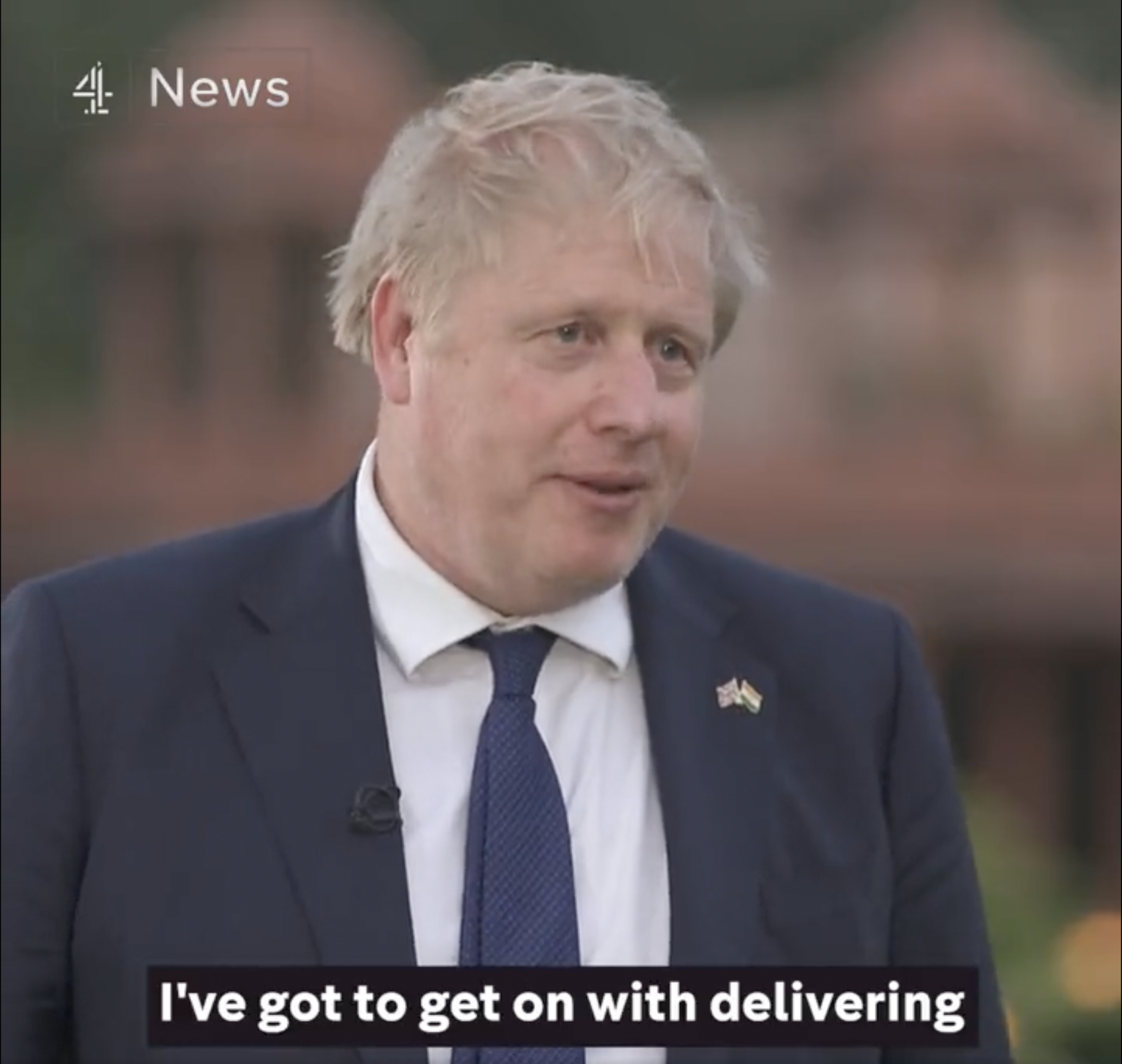
Now that Boris Johnson has put his lockdown-busting partying behind him and just wants to “get on with delivering”, perhaps he and his Government will use next week’s Queen’s Speech to finally start delivering on some of their many outstanding promises to enhance workers’ rights.
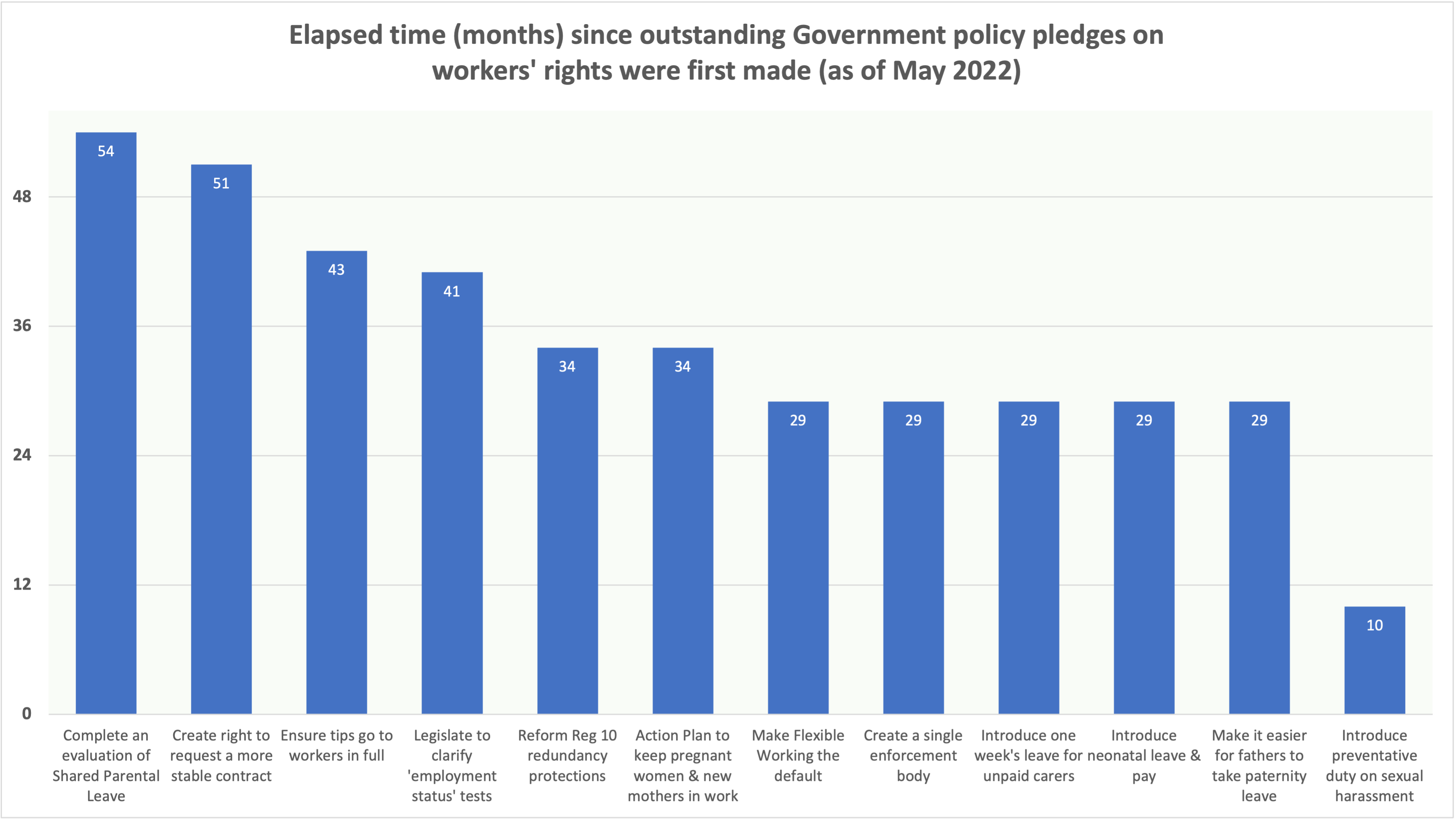
We’ve known for some weeks that the Queen’s Speech is unlikely to include the repeatedly promised ‘Big Bus’ Employment Bill but, as noted previously on this blog, that doesn’t necessarily preclude there being one or more smaller legislative vehicles delivering some of these outstanding policy pledges. Because, as the following chart shows, some of these policy pledges have been outstanding for some considerable time.
In November 2017, then BEIS minister Margot James promised the Women & Equalities Committee of MPs that BEIS would complete an evaluation of the Shared Parental Leave scheme – introduced in 2015 and already known to be failing – in 2018. That evaluation was underway by 26 April 2018 but, four years on, it is still stuck in the bowels of BEIS. Presumably, officials with wet towels wrapped around their heads are working night and day to come up with a form of words that convincingly presents a woeful take-up rate of just 2% as ‘broadly in line with our target of 25%’.
In February 2018, in its response to the July 2017 Taylor Review of Modern Working Practices, the Government pledged to tackle the blight of zero-hours contracts and other insecure work by introducing a right to request a more predictable and secure contract. This pledge was then repeated in the Conservative manifesto (see pp 37-39) for the December 2019 general election, and in the subsequent Queen’s Speech as part of the promised Employment Bill (see pp 43-44).
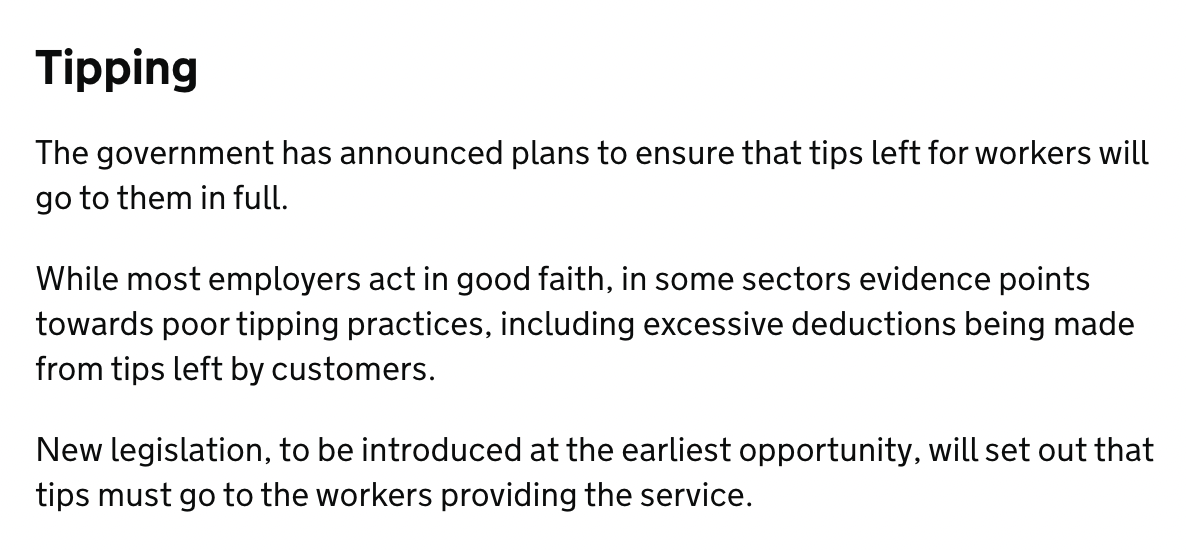
In October 2018, following an evidence-gathering and consultation process kicked off by his predecessor Sajid Javid as long ago as August 2015, then business secretary Greg Clark promised new legislation to ensure tips go to workers in full. This pledge was then repeated in the December 2019 Queen’s Speech, as part of the promised Employment Bill, and was bigged up by BEIS minister Paul Scully as recently as September 2021.
“New measures to support workers, businesses and entrepreneurs”, BEIS press release, 1 October 2018
In December 2018, the Government’s Good Work Plan included a promise to legislate to improve the clarity of the employment status tests (a need identified by the 2017 Taylor Review). And it reiterated the February 2018 promise to “legislate to give all workers the right to request a more stable contract”.
In July 2019, in direct response to the 2016 findings of the Equality & Human Rights Commission’s landmark investigation into pregnancy & maternity discrimination in the workplace, and an August 2016 recommendation of the Women & Equalities Committee of MPs, the Government pledged to extend the period covered by the existing redundancy protections. In 2021, both the Women & Equalities Committee and the Petitions Committee urged ministers to get on with implementing this outstanding policy commitment. However, Maternity Action, the TUC, Maria Miller MP and others have repeatedly suggested that more fundamental reform is needed.
At the same time, the Government committed to establishing a Taskforce of employer and family representative groups to develop an Action Plan to make it easier for pregnant women and new mothers to stay in work. No such Taskforce has been established, but in the summer of 2021 BEIS established a Pregnancy & Maternity Discrimination Advisory Board to “consider the information and guidance available on pregnancy and maternity discrimination, to ensure it continues to be relevant and is effective in supporting employers and employees”. Intended to meet “on a quarterly basis until March 2023”, to date the Board has met only once, on 23 September 2021, and in March 2022 the campaign group Maternity Action – winners of the 2022 Halsbury Award for Rule of Law – were banned from further attendance by a senior BEIS official.
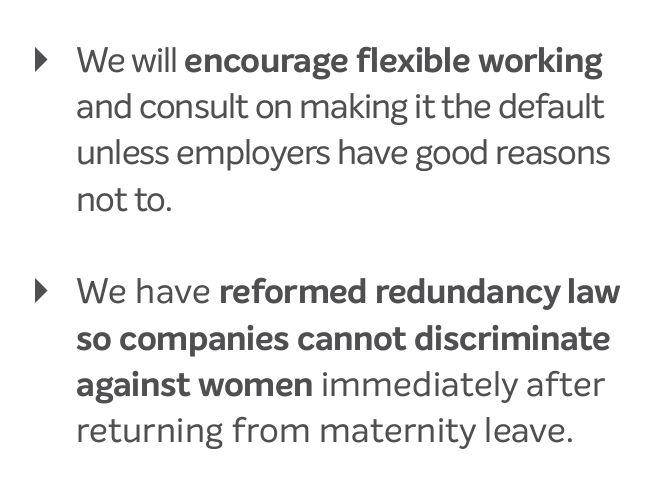
In December 2019, the Conservative general election manifesto (see pp 37-39) promised a consultation on making flexible working the default, and falsely claimed that the Government has already acted on the (still outstanding) July 2019 pledge to reform redundancy protections. The flexible working consultation was eventually held between 23 September and 1 December 2021, but it was clear from the consultation document that the Government has abandoned any idea of making flexible working the default.
Conservative general election manifesto, December 2019
The general election manifesto also promised the creation of a single enforcement body (to “crack down on any employer abusing employment law”), repeated the February 2018 pledge to introduce a right to request a more predictable and stable contract, pledged a new right to one week of (unpaid) carer’s leave, and promised legislation to introduce neonatal leave and pay. All four of these pledges were then repeated in the December 2019 Queen’s Speech, as part of the promised Employment Bill (see pp 43-44).
The December 2019 general election manifesto also committed the Government to “look at ways to make it easier for fathers to take paternity leave”. However, there is no evidence of ministers or officials having done any such ‘looking’ since 2019, and certainly no policy proposals have been forthcoming.
In July 2021, a Government Equalities Office consultation on sexual harassment concluded with the Government committing to “introduce a duty requiring employers to prevent sexual harassment” in their workplaces, along with explicit protections from third-party harassment.
Three weeks ago on this blog, I suggested – with a little help from the great Tracey Thorn and Ben Watts – that ministers have shelved their long-promised Employment Bill (again). And on Friday a (rather thinly evidenced) story in the FinancialTimesindicated that the Bill is indeed unlikely to appear in next month’s Queen’s Speech (on 10 May).
However, as alluded to in my reworking of EBTG’s “Missing”, the withdrawal from service of the ‘Big Bus’ Employment Bill does not mean the Queen’s Speech will not contain one or more smaller, standalone legislative vehicles carrying specific ‘reforms to our employment framework’. So, what might be aboard these compact legislative minibuses?
Create a new, single enforcement body, offering greater protections for workers.
Ensure that tips left for workers go to them in full.
Introduce a new right for all workers to request a more predictable contract.
Extend redundancy protections to prevent pregnancy and maternity discrimination.
Allow parents to take extended paid leave for neonatal care.
Introduce a new legal entitlement to one week’s leave for unpaid carers.
Make flexible working the default unless employers have good reason not to.
We already know, from the BEIS consultation that ran between 23 September and 1 December last year, that the Government has abandoned the last of these commitments, despite it having been an explicit manifesto commitment (hence the blatantly dishonest title of the BEIS consultation document). There may still be some minor changes to the ‘right to request’ regime, but these could be implemented by tweaks to the secondary legislation (i.e. the 2014 Regulations). So, no legislative minibus.
Despite some snail-paced progress towards the creation of a single enforcement body – in June last year the Government published its response to the consultation it had conducted between July and October 2019, and this reaffirmed the (manifesto) commitment – it is clear BEIS is nowhere near ready to proceed with the necessary legislation, even if Boris Johnson is still on board (a very open question). So, no legislative minibus on this route, either. The TUC will be (secretly) pleased about this.
However, in recent months ministers have come under intense pressure from Conservative MPs such as Luke Hall to deliver on the commitment to introduce neonatal leave and pay, as affirmed in both the Government’s March 2020 response to its 2019 consultation and the March 2020 Budget, which earmarked the necessary funding to deliver the new entitlement from April 2023. And, when pressed during Prime Minister’s Questions on 17 November last year to “bring forward a standalone Bill”, rather than wait for the Employment Bill, Boris Johnson assured the SNP’s David Linden that:
One way or another—I will get back to him on the exact way—we will legislate to allow parents of children in neonatal care to take extended leave, giving them more time during the most vulnerable and stressful days of their lives.
So, I think we can expect a legislative minibus on neonatal leave and pay in the Queen’s Speech. Which may well also have on board the promised new right to one week of carer’s leave. Such a legislative minibus would be universally welcomed, and accordingly would sail through Parliament without difficulty.
Similarly, since 2020 ministers have come under sustained pressure from both the Women & Equalities Committee, chaired by Caroline Nokes, and the Petitions Committee, chaired by Labour’s Catherine McKinnell, to deliver on the July 2019 commitment to extend the period covered by the existing Regulation 10 redundancy protections.
That commitment was made in response to the findings and recommendations of the EHRC’s 2015-16 inquiry into pregnancy and maternity discrimination in the workplace, and an August 2016 recommendation by the Women & Equalities Committee, then chaired by Maria Miller. In their February 2021 report on the gendered impact of the Covid19 pandemic, the Women & Equalities Committee urged ministers to deliver on the July 2019 commitment “in this Parliamentary session”, i.e. by May 2021. And, noting the Government’s failure to do that, in September 2021 the Petitions Committee’s second report on the impact of the pandemic on pregnant women and new parents concluded:
We echo our recommendation from [our July 2020 report] that the Government should legislate as soon as possible to introduce its planned extension of redundancy protections for new and expectant mothers. It must clarify a timeframe for doing this, and, if there is not sufficient parliamentary time to consider a full Employment Bill before the end of the year, the Government should immediately bring forward a short Bill specifically to implement these protections.
So, there could be another legislative minibus, on redundancy protections, in the Queen’s Speech. However, this one would not be universally welcomed, and could face a very rough ride through Parliament, not least because the Labour Party, campaign groups such as Maternity Action and Maria Miller MP have repeatedly said that more meaningful reform is needed. Indeed, such a Bill would be a bit of a gift to shadow ministers.
This means we can’t rule out the possibility that ministers have decided to renege on the July 2019 commitment (or, at least, to leave it rusting away in the bus garage for now). Which might explain why BEIS ministers have recently chosen to kick Maternity Action off their Pregnancy & Maternity Discrimination Advisory Board, the creation of which was another part of that July 2019 commitment – to “establish a Taskforce … to develop an Action Plan on what steps Government and other organisations can take to make it easier for pregnant women and new mothers to stay in work” – and which met for the first (and so far only) time in September last year. So, while the Government has a shiny new Action Plan on Animal Welfare, six years on from the EHRC research it still has no Action Plan to tackle pregnancy and maternity discrimination at work.
The pledge to ensure that tips left for workers go to them in full is an even older one, having first been made in October 2018, following a BEIS consultation that ran from 2 May to 27 June 2016. And it was reaffirmed in the Government’s September 2021 response to that consultation. Given that then business secretary Sajid Javid kicked off this somewhat bizarre sequence of review, consultation, pledge and consultation response as long ago as August 2015, it’s not entirely clear how much priority ministers give to this particular commitment, but I will not be totally surprised if we find a legislative minibus with this on board in the Queen’s Speech. Or if we don’t.
As for the promised new right to a more predictable/stable contract – which dates from the Government’s February 2018 response to the Taylor Review, and was repeated in the 2019 Conservative manifesto – I suspect that one is still in a box marked ‘too difficult’ on a shelf in a room hidden away at the back of Kwasi Kwarteng’s bus garage.
Anything else? Well, in July last year a Government Equalities Office consultation on sexual harassment concluded with the Government committing to “introduce a duty requiring employers to prevent sexual harassment” in their workplaces. As with neonatal leave and pay, a legislative minibus carrying such a preventative duty would be widely welcomed, and would most likely sail through Parliament. And it would provide some cover for not proceeding with the July 2019 pledge on redundancy protections.
And let’s not forget that the 2019 Conservative manifesto included a pledge to “look at ways to make it easier for fathers to take paternity leave”. There’s no evidence of ministers and officials having done any such ‘looking’ since 2019 – and their four-year evaluation of the chronically failing Shared Parental Leave scheme has yet to conclude – but maybe they will surprise us. And, again, this might explain why BEIS have booted Maternity Action off their Advisory Board.
Or perhaps ministers will finally act on the 2016 recommendations of the Equality & Human Rights Commission, the Justice Committee and the Women & Equalities Committee, and the April 2020 recommendation of the Law Commission, to extend the Employment Tribunal time limit.
I step into Hansard I’m wonking down your street again And past your door, but you don’t live there anymore It’s two years since you were in the manifesto And now you’ve disappeared somewhere, like outer space They’ve found some ‘alternative legislative vehicles’
And I miss you, like the workers miss their rights And I miss you, like the workers miss their rights
Could you be dead? You always were going to be a very big Bill We’d try to amend you while you would run We looked at their ‘in due courses’ And their ‘when parliamentary time allows’ Where we always wanted to be
And I miss you (like the workers miss their rights) And I miss you (like the workers miss their rights)
But now they will only ‘outline employment measures’ Or ‘reforms to our employment framework’ And Kwasi Kwarteng has said There will be No Big Bus You’re long gone, but I can’t move on
And I miss you (like the workers miss their rights) And I miss you, yeah (like the workers miss their rights) And I miss you
There being an R in the month, there is a new report making the case for a four-day week.
This month, the focus is on Wales, with a report by think tank Autonomy, commissioned by the Future Generations for Wales Commissioner, concluding that a shorter working week (with no reduction in pay) could “contribute to the goal of a resilient Wales, and also a globally responsible Wales”. And, according to this breathless Autonomy report, no fewer than 57% of the Welsh public support a (hypothetical) Welsh Government-backed scheme to move towards a shorter working week (with no reduction in pay). Which rather begs the question: are the other 43% all masochistic idiots, or what?
Unfortunately, as the report itself quietly acknowledges, implementation of a four-day week for all Welsh workers falls “outside the current legislative capacities of the Welsh Government”. But no worries, because we already know from trials in Iceland, Germany and – *checks notes* – an unidentified charity that the four-day week (with no reduction in pay) is the best policy idea … EVER!
Indeed, according to a BBC news headline in July 2021, the introduction of a four-day week in Iceland has been an “overwhelming success”, with 86% of working Icelanders now entitled to “shorter hours for the same pay”. These lucky Icelanders report “feeling less stressed” and “having more time to spend with their families, do hobbies and complete household chores”, the BBC informs us. And sustainable democracy campaigner Gudmundur Haraldsson is on hand to tell the BBC:
“The Icelandic shorter working week journey tells us that not only is it possible to work less in modern times, but that progressive change is possible too.”
[And today, just hours after I published this post, the Guardianreports that “the four-day working week was trialled in Iceland between 2015 and 2019, and it has since become the choice of 85% of the country’s working population”. And the Telegraph similarly reports that “the four-day working week was tested in Iceland between 2015 and 2019, with 85% of its population continuing to do so”.]*
Yay! A four-day week, for five days’ pay! You can sign this enormously progressive wonk up for that. Well, maybe not the ‘completing household chores’ bit. But more time for my hobbies? Bring it ON.
However, if this all sounds just a wee bit too good to be true, that’s because it is too good to be true. For Iceland has not introduced a four-day week (with no reduction in pay).
Sure, between 2015 and 2019, Reykjavík city council and the Icelandic national government ran two trials of a shorter [sic] working week, with no reduction in pay. These involved a total of some 2,500 workers reducing their working week from 40 to 35 or 36 hours (so, not necessarily to a ‘four-day working week’). And official analysis of the trials concluded that “productivity and service provision remained the same or improved across the majority of trial workplaces”, while “worker well-being dramatically increased across a range of indicators, from perceived stress and burnout, to health and work-life balance”.
However, these (arguably unsurprising) findings did not lead to the Icelandic government introducing a four-day week (with no reduction in pay) for Iceland’s workforce of some 200,000, which historically has tended to work relatively long hours, by international standards. Rather, in 2019 and 2020 contracts guaranteeing shorter working hours were agreed between trade unions and Iceland’s private sector employers, local councils and central government. And, according to the July 2021 report by think tank Autonomy on which the BBC news report was based, by June 2021 these new contracts covered some 170,000 trade union members (that is, 86% of the workforce).
More to the point, according to the Autonomy report, these new contracts delivered cuts to the previous working week of just 65 minutes in the public sector, and a mere 35 minutes in the private sector. Whoopee woo.
OK, maybe these small but welcome contractual adjustments will lead to greater change in the longer run. Seven months on from the July 2021 Autonomy report and BBC headline, it is still too early to know. All that this month’s Autonomy report on a more resilient Wales is able to tell us about what has transpired in Iceland is that the new collective agreements “leave open the possibility of reduced hours being implemented more widely across the [Icelandic] economy”. Ble mae’r parti?
Yes, the latest data from Eurostat (the statistical office of the EU Commission) indicates that the average weekly hours of full-time workers in Iceland fell from 44 hours in 2019, to … wait for it … 43.5 hours in 2020 (when there was a global Covid19 lockdown). But clearly we’ll need to see data for 2021 and 2022 before we start popping that siampên.
Whatever, the key point is that, while the Icelandic trials provide very helpful evidence of the (undeniable) benefits of a better work-life balance, and of the impact on productivity of a shorter working week, Iceland is not an example of the introduction of a four-day working week, as proposed for the UK by think tanks such as Autonomy and the Fabians.
None of which is to say that we should not be trying to work towards a shorter working week. As noted above, my hobbies (and even my family) stand waiting. But I’m also still waiting for advocates of the four-day week to explain exactly how it could be delivered across the UK economy without suppressing the income of the millions of hourly-paid workers on zero-hours contracts or other forms of precarious employment, most of whom simply cannot afford a 20% pay cut. On this, pretty much all that the latest Autonomy report has to say is that “there is potential to synergise the policy [of a four-day week] with [Universal] Basic Income”, because “the economic security provided by a guaranteed income can give precarious workers more power to decide their working routines”.
To which I say dim ond breuddwyd yw hynny i chi.
*Today’s report in the Guardian about a planned new law in Belgium – also in the Independent – failed to make the rather important distinction between a right to request compressed hours, and a four-day week as commonly understood (and as advocated by campaigners for, well, a four-day week). As the Telegraphmanaged to concede: “the Belgian model falls short of an actual shortened working week”. I am 86% sure this will lead to me writing another blog post pretty soon.








 Labour Pains