
What has the Good Law Project (GLP) ever done for us? How much has that cost us? Why should we care? Shouldn’t we just ignore them?
Well, yes, we could just ignore them, not least because they would hate that. More than “fighting hate and spreading hope”, what the cool kids at the GLP really, really want is to be seen fighting hate and spreading hope. But ignoring them would be a mistake that various regulators, supposed investigative journalists and other allegedly smart people have been making for almost a decade, since free speech and suicide prevention champion Jolyon Maugham KC founded the GLP in early 2017.
Because it is arguable that what Maugham and the GLP actually do, through their undemocratic lawfare and idiosyncratic campaigning against organisations that Maugham doesn’t like, is spread hate and misinformation, mis-sell false hope, and erode public respect for elected politicians and the judiciary, to the detriment of public policy, the rule of law and the functioning of our parliamentary democracy.
Maugham founded the GLP after becoming wealthy from – but bored by – his practice as a tax (avoidance) barrister. Or, as one lawyer has put it, due to a “toxically narcissistic midlife crisis”. Over the next three years, funded largely by crowdfunders, the then volunteer-only GLP focussed on using creative lawfare to frustrate the Brexit that followed from the Green Party campaigning and voting with David Cameron’s terrible Tories to hold a stupid EU referendum in June 2016. And it was two big court ‘wins’ on Brexit – the Wightman case in December 2018, about whether the Article 50 notification was unilaterally revocable, and then the Prorogation of Parliament case in September 2019 – that made Maugham famous for 15 minutes, and led to him abandoning his lucrative tax law practice to devote himself to the GLP full-time (while modestly paying himself the salary of an MP).
However, those two big court ‘wins’ achieved … nothing. Zilch, nada, rien. As Josh Glancy noted in The Times in April 2023, they “were ultimately irrelevant, mostly methadone for Remainers”.
Outside Maugham’s head, in the real world, there was never any doubt that, politically if not legally, the Article 50 notification was unilaterally revocable. Indeed, the author of Article 50, Lord Kerr, was more than happy to tell anyone with the will and ability to listen that it was designed to be unilaterally revocable. So the European Court of Justice ruling in Wightman simply confirmed what pretty much everyone already assumed to be the case. And, in any event, the UK later left the EU, without any attempt to revoke the Article 50 notification. Yet, eight years on, Maugham still cites the Wightman case as his “intellectual brainchild” and proudest moment.
Similarly, the Supreme Court’s ruling in September 2019 that Boris Johnson’s five-week Prorogation of Parliament was unlawful, null and void did not stop Johnson comfortably winning a general election just three months later. Nor did it stop the UK leaving the EU in January 2020.
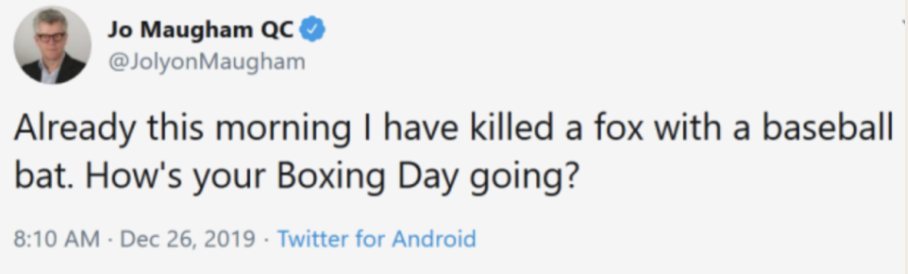
Were it not for the arrival of Covid19 a few weeks later, the story of the GLP might well have ended there – much like the life of the fox that Maugham battered with a baseball bat in his garden on Boxing Day 2019, before firing up Twitter to gloat about it. But, thanks to Boris Johnson, Dominic Cummings and Matt Hancock, between April 2020 and the lifting of Covid19 restrictions in February 2022 the GLP raised some £2.5 million from 18 crowdfunders in support of Covid19-related legal challenges.
Yet, while five of the 18 crowdfunders raised more than £200,000, and two of them more than £400,000, not one of the legal challenges resulted in a clear court win, and only two had any significant positive outcome for the GLP. In February 2021, their ‘Transparency’ case concluded with the High Court issuing a near-meaningless ‘declaration’ that the Government had not fully complied with transparency rules on the publishing of PPE contracts.
Similarly, in January 2022, their ‘VIP Lane’ case concluded with the High Court ruling that the operation of the High Priority Lane for the awarding of PPE contracts was “in breach of the obligation of equal treatment”. However, having concluded that all the contracts in question were “highly likely” to have been awarded in any event, the Court refused to grant a declaration (sought by the GLP) that the High Priority Lane was unlawful per se (see paragraph 518 of the judgment), and ordered the GLP to pay £250,000 of the Government’s legal costs.
Furthermore, these meagre legal achievements were obtained at considerable cost to taxpayers. According to the minister’s answer to a written parliamentary question, by October 2023 the Department of Health and Social Care alone had spent £3.88 million (plus VAT) on defending the GLP’s various legal challenges, of which only £337K had been recovered from the GLP as legal costs awards.
Yet, despite this woeful lack of ‘success’ in changing public policy, 2017-21 were the GLP’s ‘glory years’, during which total annual income – mostly from direct/regular donations – mushroomed to more than £6 million, and their payroll grew steadily, from zero in late 2019, to 12 in January 2021 and 22 in January 2022. And, ever since, the GLP has sat comfortably on financial reserves of some £4 million.
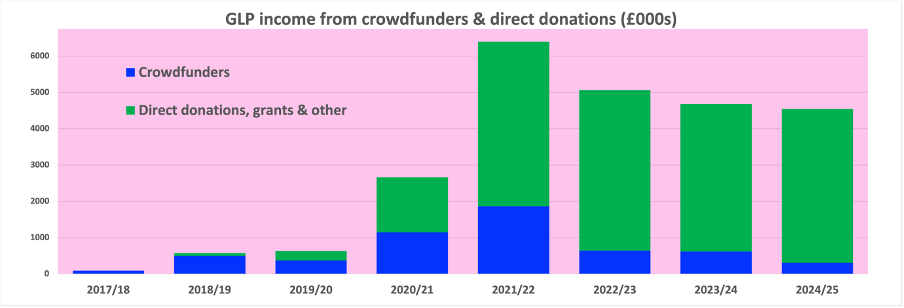
However, 2022 was the GLP’s annus horribilis, with a string of existential legal defeats in the High Court and Court of Appeal in Covid19-related cases, in which the judges not only ordered the GLP to pay a total of some £750,000 of legal costs to the government, but ruled that the GLP has no standing to bring such legal claims.
Most famously, in February of that year, in the GLP’s ‘cronyism’ case (also known as the GLP & Runnymede case), for which they crowdfunded a stonking £388,635, the High Court ruled (see paragraph 126) that “the claim brought by the GLP fails in its entirety”, and ordered the GLP to pay 80% of the Government’s legal costs. Yet Maugham and the GLP claimed this as a ‘win’. As barrister Adam King noted in April 2023, when reviewing Maugham’s autohagiography, Bringing Down Goliath:
When the High Court rules that your claim “fails in its entirety”, and orders you to pay 80% of the other side’s costs, is it really ethical to spin that outcome to donors as an unalloyed victory – as having won “at every substantive level”? Yes, all right, the GLP’s co-claimant [the Runnymede Trust] got part of what they wanted (a limited ‘declaration’), but both of them failed to persuade the Court of the headline allegation of “cronyism”. Never – ever – to be deterred, Maugham insists that this failure was only at “a deeply technical level”, now a droll euphemism for a forensic spanking.
Then, a few months later, in the GLP’s Abingdon Health case, for which they had crowdfunded £160,789, the High Court not only once again dismissed the GLP’s claim in its entirety, but went on to rule that the GLP lacked standing to bring such legal challenges.
In the summer of 2025, Maugham confessed that, following the end of the Covid19 pandemic in late 2021 – and, by implication, the above existential legal defeats – he and the GLP spent several years “blundering around trying to find the next thing that we should focus on”. In June 2022 they launched their own independent law firm, the Good Law Practice, to “foster legal structures that help people respond to the world around them”, but the firm ceased trading in October 2024. A much-vaunted office in Scotland somehow failed to materialise. And, in 2023, Maugham’s aforementioned booky-wook was taken apart in scathing reviews in the Times and elsewhere:
[Maugham’s book] is worth taking seriously, not because it has any scholarly, literary, or other value, but rather because, beneath the many, many layers of accumulated idiocy, Bringing Down Goliath represents an ideological attack on the foundations of the rule of law. Its rhetoric would be dangerous in the hands of a competent author, but even allowing for Maugham’s fumbling fingers, the ideas espoused in this book should worry anyone who cares to maintain the rule of law in the United Kingdom … A good judge, to Maugham, is a judge who will implement Maugham’s preferred political outcomes.
Maugham’s view of the judiciary resembles that advanced (with similar bloviating and tedium) by Chinese president Xi Jinping. The Chinese Communist Party is eager to tout its commitment to the ‘rule of law’, by which they really mean rule by law. The purpose of the judiciary is to achieve the end goals of the Party, and the idea of judicial independence is a trap.
It is fortunate that the book is so incompetently written that it is likely to turn readers against Maugham’s philosophy, but that is no reason for complacency. It may not be quite coherent enough to be a threat to the rule of law, but it is a dangerous watershed in the mainstreaming of an ideology utterly inimical to our present legal system.
Meanwhile, the GLP’s income from crowdfunders plummeted, from some £450,000 per quarter in late 2021, to some £200,000 per quarter in late 2022, and just £40,000 per quarter in late 2024, after the demise of their Tory cash cow. And the GLP’s woeful record of ‘success’ in actually changing public policy continued.
Of the 64 discrete crowdfunders launched by the GLP since 1 January 2021, to date only five have resulted in any kind of positive outcome for the GLP. You can, if you want, characterise that as a ‘win ratio’ of about 8%. But to my mind it is more meaningful to focus on the actual impact on public policy of those rare legal ‘wins’. Which, as with the earlier legal ‘wins’ on Brexit and Covid19, is ‘virtually nothing’:
- two now irrelevant court wins on Net Zero, in 2022 and early 2024, that did not lead to any significant change in the then Tory government’s policies before the change of government in July 2024;
- the overturning of a Shrewsbury Town Council planning decision, in 2023;
- the funding of one of law firm Bindmans’ defamation cases, in 2023; and
- a £25K settlement with a US law firm, in a case about transgenderism, in 2025.
However, with the Supreme Court’s momentous ruling in For Women Scotland on 16 April 2025, Maugham and the GLP found – or, more accurately, rediscovered – their ‘next new thing’: the aggressively misogynistic and homophobic, pseudo-religious ideology of transgenderism. And, since then, they have lucratively mined a rich seam of seemingly surplus cash in the so-called ‘trans community’: two crowdfunders launched in late April 2025 in support of the GLP’s efforts to undo the ruling have so far raised a combined total of almost £642,000, more than twice the grand total of £304,000 raised from all crowdfunders in the whole of their FY 2024-25 (Feb 2024 to Jan 2025).
In a witness statement to the High Court in December 2021, Maugham stated that the GLP’s work on transgenderism “has a particular resonance for me because of someone important to me who is affected by these issues”. That person is widely understood to be the eldest of Maugham’s three daughters, who appears to have started ‘identifying’ as trans in 2019 – the year after Channel 4’s “non-binary answer to Big Brother”, Genderquake, was filmed in the Maugham family’s second home (the fabled windmill) – and is now an adult trans activist going by the pseudonym ‘Grin’. And, according to ‘Grin’, her youngest sister (now 15) started ‘identifying’ as trans in 2023.
‘Grin’ was evidently a founder of the strangely secretive transactivist group Trans Kids Deserve Better, which mounted week-long protests outside the offices of NHS England and the Department for Education in 2024, and the London office of the Equality & Human Rights Commission in 2025. Members of the group go by monikers such as ‘Paint’, ‘Grin’ and ‘Oracle’, which apparently “enables zem to feel like ze fit in”. Seriously.
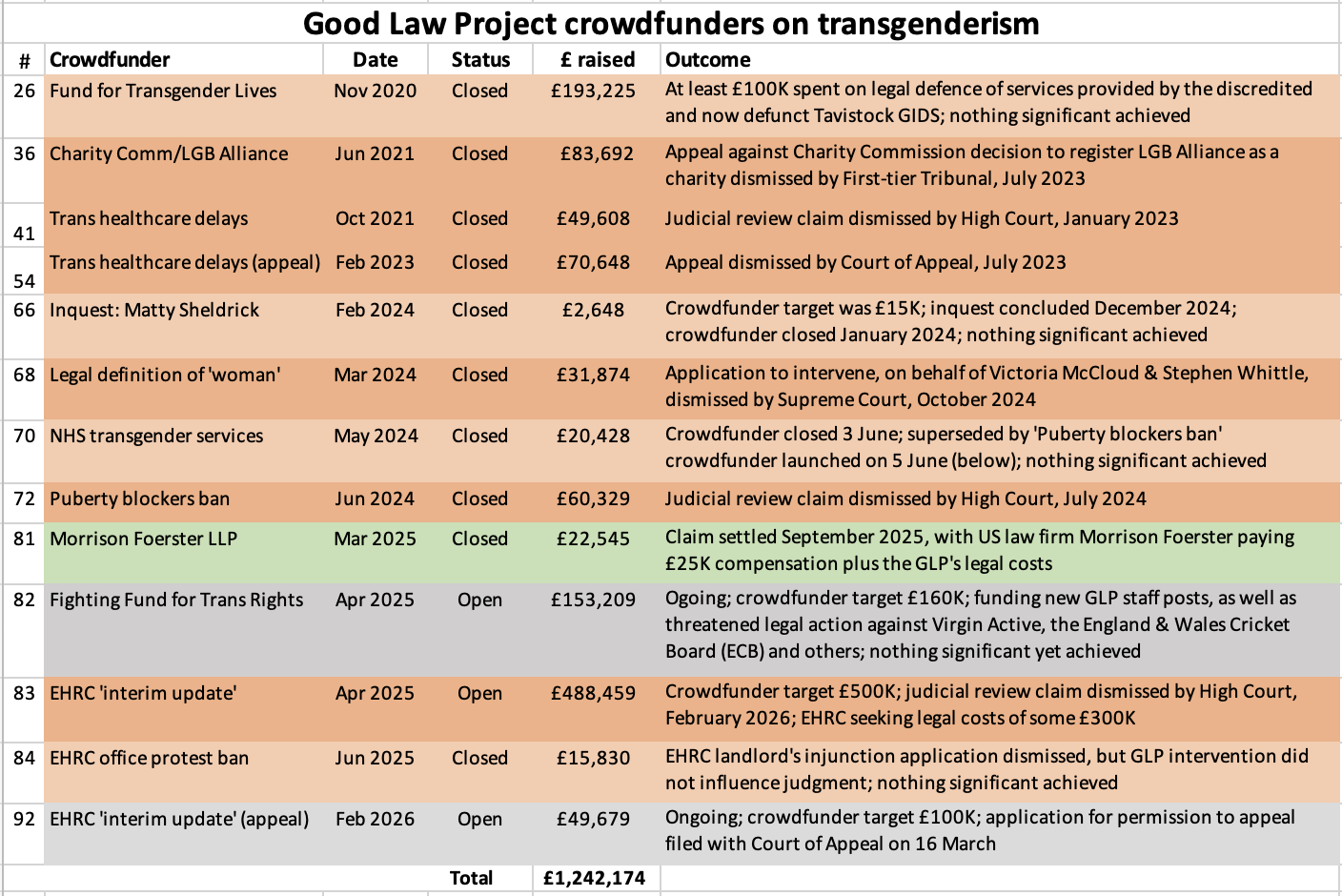
Since late 2020 – when, by her own account, the then 13-year-old ‘Grin’ was on the waiting list of the since discredited and now defunct Tavistock Gender Identity Development Service (GIDS) – the GLP has raised a total of £1.242 million from 13 crowdfunders in support of transgenderism-related lawfare. The first of these, launched in November 2020 in support of various legal actions in defence of services provided by the Tavistock GIDS, had raised £193,225 by the time it was closed in July 2024, without any significant change in public policy having been achieved.
The second, launched in June 2021 in support of a legal challenge to the Charity Commission’s grant of charitable status to the LGB Alliance, raised £83,692, but the claim was dismissed by the First-Tier Tribunal in July 2023. And two crowdfunders – the first launched in October 2021 – in support of a legal challenge to waiting times in NHS transgender services raised a total of £120,256, but the claim was dismissed by the High Court in January 2023, and then by the Court of Appeal in July that year.
A crowdfunder launched in March 2024 in support of an application by transgender icons Victoria McCloud and Stephen Whittle to intervene in the Supreme Court case of For Women Scotland raised £31,874, but the application was dismissed by the Court in October 2024. And another launched in June 2024 in support of a legal challenge to a ban on the supply of puberty blockers to trans-identifying children raised £60,237, but the claim was robustly dismissed by the High Court in July 2024.
Before and for several weeks after that High Court drubbing, the unelected Maugham had a melodramatic meltdown on social media, during which he accused the democratically-elected Secretary of State for Health & Social Care, Wes Streeting MP, of supporting a measure that “will kill trans children”. This and other emotive and inflammatory claims by Maugham and the GLP on social media were strongly criticised in a report by the Government’s adviser on suicide prevention, Professor Louis Appleby. And a few weeks later Maugham emailed supporters to inform them that, as “it’s getting harder and harder to win rights for the trans community through the courts, and it doesn’t feel right to keep asking the community and its allies to carry on contributing to the enormous costs of this increasingly difficult litigation”, the GLP would now be “focusing our legal campaigns elsewhere” instead.
Maugham did not respond much better to the Supreme Court ruling of 16 April 2025, in the case of For Women Scotland, on the meaning of the word ‘sex’ in the Equality Act 2010. Seemingly forgetting what he himself had confidently asserted in September 2019 – that “if the Supreme Court says it is the law, it is the law” – Maugham accused the judges of the “so-called Supreme Court” of having “ripped up the Equality Act”, of having been “hubristic, reckless or bigoted in the way they approached the For Women Scotland case”, and of having “abandoned their judicial oath in service of pleasing their wealthy friends”. The Chinese Communist Party will have been hugely impressed.
Within 24 hours of the Supreme Court’s ruling, the GLP had launched a crowdfunder in support of a new Fighting Fund for Trans Rights, and one week later they launched another, in support of a legal challenge to the ruling that later turned out to be a legal challenge not to the ruling itself, but to the Equality & Human Rights Commission’s Interim Update on the ruling. And those crowdfunders – both of which remain open to new donations – have since raised a stonking £641,667 from some 15,000 members of the so-called ‘trans community’ and their allies.
Yet, as noted previously on this blog, all that Maugham and the GLP have achieved with that moolah (so far) is yet another drubbing in the High Court on 13 February, and a bill from the EHRC for almost £300,000 of legal costs. For not only did the High Court dismiss all three grounds of the GLP’s legal claim, but it ruled that the GLP did not have standing to bring the claim.
Somewhat characteristically, Maugham and the GLP immediately sought to spin this comprehensive legal defeat as something of a ‘win’, telling supporters and potential donors to the inevitable new crowdfunder in support of an appeal to the Court of Appeal that:
The judge has said we are right about the law in a central part of our case: it can be entirely lawful for service providers to allow trans women to use the women’s toilets – without having to admit cis men. This means that the Minister will have to send back the EHRC’s draft guidance to be rewritten. It’s good news.
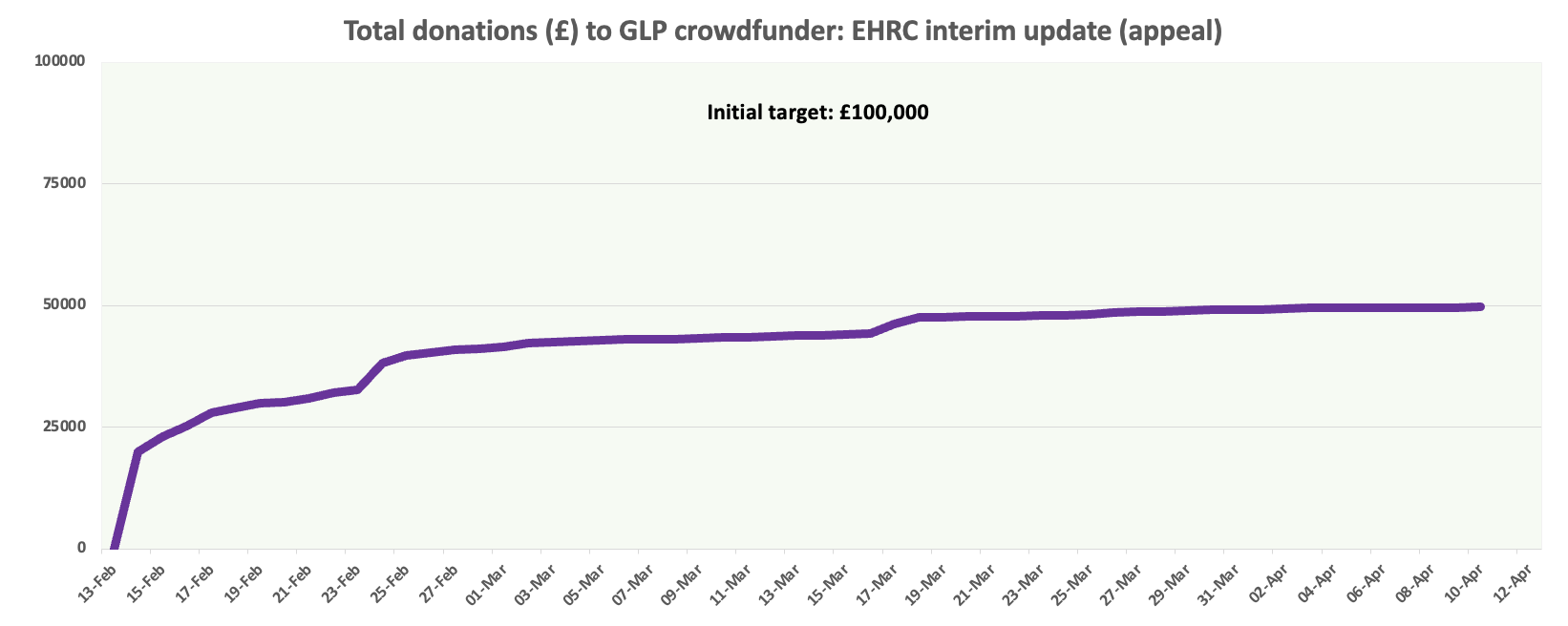
Needless to say (but associate professor Michael Foran of Oxford University has helpfully said it), that is actually fake news. Two months on, the Minister appears not to have sent the EHRC’s draft guidance back to be rewritten. And, despite – or because of – the above good/fake news, the GLP’s new crowdfunder has already raised almost £50,000. Should it go on to reach its (initial) target of £100,000, Maugham and the GLP will have mined a grand total of some £760,000 from a rich seam of seemingly surplus cash in the ‘trans community’ to fund their attempt to undo the Supreme Court’s April 2025 ruling. Yet, as you may recall, if the Supreme Court says it is the law, it is the law.
That £760,000, plus the some £535,000 blown on the earlier transgenderism-related cases, is an awful lot of money for nothing since November 2020, and one has to wonder how long the ‘trans community’ will continue to buy the false hope offered by Maugham and the GLP. As one member of that community is reported to have said on social media in February:
Maugham always pretends he’s had some sort of win even when he has unambiguously and comprehensively lost. He did the same with his Brexit cases. I’m fed up of this turd polisher claiming he does so much for us.

 Labour Pains