
Between 2000 and 2013, while working as employment policy officer at Citizens Advice, I researched and wrote a series of deadly boring policy reports arguing for a consolidation of the three main labour market enforcement bodies – the HMRC minimum wage enforcement team, the Employment Agency Standards Inspectorate, and the Gangmaster Licensing Authority – into a single enforcement body fit for the 21st century, with the legal powers and resources to “root out the rogues” without imposing unnecessary regulatory burden on the great majority of compliant employers.
In the reports – and in any number of shorter articles, submissions to parliamentary committees, campaign leaflets, and conference presentations – I noted that, all too often, vulnerable workers are too fearful of further victimisation or dismissal to issue an employment tribunal claim, the principal means of enforcing most statutory workplace rights. And, as a result, rogue employers can profit from exploitation with near impunity.
I suggested replacing this fragmented enforcement architecture with a “more joined-up system of advice, guidance and practical business support for small, low-profitability employers, and a more pro-active approach to compliance and, where necessary, enforcement” through a single enforcement body – or Fair Employment Agency.
From the outset, my proposal was firmly opposed by the Great Protector of workers’ rights, the TUC. Enforcing workers’ rights is a job for trade unions, not government, I was told. And union membership was now growing so rapidly that all workers would be unionised by the 26th century. Well, all workers in whatever remained of the public sector in the 26th century, anyway.
Whatever, we can now let bygones be bygones, because tomorrow the Fair Work Agency, provided for in the Starmer Government’s humongous Employment Rights Act 2025, finally comes into existence.
Matthew Taylor, who produced the 2017 Taylor Report on the gig economy and modern working practices for Theresa May’s ill-fated government, and served as the then government’s head of labour market enforcement between 2019 and 2021, returns as Chair of the new executive agency, and Lisa Penney joins him as CEO. Somewhat predictably, the usual suspects are not happy, but all long journeys begin with a single step and tomorrow is not just a step, but a giant leap for enforcement of workers’ rights. A quarter of a century ago, I shot for the moon, and now Matthew Taylor and Lisa Penney are in lunar orbit.
Needless to say, I have not had a ‘thank you’ telegram from the King, or even just an Easter Egg from employment rights minister Kate Dearden MP. The TUC will probably claim the Fair Work Agency was their idea. But I plan to spend tomorrow stuffing my face with chocolate while re-reading some of my old reports and blog posts, including this one, originally posted in August 2024:
Single Enforcement Body: Yes kids, we’re almost there!
Posted on August 21, 2024 by wonkypolicywonk
Almost three years ago, in December 2021, I concluded on this blog that, in terms of progress towards the creation of a single enforcement body for workplace rights – a reform I had first proposed 20 years earlier, when a lowly policy wonk at Citizens Advice – we were not nearly there yet, but we were over halfway.
At the 2019 general election, the Labour, Tory and Lib Dem manifestos had all pledged a consolidation of the existing, fragmented enforcement architecture into such a single enforcement body – you wait 18 years for a manifesto pledge to implement your great policy idea, and then three come along at once. A few weeks later, the new Tory Government’s first Queen’s Speech had duly included an Employment Bill to “strengthen workers’ ability to get redress for poor treatment by creating a new, single enforcement body”. And in June 2021 the Government had published a positive response to the high level consultation on the issue it had conducted in 2019 (in response to the 2017 recommendation on enforcement in the Taylor Review of Modern Working Practices).
Sadly, in 2022 we hit horrendous political traffic, followed by a long series of policy speed restrictions. And, given how things have since turned out, my December 2021 blog post should perhaps have made more than a passing reference to the fact that, in September that year, the Labour Party’s New Deal for Working People had pledged to “establish and properly fund a single enforcement body (SEB) to enforce workers’ rights”:
The new body will be given extensive powers to inspect workplaces and bring prosecutions and civil proceedings on workers’ behalf relating to health and safety, minimum wage, worker exploitation, and discriminatory practices.
Labour will ensure that there are enough inspectors employed in the system via the SEB so that they can undertake unannounced inspections and follow up on anonymous reports.
That final point about the number of inspectors is key. As Torsten Bell, until recently the chief executive of the super wonky Resolution Foundation and now the Labour MP for Swansea, notes in his super wonky new book, Great Britain? How we get our future back:
Labour market rules only mean something if they are enforced. Too often they are not.
Responsibility for enforcement is ludicrously spread across six different organisations, overseen by seven different government departments. Nor do the enforcement bodies have enough boots on the ground to be a meaningful deterrent for unscrupulous employers. The International Labour Organisation recommends countries should have one labour market inspector for every 10,000 workers. We manage less than a third of that benchmark – only 0.29, or one for every 34,500 workers.
This system puts the onus on workers themselves to protect their own rights, by going to an employment tribunal. But the workers most likely to have their rights infringed are also those those least likely to bring a case.
If we were remotely serious about labour market rules being enforced, then we would have a single enforcement body cracking down on problems such as bogus self-employment. [And] it should be adequately resourced, doubling the number of inspectors from 900 to 1,800 to present a credible threat to dishonest firms.
Amen to that, and I just wish Torsten had been around between 2000 and 2013, when I researched and wrote a deadly boring series of policy reports, articles and submissions to parliamentary committees, all arguing for “a more pro-active approach to compliance and enforcement” through a single enforcement body – or Fair Employment Agency – but was repeatedly thwarted by the Great Protector of workers’ rights, the TUC (which argued that enforcement is a job for trade unions, not government).
Whatever, in May this year Labour’s Plan to Make Work Pay updated the 2021 New Deal for Working People with a pledge that “Labour will deliver where the Conservatives have failed. We will finally establish a Single Enforcement Body to enforce workers’ rights, including strong powers to inspect workplaces and take action against exploitation.”
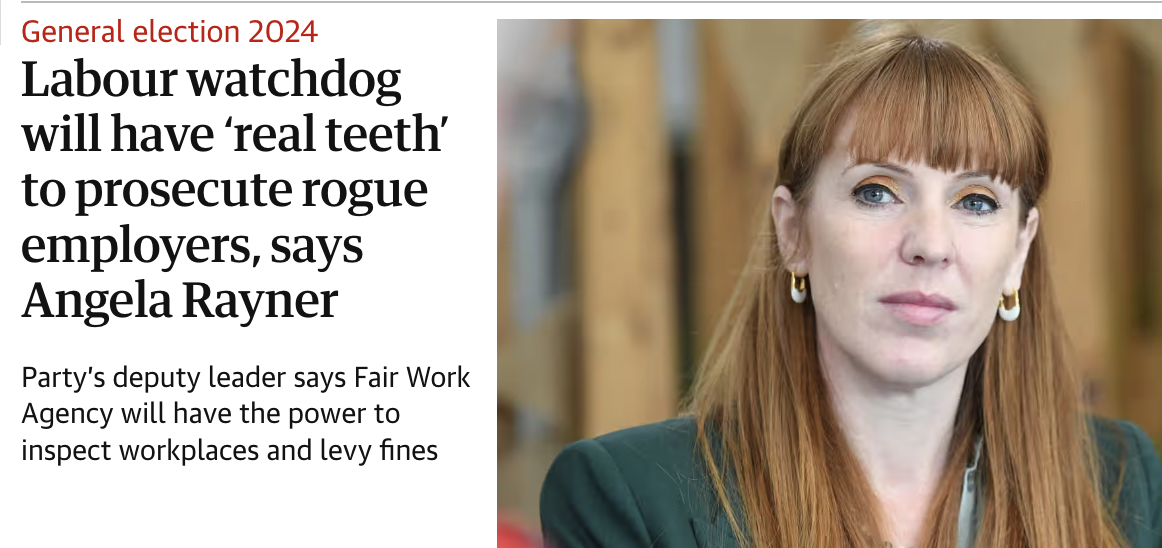
A few weeks later, Labour’s manifesto for the General Election included a pledge to “create a Single Enforcement Body to ensure employment rights are upheld”. And on 17 July, in the King’s Speech, the newly elected Labour Government set out its plan to bring forward an Employment Rights Bill to, among (many) other things, “establish a new Single Enforcement Body, also known as a Fair Work Agency, to strengthen enforcement of workplace rights”.
We’ve been here before, of course, and – given the (laudable) breadth and depth of the legislative programme set out in the King’s Speech, and the deplorable state of public finances – I am not counting any chickens. But I do think I can say, with a degree of confidence: yes, kids, it’s been a long, long journey, but we are nearly there.
Suffice to say, if and when we do finally get there, I have a (short) list of things I think should be included in the Fair Work Agency’s remit, such as enforcement of unpaid employment tribunal awards.
Yep, I wrote a series of boring reports on that issue, too.

 Labour Pains