
Note: this post was revised and updated on 10, 17 and 24 June, and again on 1 July, in light of relevant developments and new information
For several weeks now, there have been not one, not two, but three separate crowdfunders in support of proposed legal challenges to the draft updates to the Code of Practice for services, public functions and associations, issued for consultation by the Equality & Human Rights Commission on 20 May, in response to the landmark Supreme Court ruling of 16 April on the meaning of the words ‘woman’, ‘man’ and ‘sex’ in the Equality Act 2010.
The EHRC’s six-week consultation closed yesterday (30 June). So, how are the three legal challenges coming along?
Supreme court grifting, Part I
First up, naturally, was Jolyon ‘Angry Dad’ Maugham KC and his Good Law Project, who – having launched one lucrative crowdfunder in support of a new GLP Fighting Fund for Trans Rights within 24 hours of the Supreme Court ruling – launched a second, even more lucrative crowdfunder in support of a vaguely specified legal challenge to the ruling itself on 25 April. As Julie Burchill notes trenchantly in Spiked, “given the merest glimpse of a dead horse, from Remain to transvestites’ ‘rights’, [Jolyon Maugham] will rush to … start up a crowdfunder”.
The ‘challenge the Supreme Court ruling’ crowdfunder has to date raised a stonking £441,466 from some 10,900 pledges – considerably more than the £325,659 collectively raised by all ten crowdfunders launched by the GLP between 1 April 2024 and 31 March 2025. It is already the most lucrative GLP crowdfunder of all time, out of the 85 launched since March 2017.

As previously reported on this blog, I made a complaint to the Advertising Standards Authority about the crowdfunder on 1 May (ASA ref: A25-1920281), as I consider the crowdfunder text to be grossly misleading and manipulative. More to the point, it fails to provide potential donors with the material information they need to make an informed – as opposed to a purely emotional – decision to donate (and, if so, how much). To my mind, this is a clear breach of Rule 3.3 of the Non-Broadcast Code of Advertising Practice (the CAP Code) produced by the Committee of Advertising Practice, the sibling organisation of the ASA. Crowdfunders are covered by the CAP Code.
In any event, the legal challenge that the GLP has ended up proposing – in their 32-page pre-action protocol letter before action, sent to the EHRC on 16 May and published on the GLP’s website, but not added as an update to the crowdfunder text – is not the legal challenge to the Supreme Court ruling suggested in the crowdfunder text and title. Rather, it is to the EHRC’s interim update of 25 April, and to the EHRC’s interpretation of the Supreme Court ruling that underpins both that (now somewhat irrelevant) interim update, and the draft revised Code of Practice published on 20 May. However, if those parts of the legal challenge are dismissed, the GLP will then ask for a ‘declaration of incompatibility’ with Article 8 and/or Article 14 of the European Convention on Human Rights.
According to a recent blog by Ian Dunt – the “most-read columnist at the award-winning i newspaper” – the GLP’s letter before action is “tightly argued, literate, thorough and forensic. It has the kind of unmistakable legal swagger you see when an author is feeling very confident about their position.” However, Dunt appears to be unaware of – or to have deliberately overlooked – the legal swagger with which Maugham and the GLP have fired off so many letters before action, only to either fold or get one hell of a beating in court. Indeed, it is now almost two years since the GLP last launched a crowdfunder that concluded with a win in court. As Maugham himself said recently, “it is very foolish to be overconfident about these things”.
In contrast, the senior barrister Aidan O’Neill KC, who represented For Women Scotland in the Supreme Court, and who probably knows a tad more about ‘legal swagger’ than Ian Dunt, says that Maugham and the GLP are giving trans-identifying people “false hope” by pursuing a legal challenge with no realistic chance of success. You pays your money and you takes your choice.
In their letter before action, the GLP arrogantly demanded a response from the EHRC by 23 May, which is one week shorter than the usual 14-day timeframe set out in the pre-action protocol. But on 20 May, the EHRC responded by requesting an extension of the normal deadline, from 30 May to 20 June. This led the nothing if not excitable Maugham and GLP to claim that “the wheels are falling off the false EHRC guidance”. And, in a video posted on social media on 21 May, a combative but evidently somewhat stressed Maugham told supporters to “watch this space”.
On 6 June, the GLP announced that they had now filed their claim in the High Court. However, they have not yet published this court claim, despite Maugham stating on social media on 7 June that “it will be” published. Then, on 17 June, in a news article published on their website and headed “EHRC backs down on single-sex toilets”, the GLP published the EHRC’s formal response, dated 13 June, to the GLP’s letter before action of 16 May.

Needless to say, there has been no ‘rowing back’, ‘conceding’ or ‘backing down’ by the EHRC, on toilets or anything else. If they had ‘backed down’ on what they said (and still say) on single-sex toilets in their Interim Update of 25 April, they would have amended the wording of the Interim Update accordingly – otherwise, they’d be cruising for a bruising if/when the case reaches court. But they haven’t amended it. They’ve simply explained it to Maugham, the GLP and the law firm Leigh Day, who now appear to be acting for the GLP. In reality, the EHRC’s response robustly dismisses each of the three grounds set out in the GLP’s letter before action that are directed to the EHRC, as “misconceived” (Ground 1), “an unsustainable allegation, improperly made” (Ground 2), and “adding nothing” (Ground 4) respectively.
A fourth ground – (Ground 3), the ‘declaration of incompatibility’ with the European Convention on Human Rights – is directed not to the EHRC, but to the Minister for Women & Equalities, Bridget Phillipson MP. However, there is no indication from the GLP whether they have yet received a formal response from the Minister. And there is no indication from the GLP of when they expect the High Court to make a decision on permission.
So, we continue to ‘watch this space’, and to stockpile popcorn.
Supreme court grifting, Part II
Next to take up arms against the EHRC was the “trans-led advocacy and human rights organisation” TransLucent, which on 13 May launched a crowdjustice crowdfunder in support of vaguely specified legal action aimed at forcing the EHRC to “withdraw the existing interim update, and [establish] a FULL and proper, twelve-week consultation”, as well as ensuring “a full, proper and independent review of the consultation responses before any new or amended [EHRC] guidance is published”.
The crowdfunder has so far raised just £10,855 from 248 donors (an average donation of £43.77). This is some way short of the current target of £60,000, and the crowdfunder text indicates that, ultimately, TransLucent might need to raise as much as £100,000 to pursue the proposed legal action in court.
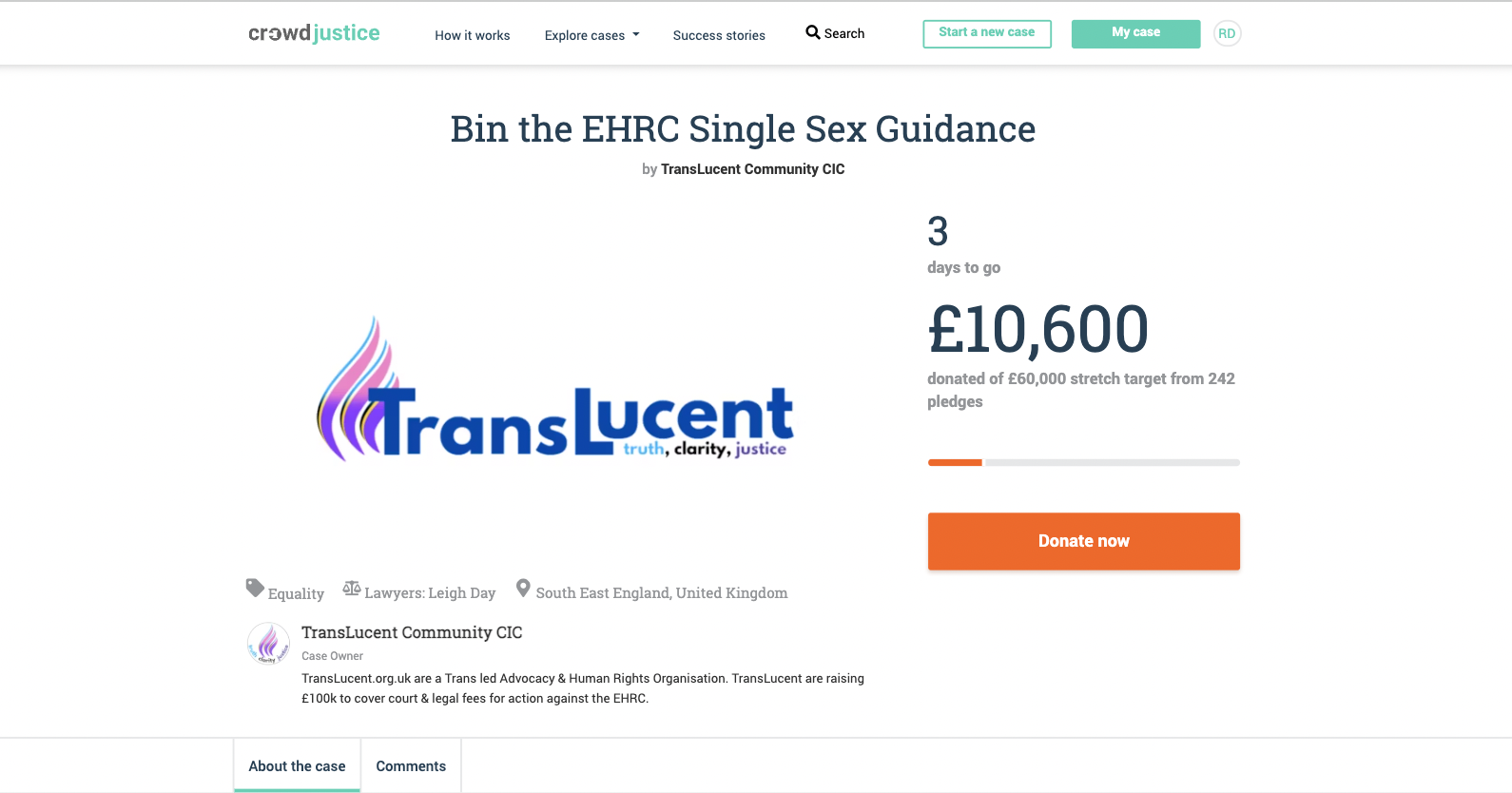
According to the crowdfunder text, TransLucent’s lawyers – the law firm Leigh Day – sent “a legal letter” to the EHRC on 12 May. And, on social media on 28 May, Translucent confirmed that Leigh Day had received the EHRC’s response, and that “we are now consulting with them and our KCs”. However, it is entirely unclear whether this ‘legal letter’ was a pre-action protocol letter before action, or just a letter. In a news article on their own website, Leigh Day refer only to “a letter sent to the regulator”.
TransLucent have not published either Leigh Day’s letter of 13 May, or the EHRC’s response, and there has been no update since 28 May, despite the dismissal by the High Court on 6 June of Liberty’s similar legal challenge (see below). They have not named the KCs advising them, and have not given any indication of the proposed legal challenge’s prospects of success. Accordingly, potential donors to the crowdfunder have not been provided with the material information they need to make an informed decision about whether to donate (and, if so, how much).
So, to my mind, the TransLucent crowdfunder is in breach of Rule 3.3 of the CAP Code, and I have made a compliant to the Advertising Standards Authority (ASA ref: A25-1296571). Furthermore, as the law firm Leigh Day is clearly complicit in what has become an exercise in obtaining money by deception, I have made a complaint to the Solicitors Regulation Authority.
Supreme court grifting, Part III
Perhaps feeling a bit left out, on 30 May the civil liberties advocacy group Liberty announced the launch of a crowdjustice crowdfunder in support of vaguely specified legal action against the EHRC “over their failure to carry out a fair consultation on changes to their Code of Practice following [the] Supreme Court decision” of 16 April.

It was unclear from the crowdfunder text whether Liberty had already issued a claim in the High Court, or had simply sent a letter before action to the EHRC. According to a news report, Liberty “sent a pre-action letter to the EHRC earlier this week [sic] and have now submitted legal papers to the High Court”, while Liberty’s own news article states “we have taken legal action because the consultation period set out by the EHRC is unlawful” and “a High Court judge will now decide how quickly the case should be dealt with and whether it will go ahead to a hearing”. On social media and by email, I asked Liberty to clarify, but I have not had any response.
However, on 6 June, Jolyon Maugham posted on social media that Liberty had just been refused permission by the High Court. At that point, Liberty’s crowdfunder stood at £13,274 from 508 donations. Later that day, the EHRC confirmed that Liberty had been refused permission, and on 9 June the Administrative Court blog reported the judge’s reasons for refusing permission. But it was only later on 9 June that Liberty themselves announced – in a perfunctory, 41-word update to the crowdfunder text – that they had been refused permission and will attempt to appeal in the Court of Appeal.
On 18 June, in another perfunctory update to the crowdfunder text, Liberty announced they have secured an appeal hearing in the Court of Appeal “in the week commencing 23 June” – that is, in the final week of the six-week consultation. The appeal was subsequently set for 26 June.
On 26 June, in a unanimous decision, the Court of Appeal refused Liberty permission to appeal the High Court’s ruling of 6 June, and ordered Liberty to pay costs of £20,000 to the EHRC. During the hearing it emerged that the EHRC has already received more than 12,000 responses to the consultation. In a statement, the EHRC welcomed the ruling, and on 27 June Liberty finally closed their crowdfunder, which by then had raised £20,638 from 808 pledges.
Liberty have not at any stage published their letter before action to the EHRC, or the EHRC’s response, or the written judgment of the High Court refusing permission, or their appeal to the Court of Appeal. They have not published details of their legal team, and have not at any point given any indication of the legal challenge’s (and now their appeal’s) prospects of success. So, once again, potential donors to the crowdfunder were not provided with the material information they needed to make an informed decision about whether to donate (and, if so, how much). Accordingly, I have made a complaint about the crowdfunder to the Advertising Standards Authority (ASA ref: A25-1296348).
What might all this supreme grifting achieve?
Between the three crowdfunders in support of legal action against the EHRC, the Good Law Project, TransLucent and Liberty have already grifted a total of more than £467,000 from the trans community (and its allies). And, were all three crowdfunders to reach their current target, that sum would rise to £585,000. Yet it is hard to see any of the proposed legal challenges achieving anything hugely significant.
Until the High Court refused them permission on 6 June, I thought Liberty probably had the best chance of a legal win in court, as they were not actually asking for very much: should a court rule in Liberty’s favour, the EHRC would simply have to extend the consultation on its draft Code of Practice by six weeks (i.e. move the deadline from 30 June, to mid-August). However, beyond some embarrassment (and minor administrative inconvenience) for the EHRC, that would be something of a hollow victory, as nothing significant would be achieved. The EHRC could keep the consultation open for six months, but that wouldn’t significantly alter the outcome – the Supreme Court has said what the law is (and has been since 2010), and that is not going to change.
This did not go unnoticed by some Liberty supporters and trans activists. One noted on social media: “Can you tell us what you hope to achieve with this action? A longer bogus consultation just enhances its legitimacy. Good Law Project’s action is aimed at defending our rights. I can’t see what the purpose of this is.”
Whatever, as noted above, on 26 June the Court of Appeal refused Liberty permission to appeal. So their legal challenge is now as dead as the parrot in that Monty Python sketch. And its sole achievement was to transfer £20,000 of the £20,638 raised by their now closed crowdfunder to the barristers and solicitors that the EHRC had to hire to defend it.
Accordingly, I also thought, initially, that TransLucent might also have some chance of being able to claim at least a partial legal victory (on the 12 weeks point). However, with the High Court [and now also the Court of Appeal] having refused Liberty permission on that point, that now seems most unlikely. And I really can’t see any High Court judge granting TransLucent’s wish for a “a full, proper and independent review of the consultation responses before any new or amended [EHRC] guidance is published”. Apart from anything else, that would amount to judges making policy and, according to no less a legal authority than Jolyon ‘Angry Dad’ Maugham himself, that is not their job.
As noted above, TransLucent have gone very quiet since they received the EHRC’s response to Leigh Day’s letter on 27 or 28 May, and their crowdfunder has been moribund since early June (over the past two weeks, it has received just two donations). So it is increasingly hard to believe that this proposed challenge will ever reach court.
Which leaves just the proposed challenge by Jolyon Maugham and the GLP. And today we learnt that there is a permission hearing scheduled for the w/c 28 July.
I’m a policy wonk, not a lawyer, but – in light of the judge’s reasons for refusing Liberty permission on the 12-week point, the generally supportive response to the EHRC consultation of Michael Foran, incoming associate professor of law at Oxford University, and the robustness of the EHRC’s formal response to the GLP’s letter before action – I find it very hard to see a High Court judge agreeing to blow up the entire EHRC consultation process, some weeks after it has concluded. Indeed, the GLP’s failure to publish the filed claim suggests to me that they might even have dropped Grounds 1, 2 and 4, to concentrate on seeking a ‘declaration of incompatibility’ (Ground 3).
Whatever, I find it even harder to see a High Court judge effectively overturning a unanimous decision of the Supreme Court by issuing a declaration that the Article 8 ECHR right to a private life includes the right to access single-sex spaces reserved for the opposite (biological) sex.
Maugham and others – such as the trans-identifying barrister Robin Moira White and former judge Victoria ‘Strasbourg’ McCloud – appear to have convinced themselves that the Supreme Court somehow overlooked the European Convention on Human Rights. But, as Michael Foran and others have previously explained, that argument has more holes than a block of Emmental. And, in any case, such ‘declarations of incompatibility’ are not binding on Parliament.
So, even if – and at this stage that’s an enormous ‘if’ – Maugham and the GLP were to ‘win’ such a declaration in court, that wouldn’t necessarily make any difference: there is no evidence of any appetite among ministers for the Government to legislate to nullify the Supreme Court ruling. On the contrary, as Joan Smith noted earlier this month, the Government’s unexpected announcement of Dr Mary-Ann Stevenson as ministers’ preferred candidate to replace Baroness Falkner as Chair of the EHRC in the autumn suggests that “Keir Starmer has quietly come to the conclusion that Labour’s long history of trying to please trans organisations is no longer tenable”:
Starmer must have anticipated — and prepared for — the reaction to Stephenson’s appointment. Perhaps he’s finally realised he has to choose between offending zealots in the parliamentary party and the general public, who’ve had enough of rainbow flags and ‘gender-neutral’ facilities.
Not that the failure of all three proposed legal challenges would be the end of the matter, of course. As Lara Brown notes in the current issue of the Spectator, for transgender ideologues like Maugham, “defeat is merely a fundraising opportunity”.
Who knew that the most marginalised and disadvantaged community on the planet had so much spare cash to throw away on half-baked, performative lawfare?


 Labour Pains
Pingback: Taking liberties (and cash): the Supreme Court lawfare of TransLucent, Liberty and the Good Law Project | Labour Pains