
With the industrial-scale grifting of Jolyon Maugham KC and his Good Law Project in the doldrums – only one of the 12 crowdfunders launched by the GLP last year raised more than £40,000 – they must have looked on with growing envy last week as a crowdfunder launched by the Women Against State Pension Inequality (WASPI) campaign reached its initial target of £75,000 in just a few hours, before going on to reach two-thirds of its revised target of £180,000 (!) by the weekend.
However, while the crowdfunder is headlined “Help us fight on for justice for WASPI women”, it is entirely unclear from the crowdfunder text what ‘justice for WASPI women’ would actually look like, given recent events (which I’ll come to shortly). So it is equally unclear what, if anything, the some 7,500 people – overwhelmingly women – who’ve donated an average of £17.40 each might eventually get for their money. Which seems a tad, well, unjust.
Launched in 2015, the ten-year WASPI campaign appeared to have reached the end of the road in December, when – despite senior figures such as Keir Starmer, Rachel Reeves and Liz Kendall having backed the campaign when in opposition – the new Labour Government rejected the key recommendation of a March 2024 report by the Parliamentary & Health Service Ombudsman (PHSO) on whether incremental changes in the state pension age, introduced by the Pensions Act 1995 and accelerated by the Pensions Act 2011, were adequately communicated to the 3.5 million affected women.
The Ombudsman’s six-year investigation had concluded that maladministration on the part of the DWP resulted in some 1950s-born women being denied an adequate opportunity to make informed choices about their retirement, but that this did not result in the women suffering direct financial loss. And, significantly, it recognised that the immense cost and administrative burden of assessing up to 3.5 million women’s individual circumstances and, accordingly, the level of injustice done to them by the DWP’s maladministration necessitates a more standardised approach.
Accordingly, the Ombudsman recommended that the Government pay flat-rate compensation – at Level 4 (£1,000 to £2,950) of the Ombudsman’s severity of injustice scale – to each and every one of the 3.5 million 1950s-born women affected by the state pension changes (that is, including those – perhaps the great majority – who were not in any way affected by the DWP’s maladministration, perhaps because they were perfectly aware of the state pension changes from the DWP’s general communication efforts from the mid-1990s onwards).
In its 62-page December 2024 response, the Government accepted that there had been (some) maladministration in communicating the state pension changes, for which it apologised, but rejected the Ombudsman’s recommendation on compensation:
The [Ombudsman’s] report itself acknowledges that assessing the individual circumstances of 3.5 million women born in the 1950s would have a significant cost and administrative burden. For the DWP to set up a scheme and invite 3.5 million women to set out their detailed personal circumstances would take thousands of staff years to process.
The alternative put forward in the report is for a flat-rate compensation scheme, at Level 4 of the Ombudsman’s injustice scale. This would provide £1,000 to £2,950 per person, at a total cost between £3.5 and £10.5 billion.
Given the great majority of women knew that the state pension age was increasing, the Government does not believe paying a flat-rate to all women – at a cost of up to £10.5 billion – would be a fair or proportionate use of taxpayers’ money.
While welcoming the Government’s apology, the Ombudsman has described the decision on compensation as “disappointing”. But in March 2024 the Institute for Government presciently suggested that the Ombudsman’s recommendation on compensation “risks satisfying no one – at considerable cost”:
[The] recommendation for compensation of £1,000–£2,950 comes nowhere close to what those who think they were cheated out of pensions wanted [but] still comes with a price tag in the billions – because the recommendation seems to be to compensate the entire affected cohort, even those who were perfectly well aware of the changes.
This blog post is not about the merits of the WASPI campaign per se (or, indeed, those of the Ombudsman’s report or the Government’s December 2024 decision). But I do think it’s pertinent that, as barrister Barbara Rich has explained, the ultimate goal of the campaign has never been entirely clear: is it full (or partial) restitution of the state pension payments on which 1950s-born women inevitably ‘missed out’ as a result of the (entirely lawful) equalisation of the state pension age? Or is it simply some degree of (financial) compensation for the DWP’s maladministration in the communication of that equalisation? And, if it’s the latter, what level of financial compensation?
Whatever, as Barbara Rich also explains, full (or even just partial) restitution has not been an option for some years now (if indeed it ever was): an unsuccessful legal challenge brought by a break-away group of WASPI women (Backto60) in 2019 confirmed there is simply no legal basis for it. Which means no government can ever be forced to cough up the tens of billions of pounds that it would cost.
And, realistically, neither this nor any future government is going to commit “thousands of staff years” to processing up to 3.5 million claims for individually-tailored compensation, or pay out up to £10.5 billion of flat-rate compensation of up to £2,950 to each of 3.5 million women (a level of compensation which, it is important to note, the WASPI campaign has told MPs it considers to be “on the low side”).
In short, it is now beyond doubt that this is simply not a winnable campaign. Life is imperfect, sometimes unfair. But the past cannot be undone, and there really is no money tree. Like most political careers, some political campaigns simply end in failure. At that point, everyone just has to move on.
So, what is the point of crowdfunding a stonking £180,000 – possibly more – from women “fuelled by anger” for a legal challenge to the Government’s December 2024 decision on compensation?

As the crowdfunder text itself states, even if the proposed legal challenge were to be successful in court – a very big ‘if’ – that would still not require the Government to pay the compensation recommended by the Ombudsman (let alone anything ‘better’ than that). The Government’s December 2024 decision would be quashed, but the Government would only be required to make the decision again. And, as already noted, with £10.5 billion or more at stake, we can be sure that, in substance, the new decision would be exactly the same as that made in December 2024.
Sure, the WASPI campaign could then start crowdfunding for another legal challenge. But such attritional lawfare could cycle on for years. And all for as little as £1,000 of compensation for each WASPI woman. Would the WASPI campaign’s crowdfunders keep hitting their eye-wateringly high targets? Maybe they would, maybe they wouldn’t.
Either way, it seems to me that the only people who really stand to benefit from the currently proposed legal challenge – for which, as I write, 7,445 people fuelled by anger have donated a total of £129,407 – are the lawyers in the WASPI campaign’s legal team at law firm Bindmans.
Which is fine – lawyers have to eat and pay the rent/mortgage, just like everyone else. But I really can’t see how that delivers ‘justice for WASPI women’.
Moreover, the grim political reality I have set out above is simply not spelled out to potential donors in the WASPI campaign’s crowdfunder text (including two updates added on 24 February, and a third update added earlier today). Which means those 7,445 donors have not been given all the material information they need to make an informed decision about whether to donate, and if so how much. (Furthermore, the first 4,175 of those donors, who got the crowdfunder to its initial £75K target by donating an average of just under £18 each, were not given sight of Bindmans’ pre-action protocol letter before claim, setting out the details of the proposed legal challenge, as that was only added after the £75K target had been met. Nor were they told that the actual target was £180K, not £75K.)
Which is pretty ironic, when you think about it.
Anyway, time will tell, and I’ll be following progress of the legal challenge and posting updates below, or in new blog posts. First up, it is going to be interesting to see how the Government responds to Bindmans’ letter before claim – the Government’s lawyers should respond by Monday 10 March – and also whether the WASPI campaign publish that response in a further update to the crowdfunder text.
Apart from the merits of the proposed judicial review claim, the Government may well argue that the WASPI campaign represents too few of the 3.5 million 1950s-born women to have standing – in the letter before claim, Bindmans identify the proposed claimant as the WASPI campaign, which is a private limited company, not one or more individual WASPI women. And the 7,445 donors to the crowdfunder represent just 0.2% of the 3.5 million women affected by the pension age changes.
Update, 17 March:
On 11 March, in another update to the crowdfunder (Update 4), the WASPI campaign confirmed that Bindmans had, the previous day, received the Government Legal Department’s response to Bindmans’ letter before claim of 23 February. But, indicating that the GLD/DWP have “refused to agree” to the WASPI campaign publishing the response, the update states: “we cannot publish, give details of, or comment on that response at this stage. What we can say is that the DWP’s position is unchanged.” And a further update to the crowdfunder (Update 5), posted later the same day, states:
Our lawyers will be issuing our legal claim this week seeking judicial review of the Government’s decision [to reject the Ombudsman’s recommendation on compensation].
However, the weekend came and went without any indication from the WASPI campaign that their claim has been issued in the High Court. And, by this morning, the crowdfunder stood at £156,189 from 9,192 donations (an average donation of £16.99).
So, three weeks on from the launch of the 900-word crowdfunder, and despite the addition of five updates with a combined content of more than 4,000 words, there is still no clarity about what the WASPI campaign hopes to achieve by bringing the costly legal challenge, other than being able to assert that “WASPI women do not give up”.
On social media, the WASPI campaign has not responded to any of my repeated requests for clarification of what ‘justice for WASPI women’ might look like, should the proposed legal challenge succeed. Ultimately, however, there is only one possible successful outcome to this legal challenge: the Government is forced to take the decision again, and its new decision is to (reluctantly) accept the Ombudsman’s March 2024 recommendation, and pay compensation of between £1,000 and £2,950 to each WASPI woman.
The proposed legal challenge simply cannot lead to any other ‘successful’ outcome – either the legal challenge fails, leaving WASPI women exactly where they are now, or it eventually results in the payment of a maximum of £2,950 of compensation to each WASPI woman. For it is simply inconceivable that, forced to make its December 2024 decision again, the Government would decide to pay more (or ‘better’) compensation than that recommended by the Ombudsman.
Yet that reality is not even intimated – let alone made clear – in the original crowdfunder text or the five updates. Indeed, among the combined word-count of some 5,000 words, there is only one, brief reference to the level of compensation recommended by the Ombudsman: a single, unadorned sentence buried in the 2,000-word Update 2.

Which begs the question: how many of the some 9,000 donors to the crowdfunder appreciate that, in the unlikely event that the the Government is eventually forced, by this or a potentially further legal challenge, to implement the Ombudman’s recommendation, the compensation paid to each WASPI woman would be no more than £2,950?
For example, it seems unlikely that this reality is understood by Sally Dawn, who on Friday made her third donation to the crowdfunder. Or by Linda, who yesterday made her second donation because “we aren’t going away”. Which begs a further question: how is this crowdfunding different to the criminal offence of obtaining money by deception?

Later today, MPs will debate the Ombudsman’s March 2024 report and recommendations, and the Government’s 2024 decision, in a Westminster Hall debate organised by the Petitions Committee, in response to a 159,500-signature e-petition. But somehow I doubt this will bring any more clarity on what ‘justice for WASPI women’ might actually look like, should the WASPI campaign’s crowdfunded legal challenge succeed.
Update, 24 March:
As expected, the Petitions Committee-organised Westminster Hall debate on 17 March added nothing to our understanding of what the WASPI campaign actually want the Government to do, despite 28 MPs (13 Labour, nine Lib Dem, two Conservative, four Other) making a speech, and another 16 MPs making a short intervention.
Of these 44 MPs, only one – Petitions Committee member Dr Roz Savage, who led the debate – mentioned the £2,950 maximum compensation figure recommended by the Ombudsman, and even then only in passing. Instead, just like the WASPI campaign, the MPs tended to rely on empty platitudes such as “fairness and justice”, and “fair and equitable” or “fair and just” compensation. However, in his response at the conclusion of the debate, the Treasury and DWP minister – Torsten Bell, formerly head of the Resolution Foundation – noted that the Government had considered and rejected alternatives to the flat-rate compensation recommended by the Ombudsman:
We considered a range of compensation options for women who lost opportunities as a result of the delay in sending letters. For example, we considered rules-based schemes, such as that which the Work and Pensions Committee suggested, and we also considered the possibility of paying limited compensation to a smaller group of women—for example, those on pension credit.
However, many of those schemes would mean compensating women who were aware that the state pension age was increasing. Payments would not relate directly to the injustice in question but to benefit entitlement or the timeline for the policy change. Paying a flat rate to all 3.5 million women, regardless of whether they suffered injustice, would be neither fair nor proportionate. It would also not be affordable, as such compensation schemes would cost up to £10.5 billion. [But] the Government’s decision was not driven purely by cost.
Also on 17 March, the WASPI campaign added a sixth update to their crowdfunder text, confirming that Bindmans had filed the court claim, and that “we will publish our [Grounds of Claim] in full by the end of the week”. As of today, the crowdfunder has raised a total of £172,191 from 10,273 donations.
Update, 4 April
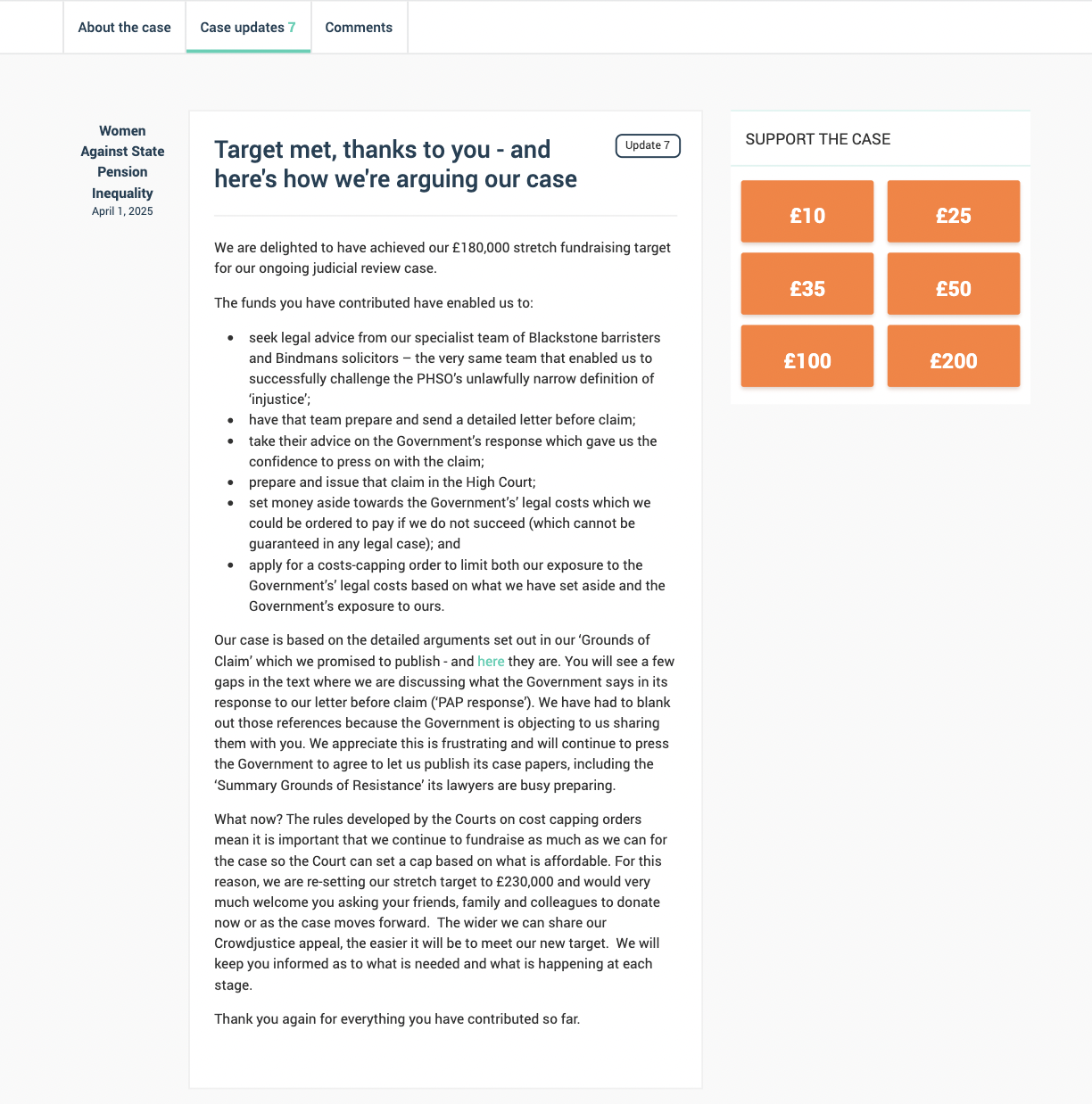
The crowdfunder reached its £180K target on 31 March, when the target was promptly raised to £230K. And, the following day, the WASPI campaign added a seventh update, with a link to the Grounds of Claim. The crowdfunder currently stands at £182,368 from 10,950 donations (an average donation of £16.65).
Update, 23 April
On 16 April, in a tenth update to the crowdfunder text, the WASPI campaign published the Government’s 29-page Summary Grounds of Resistance to the claim. As expected, the Government rejects all the grounds of the claim, argues that permission to apply for judicial review should be refused by the Court, and contests the WASPI campaign’s application for a costs capping order.
We now await the Court’s decision on permission. Today, the crowdfunder stands at £187,025.
Update, 9 July
On 5 June, the High Court granted permission to proceed to a full hearing. And, on 22 June, in a further update to the crowdfunder text (Update 13), the WASPI campaign announced that they had successfully negotiated, and the High Court had confirmed, a costs cap of £60,000, which is £40,000 higher than they had been hoping for. Accordingly, the crowdfunder’s target was increased by £40,000, to £270,000.
On 3 July, at the conclusion of a House of Commons debate on the issue, the DWP minister Torsten Bell confirmed that the Government has not changed its position.
As of 9 July, the crowdfunder stands at £229,752 from 13,878 pledges. We now await a hearing date.

 Labour Pains
There was never any justification to the WASPI campaign from the outset, the Government having decided in the early 1990s to equalise the retirement age. Even I, a man, knew about it at the time, especially since my wife was one of those affected.
However, there is a political problem, and it is that Labour in Opposition shamefully and shamelessly exploited the WASPI women and led them to believe that once in government, they would address the claims on their behalf. This is the nub of the issue: Labour politicians led the WASPI women up the garden path, to grub for their votes. Therefore, I propose that the Labour Party itself ‘compensates’ the WASPI women out of its own funds!
Good luck with that, Richard! It is, as you say, a political problem for ministers. But when in opposition they backed all sorts of campaigns and made all sorts of promises, many of which have already been abandoned. And, to my mind, this is one of their smaller reverse ferrets.
The WASPI campaign goes from strength to strength. There is another, diversive minority fringe group CEDAWinLAW or Backto60 as they used to be called. They’ve been spending most of their time bad mouthing WASPI due to their complete failure in their group being able to achieve anything for 50sWomen
Neither the WASPI campaign nor the CEDWinLAW/Backto60 group have achieved anything for 1950s-born women. And the chances are you never will – not least because you are not clear about what it is you actually want. What would ‘justice for WASPI women’ actually look like?
“Justice for WASPI women” makes more sense when you realise that “justice” nowadays, for a lot of people, just means “getting what I want”. And no more than that.