
While we await the return of MPs to Westminster to begin work on the new Labour Government’s ambitious legislative programme, including what is set to be a truly humungous Employment Rights Bill, the (very) clever policy wonks at the Resolution Foundation have been trying – and failing – to work out how one of the promised key measures in that Bill might actually work.
Last week, the Foundation’s principal economist, Nye Cominetti, posted on X/Twitter:
Labour plan to give workers on zero-hours contracts a right to a contract with hours reflecting the hours they regularly work (assessed across 12 weeks). Sounds simple, but I’m struggling to guess how this will work in practice. Big questions:
Are ‘regular’ hours the average observed, or the minimum? Will weeks where no work happened be included, or does that disqualify? Will workers have a right to these hours in all weeks, or on average only? Will it still be possible for a worker to have a zero hours week? This matters.
And I would suggest that, if you are a new Labour minister, and even the Resolution Foundation cannot see how your shiny new policy would actually work in practice, then you have a problem.

Part of the problem is that the near-totemic pledge to ‘ban zero-hours contracts’ has mutated somewhat since Labour’s September 2021 New Deal for Working People, in which the ‘right to a contract with hours reflecting the hours they regularly work (assessed across 12 weeks)’ was presented as quite separate to a ban on zero-hours contracts:
Labour will ban zero hours contracts and contracts without a minimum number of guaranteed hours. We will also [sic] ensure anyone working regular hours for twelve weeks or more will gain a right to a regular contract to reflect those hours normally worked.
As I’ve noted elsewhere, by February this year shadow ministers had qualified the proposed ban, limiting it to exploitative zero-hours contracts, without explaining how they plan to distinguish between exploitative and non-exploitative contracts. And, as noted on this blog, in March it emerged from a speech by shadow chancellor Rachel Reeves that the separate right to a regular contract where regular hours have been worked for 12 weeks had now transmogrified into the means by which shadow ministers planned to accomplish the ban. During the General Election campaign, this was explained in a video posted on X/Twitter by Justin Madders, now a business minister:
There’s over a million people on zero-hours contracts. Many of them don’t want to be on them. They don’t know how many hours they will get to work from one week to the next. How can they plan their lives? How can they be sure they can pay the bills or even put food on the table, if they don’t know how many hours they’re going to work?
So we’re going to change the law, so that after 12 weeks in employment, you will be legally entitled to a minimum number of hours each week, based on what you’ve actually done in the previous 12 weeks. That will get rid of the insecurity of zero-hours contracts, give people certainty and a base to work on, and actually make sure that we have a fair workplace for all under Labour’s New Deal for Working People.
However, as I noted in April, this would not amount to a ban on (exploitative) zero-hours contracts, and would most likely benefit only a very small proportion of the some 1.1 million workers currently on a zero-hours contract:
All that is actually on the table is a new right to seek a bit more ‘security’, but only for those workers who already have the rather significant security, in this context, of working regular (and therefore predictable) hours over a sustained period. And, realistically, a great many of those workers will be content enough with that working arrangement to not want to exercise the new right.
But there is no such protection for those who need it most – the far greater number of workers who are being exploited by being given only irregular and unpredictable hours by a rogue employer.
To fully understand why this switcheroo had employment policy wonks like me staring at our screens in disbelief, it’s worth looking back at the origin of the proposed ‘right to a contract that reflects the hours regularly worked’. This was one of several recommendations in an October 2018 report by the Low Pay Commission on ‘one-sided flexibility’, which the Government had requested from the Commission in February 2018 in response to the Taylor Review of Modern Working Practices.
In 2017, while calling for “significant changes to our labour market”, the Taylor Review had concluded that “to ban zero-hours contracts in their totality would negatively impact many more people than it helped.” Indeed, the Taylor Review cited Labour Force Survey evidence that two-thirds of those on zero-hours contracts do not want to work more hours. Which would suggest they are not totally unhappy. Instead, the Taylor Review recommended that “the Government should ask the Low Pay Commission to consider the design and impacts of the introduction of a higher National Minimum Wage rate for hours that are not guaranteed as part of the contract”.
However, in its October 2018 report, the Low Pay Commission rejected the Taylor Review’s proposal of a higher minimum wage rate for any hours that are not guaranteed, and recommended “an alternative package of measures”, including: a right to switch to a contract which reflects your normal hours (over a defined reference period); a right to reasonable notice of work schedule; and compensation for shift cancellation or curtailment without reasonable notice.
Not only were these proposed measures not specifically aimed at workers on zero-hours contracts, but the Low Pay Commission joined the Taylor Review in explicitly rejecting the idea of a ‘ban’ on such contracts, confining the issue to an Appendix to the report.
Furthermore, as Nye Cominetti and his fellow wonks at the Resolution Foundation have been finding, the Low Pay Commission left unanswered a number of questions about how the proposed ‘right to a contract that reflects the hours regularly worked’ might work in practice, including how long the reference and qualifying periods should be (Labour appear to have got their 12-week reference period from the trade union USDAW), and how it might be enforced. And with good reason: the most vulnerable workers are those least likely to risk their job by taking their employer to a tribunal.
In short, Labour ministers such as Angela Rayner and Justin Madders appear to have realised, somewhat belatedly, that the ban on exploitative zero-hours that they have repeatedly promised to voters is neither practicable nor desirable. And, to cover their retreat, they have grasped at the similarly promised but quite separate ‘right to a contract that reflects the hours regularly worked’, to use as a political fig leaf.
Which is fine. That’s the kind of thing politicians do. But if Rayner and Madders genuinely think this will “get rid of the insecurity of zero-hours contracts”, they are deluded.
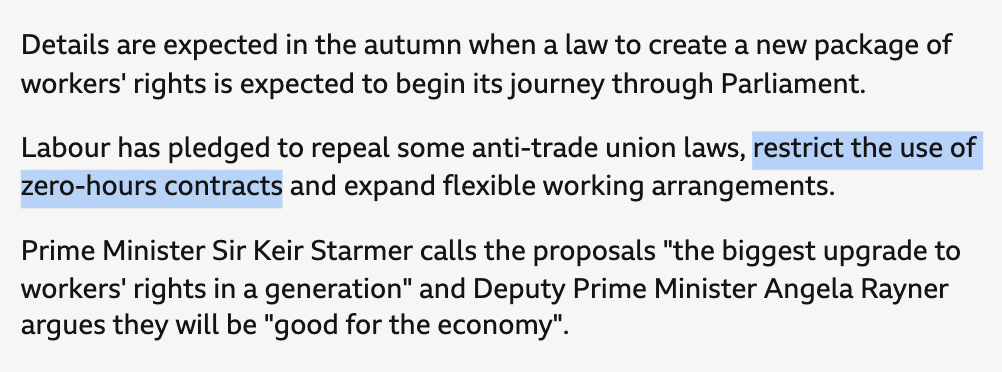
[Update, 30 August: It may or may not be significant that a BBC news report today, about the flexible working provisions of the coming Employment Rights Bill, refers to Labour having pledged to “restrict the use of zero-hours contracts”. If this is based on what the Department for Business & Trade briefed to the journalist, then this could be the first sign of a retreat from use of the B-word.]

 Labour Pains