
As previously reported on this blog, on 5 June, having already crowdfunded more than £20,000 in May for legal advice on challenging NHS correspondence with parents of trans-identifying young people on puberty blockers, Jolyon Maugham KC and his Good Law Project (GLP) launched a new crowdfunder, with an initial target of £75,000, in support of a proposed legal challenge, by transgender advocacy group TransActual, to emergency Regulations and an emergency Order introduced by the then Conservative Government on 30 May.
The emergency Regulations and Order temporarily ban (until 3 September 2024) the prescribing and supply of puberty blockers to under-18s by UK-based private prescribers and prescribers registered overseas. NHS England and NHS Scotland constrained the new prescription of puberty blockers to trans-identifying under-18s in April this year, following the Cass Review into gender identity services. However, UK-based private prescribers and prescribers registered overseas were able to continue to offer services that are no longer available through the NHS – and one organisation that arranges access to prescribers registered overseas is the controversial online ‘clinic’ GenderGP. The emergency Regulations and Order (temporarily) closed that loophole.
Rather than update my post of 7 June, this post sets out a chronological summary of developments between 5 June and 29 July.
5 June to the High Court hearing on 12 July
The substantive part of the GLP crowdfunder text launched on 5 June consists of just 18 sentences. Some of these sentences are factually misleading, many are tendentious in the extreme, and nearly all are emotive, alarmist and/or grossly manipulative. I’ve been monitoring the GLP’s industrial-scale crowdfunding for more than two years, and this is, by some distance, the most disreputable and exploitative I have seen.
Most crucially, at the heart of the crowdfunder text is an unproven claim that there has been a substantial increase in the number of deaths of young trans-identifying patients of the Tavistock GIDS since a High Court ruling in December 2020 (which led the NHS to restrict the prescribing of puberty blockers to under-18s), as well as an unevidenced suggestion of a deliberate NHS cover-up of such deaths since 2020, and a bald assertion that the emergency Regulations and Order are “likely to lead to further deaths of young trans people”. More specifically, the crowdfunder text alleges there was just one such death in the seven years prior to the December 2020 High Court ruling, but 16 such deaths in the three years following the ruling.
On 10 June, by which time the crowdfunder had already received more than £30,000 of donations, the GLP sent an email promoting the crowdfunder – with the subject heading “They’re putting trans lives in danger” – to some or all of the more than 300,000 people on their mailing list (including me). While this email omitted the crowdfunder’s controversial suggestion of an NHS cover-up of rising numbers of deaths of young trans-identifying people, it doubled down on the prediction that the emergency Regulations and Order will lead directly to the suicide of such young people, raising the crowdfunder’s “likely” to “highly likely”.

On 18 June, with the crowdfunder having reached almost £41,000 – including an anonymous donation of £3,000 (plus processing fees) on 14 June – the GLP announced on their news pages and in an update to the crowdfunder text that, having received the Government Legal Department’s response on 13 June, TransActual had now filed a court claim.
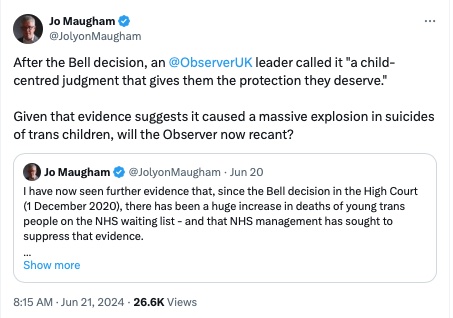
On 20 and 21 June, both Jolyon Maugham and the GLP doubled down on their unproven claims about the deaths of trans-identifying young people, with Maugham posting a 34-post thread on X/Twitter, and the GLP posting a news item on their website and sending a further email to some or all of the more than 300,000 people on their mailing list.
In these and other posts on X/Twitter, Maugham variously referred to “a huge increase” and “a massive explosion” in the number of suicides of trans-identifying young people since 2020. Yet informed criticism of these claims had continued to cast serious doubt both on the suicide numbers cited by Maugham and the GLP, and their suggestion of a deliberate NHS cover-up.
On 2 July, by which time the crowdfunder had reached almost £51,000, the GLP announced in an update to the crowdfunder that the court claim would be heard by the High Court on 12 July.
At 9am on 12 July, some 90 minutes before the start of the High Court hearing, Jolyon Maugham revealed, in a thread posted on X/Twitter, that – subject to the outcome of the legal challenge – the new Secretary of State for Health & Social Care, Wes Streeting, intends to “renew [the temporary ban introduced on 30 June] with a view to converting it to a permanent ban” (as confirmed in an email from the Government Legal Department dated 12 July). In this thread, Maugham stated: “My feelings about Wes Streeting are unprintable: these measures will kill trans children”.
A few minutes later, Maugham further posted on X/Twitter:
“I am proud to know I can look every trans family in the eye and say, I fought tooth and nail for the lives of your family. But now that Wes Streeting has made his position clear I think it is time, if you have this choice, to leave the United Kingdom.”
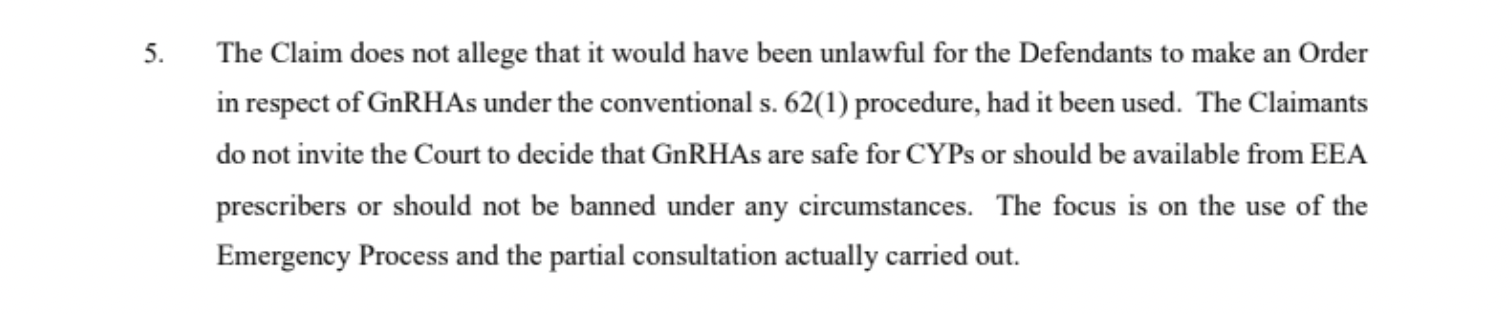
Later on 12 July, the GLP published a ‘case update’ on their website, containing a hyperlink to the claimants’ skeleton argument. And paragraph 5 of the latter spells out the very narrow scope of the legal challenge: “The claim does not allege that it would have been unlawful for [the Government] to make an Order in respect of [puberty blockers] under the conventional procedure, had it been used. The Claimants do not invite the Court to decide that [puberty blockers] are safe for [under 18s] or should be available from [overseas] prescribers or should not be banned under any circumstances. The focus is on the use of the Emergency Process and the partial consultation actually carried out.” And it is, at the very least, questionable whether this very narrow scope of the (then proposed) legal challenge was clear from the ‘Puberty blockers ban’ crowdfunder text and/or the emails to those on the GLP’s mailing list.
The High Court hearing concluded on 12 July, with the judge reserving judgment.
12 July to 21 July
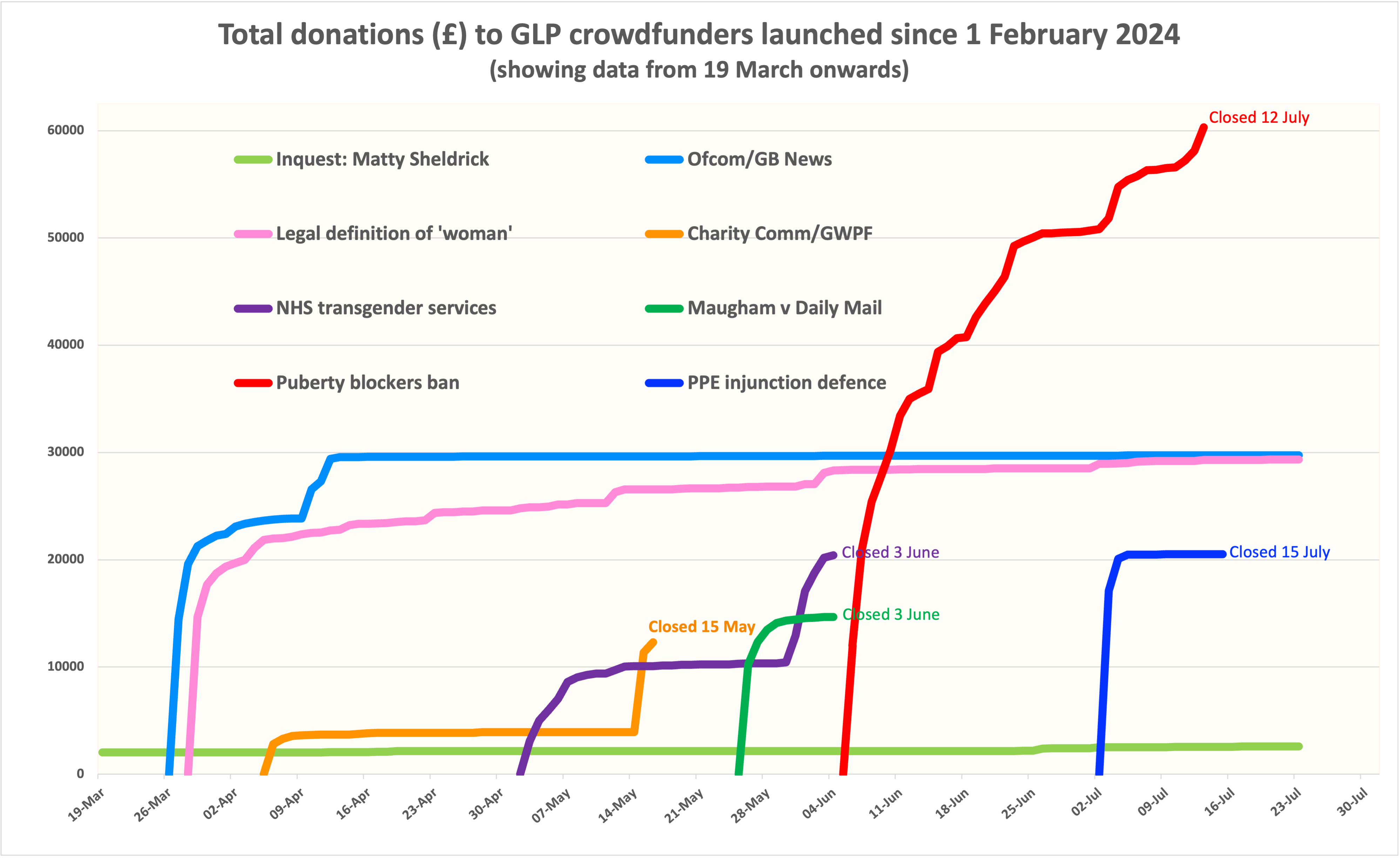
By the morning of 12 July, the GLP crowdfunder had reached £58,124, and by the time the crowdfunder was closed by the GLP that evening it had raised a total of £60,329 from some 1,770 donors (an average donation of £34). This is more than twice the largest sum raised by any of the seven other crowdfunders launched by the GLP since 1 February (i.e. since the start of the GLP’s current reporting year, 2024-25), and more than three times the average sum raised by those seven crowdfunders (£18,511).
On 14 July, the Secretary of State, Wes Streeting, posted on X/Twitter a nine-post thread explaining his decision to defend the court claim brought by TransActual, and setting out “some context for the caution and care I am taking when it comes to this vulnerable group of young people”. In this thread, the Secretary of State noted that “some of the public statements being made are highly irresponsible and could put vulnerable young people at risk”.
Within two hours, Jolyon Maugham posted on X/Twitter a 17-post thread setting out 16 “questions for Wes Streeting”. And over the following few hours Maugham further posted a series of posts on X/Twitter, including:
“A measure so extreme that I genuinely did not believe even the Tories would introduce it – until they did – a month later now has Wes Streeting out on a limb defending it. Quite, quite staggering.” (2:46pm)
“It’s a bold political move to edge yourself out on a limb before learning whether a judge will saw it off. We might find that aligning yourself with billionaires and the right wing media isn’t conclusive evidence of political genius.” (3:53pm)
“Even Victoria Atkins was honest enough to admit that her decision to ignore the advice of civil servants and the NHS about the risk of serious harm was ‘bold’ rather than cautious. I didn’t expect the new Labour Health [Secretary] to be less honest than his Tory predecessor.” (7:03pm)
At 6:37 am on 15 July, Jolyon Maugham posted on X/Twitter:
“Nothing yet from Wes (beyond unfollowing me on Twitter). If you want to understand how we got here it might be worth looking at his links with Policy Exchange, whose position on trans people is so extreme sometimes even Murdoch’s papers won’t publish it.”
And, when challenged (by a supporter) about expecting the Secretary of State to answer his questions “on a Sunday”, Maugham responded:
“I understand why you say that but he sent out his thread on a Sunday, unfollowed me on Twitter on a Sunday and we have, in the past, exchanged phone calls, Twitter DMs and WhatsApps, and we could have again.”
Some 90 minutes later, Maugham posted on X/Twitter a further 10-post thread, setting out nine further questions addressed to the Secretary of State. In the first post of this thread, Maugham states:
“Hello [Wes Streeting], I have added a further nine questions to my list, make a total of twenty-five. If you ignore them, the trans community and its allies will reasonably conclude they are regarded by Labour with contempt. Please don’t ignore them.”
At 6:22 am on 17 July, Jolyon Maugham posted on X/Twitter:
“Spare a thought today for [Wes Streeting], unlikely to be loved by Cabinet colleagues for his decision, only a week into the new Government, to front run the King’s Speech, torpedo relations with the LGBT+ community, and perpetuate the Tories’ wicked culture war.
And don’t underestimate the political tail of [Wes Streeting’s] decision. His colleagues will slowly be coming to terms with him locking them into a future of bereaved parents tipping ashes outside No 10 and a revival of mass die-ins wherever they go.”
Later that day, the GLP posted on their website an anonymous and emotive account, by a parent, of the transing of her (biologically male) child, now 14, from the age of four.
At 7:03 am on 19 July, Jolyon Maugham posted on X/Twitter:
“A week ago Wes Streeting, ignoring the advice of doctors and civil servants, without consulting trans people, ignoring the profound risks to them, going beyond the politicised Cass report, banned a drug used worldwide, for decades, without proven ill effects. We will not forget.
And to those who observe this isn’t really what Wes Streeting believes: we know. But we don’t think that ambition and expediency makes a wicked act better. We think it makes it worse.”
Later on 19 July, the Department of Health & Social Care (DHSC) published an independent review, by Professor Louis Appleby of the University of Manchester (and the DHSC’s adviser on suicide prevention), of the claims made about number of deaths of young patients of the Tavistock GIDS. The Review notes that:
The claims have been led by the legal campaign group the Good Law Project, who are challenging the decision by the previous Health Secretary to end the prescription of puberty-blocking drugs by private clinics to children and young people with gender dysphoria.
The central claim, made on X (formerly known as Twitter), is that there has been a large rise in suicide by current and recent patients of the Gender Identity Development Service (GIDS) service at the Tavistock since an earlier restriction of puberty-blocking drugs that followed a High Court decision in a case (Bell v Tavistock) in December 2020. The rise is described as a “surge” in suicides and “an explosion”, indicating a substantial and, by implication, unequivocal increase. There are multiple references to children dying in future because they are unable to access puberty-blocking drugs.
This claim is said to be based on unpublished data provided by two members of staff at the Tavistock, described as whistleblowers. On Twitter/X the evidence is presented in screenshots of extracts from the records of Tavistock Board meetings and other documents. These variously refer to suicides, deaths from unspecified causes and “safety incidents”. A specific claim is that there was one suicide by a patient on the GIDS waiting list in the three years before the High Court judgment, and 16 deaths (rather than suicides) in the three years after the judgment. The whistleblowers are said to have alleged a cover-up by NHS England.
These claims have been retweeted thousands of times by other campaigners and members of the public. They have been repeated by some leading journalists, though there is nothing to suggest that they have examined the evidence for themselves. They too have adopted the language of “dying children”.
And the Review concludes:
1. The data do not support the claim that there has been a large rise in suicide by young patients attending the gender services at the Tavistock since the High Court ruling in 2020 or after any other recent date. The figures for the six years covered in this review are 12 suicides in total, two per year on average, of whom half were under 18. With small numbers, single-figure differences can be expected and causal explanations are unreliable.
In the three years leading up to 2020-21, there were five suicides, compared to seven in the three years after. This is essentially no difference, taking account of expected fluctuations in small numbers, and would not reach statistical significance. In the under 18s specifically, there were three suicides before and three after 2020-21.
2. The way that this issue has been discussed on social media has been insensitive, distressing and dangerous, and goes against guidance on safe reporting of suicide.
3. The claims that have been placed in the public domain [by the GLP and others] do not meet basic standards for statistical evidence. To be reliable, evidence should be objective, unbiased and open to independent scrutiny. It should admit uncertainty.
4. There is a need to move away from the perception that puberty-blocking drugs are the main marker of non-judgemental acceptance in this area of health care.
5. We need to ensure high quality data in which everyone has confidence, as the basis of improved safety for this at risk group of young people.
In short, the GLP ‘Puberty blockers ban’ crowdfunder should not have included (a) the unproven claims about the number of deaths of young trans-identifying patients of the Tavistock GIDS before and since December 2020; and (b) the irresponsible suggestion that the temporary ban introduced on 30 May will lead directly to “further deaths of young trans people”. And it is hard to believe that, stripped of these two, highly emotive elements, the crowdfunder would have raised £60,329 – more than three times the average sum raised by the seven other crowdfunders launched since 1 February – in little more than five weeks.
Accordingly, it is at least arguable that the GLP crowdfunder, and its promotion on social media and in two emails to the more than 300,000 people on the GLP’s mailing list, amounts to the criminal offence of obtaining money by false representation, as defined in the Fraud Act 2006.
Far from accepting the criticism set out in Professor Appleby’s Review, at 7:19 pm on 19 July Jolyon Maugham posted on X/Twitter a 34-post thread re-iterating his and the GLP’s original claims, as well as some of the legal arguments made on behalf of TransActual in the High Court hearing. There is only one note of contrition, at the conclusion of the thread, where Maugham states:
31. It is very hard to balance campaigning to protect the most targeted and vulnerable in the country from wicked ideologues. And to none of us is it given always to get the balance right. But failing to speak of the harm that ideology generates is not the answer.
32. I want to promise to those many, many trans people and families who thank me for my advocacy: I am not going away. Not until Wes Streeting is more interested in what you want than the billionaires and right wing media he so transparently courts.
33. Where, as will be the case, I have got the balance wrong, to the trans community I apologise. This is a tough, tough job: facing down the Trumps and the Putins and the Murdochs and the billionaire and the Rothermeres. And now, devastatingly, a Labour Health Secretary too.
Have you noticed how all the wrong people are clapping, Keir?
On 21 July, Jolyon Maugham posted on X/Twitter that he is now “off walking in the mountains for a fortnight and am deleting Twitter ’til I get back”.
In light of the above, I have renewed my complaint about the GLP’s ‘Puberty blockers ban’ crowdfunder, and its promotion by Jolyon Maugham and the GLP, made to the Advertising Standards Authority on 7 June (ASA ref: A24-1248491). And, on the advice of the ASA, I have reported the matter to Trading Standards via Citizens Advice (ref: 18443190).
I have also made a formal complaint about Jolyon Maugham to the Bar Standards Board (BSB ref: 0FAD3306). In my complaint, I suggest that Maugham may have: broken the law by committing a serious criminal offence (obtaining money by false representation); acted dishonestly; acted without integrity, including by failing to disclose a personal (family) interest; and behaved in a way which is likely to diminish the trust and confidence which the public places in them or in the profession.
And I have reported the matter to the police via the Action Fraud reporting portal (crime reference number: NFRC240706792775).
To be clear, I don’t expect any of these agencies to act on my complaints – my lived experience is that they are all chocolate teapots (and in some cases the chocolate is very poor quality). But there may come a time when they have to account for their inaction.
21 July to 29 July
On 23 July, Professor Appleby posted on X/Twitter a nine-post thread responding to some of the reactions to his Review. The same day, in the House of Commons, the Secretary of State for Health & Social Care, Wes Streeting, told MPs that the Labour Government is “wholeheartedly committed to the full implementation of the Cass review, which will deliver material improvements in the wellbeing, safety and dignity of trans people of all ages. I think that is important.”
On 24 July, during Prime Minister’s Questions in the House of Commons, the Prime Minister stated: “The Cass Review was clear that there is not enough evidence on the long-term impact of puberty blockers to know whether they are safe”.

On 29 July, the High Court dismissed all three grounds of the judicial review claim. Key paragraphs from the 61-page judgment include (see also this thread by Dr Michael Foran):
180. The [Government] were entitled to rely upon the precautionary principle when making their judgments under section 62(1) and (3) MA 1968. The [Secretary of State] expressly stated at the meeting of 19 April 2024, that the level of risk she was prepared to tolerate, in the context of protecting the health of vulnerable children, was low. In my view, the guidance in Alpharma, set out above, accords with a rational and balanced approach to the assessment of risk in this context, where there remains scientific uncertainty.
184. I accept the [Government’s] submission that a margin of appreciation is appropriate for a responsible decision-maker who “is required, under the urgent pressure of events, to take decisions which call for the evaluation of scientific evidence and advice as to public health risks, and which have serious implications for the…general public”: R v Secretary of State for Health ex p Eastside Cheese Company [1999] 3 CMLR 123, at [50], per Lord Bingham.
210. In my judgment, the Cass Review’s findings about the very substantial risks and very narrow benefits associated with the use of puberty blockers, and the recommendation that in future the NHS prescribing of puberty blockers to children and young people should only take place in a clinical trial, and not routinely, amounted to powerful scientific evidence in support of restrictions on the supply of puberty blockers on the grounds that they were potentially harmful. Although the Cass Review did not state in terms that puberty blockers cause “a serious danger to health”, that was not the question that the Cass Review was asked to consider. That was a matter for the [Government] to determine on all the evidence before them. It would have been premature to do so before the Final Report had been published.
218. In regard to timing, the [Secretary of State] reasonably considered that it was essential to make the Order as soon as possible to protect children and young people from irresponsible prescribing of puberty blockers by EEA providers, such as GenderGP, contrary to the recommendations of the Cass Review. The standard procedure, under which the CHM would conduct a consultation procedure and then provide advice, was estimated to take between 5 and 6 months. In my view, it was rational for the [Secretary of State] to decide that it was essential to adopt the emergency procedure to avoid serious danger to the health of children and young people who would otherwise be prescribed puberty blockers during that 5 to 6 month period. Under the emergency procedure, there is no requirement to hold a consultation procedure.
219. DHSC officials believed that, if there was a delay between the announcement of the Order and the date it came into effect, patients would rush to “beat the ban” and try to initiate treatment, knowing that they would be allowed to continue once treatment had begun. In my view, it was reasonable for the [Secretary of State] to accept this advice. It would be an obvious reaction by supporters of puberty blockers to the news of an impending ban.
228. In conclusion, applying the heightened test of anxious scrutiny, I am satisfied that the decision to make the emergency Order on 29 May 2024, was a rational one, for the reasons set out above. Parliament has entrusted the Ministers to exercise the powers in section 62 MA 1968, in the exercise of their discretionary judgment. This decision required a complex and multi-factored predictive assessment, involving the application of clinical judgment and the weighing of competing risks and dangers, with which the Court should be slow to interfere.
257. Permission to apply for judicial review is granted on Grounds 1 to 3. The claim for judicial review is dismissed on Grounds 1 to 3.
The Good Law Project say they are “deeply saddened” by the judgment, while in a statement TransActual describe it as “appalling”:
This is a disappointing result. Defence evidence makes clear that they decided on an emergency ban first and sought ways to justify it second.
The judgment leans heavily on the widely discredited Cass review. This – never forget! – is the work of someone with no experience of trans healthcare. It excluded trans researchers from the review team, on grounds of potential bias, while including several clearly identified anti-trans academics; and it was led by an individual appointed from a shortlist of one – and since elevated to the House of Lords by the outgoing Conservative administration.
We are seriously concerned about the safety and welfare of young trans people in the UK. Over the last few years, they have come to view the UK medical establishment as paying lip service to their needs; and all too happy to weaponise their very existence in pursuit of a now discredited culture war.
Update: On 22 August, the DHSC renewed the temporary ban until 26 November, and extended its scope to cover Northern Ireland. To date, there are no reports of trans-identifying young people killing themselves since – let alone because of – the introduction of the ban on 30 May.
Update: On 11 December, the DHSC announced that the temporary ban is to be made indefinite. There are still no reports of trans-identifying young people killing themselves since – let alone because of – the introduction of the ban on 30 May.

 Labour Pains
Pingback: Good Law Project: things fall apart | Labour Pains
Pingback: Jolyon’s land of broken dreams | Labour Pains
Pingback: Good Law Project: Tufton Street!!! Disabled kids!!! | Labour Pains
Pingback: Jilted Jolyon seeks to reform Reform | Labour Pains
Pingback: Good Law Project: Jolyon’s End of Days message | Labour Pains
Pingback: Good Law Project: Rage, rage against the dying of The Grift | Labour Pains
Pingback: Good Law Project: JoMo v MoFo | Labour Pains
Pingback: Difficult transition: Jolyon Maugham KC’s identity crisis | Labour Pains
Pingback: Lost cause: the crowdfunded lawfare of Jolyon Maugham KC | Labour Pains