
On 5 June, having already grifted more than £20,000 for legal advice on challenging NHS correspondence with parents of trans-identifying young people on puberty blockers, Jolyon ‘I used to be a KC’ Maugham’s midlife crisis plaything, the (Not Very) Good Law Project, launched yet another new crowdfunder, with an initial target of £75,000, in support of possible legal action against emergency Regulations on the prescribing and supply of puberty blockers to under 18s, introduced by the Government on 30 May.
Heavily – and controversially as well as hypocritically – promoted by Maugham himself on X/Twitter, the crowdfunder raised more than £12,000 within 24 hours, and as of 4pm on 7 June stands at £23,614 from 644 donors (an average donation of £36.67).
The substantive part of the crowdfunder text consists of just 18 sentences. Some of these sentences are factually misleading, many are tendentious in the extreme, and nearly all are emotive, alarmist and/or grossly manipulative. I’ve been monitoring the GLP’s industrial-scale crowdfunding for two years now, and this is, by some distance, the most disreputable and exploitative garbage they’ve ever put out. It’s so bad it is hard to know where to start, but below I set out some brief comments on the five, key sections:
Just before parliament was dissolved on 30 May, the health secretary Victoria Atkins introduced an immediate ban for trans young people using puberty blockers prescribed by regulated prescribers in France, Germany, Switzerland and throughout Europe. The consequences are profound.
As the GLP subsequently acknowledged, this is factually incorrect (and therefore misleading). The Regulations introduced on 30 May do not ban the use of puberty blockers by trans young people – rather, they ban the prescribing and supply of puberty blockers, by UK-based private prescribers and prescribers registered in the European Economic Area (EEA) or Switzerland, to children and young people under 18.
On 6 June – some 24 hours after launching the crowdfunder, by which time it had received over £12,000 of donations – the GLP revised the text to say: “… an immediate ban on trans young people obtaining in the UK puberty blockers prescribed by regulated prescribers …”. But the fact remains that the GLP did not understand the effect of the Regulations when launching the crowdfunder on 5 June.
The crowdfunder text also fails to note that the ban is only temporary, until 3 September, and that patients already established on puberty blockers by a UK prescriber are not affected (i.e. the ban will only affect new patients).
A medicine that young trans people have used for decades, that is lawfully prescribed throughout Europe, that is recommended by decades-old international treatment protocols, that cis people can continue to use, and the NHS can continue to prescribe to young trans people if they have already started, will no longer be available. In fact, it will become a criminal offence to supply in the United Kingdom puberty blockers to those caught by the ban, punishable by up to two years in prison.
The Cass report has been widely criticised – by the trans community, the World Professional Association for Transgender Health, by the Endocrine Society and by the American Academy of Pediatrics – for its conclusions. But even the Cass report contemplates continued use of puberty blockers to treat trans people.
These two paragraphs are extremely tendentious, to the point of being grossly misleading to an uninformed reader. The NHS stopped the routine prescription of puberty blocker treatments to under-18s in April this year, following the Cass Review into gender identity services. In addition, the government has introduced indefinite restrictions on the prescribing of puberty blockers within NHS primary care in England, in line with NHS guidelines. And the Cass Review’s recommendations were endorsed by NHS England and both Government ministers and Labour shadow ministers.
The ban also bypassed the normal requirement for consulting a statutory committee to protect the public interest. And introducing it shortly before parliament rose meant that parliament could not scrutinise it either.
Again, this paragraph is extremely tendentious. The Government has used emergency powers available to ministers under section 62 of the Medicines Act 1968. And it has stated clearly that it has done so in order to “respond to the serious safety risks for vulnerable children and young people without delay. At present providers registered outside of the UK, beyond the jurisdiction of UK regulators, are able to continue to offer services that are not evidence based and treatment options that are not available through UK registered providers for safety reasons. The emergency Order enables these loopholes to be closed immediately. It is necessarily a temporary measure, enabling further work to be done to determine the appropriate legislative approach for the future.”
Furthermore, the Government consulted NHS England, the devolved administrations, the British Medical Association, Community Pharmacy England, the chair of the Commission on Human Medicines, the General Medical Council and the General Pharmaceutical Council.
The GLP has made no attempt in the crowdfunder text to reflect – or even merely link to – the Government’s explanation of its course of action.
[The ban’s] results are predictable – and terrifying.
We have heard from a well-placed whistleblower inside the NHS that, in the seven years before the decision in the [December 2020] Bell case (concerning the use of puberty blockers), one person using Gender Identity Development Services lost their life. The NHS reacted to that decision by introducing immediate, heavy restrictions to NHS services for young trans people. And it did not lift them when the decision was overturned in the Court of Appeal. We have been informed that in the three years following the [December 2020] decision 16 people lost their lives. We have contemporaneous evidence that this concern was raised at the time and the whistleblower believes senior management took a decision to suppress evidence of the deaths. We put these allegations to the Tavistock, we know it received them, but it has failed to respond.
This ban closes off the only route to treatment left open by the restrictions on treatment in the NHS. Atkins’s shockingly callous decision is likely to lead to further deaths of young trans people. We have received many emails from desperately worried parents.
These highly emotive paragraphs – including the bald assertion that the ban “is likely to” cause the suicide of trans-identifying young people, and the implicit suggestion of an NHS cover-up – are not just extremely partisan, but grossly irresponsible (and seemingly contrary to the Samaritans’ guidelines on reporting suicide). Because such monetising of the (alleged but unsubstantiated) suicides of young and quite possibly seriously mentally ill young people is reckless if not dangerous. As a Government adviser on suicide prevention and mental health noted today: “alarming claims about suicide may be not only misleading but harmful. More so if they highlight a single cause those already at risk may identify with. Suicide is complex.”
[Update: Furthermore, one reason the GLP has “received many emails from desperately worried parents” is that they have been soliciting such emails on social media. And there is, at the very least, a large question mark over the unsubstantiated suicide figures given to the GLP by the unidentified “NHS whistleblower” – one detailed analysis of the available sources provisionally concludes that, between 2017 and 2024, there were only three confirmed or possible suicides of trans-identifying young people using Gender Identity Development Services, and that in each case the young person had an extremely complex medical history.]
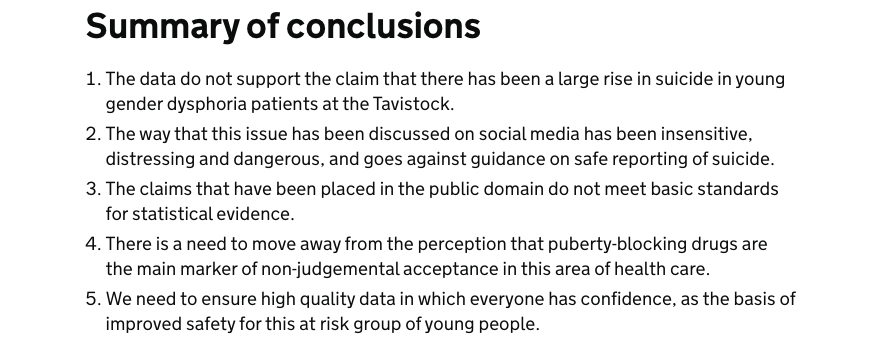
Further update, 19 July: The Department of Health & Social Care (DHSC) has today published an independent review of the claims by Jolyon Maugham and the GLP about suicides by young patients of the Tavistock GIDS, by Professor Louis Appleby of the University of Manchester and the DHSC’s adviser on suicide prevention. The review’s conclusions are utterly damning of both the claims made, and the manner in which they have been presented:
Trans Actual CIC, working with Good Law Project, has instructed Russell-Cooke solicitors and senior barristers David Lock KC, Jason Coppel KC and Rob Harland to advise on a legal challenge to the Regulations. So we’re taking the first formal step in urgent legal proceedings against Atkins.
We will issue the case in court as soon as possible and will ask for an urgent hearing – but we desperately need your help.
The link in the first paragraph is to the letter before claim sent on behalf of TransActual by the law firm Russell-Cooke, under the Pre-action Protocol for judicial review of the Civil Procedure Rules, on 4 June. And, as the very purpose of the Protocol is to enable parties to try to settle the dispute without resorting to litigation, the bald statement “we will issue the case in court as soon as possible” – a statement that the GLP has repeated on social media – is contrary to the Protocol. Because it is perfectly possible that the Government Legal Department’s response to Russell-Cooke’s letter before claim will lead TransActual to drop the proposed legal action. But potential donors to the GLP’s crowdfunder have not been given sight of that response, and the crowdfunder text does not give any indication of the proposed legal claim’s prospects of success.
In short, a visitor to the crowdfunder page would not have the material information they need to be able to make an informed decision about whether or not to donate to the crowdfunder (and, if so, how much to donate). As with a number of other recent GLP crowdfunders (see here, for example), this appears to be a breach of Rule 3.3 of the Non-Broadcast Code of Advertising Practice (the CAP Code) produced by the Committee of Advertising Practice, the sibling organisation of the Advertising Standards Authority. Accordingly, I have made a formal complaint to the Advertising Standards Authority (ASA ref: A24-1248491).
Jolyon and the GLP’s crowdfunded transgenderism
The Puberty blockers crowdfunder is the GLP’s 72nd crowdfunder since March 2017, and the eighth in support of lawfare on transgender issues.
The first of the eight transgenderism crowdfunders, launched in November 2020 as the GLP’s Legal Defence Fund for Transgender Lives, remains open and has raised £191,750, but the last of 19 updates to the crowdfunder was posted as long ago as June 2022. By then, most if not all of the £191.7K had been spent on the legal defence of controversial services provided by the discredited and now defunct Tavistock Gender Identity Development Service. And the second, launched in June 2021 in support of the ultimately doomed legal challenge by Mermaids to the Charity Commission’s decision to grant charitable status to LGB Alliance, pointlessly raised £83,692.
In September 2021, the GLP launched the first of two separate crowdfunders in support of a legal challenge to “the long waiting times experienced by trans people seeking help from the NHS”; this first crowdfunder raised £49,608, but the legal claim was dismissed by the High Court in January 2023. The following month, the GLP launched the second crowdfunder, in support of an appeal against the High Court ruling; this raised £70,648, but the appeal was dismissed by the Court of Appeal in July 2023.
In total these four crowdfunders raised £395,698 for the GLP’s highly performative lawfare on transgender issues. But absolutely nothing of lasting value was achieved.
Most recently, four of the seven crowdfunders launched by the GLP since 1 February 2024 (i.e. since the start of the GLP’s current financial year) have been in support of lawfare on transgender issues. In February, the GLP launched a crowdfunder in support of an attempt by the Clare Project – a “community-led support charity for trans, non-binary and intersex adults” in Sussex – to secure an Article 2 inquest into the suicide of transgender Matty Sheldrick in Brighton in 2022.
In March, the GLP launched a crowdfunder in support of an application to intervene by the retired, transgender judge Victoria McCloud in the forthcoming Supreme Court case on the legal definition of ‘woman’. In May, as noted above, the GLP launched a crowdfunder in support of obtaining legal advice on a possible legal challenge to NHS correspondence with parents of trans-identifying young people on puberty blockers; the crowdfunder was closed on 3 June, having raised £20,428. And this month the GLP launched the Puberty blockers crowdfunder.
Not only is lawfare on transgenderism the focus of five (25%) of the 20 crowdfunders launched by the GLP since 1 January 2023 but – as the following chart shows – the average donation to the crowdfunders on transgenderism is consistently and markedly above the norm.

Thanks to the combination of these high average donations, and the fact that – as noted above – four of the seven crowdfunders launched since 1 February (i.e. the start of the GLP’s current financial year) are in support of lawfare on transgender issues, the overall contribution of transgenderism to the GLP’s crowdfunded income has increased markedly in the current half-year (February to July), relative to previous such periods:

All of which invites some intriguing questions: With the expected demise of the Conservative Government that has been the main target of the GLP’s largely unproductive lawfare since 2017, is Maugham’s deeply personal, ideological and unscientific agenda now turning the GLP into little more than a trans rights group? Why is Maugham so keen on the chemical castration of young people? And when will he start living by his own, much proclaimed values?

Update 11 June: By yesterday morning, the crowdfunder had reached £30,228 – making it the first of the seven GLP crowdfunders launched in 2024/25 (i.e. the GLP’s current financial year) to raise more than £30K – but the flow of donations was slowing. Then, at 7pm, the GLP sent an email promoting the crowdfunder – with the subject heading “They’re putting trans lives in danger” – to some or all of the more than 300,000 people on their mailing list (including me), and this generated a new wave of donations: by 8am today, the crowdfunder stood at £33,416.
Somewhat surprisingly, the opening paragraph of the email uses the original, factually incorrect wording of the crowdfunder text – wrongly suggesting that the ban is on young trans people “using” puberty blockers – rather than the revised text that the GLP posted to the crowdfunder page on 6 June (see above). The factually incorrect (and therefore misleading) words are even highlighted in bold:
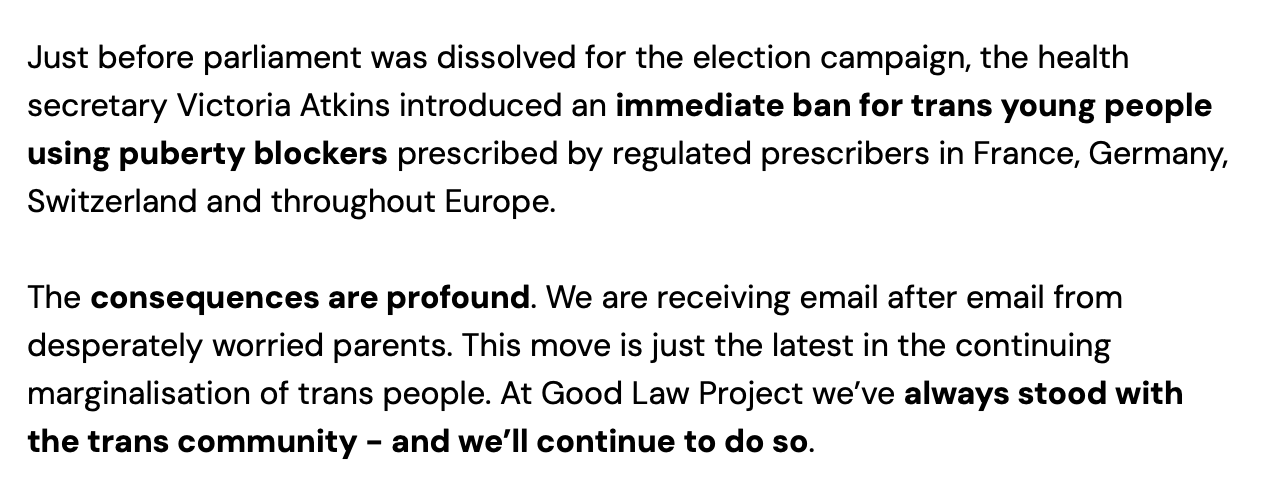
Even more surprisingly, perhaps, while the email omits the crowdfunder and Maugham’s controversial claim of an NHS cover-up of 16 suicides, it doubles down on the shameless suggestion that the Regulations will lead directly to the suicide of young trans people, raising the crowdfunder text’s “likely” to “highly likely”:

Furthermore, the email fails to indicate whether or not Russell-Cooke – the law firm acting for TransActual – have received a response from the Government Legal Department to their letter before claim. In that letter before before claim, sent on 4 June, Russell-Cooke requested a response by 4 pm on 7 June. As reported on this blog, only last month the GLP had to make a public apology and offer a refund to donors after twice promoting their Charity Commission/GWPF crowdfunder, on 21 April (on social media) and 14 May (on social media and in an email to their mailing list), without revealing that they had received a (dismissive) response to their letter before claim on 18 April.
Accordingly, I have renewed my complaint to the ASA.
Update, 23 June: On 18 June, with the crowdfunder having reached £40,755 – including an anonymous donation of £3,000 (plus processing fees) on 14 June – the GLP announced on their news pages and in an update to the crowdfunder text that, having received the Government Legal Department’s response on 13 June, they had now issued a court claim. And on 20 June a further update was added to the crowdfunder text: “We have had response from the High Court to say that the case will be heard as soon as possible after 15 July for a one-day hearing.”
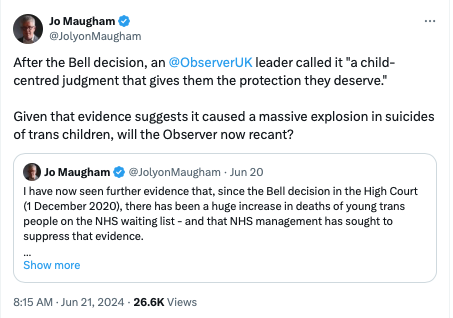
On 20 and 21 June, both Maugham and the GLP doubled down on their unsubstantiated claims about the number of suicides among trans-identifying young people, with Maugham posting a 34-post thread on X/Twitter, and the GLP posting a news item on their website and sending a further email to some or all of the more than 300,000 people on their mailing list.
In these and other posts on X/Twitter, Maugham variously referred to “a huge increase” and “a massive explosion” in the number of suicides of trans-identifying young people. Yet informed criticism of these claims has continued to cast serious doubt both on the suicide numbers cited by Maugham and the GLP, and the suggestion of a deliberate cover-up.
By the morning of 23 June, the crowdfunder had reached £49,242, including an anonymous donation of £2,000 (plus processing fees) on 22 June. This represents 91% of the GLP’s total income from crowdfunders in June to date (£54,175).
And, just after 8pm on 24 June, the crowdfunder reached £50,000.

 Labour Pains
Pingback: Jolyon Maugham v Trump, Putin and, er, Wes Streeting | Labour Pains
Pingback: Good Law Project: things fall apart | Labour Pains
Pingback: Good Law Project: Jolyon’s End of Days message | Labour Pains