
“We didn’t lose. At a deeply technical level we lost. At every substantive level we won.“
So said Jolyon Maugham KC in February 2022, in response to a High Court judge ruling, somewhat unambiguously, that “the claim brought by the Good Law Project fails in its entirety”. And now, it seems, the (Not Very) Good Law Project has lost – but only at a deeply technical level – again.
On 17 April, the GLP announced on their news pages, and in an update to their crowdfunder in support of proposed legal action against the regulator Ofcom by ‘media expert’ Professor Julian Petley, in relation to Ofcom’s regulation of GB News:
Ofcom backs down in face of broadcasting bias challenge … Under threat of legal action, Ofcom has abandoned a two-tier approach to impartiality touted by its CEO in March 2024.

Launched on 26 March, the brief (240-word) crowdfunder had included only minimal information about the basis for the proposed legal challenge, and no indication at all of its prospects of success. It did, however, include a link to the GLP’s 15-page letter before claim, sent to Ofcom on 22 March. And, from this, it was clear that the proposed legal challenge was based on the GLP and Professor Petley’s interpretation of remarks made by Ofcom’s chief executive in late February 2024 (and reported in early March).
On the basis of those remarks, the GLP and Professor Petley had concluded that Ofcom “holds GB News to a lower standard because of its smaller audience”, and that this “two-tier approach to impartiality” is in breach of both Ofcom’s own Broadcasting Code, and the Communications Act 2003.
Despite – or, arguably, because of – this meagre and (clearly) one-sided provision of information about the proposed legal challenge, the crowdfunder received a stonking £19,592 from 1,116 donors within 48 hours. And, by the morning of 17 April, it had received a total of £29,607 from 1,560 donors (an average donation of £18.98).
However, both the GLP’s news announcement and their update to the crowdfunder on 17 April include a link to Ofcom’s response, dated 12 April, to the GLP’s letter before claim. And it is clear from this that, far from ‘backing down’, Ofcom has robustly denied ever having a “two-tier approach to impartiality”. Inter alia, Ofcom’s response letter states:
“We consider that the proposed claim is based on a false premise and is entirely misconceived. It discloses no arguable grounds for judicial review. Ofcom will contest any application brought on those grounds in full and will seek its costs of so doing.
The brief selective comments [by Ofcom’s chief executive] you rely upon in your letter [before claim] were clearly not intended to be, and should not be taken as, an unpublished policy position of Ofcom. For the avoidance of doubt there is no such unpublished policy and your understanding from these remarks that Ofcom has such a policy is incorrect.
Your client [i.e. Professor Petley] incorrectly construes the comments made by Ofcom’s Chief Executive … Ofcom does not have any form of published or unpublished policy containing what you describe as ‘Lower Standards for Smaller or Non-Public Service Broadcasters Approach’. Therefore, all three grounds [of your proposed judicial review] are based on a false premise, are entirely misconceived and without merit.
Finally, we note that, while you have informed us that your client is Professor Julian Petley, the Good Law Project’s website currently states that the ‘first step’ in legal proceedings has been taken against Ofcom, and seeks financial donations to support ‘our legal action’. As you will be aware, the letter before claim is a step required to be taken prior to legal proceedings, with the express purpose of trying to settle the issues without proceedings.
We are concerned that you are raising significant funds from the public on the basis of a misconceived claim. We trust that your client will not continue to incur legal costs, funded by public donations or otherwise, in connection with a proposed action which has no basis. For the avoidance of doubt, Ofcom will defend any application in full and will seek to recover its legal costs of doing so.”
As the GLP appear to concede in their 17 April news announcement: “No two-tier approach then”. But you don’t have to be a King’s Counsel to conclude from all this that Ofcom have not ‘backed down’. As one lawyer noted on X (formerly Twitter): “I think this is possibly [the GLP’s] most disgracefully disingenuous attempt to claim a ‘win’, in a long line of such disgracefully disingenuous attempts.”
Whatever, between 26 March and 17 April, the GLP and Professor Petley crowdfunded £29,607 from 1,560 people for a somewhat speculative legal challenge that, it turns out, appears to have been entirely misconceived and, accordingly, to have had no prospect of success. Prior to 17 April, potential donors – and the 1,560 actual donors – were simply not given the material information they needed to make an informed decision about whether to donate to the crowdfunder (and, if so, how much).
Indeed, the fact that, since 17 April, only three people have donated a total of £8 to the crowdfunder tends to suggest that, had Jolyon and the GLP waited until they were in a position to share Ofcom’s letter of response before launching the crowdfunder, many of the 1,560 people who donated an average of £18.98 would not have donated at all, or would have donated less than they did. (And one of those three people was me, donating a very generous £1 on 18 April simply to test whether the crowdfunder truly is still open to new donations).
And you don’t have to be a cynical, paid Tory troll like me to take that view. Way back in November 2017, no less a person than Jolyon himself explained that this is exactly why he tends to launch his many crowdfunders – an industrial-scale 69 of them since March 2017 – after sending a letter before claim, but before getting the proposed defendant’s response to that letter before claim:
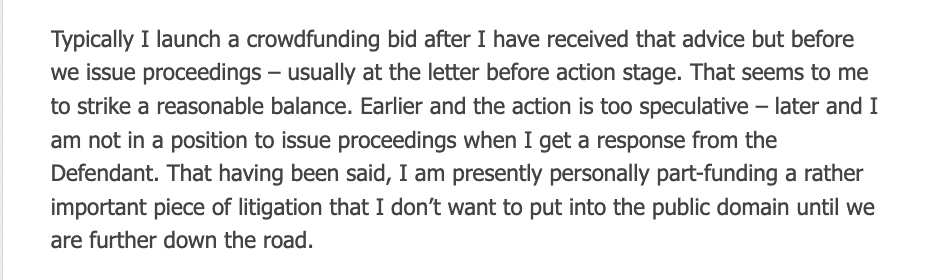
Similarly, in July 2020, Jolyon noted in the Law Society Gazette that:
Very few crowdfunding pages that launch badly will hit their targets. Most that do hit their targets do so quickly. It is impossible to return money to donors. This encourages you, if you are a crowdfunder, to over-raise at the outset, which (certainly in litigation in which permission is needed) means you are, to a greater or lesser extent, telling people you will use their money for something you cannot know you will spend it on.
There is an obvious incentive to ask for money early, before you have understood your own case.
The evidence suggests that the GLP and Professor Petley crowdfunded £29,607 from 1,560 people before they understood their own case.
Alternatively, of course, people have not been donating to the crowdfunder since 17 April because they have been misled into thinking that, with Ofcom having ‘backed down’, the GLP have won. At every substantive level. In which case, it’s just a shame (for the GLP) that ‘winning and losing’ is a silly metric.
Either way, to my mind the GLP’s Ofcom/GB News crowdfunder, and the actions of Jolyon, the GLP and Professor Petley in promoting it, are in breach of both the GLP’s own much touted values and Rule 3.3 of the Non-Broadcast Code of Advertising Practice (the CAP Code) produced by the Committee of Advertising Practice, the sibling organisation of the Advertising Standards Authority. Rule 3.3 provides that:
Marketing communications must not mislead the consumer by omitting material information. They must not mislead by hiding material information or presenting it in an unclear, unintelligible, ambiguous or untimely manner.
Material information is information that the consumer needs to make informed decisions in relation to a product.
I have therefore made a formal complaint to the Advertising Standards Authority against the GLP and Professor Petley (ASA ref: A24-1242970).
[Update: As of 11 May, the crowdfunder remains open to new donations, and stands at £29,636, including an anonymous £10 donation on 25 April, and a £10.45 donation from ‘Colin’ on 7 May. Yet, with the threatened judicial review now abandoned, it is entirely unclear why this case requires further funding.]

 Labour Pains