
Welcome to the fourth Good Grift Watch update, promised when I launched Good Grift Watch on this blog in June. This update covers the three-month period 1 September to 30 November 2023. The three previous updates are here, here, and here.
Sept – Nov 2023 in brief:
- In September, the GLP’s Sewage dumping case was dismissed by the High Court
- In October, the GLP abandoned its threatened judicial review in its Private equity case
- The GLP launched only one new crowdfunder, but it raised more than £126K
- In November, a GLP tweet about their NHS Data case was ‘community noted’ for being inaccurate and misleading
- There is still no update to Louise Raw’s December 2022 crowdfunder in support of proposed legal action against Jeremy Clarkson and the Sun newspaper
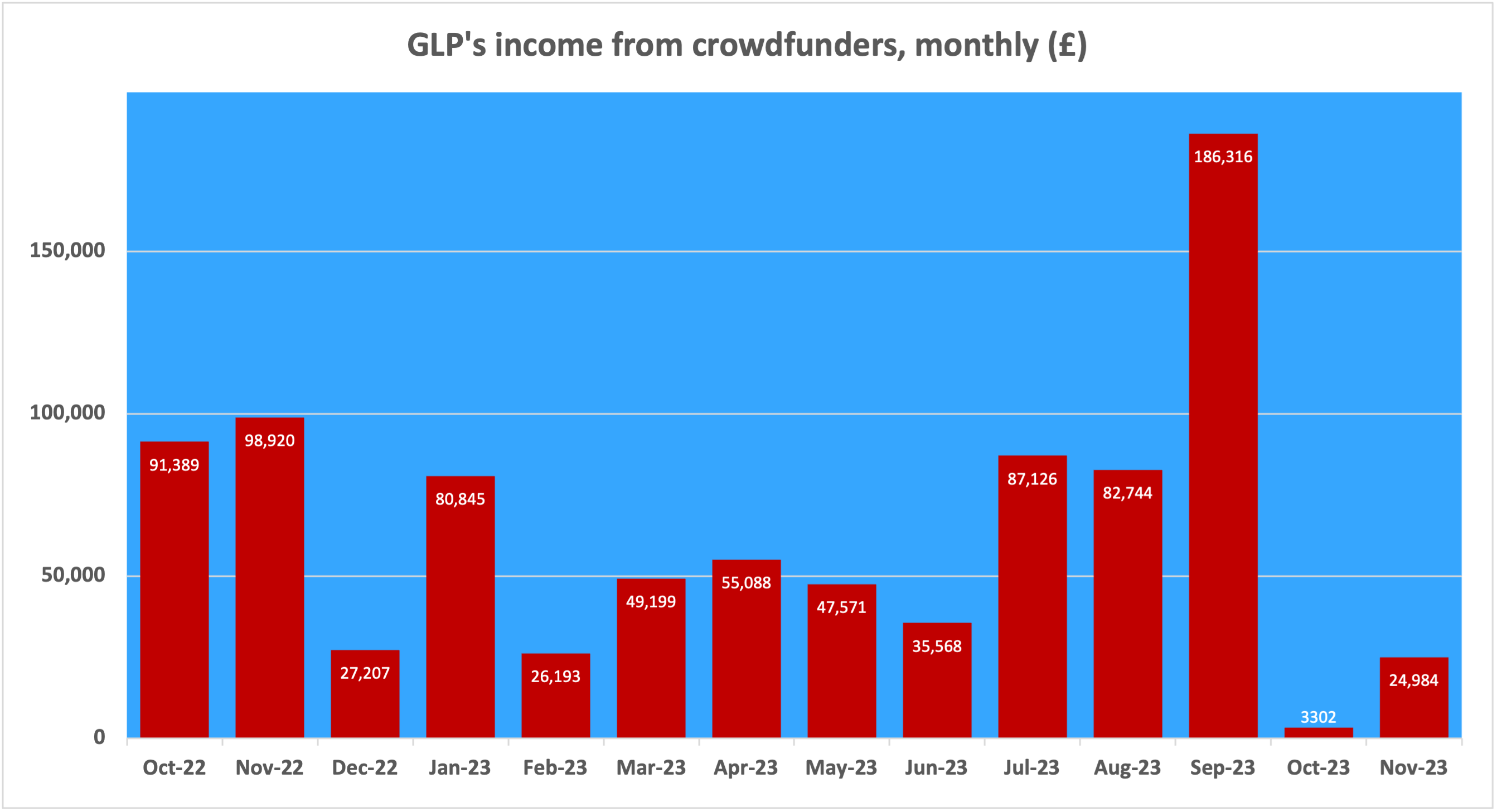
- The GLP raised £186,316 from crowdfunders in September, but just £3,302 in October, and £24,984 in November
- The GLP published their annual report and accounts for 2022/23, revealing a 24% fall in total income from crowdfunders, direct donations and grants
- A written Parliamentary Question elicited new data on the amount the GLP has paid to and received from the Government in respect of legal costs
The GLP’s Sewage dumping case
On 5 September, a BBC news report about sewage spills prompted the GLP to email supporters seeking donations to their Sewage dumping case, which was then awaiting judgment, having been heard by the High Court in early July. And on 12 September the GLP sought donations to the case on social media. However, on 15 September the High Court dismissed the judicial review claim, for which the GLP had by then crowdfunded a total of £93,262.
When launching the Sewage dumping crowdfunder in October 2022, and subsequently, the GLP had emphasised that the judicial review claim relied in part on the so-called Public Trust Doctrine:
We believe this could be one of the UK’s most significant environmental law cases in recent history. Our legal challenge revives an old common law legal doctrine – the Public Trust Doctrine – to force Government to take the protection of our rivers and seas seriously.
The Public Trust Doctrine has been recognised by the English Courts since at least 1299. It says that the state has a fiduciary duty to safeguard vital natural resources and hold them in trust for the benefit of both current and future generations. It enshrines the right for people to fish, gather food and navigate our shared tidal waters.
We believe that the Public Trust Doctrine is part of the UK Constitution, although it has not been relied on much in our courts and its scope is unclear. Winning this case could set a landmark precedent which would enable campaigners to use the Public Trust Doctrine as a foundation for legal challenges to compel the Government to protect our shared natural environment.
However, the High Court dismissed this and all the other grounds of the GLP’s claim, stating that “there is no justification for extending the common law in the way [the GLP] suggest”. And, responding to the judgment, the GLP said: “Given the nature of the Court’s findings, we are unlikely to appeal the decision.” Nevertheless, the GLP chalked the case up as a ‘campaign win’, on acccount of the Department for the Environment, Food and Rural Affairs having agreed in June 2023 to consult on expanding its storm overflows discharge reduction plan, so as to cover all coastal and estuarine waters.
Updated table of court outcomes in GLP cases since 1 October 2021 (i.e. since the start of the 2021/22 legal year):

The GLP’s Private equity case
On 5 October, the GLP announced that HM Revenue & Customs have “conceded the key argument raised” by the Good Law Practice on behalf of multi-millionaire fashion-victim Dale Vince in the GLP’s Private equity case, about the tax treatment of carried interest in relation to private equity buyout funds – for which the GLP crowdfunded £15,091 – with the result that “private equity managers could [now] face [a] £420m annual bill”.
However, in its response to the proposed legal challenge by Mr Vince, dated 8 September 2023 and published by the GLP, HMRC contests the proposed claim on the basis “it lacks any legal merit”, and suggests that “if Mr Vince is truly concerned with tax collection, he should reconsider the proposed challenge [as] it is using up substantial amounts of scarce resources which could otherwise be deployed in service of HMRC’s statutory function of collecting tax.” And, on 11 October, the GLP conceded that, despite their claimed ‘win’ in this case, “there is little prospect of any immediate [policy] change”.
Accordingly, it is far from clear how the GLP’s claimed ‘win’ will “net the Government a further £420m a year in tax”. Indeed, this case appears to be yet another (expensive) exercise in futility, and the claimed campaign ‘win’ simply a device to veil the fact that the GLP has abandoned the threatened judicial review claim without any public benefit having been achieved.
The associated GLP crowdfunder was closed on 24 October.
New GLP crowdfunder: Misuse of public funds
On 8 September, the GLP launched a new, in-house crowdfunder, with a target of £75,000, to fund “a year-long, journalist-led project on the misuse of public money, centred on the pandemic” and “explore and, we hope, bring a private prosecution connected with the sleazy VIP lane”. The crowdfunder reached its £75,000 target within 24 hours, and received more than £100,000 within 48 hours – the first GLP crowdfunder to do so since the Partygate crowdfunder launched in January 2022. Clearly, the GLP retain impressive power to raise vast sums at pace if they press the right buttons of their hardcore support base, namely those labelled ‘Covid19’ and ‘government sleaze’.
An update to the crowdfunder posted on 9 September states that, despite having exceeded its £75,000 target, “we are leaving the crowdfunder open because we also believe we have identified an opportunity to bring a private prosecution connected with [the] Government’s sleazy VIP lane. This would be the first ever private prosecution we have brought. It is too early to say more but any further funds you donate will be used to explore, and we hope bring, that private prosecution.” In short, the more than 5,600 people who have donated to the crowdfunder have done so without sight of any litigation strategy for a private prosecution, let alone any assessment of the chances of success in court, and one has to wonder how much understanding of the challenges involved in bringing such a private prosecution these donors had when parting with their cash.
A further update states that the crowdfunder was closed on 21 September. However, during October the total sum raised by the crowdfunder increased by £170, from £125,826 on 1 October, to £126,026 on 1 November, and during November it increased by a further £67, to £126,093 on 1 December.
Update: On 5 December, the GLP quietly let it be known that they will not be bringing any private prosecution connected with the Government’s sleazy VIP lane: “After taking legal advice, we’ve concluded that it would be hard to establish that leading Tories have committed misconduct in a public office”. So, the GLP grifted £126,000 with titillating talk of a private prosecution, only to abandon the idea within two months.
The GLP’s NHS Data case
The GLP’s credibility took a battering in mid-November, when a grossly inept tweet and short video in support of the GLP’s NHS Data case was heavily criticised by health policy experts and then ‘community noted’ for being inaccurate and misleading.
The GLP tweet was posted on 23 November, two days after NHS England announced the awarding of a £330m contract to deliver a federated data platform (FDP) to the US-based tech company Palantir. NHS England say that the FDP will “join up key information currently held in separate NHS systems” and allow staff to “plan and maximise resources such as operating theatre and outpatient clinic time to ensure patients receive more timely care”, but the GLP say that “the way in which NHS data is currently processed lacks transparency and … we expect the situation to get worse now Palantir is in charge”.
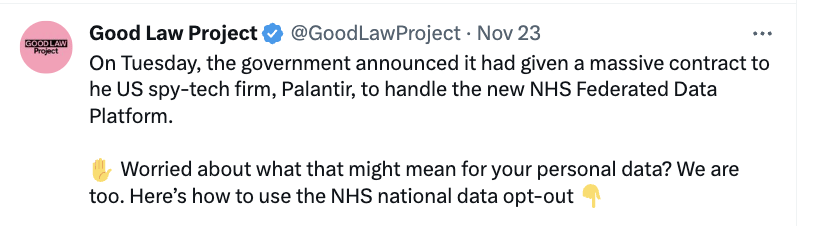
The GLP’s tweet of 23 November included a two-minute video of a GLP staffer demonstrating how to use the online NHS national data opt out to avoid “all of your personal medical information” being shared with “America’s scariest tech giant … co-founded by someone called Peter Thiel, who is a right-wing venture capitalist with very critical views of the NHS”. The GLP staffer states:
“I don’t personally want my data shared with Palantir, so I’m gonna opt out [using the NHS national data opt out] and I’m gonna [show you] how easy this process is … So, what we’ll need is your name, date of birth and postcode, or NHS number …. So, here it’s telling me the information which I’m opting out of … ‘I allow my confidential information to be used for research and planning’, so, No, that’s me opting out … That was actually a lot easier than I thought, I thought I was going to have to get some bank statements ready, tenancy agreements and stuff, but it was just name and date of birth. What do you think? Will you opt out, have you opted out? Let us know in the comments below.”
And, sure enough, below the tweet were numerous comments from people saying they had now opted out. However, prior to the posting of the tweet and video, NHS England had stated clearly that “the national data opt out does not apply [to the FDP]”.
Between its launch on 20 July and the NHS’s announcement on 21 November, the GLP’s NHS Data crowdfunder raised some £49,000, and in the days following the NHS’s announcement it received more than £16,000 of new donations, bringing the total to more than £65,000. But on 24 November the GLP quietly edited the crowdfunder text, acknowledging that “it is not possible to opt out of sharing patient data with the Federated Data Platform and therefore Palantir”.

Then, on 27 November, after the misleading nature of the GLP’s video was noted by the Times, this weasely confession was followed by a ‘Questions & Answers’ post that gives every impression of having been written to confuse, rather than enlighten. The Q&A states: “The effects of the national data opt out are complicated and unclear, and its operation may well be unlawful”. Which simply begs the question: Why did the GLP put out a video demonstrating how to to “use the national data opt out” to prevent “your personal medical information [being shared] with America’s scariest tech giant”`?
Interestingly, on 30 November it emerged that four organisations – not including the GLP – are trying to bring a judicial review of the lawfulness of NHS England’s decision to establish the federated data platform. Somewhat surprisingly, the GLP have not expressed any support for this move.
Louise Raw’s Jeremy Clarkson case
There has been no update to the crowdfunder launched by Dr Louise Raw in December 2022 in support of proposed legal action against Jeremy Clarkson and the Sun newspaper, despite the press regulator IPSO having concluded its consideration of complaints about Clarkson’s article on 30 June. IPSO upheld a complaint that Clarkson’s article “contained a pejorative and prejudicial reference to [Meghan Markle’s] sex”, but did not uphold complaints that “the article was inaccurate, harassed [Markle], and included discriminatory references to her on the grounds of race”.
When the crowdfunder was last updated, on 22 May, Dr Raw stated that her legal team would “write a letter before claim to The Sun and Clarkson” if the IPSO ruling is “positive”, or “consider a Judicial Review [of IPSO]” if the ruling is “negative”. However, there is no evidence of either action having been taken (or even considered). Similarly, there is no evidence of claimants joining the “class action” floated in the 22 May update to the crowdfunder, or of any “parliamentary campaign”.
On 14 November, and again on 21 November, I asked Dr Raw for an update on the case via X (formerly known as Twitter), but Dr Raw has not responded. So, at the time of writing, it is unclear how much of the £15,325 donated to the crowdfunder has been spent, and how much (if any) remains. In particular, it is unclear how much has been paid to: (a) Equal Justice Solicitors; (b) Tom Coghlin KC of Cloisters Chambers; (c) Waterfords Solicitors; and (d) other lawyers or providers of professional services. And it is unclear whether any surplus has been (or will be) donated to a domestic violence charity, as promised by Dr Raw in December 2022.
As of 1 December, the crowdfunder remains open to new donations, though Dr Raw appears not to have promoted the crowdfunder for some time, and the last donation was made on 23 May (i.e. the day after the last update to the crowdfunder). However, almost 12 months after the crowdfunder was launched, nothing has been achieved, and there has been woefully inadequate accountability to donors in respect of how their money has been spent. The only people who have benefited from the whole sorry mess are the lawyers, who got paid with some (or perhaps all) of the £15,325 foolishly donated by understandably outraged but ill-informed members of the public, and Dr Raw herself, who has been able to cast herself as a heroic defender of standards in public life. Classic grifting.
GLP annual report for 2022/23
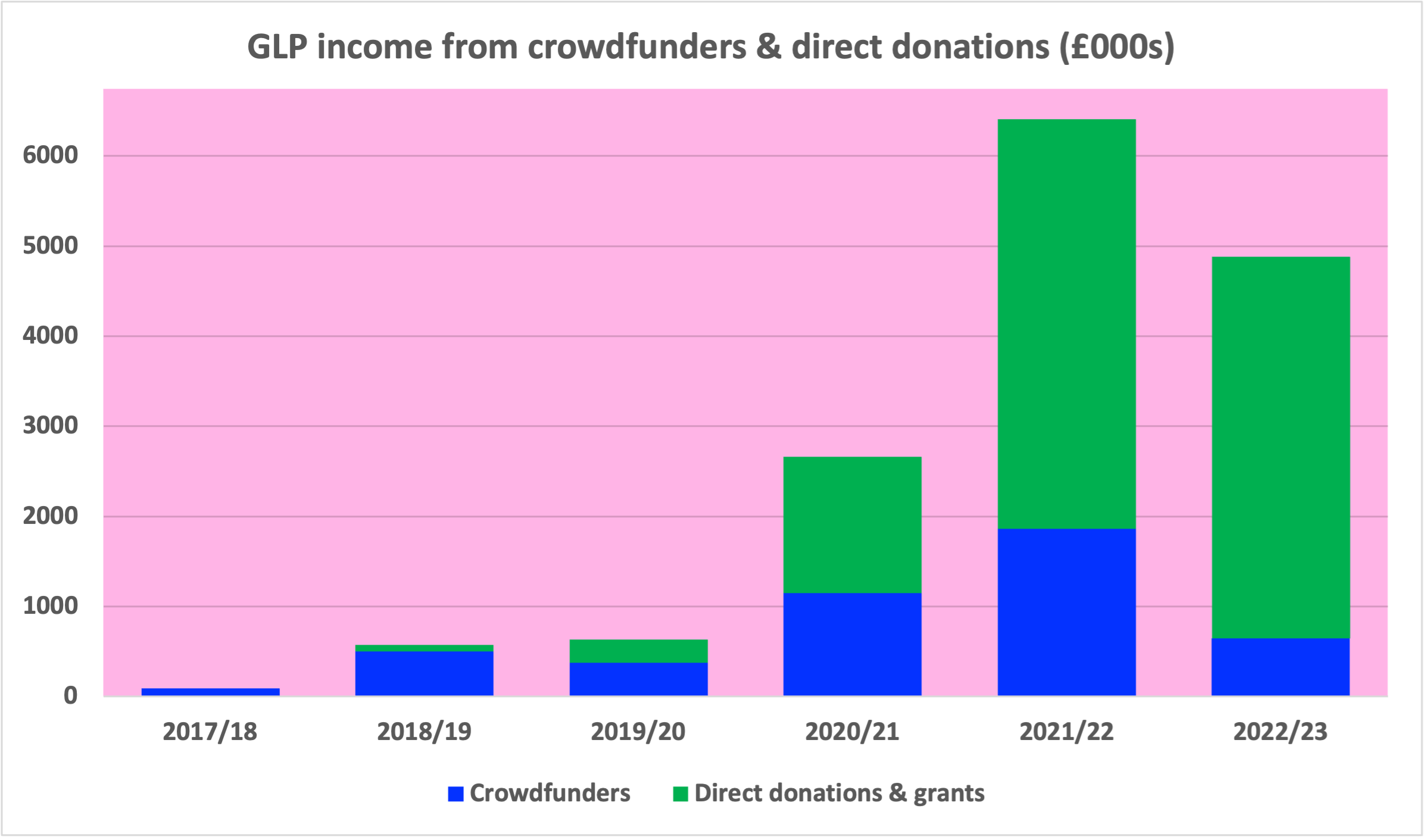
On 11 September, the GLP published their annual report and accounts for 2022/23 (i.e. up to 31 January 2023). This reveals that, after four years of remarkable growth, income from direct donations and grants levelled off in 2022/23, at a hefty £4.241 million (some £300K less than in 2021/22). And, with income from crowdfunders down from £1.863 million in 2021/22 to £644K in 2022/23, total income from crowdfunders, direct donations and grants was down 24%, from £6.406 million to a still very healthy £4.885 million.
Amid much crowing about impact, the annual report also recycles the GLP’s questionable statistics on case outcomes, over which I have previously cast a sceptical eye on this blog.
The GLP’s crowdfunded income in 2023/24
During the three-month period September to November 2023, the GLP launched one new crowdfunder, closed three crowdfunders, and received donations totalling £214,602 via ten different crowdfunders. The vast majority (93%) of this sum was donated via just four crowdfunders – Misuse of public funds (£126,093), Net Zero 2 (£37,018), NHS Data (£18,240), and Climate change protesters (£18,001) – and 87% of it was donated in September, with donations plunging to next to nothing in October, then bouncing back somewhat in November.
In 2023/24 to date (i.e. 10m/12m), the GLP have launched 11 new crowdfunders – two more than in the whole of 2022/23 – and received donations totalling £598,091 via 19 crowdfunders. This compares with a total of some £1.86 million in 2021/22, and some £661K in 2022/23. Two-thirds (67%) of this £598,091 was donated via just six crowdfunders: Misuse of public funds (£126,026), Trans healthcare appeal (£70,588), Climate change protesters (£69,379), NHS data (£65,364), Asylum Seeking Children (£36,308), and Sewage dumping (£36,250). And three of these six cases have already concluded with a court defeat for the GLP.
As of 1 December, the GLP has nine open crowdfunders (three on Crowdjustice, six in-house).
The GLP’s net income from legal costs
In late November, the Answer by the Solicitor General (on behalf of the Attorney General) to a Parliamentary Question tabled by Sir John Hayes MP about payments the GLP has made to and received from the Government in respect of legal costs since 2017 was promptly challenged by Jolyon Maugham, who (rightly) noted that the Answer overlooked some payments made to the GLP.
Responses to my Freedom of Information requests by the Department of Health & Social Care (DHSC) and the Department for Business, Innovation & Skills (BEIS, as it then was) in January and February 2023 confirm that the Solicitor General’s Answer to the Parliamentary Question omits a payment to the GLP for legal costs of £85,000 by the DHSC in March 2021, and a payment to the GLP for legal costs of £12,187 by BEIS in January 2023. So the following chart shows the reconciled figures. In total, since 2017 the GLP has paid £539,766 in legal costs to the Government, while the Government has paid £160,926 in legal costs to the GLP – a net cost to the GLP of £378,840.

Upcoming events
Judgment is awaited in the GLP’s Manchester Ship Canal case, which was heard by the Supreme Court in early March (and for which there was no crowdfunder).
Updated Table of Failure and Futility (TOFF)
This table shows the sum raised by and outcome to date of the GLP’s 64 crowdfunders since March 2017. Dark orange = court defeat; light orange = other negative/unproductive outcome; dark green = court win; light green = other positive/productive outcome; grey = in progress/other. [NB: table updated on 8 December to reflect the GLP’s abandonment of their proposed private prosecution in the Misuse of Public Funds case.]


 Labour Pains
Pingback: Good Grift Watch: update #5 (December 2023) | Labour Pains
Pingback: Good Grift Watch: update #6 (January 2024) | Labour Pains